Space Station Significance, Space Debris, Space Tourism & the Indian Space Programme (Part 1)
GS Paper: GS Paper III | Subject: Science & Technology | Last updated: 2026-07-02
This is Class 2 of the Science & Technology course (teacher: Vinay Krishna, 01–02 July 2026). It picks up exactly where Class 1 stopped — the teacher had set the significance of a space station as homework — and then moves through three more space-technology topics before opening the Indian Space Programme (which will run for all remaining space lectures). So the note has four parts: (1) the significance of a space station (the research it enables + its role as a tool of diplomacy), (2) space debris / space junk (a very likely Mains topic), (3) space tourism (an easy but very likely topic), and (4) the Indian Space Programme — Part 1 (why India went to space, dual-use technology, the founding scientists, and what makes an ideal launch station). The class board notes were very rough, so every diagram below is a clean redraw built from the lecture — the rough scans are not reproduced.
Continuity note: the fundamentals of space stations — micro-gravity vs zero-gravity, weightlessness, high-frequency radiation, the ISS/Tiangong/BAS, docking/SpaDeX, Point Nemo — were covered in Class 1. This class assumes that base and builds the significance on top of it.
Table of Contents
Part 1 — Significance of a Space Station
- Recap: what a space station is, and why its value is "research value"
- Research domain 1 — Human physiology
- Research domain 2 — Model organisms
- Research domain 3 — Material science (fluids, 3-D printing, bio-printing)
- Research domain 4 — Astronomy
- Research domain 5 — Atmospheric science (Transient Luminous Events)
- The 7th use — a space station as a tool of diplomacy
Part 2 — Space Debris / Space Junk
- What is space debris? (definition + the "dead satellite" idea)
- Why it is now an un-ignorable challenge (the drivers)
- Kessler Syndrome
- Space Debris Removal (SDR) — the tools
- Challenges to debris removal (cost, tech, misuse, and the political gap)
- What to do with the debris you catch — de-orbit vs graveyard orbit
- Current developments (ClearSpace, Astroscale, ISRO, Kevlar, LignoSat, bodyguards)
- Space Situational Awareness (SSA) & ISRO's NETRA
- The rising trend of collision-avoidance manoeuvres
Part 3 — Space Tourism
- Definition & the three types
- Pros and cons; the need for sustainable space tourism
- Key facts (first tourist, first Indian, providers)
Part 4 — Indian Space Programme (Part 1)
- Was India "too early"? Nation-building vs socio-economic priorities
- Space as the most dual-use technology (military dimension)
- The founding scientists — Bhabha and Sarabhai
-
What makes an ideal launch station — and why Thumba
-
Quick revision & Prelims pointers
Part 1 — Significance of a Space Station
1. Recap: What a Space Station Is, and Why Its Value Is "Research Value"
To recap the Class-1 thread: the space race produced the goal of an orbital platform on which humans can sustainably live and carry out research in space — the space station. What makes a station valuable is that it gives us, free of cost, the conditions that certain research requires as prerequisites — chiefly the micro-gravity condition and access to high-frequency radiations. After building individual platforms, the world converged on the International Space Station (ISS), which for many decades was the exclusive arena; today there is also China's Tiangong, and more are coming — India's Bharatiya Antariksh Station (BAS) and a rush of private stations (SpaceX's Haven, Blue Origin's Orbital Reef, Axiom, Blue Origin, and others).
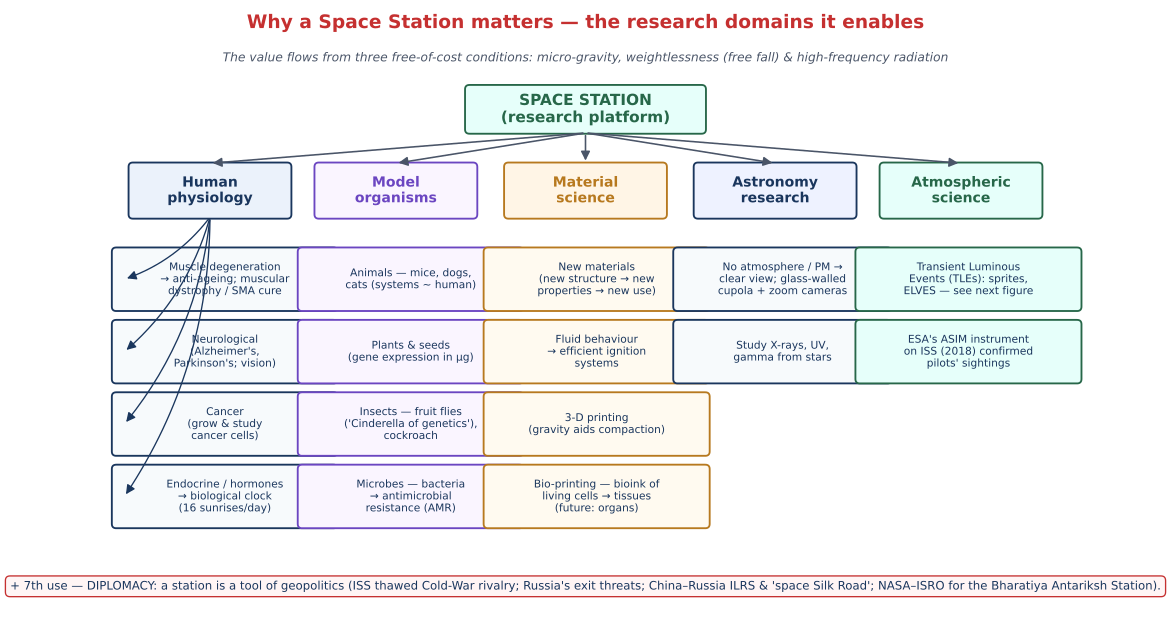
The whole significance of a station flows from its RESEARCH value — it is a research platform, a laboratory in space. So "the significance of a space station" is really a map of the research domains it makes possible. The teacher walked through five research domains plus a sixth, non-scientific use (diplomacy).
2. Research Domain 1 — Human Physiology
The single most important research domain on the station is research on human physiology. Physiology means the functioning of the body's systems — every aspect of your biological functioning: the cardiovascular, digestive, endocrine, nervous, skeletal and musculoskeletal systems. All of these functional aspects of the body are what physiology studies.
Why is the station the right place to study them? Because of gravity. As the teacher put it, "even the laziest creature in the world is working 24×7 against gravity." Whatever state your biology is in — heart function, muscle function, brain function, vision, hearing — is a direct result of the gravity we are constantly negotiating. So the moment a human is placed in micro-gravity (negligible gravity), every aspect of human functioning gets challenged, and it is precisely in that state of challenge that human physiology can be studied — so that we understand the systems better and work out the anomalies and diseases humankind faces.
EXAM FOCUS / PYQ (a classic Prelims trap): Imagine UPSC asks "which of the following are research domains on a space station?" and lists six or seven human functional systems. If you don't know this, you may hazard a guess and leave some out. The correct instinct is that essentially the entire range of human physiology is researched up there — every functional system is a valid research domain. Don't under-select.
The teacher illustrated the payoff with several concrete threads:
TEACHER'S EXAMPLE (muscle degeneration → anti-ageing → curing muscular dystrophy): In near-zero gravity, one thing that gets accelerated is muscle degeneration — the tonicity of your muscle and skin is a direct result of gravity, which is why it degenerates faster when gravity is absent. By studying muscle regeneration up there, we can extrapolate back to Earth to understand natural muscle ageing and work out anti-ageing strategies. It also helps with degenerative muscle diseases — e.g. muscular dystrophy, and a well-known one called spinal muscular atrophy (SMA), a genetic disorder in which muscle degeneration sets in right after birth in babies; it worsens until the child cannot walk or run and eventually cannot even breathe by itself (breathing is just muscles contracting and expanding), and the child dies. Fortunately there is now a gene-therapy option — the correcting gene is injected into the child's muscles and the child survives. "Seems a happy ending — until I tell you the price of one injection is ₹18 crore," which is why you see appeals on crowdfunding platforms (Ketto and others) for such families. So muscle-degeneration studies aim at better management and cure of such diseases.
CURRENT AFFAIRS TIE-IN: When India's astronaut Group Captain Shubhanshu Shukla went up (on Axiom-4), muscle regeneration was one of the research domains he participated in. (Verified: Axiom-4 launched 25 June 2025 for an 18-day ISS stay, splashing down 15 July 2025; the muscle-regeneration experiment was designed by scientists at inStem, Bengaluru, funded by the Department of Biotechnology; Shukla reported losing ~4.2 kg of pure muscle over ~20 days.)
CLARIFICATION (his rank & name): the transcript's auto-caption garbled it as "wing commander shivanshu Shukla." The astronaut is Group Captain Shubhanshu Shukla — the first Indian to fly to the ISS and the second Indian in space (after Rakesh Sharma). One injection figure the teacher quoted (₹18 crore) matches the real-world price of the SMA gene therapy Zolgensma, among the world's costliest single-dose drugs.
Other physiology sub-domains the teacher listed:
- Neurological research — brain function, extended to disorders like Alzheimer's and Parkinson's. In near-zero gravity, vision sharpness, alertness and decision-making gradually get compromised, which is one reason astronauts need extensive training before long stays.
- Cancer research — one common activity is to grow cancer cells in micro-gravity and then work on them.
- Endocrine (hormone) system — a major area, because what gets altered on the station is the biological clock (discussed below).
EXAM FOCUS / PYQ (a very probable Prelims number): How many sunrises and sunsets does a person on the space station witness in one day? On Earth, the body's timing cues (physiological activity) are set by the sunrise and sunset. But the ISS, orbiting at ~400 km, circles the Earth 16 times in 24 hours — so a person on the station sees 16 sunrises and 16 sunsets in a single day. Maintaining a calendar ("how many days have I been here?") therefore becomes a real difficulty, and this disruption of the biological clock connects directly to the endocrine system as a research area.
3. Research Domain 2 — Model Organisms
Research for humans is not always conducted on humans. On many occasions we conduct research meant for humans on other organisms, called model organisms.
Model organism = an organism on which we conduct research so as to extrapolate the findings to humans. The easiest example you already know: Gregor Mendel's laws of inheritance, derived not from humans but from the garden pea plant — so the garden pea was his model organism.
What makes a good model organism? Three things the teacher stressed: it must be easy to handle, easy to breed, and possess some distinct characteristics we can study (e.g. eye colour, body size, wing pattern).
Model organisms taken up to the station include:
- Animals — dogs, cats, and very commonly mice. Mice are used because they are easy to breed and their functional systems are quite similar to humans, so results extend well to human study.
- Plants and their seeds — e.g. on Axiom-4, seeds of common Indian-kitchen crops were kept in micro-gravity and brought back to germinate on Earth so scientists can see how the micro-gravity condition affects gene expression and later development. (The mechanism sits in biotechnology, to be covered later.)
- Insects — very good model organisms; cockroaches and especially fruit flies. The fruit fly is the small fly you see hovering around an over-ripe banana in the kitchen.
EXAM FOCUS / PYQ (fruit fly): Fruit flies (Drosophila) are beautiful model organisms for genetic research — multiple Nobel Prizes have been won using them, which is why they are called the "Cinderella of genetics."
- Microorganisms — bacteria, fungi, viruses, and particularly bacteria, because they are easy to breed and have distinct characteristics to base genetic research on. Bacteria are grown in micro-gravity especially for research on antibiotic resistance, also known as antimicrobial resistance (AMR).
TEACHER'S EXAMPLE (why AMR matters): These microorganisms are gradually becoming tolerant of all available antibiotics — one of the biggest challenges in modern medicine. When penicillin was discovered (one of the first and most famous antibiotics), humans thought "it is time to end the chapter on communicable diseases" — patients would "wake up from the death-bed" — but they did not reckon with evolution. Over the years bacteria learned to live with our drugs. We keep competing by developing new antibiotics, but bacteria always have the upper hand because we cannot have an endless supply of new antibiotics — we are running out of stock. So on the station we study the mechanism by which bacteria develop resistance and what strategies we can use against it. (Detail is not needed for the exam — just know that model organisms — animals, plants, insects and especially microorganisms — are researched up there.)
4. Research Domain 3 — Material Science
The station is a very good platform for material-science research — developing new materials.
Why micro-gravity yields new materials. Any physical entity derives its function from its structure ("this chair works as a chair because it is structured like that"). The structure a material takes depends on many factors, one of which is gravity. So a material developed in reduced gravity may take a new structure → and since structure determines properties, and properties determine applications, you get new applicational value. Hence new materials are developed there.
Two more material-science threads:
(a) Fluid behaviour → better ignition systems. In near-zero gravity, the flow behaviour of liquids changes — you may have seen reels where water floats as a globule out of a bottle until an astronaut swallows it, because there is no gravity to make it fall. This changed fluid property can be researched to develop more efficient ignition systems, where the flow of fuel into the ignition unit must be absolutely controlled.
(b) 3-D printing → bio-printing. 3-D printing layers particles to build a three-dimensional structure from a pre-designed computer model. In near-zero gravity, the compaction of particles (normally caused partly by gravity) becomes controllable, so you can create structures of different compaction / consistency.
TEACHER'S EXAMPLE (the cake analogy for consistency): Baking a cake for the first time, you want it fluffy, but you may end up with something so hard it could be a "weapon." Gravity has a role in that consistency — which is exactly what we experiment with in micro-gravity to get the right structure. (UPSC won't ask the "why/how" detail — just know 3-D printing is done there.)
Bio-printing (an off-shoot of 3-D printing). As the name suggests, the end goal here is not lifeless objects but living tissues (and, in the future — not yet — organs). Unlike normal 3-D printing where we layer particles, in bio-printing we add living cells, and the "ink" in the cartridge is called bioink — not ink in the conventional sense, but a fluid containing the cells to be layered. Again the point of micro-gravity is that it gives the right tissue consistency — not too compact or hard. So the station regularly hosts bio-printing of tissues (and, in future, organs).
5. Research Domain 4 — Astronomy
The station is an excellent platform for astronomy research, for a simple reason: there is no atmosphere to obstruct the view — no PM 2.5, PM 10, nothing. There is a section of the ISS with a glass wall (the cupola) — absolutely transparent — and different cameras with telephoto zoom lenses, so astronauts can photograph stars and galaxies and analyse them. And because the station is exposed to high-frequency radiations (as noted at the start), it is also used to study the X-rays, UV rays and gamma rays coming from space and from distant stars. So astronomy research is a very common use of the station.
6. Research Domain 5 — Atmospheric Science (Transient Luminous Events)
UPSC also asks whether the station is a platform for atmospheric science research — and the answer is yes; on many occasions it is an excellent place from which to understand atmospheric phenomena.
The teacher's flagship example — a high-probability Prelims item — is a class of upper-atmosphere light phenomena:
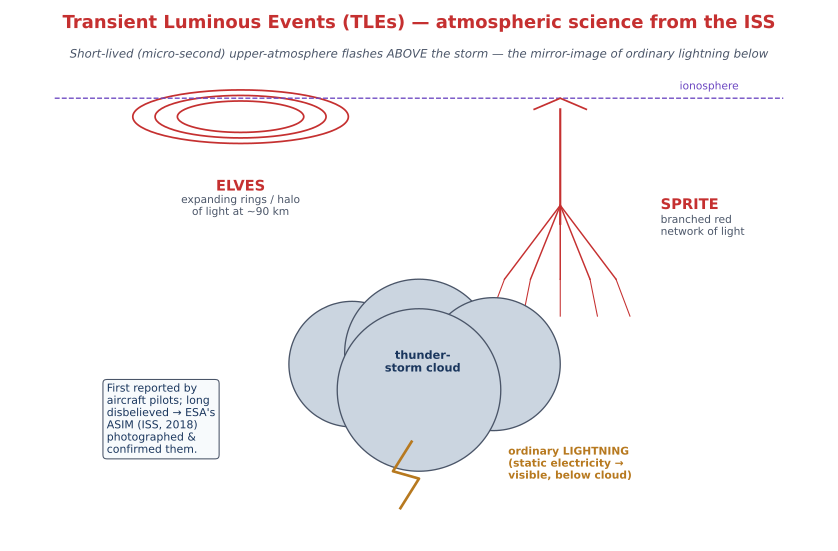
The phenomenon. Under a cloud, static electricity can produce lightning — which is observable from below. But there is another expression of light on the other side of the cloud, at much higher altitudes, where you can get halos or rings of light (called ELVES) and, under them, a branched red network of light (called SPRITE). These luminous/lightning events are collectively defined as Transient Luminous Events (TLEs) — "transient" because they are short-lived (they last for micro-seconds).
EXAM FOCUS / PYQ: Expect a Prelims question on TLEs — remember the two named forms, sprites and ELVES, and the umbrella term Transient Luminous Events (TLEs).
The discovery story (why the station matters here). TLEs were first noticed by aircraft pilots, who observed such phenomena from high altitude — but no one believed them ("you're just overworked and seeing things"). When the sightings became too many, the European Space Agency (ESA) placed an instrument on the ISS specifically to photograph such events; it captured TLEs and confirmed the pilots were right. Today, if you image-search "sprites," you'll see multiple beautiful, categorised expressions of light — all confirmed by the instrument on the ISS. So the station is a platform for atmospheric observation, not only for looking outward into space.
VERIFICATION / added precision: the ESA instrument is the ASIM — Atmosphere-Space Interactions Monitor, installed on the ISS and launched on 2 April 2018. It is dedicated to measuring TLEs and Terrestrial Gamma-ray Flashes (TGFs). ELVES appear as rapidly expanding rings/halos of light near the ionosphere (~90 km); sprites are red, jellyfish-/tendril-shaped discharges above thunderstorms. (Related forms you may also meet: blue jets and gigantic jets.)
7. The 7th Use — A Space Station as a Tool of Diplomacy
Beyond these scientific goals, a space station is also a tool of diplomacy — a matter of geopolitics as much as of science. (The teacher's underlying point, made when asked "why not just create these conditions on Earth?", is that Earth-based simulation of micro-gravity is prohibitively costly, whereas the station gives consistent, free-of-cost micro-gravity — the world has been enjoying it for over 20 years and will for perhaps 30.)
Write this as points:
- The development of the ISS marked the thawing (melting) of the "coldness" between the antagonistic space powers, turning Cold-War rivalry towards collaborative coexistence.
- Russia, however, has recently been gesturing to withdraw from the collaboration — which reflects the frictions between nations (the biggest recent trigger being the Russia–Ukraine crisis). (As of now Russia has gone quiet, understanding that 2030 — the ISS's likely end — is not far, so an early exit would be costlier for it.)
- China is collaborating on common space stations in two arenas: (i) around the Earth, and (ii) around the Moon — the station around the Moon being the International Lunar Research Station (ILRS) (China–Russia). China is also extending its "Silk Road" initiative into outer space — a "space Silk Road" — under which it aims to provide visits to Tiangong at cheaper prices to the members of the Global South (Pakistan's first astronaut, for instance, is slated to visit the Chinese station).
- NASA has offered ISRO assistance and a probable collaboration for India's upcoming Bharatiya Antariksh Station.
- However, ISRO/India has also expressed interest in Russian collaboration — an ISRO official recently said India wants to work with Russia to build its own space station.
The takeaway line (good for Mains): "Space technology in general, and the space station in particular, is as much a manifestation of global geopolitics as it is a factor impacting the same." In other words, the ground reality is manifest in space, and happenings in space also impact the ground reality — a two-way street. Given India's goal of building its own station, this remains an important topic.
Part 2 — Space Debris / Space Junk
8. What Is Space Debris? (Definition + the "Dead Satellite" Idea)
We are no longer in a world of two or three space nations. Today there are over 80 space-capable / space-faring nations running their own space programmes, and together they have placed over 15,000 functional satellites in space — and they all want to launch more.
But every satellite has a functional lifespan (8, 10, 12, even 20 years, depending on its size and design). After that it is declared functionally dead — yet, unlike a dead human, a dead satellite does not leave; it stays in orbit.
TEACHER'S EXAMPLE (the "spooky" traffic of the dead): "There's an interesting difference between dead satellites and dead humans." With humans the soul leaves and the body stays; in space it is the opposite — the satellite's function has left but the body refuses to go. So space becomes a "spooky territory" where the living and the dead move together — and the dead are in the majority. Imagine driving in traffic where most cars have dead drivers still moving on the road — that is the situation in space.
If we count dead objects larger than 10 cm, there are over 33,000 of them. Why 10 cm? Because objects larger than ~10 cm can be monitored from Earth; below that size they cannot be ignored either, and if we include all objects, the count runs into the millions. And all of these move at massive speeds — ~25,000–30,000 km/h — at which even a tiny ball-bearing can inflict fatal damage on a functional satellite.
DEFINITION (a Prelims trap): all such objects that pose a risk to the health and safety of our functional entities are together called space debris (spelt debris, pronounced "deb-ree"; singular and plural are the same — you say "debris," never "debrises") — alternatively, space junk. Crucially, space debris includes BOTH man-made objects AND natural bodies, because the topic is studied with respect to the risk of being hit, and a hit can come from a natural body too. (Man-made objects get more focus only because we keep generating more of them, especially in the zones where our functional satellites sit.)
The three contributors to man-made debris (from the board):
- Dead satellites themselves.
- Upper parts / spent stages of launch vehicles.
- Objects accidentally added by humans — e.g. during space-walks, tools slip out of astronauts' hands and, since they cannot go chasing them, the tools become debris. (Some spent stages, when they fall back, follow a trajectory into the ocean and are badly — though not completely — burnt out; more on controlled re-entry later.)
9. Why It Is Now an Un-ignorable Challenge (the Drivers)
The teacher stressed that space debris has become extremely exam-relevant because the problem is exploding. Expect a Mains question structured as: definition → why the problem is becoming so big → probable solutions → challenges to the solutions → current developments → India's position. The present drivers:
- A flood of new space agencies — both state agencies and, more importantly, private companies, which are more numerous and have a bigger hunger. Governments are limited by governance priorities and a supply-driven model; private companies run on a demand-driven model where profit maximisation is the goal, so their scale of operation is huge. (The teacher's aside: Elon Musk becoming the world's first trillionaire rests on promise-based valuation — e.g. "settlements on Mars" — more than on present real value.)
- Entirely new activities in space. For example:
- Satellite-based internet. Instead of cable networks, we now put routers in the sky beaming data home. This is Starlink (SpaceX). To blanket the world, Starlink plans ~42,000 satellites, and has already placed over 10,000. (Of the ~15,000 functional satellites today, more than 10,000 belong to Starlink alone — so the rest of the world has contributed ~5,000, and this one venture out-numbers everyone else by ~8×.) And Starlink won't be alone — Amazon's Project Kuiper, OneWeb, and now Jio are all planning such constellations.
- Data centres in space (to solve Earth's heat-management problem) — a plan that could require ~1 million satellites.
- Space tourism — more visits, more debris.
A recent, relatable sign of the strain: even before Starlink is fully assembled, on average one satellite drops from the sky every single day. This is what Delhi-NCR witnessed in September (last year) — a bright streak of light at night that many mistook for a meteor shower; it was actually a falling Starlink satellite. There is also a fear that one such fall could trigger a chain reaction, and star-gazers are frustrated that when they look up for stars they increasingly see Starlink instead.
10. Kessler Syndrome
The idea. The number of space debris will always continue to increase — even if we stopped launching satellites altogether, the count would keep rising, because the objects already up there keep colliding and creating fragments. This self-sustaining, cascading growth is the Kessler Syndrome (also Kessler effect, collisional cascading, ablation cascade).
EXAM FOCUS / PYQ: Kessler Syndrome is a very probable Prelims term. (A student's point in class was correct: ASAT tests — anti-satellite tests, from Class 1 — also add to debris; India's Mission Shakti hit a very low satellite deliberately so fragments fall back quickly.)
VERIFICATION / CLARIFICATION (who & when): the teacher attributed it to an American astrophysicist in the 1980s. It is more precisely Donald J. Kessler (with Burton Cour-Palais), NASA, in his 1978 paper "Collision Frequency of Artificial Satellites: The Creation of a Debris Belt." So the year is 1978, not the 1980s.
The teacher's twist (a nice Mains line): "Kessler Syndrome is not so much a statement of the problem as a hint at the solution." Why? Because we cannot solve debris by launching fewer satellites — space technology offers too many indispensable applications, and unlike mobile phones or TVs (which are near saturation, so their new demand is mostly replacement), space technology is not even ~20% saturated — "the story has only just begun," and usage will only grow. So "use less" is not an option; the option is to clean up more — i.e. Space Debris Removal (SDR).
11. Space Debris Removal (SDR) — the Tools
What SDR means. A technology that goes into space, observes an orbit, discriminates debris from functional satellites, picks up the debris and removes it. Visualising it is easy; achieving the technical capability is a "big thing" — easier said than done — which is why we first look at the challenges (next section). But work is happening; countries are developing several capture techniques:
- Magnetic (magnetic-field) method — use a strong magnetic force to attract the debris to a collection point before removing it (like the strong magnets that pull metal objects out of a garbage pile).
- Robotic arms / claws — satellites with arms that go close to the debris, grip it, and remove it (good for larger pieces). (A version of the arms-and-clips technology — not for debris, but the manipulator itself — was tested by an ISRO mission.)
- Net / sail method — some nations (e.g. China) are working on throwing a net over the moving debris to catch it (imagine a police car casting a net under a fleeing car's wheels), then removing it.
- Laser ablation — India and Japan have started working on firing lasers to vaporise/ablate the object.
The common requirement — AI. Whichever tool is used, all of them need AI-powered pattern recognition, so the spacecraft correctly identifies what to remove (you don't want it grabbing a functional satellite by mistake).
12. Challenges to Debris Removal (Cost, Tech, Misuse, and the Political Gap)
The teacher listed the challenges — the last one is the most important for Mains:
- Huge cost. Why would anyone spend to go up and clean for everyone? (His satire: if Mr. Trump wanted the Nobel Peace Prize for "cleaning space for all," his team's back-of-the-envelope calculation would show it's too costly to justify — that money could build five bombs instead.) No country wants to pay to clean up for all.
- Technological sophistication. You need something that goes into space, discriminates debris from functional entities and retrieves it, despite the debris moving at 25,000–30,000 km/h. Very hard to develop.
- Potential unfair usage / space warfare. Once you are up there, who ensures you only remove debris and don't quietly grab a rival state's functional satellite ("picked it up by mistake")? So the same capability has space-warfare potential.
- Political challenge — who owns the responsibility? (The biggest challenge, and the one to lead with in a Mains answer.) Before any technological fix, the real gap is that there is currently no law to regulate space traffic and hence no way to place responsibility on anyone. So the first thing the world needs is an enforceable law that mandates space-debris removal as a "common but differentiated responsibility."
"Common but differentiated responsibility" — applied to debris. Everyone is responsible, but in the right proportion. You don't force Bhutan or the Maldives — with no real space programme — to pay equally. You need not even have a space programme to be liable; you just need to use space. Liability should track how much your usage generates debris.
A neat consequence (good Mains point): once removal becomes a law, SDR turns into a revenue-generating exercise — agencies that have the technology can sell the cleaning service (a country tells another, "your five dead satellites are up there — please clean them, at ₹X per kg"). So a mandate would make debris removal commercially attractive, which is exactly why agencies are keen to develop it.
13. What to Do with the Debris You Catch — De-orbit vs Graveyard Orbit
Once you've caught the debris, where does it go? The answer depends on which orbit it is in.
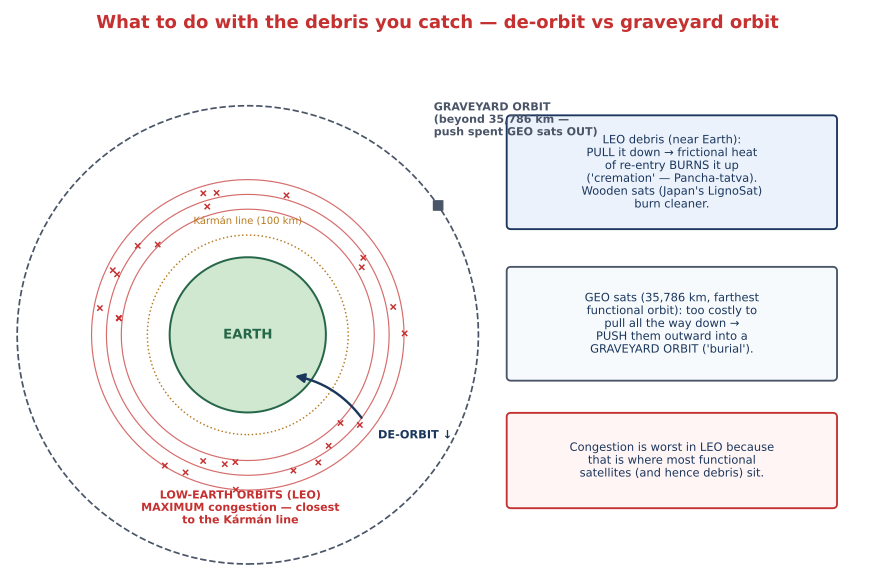
Key fact: the maximum congestion of space traffic/debris is in the orbits close to the Kármán line — a few hundred km from Earth's surface — and these are the Low-Earth Orbits (LEO). This is where most functional satellites (and hence most debris) sit.
- For debris close to Earth (LEO): pull it down toward Earth. As it falls through the atmosphere, frictional heat generates fire and burns it up — the teacher's image: "a ceremonial cremation, consigning the satellite's body to the five elements (Pancha-tatva)." Japan's wooden satellite (LignoSat) fits here — being wood, it is easy to burn out cleanly on re-entry ("the body is itself the funeral pyre").
- For the farthest functional orbit — the geostationary belt at 35,786 km from Earth's surface (the final orbit in which functional satellites are placed; there are no functional satellites beyond it): it is not viable to pull them all the way down to burn. So the strategy is to push them outward and let them keep revolving. All orbits beyond 35,786 km are therefore called the GRAVEYARD ORBIT ("a burial, so their souls may rest").
So the disposal logic is a cultural pun the teacher enjoyed: some satellites get cremated (burnt on re-entry), others buried (pushed to the graveyard orbit) — "we take care of cultural diversity even in dealing with the dead." Which route a given satellite takes is decided by feasibility — whether it is closer to LEO or closer to GEO (35,786 km).
VERIFICATION (LignoSat): LignoSat is the world's first wooden satellite, developed by Kyoto University and Sumitomo Forestry, made of honoki (magnolia) wood, assembled without screws or glue. It was launched on 5 Nov 2024 and deployed from the ISS on 9 Dec 2024 as a demonstration of cleaner-burning spacecraft material.
14. Current Developments (ClearSpace, Astroscale, ISRO, Kevlar, LignoSat, Bodyguards)
(The teacher said to leave some blank space here, as this is a dynamic area and new developments keep coming.)
- ESA is set to conduct the world's first operational debris-removal mission, named ClearSpace (ClearSpace-1). "Operational" is the key word — so far most of it has been talk; ClearSpace is the spacecraft that will actually go up and start removing debris. (Verified: it is an ESA "Active Debris Removal as a Service" contract with the Swiss start-up ClearSpace SA; the target was later changed from the VESPA adapter to the PROBA-1 satellite.)
- Astroscale (a Japanese company) recently tested an SDR mission named ELSA-d. ELSA = End-of-Life Services by Astroscale; the "d" = demonstration (development/testing/experimental). Astroscale acts as the "undertaker" of satellites. (Verified: ELSA-d launched 22 March 2021; it used a magnetic docking mechanism between a servicer and a client spacecraft.)
- ESA, ISRO and NASA have made voluntary commitments for debris-free space missions by 2030. This requires steps such as satellite de-orbiting (using the last stores of fuel to de-orbit at end of life), burning out small/wooden satellites, controlled spacecraft symmetry for targeted falls, and Reusable Launch Vehicle (RLV) technology (to be studied in detail later). (Verified: India's initiative is the Debris-Free Space Missions (DFSM) target for 2030.)
- NASA is also testing Kevlar-based material to "debris-proof" its satellites. Kevlar is a very strong organic polymer (used in bullet-proof materials); used as a satellite covering, it can absorb the shock of a debris hit and prevent damage.
- ISRO is developing SDR technology in collaboration with Japan and with a private company named Manastu Space. (Verified: Manastu Space is an Indian space-tech start-up working on green propulsion + in-orbit refuelling + debris-avoidance; it raised ~$3 million in Aug 2025.)
- ISRO is working on "bodyguard satellites" around its strategic space assets — expect a question on this. A bodyguard satellite revolves around a strategically important satellite, continuously reviewing the situation to protect it from probable collisions ("you can't afford that satellite to be hit and lose its function"). (Verified: India has launched a large "Satellite-Protection Project" / satellite-bodyguard initiative — reported at ~₹27,000 crore — using LiDAR and other sensors for real-time threat detection and 3-D mapping of nearby objects.)
- ISRO is a member of the Inter-Agency Space Debris Coordination Committee (IADC) — a multi-institutional body working towards debris-mitigation strategies. (Verified: IADC, founded 1993, has 13 member agencies; ISRO is one.)
15. Space Situational Awareness (SSA) & ISRO's NETRA
Whether or not a nation removes debris, one capability it must possess without fail is Space Situational Awareness (SSA) — expect a Prelims question.
What SSA is. The ability to avoid getting hit by debris. If debris is coming your way, you must be capable of the collision-avoidance manoeuvre (from Class 1) — but you can only do that if you are aware of the situation in space. SSA is precisely that awareness about space objects — and, like debris, this includes both man-made and natural objects (this is the same activity behind news like "asteroid X will pass this close to Earth on date Y").
How SSA works (the mechanism): you generate awareness of every object's position and motion (speed + direction), then use it to make predictions of possible collisions, and based on those predictions you prepare and execute collision-avoidance manoeuvres.
TEACHER'S ANALOGY (the bat / radar principle): How is this done? Like a bat locating its prey. A bat sends out ultrasonic waves that hit the prey and reflect back; it then moves its face and ears until the reflected sound reaches both ears at equal intensity — forming an isosceles triangle (the two ears as the base, the nose-to-prey line as the apex) — and that is how it pinpoints the prey precisely. This is the radar principle of location. For SSA we need many radar antennae placed at many points — on land and on ships at sea — so that from many angles we can scan the entire sky and generate alerts that a particular object is at risk.
EXAM FOCUS / PYQ (NETRA): India's group of radar antennae that scans space 24×7 is called NETRA — Network for Space Object Tracking and Analysis. (Verified: Project NETRA, ISRO, announced September 2019; comprises radar, optical-telescope facilities and a control centre; can track objects as small as ~10 cm up to ~2,000 km orbit; ISRO earlier relied on US data. In 2024 ISRO released its first Indian Space Situational Assessment Report (ISSAR) from NETRA data.)
Why nations share SSA data. All countries doing SSA continuously exchange information — not out of benevolence, but out of common necessity: if you spot an American satellite in a debris's path, you check whether they know, because one hit could start a cascade (Kessler), so keeping space "sanitised" is everyone's shared interest.
16. The Rising Trend of Collision-Avoidance Manoeuvres
The teacher had the class sketch a graph without worrying about data precision — the point is the trend, which is useful in a Mains answer.
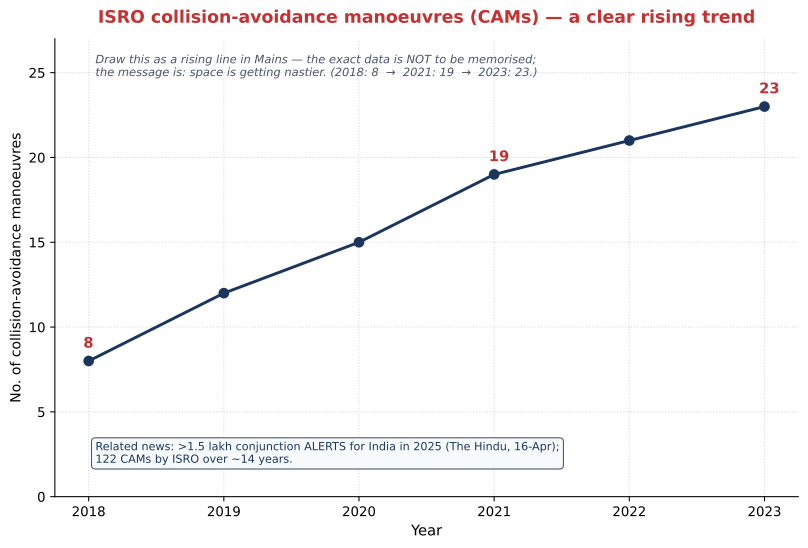
- X-axis = year; Y-axis = number of collision-avoidance manoeuvres (CAMs) conducted by ISRO. The graph shows a clear, definite increasing trend — "things are getting nastier."
- The teacher's figures: 2018 ≈ 8 CAMs; 2021 ≈ 19; 2023 ≈ 23 — i.e. it roughly doubled in three years and kept climbing. (Exact numbers need not be memorised — just draw a rising line.)
Supporting news (for seriousness of the issue, not for memorising): - The Hindu, 16 April (this year) reported that for 2025, India received more than 1.5 lakh conjunction alerts (not all needed a manoeuvre, but it shows the scale). - A report noted 122 collision-avoidance manoeuvres by ISRO over ~14 years — a now-routine activity. - Another news item: India will lift 200+ satellites over the coming years — reflecting the rising congestion as more satellites go up.
CLARIFICATION: the transcript momentarily said the graph was "European Space Agency's," then corrected it to ISRO's — the CAM-trend graph the class drew is ISRO's.
Part 3 — Space Tourism
17. Definition & the Three Types
Space tourism is a new, easy but very likely topic (the teacher: "nothing beyond the class is needed here"). Questions can come from three angles: definition, types, and pros & cons.
Definition: space tourism = visiting space for recreation purposes. (Just add "space" to "tourism.")
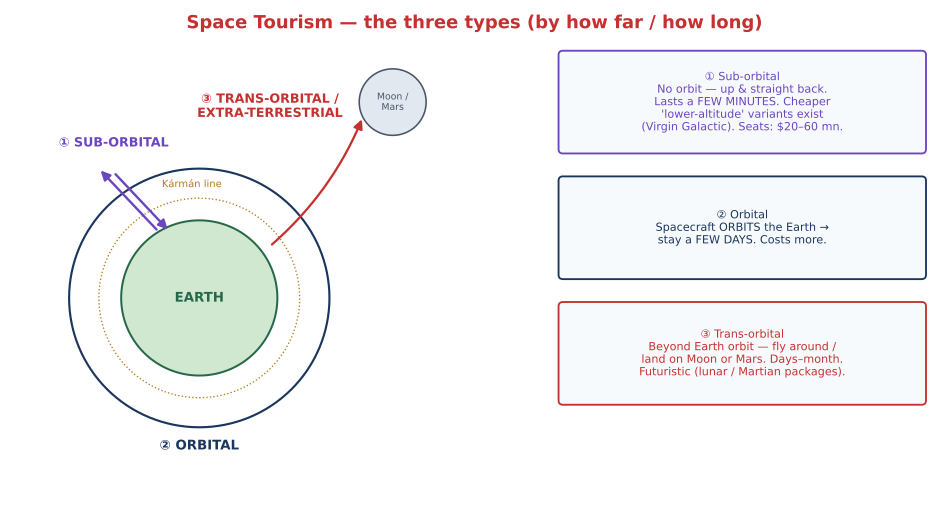
The three types (by how far you go and how long you stay):
- Sub-orbital space tourism. The spacecraft carries humans into space but does not let them orbit the Earth — "by the time they say wow, they're brought back" by gravity. Such trips last no more than a few minutes. Despite being so short-lived, people pay $20–60 million for a single seat. (Cheaper "lower-altitude" variants also exist — e.g. Virgin Galactic — giving a glimpse of the cosmos from a lower height.)
- Orbital space tourism. Here the spacecraft does orbit the Earth, so tourists stay in space a little longer — a few days — and are charged more.
- Trans-orbital / extra-terrestrial space tourism. Going beyond Earth orbit to a distant body — fly around the Moon (or Mars) and come back, or (enthusiasts) land there — "a literal honeymoon." ("Extra-terrestrial" = any territory other than Earth.) This runs for days to over a month; it is futuristic, not happening anytime soon, and future travel firms may sell dedicated lunar packages, Martian packages, etc.
EXAM FOCUS / PYQ: remember the three type-names — sub-orbital, orbital, trans-orbital/extra-terrestrial — and the rough durations (minutes → days → days-to-a-month).
18. Pros and Cons; the Need for Sustainable Space Tourism
Pros (opportunities):
- Huge revenue-generating potential — especially from the ultra-rich who have "enjoyed all worldly pleasures" and can be sold a "final pilgrimage" to behold the cosmos.
- Opportunities for research (e.g. it can carry model organisms and experiments up).
- Employment generation for high-skilled jobs.
- Drives new innovation — in space technology and other areas. (Example: the fashion house Prada was recently in the news for co-designing spacesuits with ventilation tubes — a sign of how tourism pulls new firms and innovations in.)
- A form of "heritage tourism." Visitors of different nationalities, genders and races visit space together and come to visualise Earth as one commonly shared heritage — you sometimes need to leave the Earth to truly accept that we share one home. (The teacher cited Victor Glover, the first Black astronaut to travel to the Moon's vicinity (Artemis-2), who said "there is only one home and we are all Homo sapiens.")
Cons (challenges):
- Too costly to be democratically available — outer space is the common property of mankind, but it is not commonly accessible to all.
- High carbon footprint — it would further strain an already fragile Earth ecosystem.
- Risk to life and safety of visitors — tourists are not trained for long periods before the trip, so if a technical glitch occurs they cannot repair it (and an untrained, over-excited tourist might do something dangerous, like trying to "open a window").
- No global law governing activities in space — so if something goes wrong up there, a legal remedy is very hard, with different nationalities involved.
The conclusion line (for Mains): "Hence the need of the hour is to develop sustainable space tourism — much more than space tourism itself." "Sustainable" here is not only ecological — it also means legal (a governing framework), economic (making it cheaper and safer through reusable launch vehicles, minimised energy consumption, and better safety features), so that the activity is viable and responsible.
19. Key Facts (First Tourist, First Indian, Providers)
EXAM FOCUS / PYQ (space-tourism facts): - First space tourist: Dennis Tito (an American), who funded his own trip in 2001, spending ~8 days on the ISS (via a Soyuz mission). - Main private providers: SpaceX, Blue Origin (a leading space-tourism provider), and Virgin Galactic. - First Indian space tourist: Gopichand Thotakura — he became the first Indian to visit space as a tourist aboard Blue Origin's NS-25 mission. After him, other Indian-origin travellers have gone too (e.g. Tushar Mehta; and Arvind Singh Bal, an ~80-year-old real-estate investor of Indian origin, on a Blue Origin flight). (The teacher's caution: many "first person to do X in space" headlines are manufactured to create FOMO among the wealthy — "first person in a wheelchair," "first person with a mole on the nose," etc.)
CLARIFICATION (Thotakura's details): the board note said "Telangana resident." Verified: Gopi Thotakura was born in Vijayawada, Andhra Pradesh (based in Atlanta, USA); he flew on Blue Origin New Shepard NS-25 on 19 May 2024, becoming the first Indian space tourist and the second Indian in space after Rakesh Sharma.
India's official stand: ISRO has no official target for offering space tourism as of now — obviously, since India is yet to send its first person to space on an official (Gaganyaan) mission, so tourism is a later matter. (That said, ISRO may still monetise related capabilities in the interim.) Wing Commander/Group Captain Shukla has publicly said space tourism "will be a reality soon," and providers already have long waiting lists despite the huge cost.
Part 4 — Indian Space Programme (Part 1)
From here on, the course stays focused on the Indian Space Programme for the remaining space lectures. The teacher noted this topic is best built from classroom + newspaper (few slides), provided your basic concepts are clear.
20. Was India "Too Early"? Nation-Building vs Socio-Economic Priorities
Space is one domain where India started relatively early — not compared with other countries, but in the sense that critics argued India jumped in before it was ready: it lacked funds and a manufacturing base, and it is an infrastructure-intensive field. Critics said India had a long list of socio-economic problems that deserved priority instead — maternal and infant mortality, illiteracy, communicable diseases, lack of safe drinking water, lack of financial inclusion, weak infrastructure, agriculture, disaster management — so why spend on an "elite" domain like space?
The teacher's rebuttal (a strong Mains argument): the political vision of the time understood what the critics could not — that going into space would expedite nation-building, not slow it. Today every aspect of nation-building depends directly on space technology — education, economy, agriculture, disaster management, roads, buildings, forests. So entering space actually speeds up the solving of socio-economic problems rather than competing with them. India's space venture was therefore never "too early" from the nation-building perspective.
The Sarabhai doctrine (recap from Class 1). India entered space not for cosmetic/symbolic value but primarily for nation-building. Dr. Vikram Sarabhai was clear that "every single penny invested must go for nation-building" — we must not be trapped by the symbolic aspect and must use money wisely. (As noted in Class 1, India is now rightly moving beyond the strictly applied-only Sarabhai doctrine to also do fundamental-science missions.)
21. Space as the Most Dual-Use Technology (Military Dimension)
Nation-building alone is not the full reason India went to space. Space is arguably the most "dual-use" technology we have — it serves both peaceful applications and military strength.
Dual-use = the same technology serves civilian and military ends. Given India's hostile neighbourhood, growing military strength was not a choice but a compulsion, and space feeds it directly.
The two major domains of space technology both have deep military value:
- Launch vehicles ↔ missiles. A launch vehicle shares a lot with a missile. (Russia's Sputnik was lifted not by a dedicated launch vehicle but by a modified missile; in the recent US–Israel–Iran tensions, Iran was discussed for having "doubled up" a missile as a launch vehicle. India's own "Missile Man," Dr. A.P.J. Abdul Kalam, was the project director of India's first launch vehicle — a telling overlap.)
- Satellites — every category is militarily relevant:
- Communication satellites — India has dedicated military communication satellites: GSAT-6 (Army), GSAT-7 "Rukmini" (Navy), GSAT-7A (Air Force), and CMS-03 (for maritime communication). ("GSAT" earlier stood for geostationary satellite; before "GSAT," India used the term INSAT — Indian National Satellite system. Just as remote-sensing satellites (RSS) are now often called EOS (Earth-Observation Satellites), communication satellites are increasingly named CMS.)
- Earth-observation satellites and navigation satellites also have dedicated military use — indeed navigation satellites (GPS) were first developed for the military, and only later opened to civilians.
VERIFICATION (military comsats): GSAT-7 (Rukmini) — Indian Navy (launched 2013); GSAT-7A — Indian Air Force (launched 2018, S/Ku-band); GSAT-6 — S-band, used by the Army; CMS-03 (a.k.a. GSAT-7R) — an advanced naval communication satellite and the heaviest communication satellite launched indigenously (~4,410 kg), covering the Indian Ocean Region. So the teacher's Army/Navy/Air-Force mapping (6 / 7 / 7A) is correct.
22. The Founding Scientists — Bhabha and Sarabhai
Political vision is one thing; scientific realism is another. India had little money and no manufacturing base, so it above all needed daring scientists willing to venture in despite the odds.
Dr. Homi Jehangir Bhabha — already famous as the father of India's nuclear programme — was, in effect, also handed the space charge in the early years ("the reward for good work is more work"). (The teacher noted Bhabha's family links to the Tata industrialist family may have helped mobilise early support; the Tatas have long supported Indian science.)
Dr. Vikram Sarabhai — the pivotal figure — came from a very rich textile-industrialist family of Ahmedabad, Gujarat. (So rich that, as a child, his parents set up a school and admitted him there without compromising quality; he was a genuinely good student, went to Cambridge for research, and returned.)
A recurring theme in early Indian science (a nice essay/interview line): doing science needs more than passion — it needs money, and in the early days the government had none. So those who "fell in love with science" often also had money to invest. (The teacher's global parallel: Charles Darwin could spend two decades at home refining the theory of natural selection precisely because he had family wealth — "papa was rich" — which let him withstand the fierce backlash to On the Origin of Species.)
Sarabhai's contributions (for the "Contribution of Indian scientists" Mains topic):
- Team-building. He travelled the world, found Indians working in top foreign labs, and convinced them to return to start India's space programme. It was Sarabhai who spotted the young Dr. Kalam — a fresh engineering graduate with no connections — "saw the fire in his belly," and the rest is history.
- Institution-building (his greatest legacy — "long after you leave the world, a living institution keeps producing great people"):
- His own home/research setup became the Physical Research Laboratory (PRL), Ahmedabad — the "cradle of space sciences."
- Uranium Corporation of India Limited (UCIL) — at Jaduguda, Jharkhand.
- Electronics Corporation of India Limited (ECIL) — Hyderabad.
- IIM Ahmedabad — remarkably, a man of science gave India one of its best B-schools. (The teacher's colourful aside about the "love-life" backstory to IIM-A and the Darpan Academy of Performing Arts — set up with the Bharatanatyam dancer Mrinalini Sarabhai — is anecdotal; treat the institutions, not the gossip, as exam content.)
VERIFICATION: Vikram Sarabhai (1919–1971), "Father of the Indian space programme," founded/helped found PRL Ahmedabad (1947), IIM Ahmedabad, ECIL Hyderabad, UCIL Jaduguda, the Community Science Centre, Darpan Academy, ATIRA, and the centre later named Vikram Sarabhai Space Centre (VSSC), Thiruvananthapuram.
CLARIFICATION (Article 51A(h)): the teacher linked Sarabhai/Nehru's influence to India's constitutional emphasis on science. Fundamental Duty Article 51A(h) enjoins every citizen "to develop the scientific temper, humanism and the spirit of inquiry and reform" — a genuinely useful cross-link for GS2/essay.
23. What Makes an Ideal Launch Station — and Why Thumba
To have a sustainable space programme, a country must have its own launch station. A nation can have a space programme without one — but then its satellites are launched by another agency, at a price.
Is India fully independent in launching? Not yet — some very heavy Indian satellites are still launched by foreign agencies at a cost. Launch prices have been falling, but India has historically paid on the order of ~$20,000 per kg of satellite mass — and a communication satellite can weigh 3,000 kg+ (3,000 × $20,000). Hence a sustainable programme needs your own launch technology, which saves money and can even earn revenue by selling launch services cheaply to others (India's edge: lower labour cost — "we are content people," in the teacher's words — a competitive advantage a country cannot build overnight).
So what makes an ideal launch station? Three criteria, all derivable from basic geography and physics:
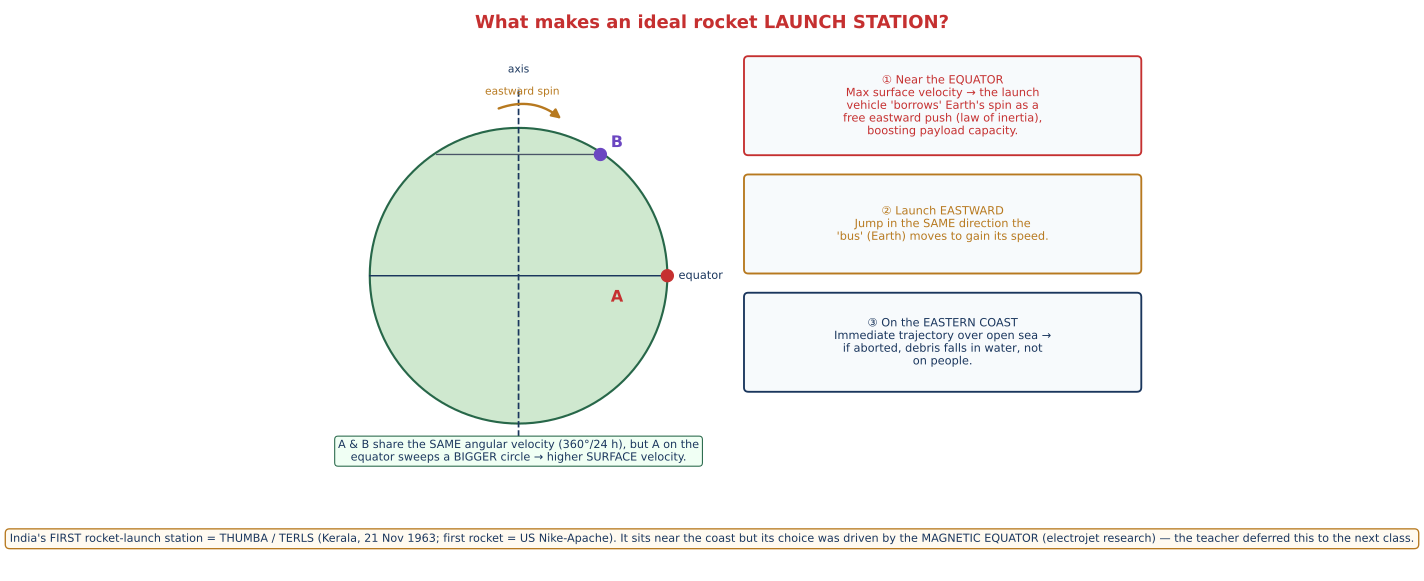
The physics set-up. Take two points — A on the equator and B on a latitude near the pole. As Earth rotates once (~24 h), both A and B sweep 360° at the centre, so they have the same angular velocity (360° / 24 h). But to keep that same angular velocity, A on the equator must cover a bigger circle, so A has a higher surface (linear) velocity — the Earth moves fastest at the equator.
Criterion 1 — as close as possible to the EQUATOR. The most important parameter of a launch vehicle is its carrying/payload capacity. A launch vehicle would love a free extra push from outside. Launching from the equator gives exactly that: because the ground there moves fastest, the vehicle "borrows" Earth's rotational speed (law of inertia — a small body leaving a fast-moving large body carries its speed). (The teacher's analogy: jumping off a moving bus — you borrow the bus's speed; the faster the bus, the bigger the effect.)
Criterion 2 — launch EASTWARD. Since the Earth rotates west-to-east, you must jump in the same direction as the "bus" to gain its speed. Launching eastward harnesses the rotational boost.
Criterion 3 — on the EASTERN COAST. The immediate trajectory of a launch should not be over a populated area. If launched from an eastern coast, the vehicle heads out over the open sea — so if there's a technical glitch and the vehicle must be aborted mid-air, it falls into the sea, causing minimal loss to life and property (and, if you care about marine life, minimal there too).
EXAM FOCUS / PYQ: the three launch-station criteria — near the equator, launch eastward, on the eastern coast — are a very probable Prelims point and an easy Mains point.
The puzzle the teacher left for next class — Thumba. India's first rocket-launch station was at Thumba (in the Thiruvananthapuram district of Kerala) — on the country's south-western coast, which at first glance seems to violate the "eastern coast" rule we just derived. "Did India learn this the hard way, by trial and error?" The teacher deliberately left this as a cliff-hanger to open the next class.
VERIFICATION / the resolution: Thumba Equatorial Rocket Launching Station (TERLS) was established on 21 November 1963; India's first rocket launched from there was the American Nike-Apache sounding rocket. The reason Thumba was chosen is that it lies almost on the magnetic (geomagnetic) equator, where the equatorial electrojet can be studied overhead — ideal for the sounding-rocket / atmospheric research with which India began its space journey (recall Class 1: India started with sounding rockets and the Rohini series). The "eastern coast, near-equator" rule applies to orbital satellite launches (which is why Sriharikota / SDSC-SHAR on the eastern coast became the orbital launch site) — so the two are not in conflict; they serve different purposes. (This is the thread the teacher will pick up next class.)
24. Quick Revision & Prelims Pointers
| Concept | One-line pointer |
|---|---|
| Space station significance | It is a research platform; value flows from micro-gravity + weightlessness + high-frequency radiation, all free of cost |
| Research domains | Human physiology (muscle regeneration → anti-ageing / muscular dystrophy / SMA; neuro — Alzheimer's/Parkinson's; cancer; endocrine → biological clock), model organisms, material science, astronomy, atmospheric science, + diplomacy |
| 16 sunrises | ISS orbits Earth 16×/day → 16 sunrises + 16 sunsets → disrupts the biological clock (circadian rhythm) |
| Model organism | Studied to extrapolate to humans; good one = easy to handle + breed + distinct traits; fruit fly (Drosophila) = "Cinderella of genetics"; bacteria → AMR research |
| Bio-printing | 3-D printing with living cells in bioink → tissues (future: organs); micro-gravity gives right consistency |
| TLEs | Transient Luminous Events above storms: sprites (red, branched) + ELVES (expanding rings); confirmed by ESA's ASIM on the ISS (2018) |
| Space debris | Objects (dead sats + spent stages + space-walk losses + natural bodies) risking functional entities; >33,000 objects >10 cm; ~25,000–30,000 km/h; singular = plural ("debris") |
| Kessler Syndrome | Debris count always rises (fragments beget fragments) — collisional cascade; Donald Kessler + Cour-Palais, NASA, 1978 |
| SDR tools | Magnetic method, robotic arm/claw, net/sail (China), laser ablation (India–Japan); all need AI pattern recognition |
| Debris governance | Needs an enforceable law mandating removal as "common but differentiated responsibility" → would make SDR revenue-generating |
| Disposal | LEO debris → de-orbit & burn ("cremation"; LignoSat = Japan's wooden sat); beyond 35,786 km → graveyard orbit ("burial") |
| Current SDR | ClearSpace-1 (ESA — first operational); Astroscale ELSA-d (2021); debris-free missions by 2030 (ESA/ISRO/NASA); NASA Kevlar shielding; ISRO + Manastu Space; bodyguard satellites; IADC (1993) |
| SSA / NETRA | Space Situational Awareness = avoid getting hit; radar antennae → collision-avoidance manoeuvre; India = NETRA (Network for Space Object Tracking & Analysis, 2019) |
| CAM trend | ISRO CAMs rising: 2018 ≈ 8 → 2021 ≈ 19 → 2023 ≈ 23; >1.5 lakh conjunction alerts for India in 2025 |
| Space tourism types | Sub-orbital (minutes; Virgin Galactic; $20–60 mn/seat) → orbital (days) → trans-orbital/extra-terrestrial (Moon/Mars; days–month; futuristic) |
| Space-tourism facts | 1st tourist = Dennis Tito (US, 2001); 1st Indian = Gopichand Thotakura (Blue Origin NS-25, 2024); providers = SpaceX / Blue Origin / Virgin Galactic; need sustainable space tourism |
| India's space rationale | Nation-building (Sarabhai doctrine) + most dual-use technology (launch vehicle ↔ missile; military comsats GSAT-6 Army / 7 Rukmini Navy / 7A Air Force / CMS-03) |
| Founders | Homi Bhabha (nuclear + early space; Tata links); Vikram Sarabhai ("Father of Indian space programme") → PRL, UCIL Jaduguda, ECIL Hyderabad, IIM-A, spotted Kalam |
| Ideal launch station | Near equator (borrow Earth's spin → payload) + launch eastward + eastern coast (aborts fall in sea) |
| Thumba / TERLS | India's first rocket station (Kerala, 21 Nov 1963; first rocket = US Nike-Apache); chosen for the magnetic equator (sounding-rocket research) — orbital launches later shifted to Sriharikota (eastern coast) |
Current Affairs
(Updated as relevant news/magazine content comes in)
| Date | Source | Headline | Connection to this topic |
|---|---|---|---|
| 16-04-2026 | The Hindu | India received >1.5 lakh conjunction alerts in 2025 | Scale of the space-debris collision risk; SSA/NETRA; collision-avoidance manoeuvres |