Space Technology — Fundamentals (+ S&T Course Intro, Exam Strategy & Memory Science)
GS Paper: GS Paper III | Subject: Science & Technology | Last updated: 2026-07-20
This is Class 1 of the Science & Technology course (teacher: Vinay Krishna, 11-06-2026). It opens the whole subject, so it has two halves: Part A — course & exam foundations (the two domains he will teach, how the UPSC exam has evolved, the science of memory & lifestyle, and how to study S&T) and Part B — Space Technology fundamentals (what space is, satellites and their uses, why satellites sit above the atmosphere, the evolution of space tech, the two space races, why we do science, the new-age uses of space, and space stations). The class board notes were very rough, so every diagram below is a clean redraw built from the lecture — the rough scans are not reproduced.
Table of Contents
Part A — Course & Exam Foundations
- The two domains: Space Technology & Biotechnology
- How the UPSC exam has evolved — and what it demands
- The science of memory & a winning lifestyle
- How to study Science & Technology (Science → Engineering → Technology)
Part B — Space Technology Fundamentals
- What is "space"? Outer space & the Kármán line
- Why do space technology? Satellites and their applications
- Why plant satellites beyond 100 km? (orbital velocity, inertia, fuel)
- Coverage — the real reason we use satellites
- Evolution of space tech: balloons → sounding rockets
- Space Race 1.0 (Sputnik → Apollo)
- Space Race 2.0 (Artemis, China, ILRS, India)
- Why do science? Fundamental vs Applied
- New-age applications of space (mining, tourism, warfare, colonisation)
- "Houses in space" — space stations
- Quick revision & Prelims pointers
Part A — Course & Exam Foundations
1. The Two Domains: Space Technology & Biotechnology
The teacher will personally cover the two domains that, between them, carry the largest volume of content in the Science & Technology section and are the most predictable — barely a year goes by without questions from them: Space Technology and Biotechnology. (Some students will also see him in Anthropology classes.) These two sit at diametrically opposite extremes of scale — space technology deals with the infinite, unfavourably large dimensions of the cosmos, while biotechnology deals with the molecular, microscopic dimensions of life.
Why space technology is so predictable comes down to three things the teacher kept returning to:
- It is highly dynamic — "every other day there is something or the other to prepare for," so UPSC generates a great deal of current-affairs material from it. Newspaper reading therefore becomes critical to your chances. (Just the previous day, for instance, ISRO decided to sell the GSLV Mk-III / LVM3 to private companies — they will build it if a buyer chooses to acquire the technology. India is sitting at a major transition point where, as a matter of policy, private companies are now being allowed to expand activities they were earlier barred from.)
- It is highly diversified in its applications — and UPSC "more often than not asks questions centred around applications and significance." You cannot imagine modern life without space technology touching almost every aspect of it.
- It is a domain where India can proudly say it has been performing decently well.
EXAM FOCUS / PYQ: Space technology questions come in the Prelims, the Mains, and the interview, and often directly from current developments. Because it is so dynamic, "you must remain highly alert and cover everything as time passes." Newspaper reading is non-negotiable here.
Biotechnology — "biology + technology," but understand it functionally, not literally. The teacher's working definition, which he wrote on the board, is:
Biotechnology = the various tools and techniques using which humans get the ability to control the rate and the direction of evolution of living forms.
In doing this, humans acquire what we have always treated as godly power — the power to decide how an organism evolves and when a species goes extinct. To understand this you must first understand evolution, which the teacher called "one of the most universal of all phenomena." Everything evolves — the tangible and the non-tangible, the living and the non-living: your thought process, dress, festivals, culture, language; even landforms, mountains and rivers. In the biological sense, evolution is:
Evolution = gradual + accumulative changes that happen in organisms towards better adaptability.
That is a natural process — but biotechnology lets us influence its rate and direction.
TEACHER'S EXAMPLE (Bt cotton vs the bollworm): Cotton is one of the most common cash crops grown in India and across the world, and like any plant it has enemies. Its most notorious enemy is the bollworm — the larva of a particular moth. Given hundreds or thousands of years, cotton might naturally evolve its own defence against the bollworm — but we don't have the patience to wait 4,000 years. So we developed Bt cotton, engineering a quick "evolution" of cotton that defends itself against the pest. That is biotechnology changing the rate and direction of evolution.
EXAM FOCUS / PYQ (biotech tools): This year's Prelims asked about the tools of biotechnology — e.g. can viruses be used to transport genetic material into a host cell or tissue? and can lipid nanoparticles be used as the vector/carrier of genetic material? Expect questions right from the tools through to the applications.
Like space tech, biotechnology is predictable for the same reasons — highly dynamic, diverse in application, and a domain India is pushing hard through policy. This is captured in the term bio-economy (harnessing the economic potential of biological entities and processes). Recently the Government of India released the BioE3 Policy — Biotechnology for Economy, Environment and Employment (the teacher rendered the three E's as ecology/environment, economy and employment) — through which India, using biotechnological tools and methods, wishes to become a global bio-manufacturing hub: producing substances like vaccines, medicines, enzymes and biofuels** through biotechnological interventions.
2. How the UPSC Exam Has Evolved — and What It Demands
The teacher framed the whole discussion through evolution itself: "there is nothing which does not evolve, so UPSC does as well — and everything evolves towards a better state of adaptability." So the simple question is: whom has the UPSC got to adapt against? The answer is you, the aspirants. It should therefore be no surprise when the exam throws up something very difficult — that is exactly it becoming more adapted against you. Expect the exam to keep getting harder.
But difficulty is one thing and reliability is another. The goal of any examining body is to design a system that is efficient at screening the deserving from the non-deserving. No system is 100% fool-proof — you can never guarantee that nobody gets through by luck and nobody deserving gets screened out — but the statistical wisdom lies in designing an exam that does this to the best possible level, and that is what "reliable" means.
The 2011 marker
To show the temporal evolution of the exam, the teacher uses 2011 as the dividing line — "before 11" and "post 11":
| Era | Prelims structure |
|---|---|
| Before 2011 | a single General Studies paper of ~270 questions |
| 2011 onwards | overhaul → CSAT introduced: ~180 questions total = 100 (GS) + 80 (CSAT) |
| 2013 | people on the streets protesting that CSAT "unduly benefits a certain academically-trained group" — scrap the CSAT |
| 2014–15 | 2014 was a general-election year (governments are more pliable to popular demand, especially from potential first-time voters), so the government made CSAT qualifying |
| Today | roughly 100 questions decide your fate |
The hidden cost of fewer questions
The teacher's central argument: does UPSC mean to suggest that asking 180 questions is statistically the same as asking 100? What statistical model told them 100 is sufficient — that the other questions were redundant? Obviously none. He pushes the logic to the extreme — if 100 is fine, why not bring it down to 22 questions, one from each domain? You'd correct the paper lightning-quick, even conduct the exam twice a year. The problem with reducing the number of questions is this:
As the number of questions falls, the relative significance of each question rises. Earlier, missing one question cost you 1/270th of your chances; now missing one costs you 1/100th. So every single question carries a higher relative weight, and with every question your fortunes swing by a bigger margin. The degree of randomness has gone up.
And there is no fixed pattern — no rule that says "this many from Geography, this many from Economy." So every year some candidates walk out happy (their area got a disproportionate share) and some shocked (their area barely appeared); some years current affairs dominates. The lesson: never try to derive a pattern and calibrate your preparation to it — there is no pattern, and "100" is not even fixed (questions get dropped; UPSC has no stated minimum number below which the paper is invalid — so even if 50 questions are wrong, the fate is decided on the rest).
EXAM FOCUS / PYQ (cutoff data): Post-2015 (after CSAT was made qualifying), the Prelims cutoffs show much bigger year-to-year variation than in the pre-CSAT era. Plotting the cutoff as a percentage of total marks, there is a clear declining trend — it fell to around 37% in 2023 — which reflects the higher degree of randomness. This is a structural feature you cannot fix; you simply have to train yourself not to be psychologically affected by it.
Two more pressures
- Number of aspirants has tripled in about a decade — from roughly 3 lakh to over 13 lakh filling the form. More and more aspirants are fighting for fewer and fewer questions → competition is far more intense. (This is true even if you are already in service and re-attempting to improve your rank — Prelims will catch you off guard if you let your guard down.)
- Number of vacancies has no trend — it zigzags. The year you are at your best could be the year vacancies drop from, say, 1,000 to 700. Your preparation must account for these variations, so that you are always aiming to be among the top rankers, not merely "getting in."
THE BOTTOM LINE: "Gone are the days when a selective approach could have helped." From Day 1, tell your mind to be as exhaustive as possible — cover everything relevant. The teacher is candid that UPSC preparation is "the most non-organic way of learning" — the volume of content and the rate at which it must be pushed into your head is not sustainable, which is exactly why most aspirants struggle with retention and slip into self-doubt ("my memory is weak, my neighbour's is better"). Section 3 is his answer to that.
3. The Science of Memory & a Winning Lifestyle
The teacher's claim: Indian academic training judges sincerity in quantitative terms ("how many hours did you study?" — the interview answer is always an inflated "18 hours"), but it is the qualitative aspects that have a telling impact on your chances. "Reading books about swimming hardly makes you a swimmer; jumping into the pool does." So train yourself consciously on the following.
(a) Good food → and the role of emotion
The first input is nutrition — assuming you eat well, good food directly improves your memory, your ability to remember, analyse and reproduce. Beyond that, the simple science of memory is emotion:
Content enveloped in emotion is retained longer. If asked to recall major incidents of your life, you'll remember the ones that generated intense emotion — euphoria, excitement, happiness, sadness, anger, frustration, fear.
TEACHER'S EXAMPLE (public embarrassment fixes the answer): Imagine a teacher deliberately picks a student he doesn't want to answer, asks a hard question, and on the student's failure says cruel things — "you don't even know this, and you'll become an IAS?" — humiliating him publicly, then gives the answer. Meet that student 10 years later: he'll have a hundred choice adjectives for that teacher — but he will also remember the answer. The public embarrassment created an emotional loop, and the content was hung onto it.
HOW TO APPLY IT — solve questions from Day 1. Don't wait until you "know the stuff well enough" to attempt questions. Questions are not (only) a test of preparation — they are a tool of preparation. Every time you solve a question after sincere study and get it right, it generates an emotion of achievement that fixates the content; when you get it wrong, it creates embarrassment, and when you later get the correct answer, that fixates the content. Either way, emotion locks the learning in. So don't delay solving questions.
(b) Feed the brain: glucose, glycogen and breakfast
The brain is "an army of neurons." Two facts to internalise:
- Your neuron count is not increasing — it decreases gradually with age (this is age-related neurodegeneration, which is also why people behave oddly with age — the brain's activity declines).
- The brain runs on one, and only one, source of energy: glucose. For the rest of the body glucose is the preferred energy molecule; for the brain it is the only molecule — "it will eat nothing else."
Glucose comes from food. When you eat and there is excess glucose, the body converts it into a storage form — glycogen (animals store reserve glucose as glycogen; plants store it as starch). This glycogen reserve is held in the liver, and it can support your needs for about 12 hours — no longer.
TEACHER'S EXAMPLE (the most brain-damaging habit — skipping breakfast): Breakfast is the most important meal of the day. Between dinner and the next day's lunch, without breakfast, those ~12 hours of glycogen get exhausted, after which the brain is starved of glucose — that headache you feel when you've missed a meal is literally "your brain revolting." Skip breakfast regularly and you (i) facilitate neurodegeneration and (ii) sit in class at half-alertness, half-memory, half-attention — which accumulates into a huge impact. Start your day with a nutrition-loaded breakfast so your brain feels pampered and rewards you.
(c) Hydration
The next big controller of cognition (understanding, remembering, staying attentive, reproducing and analysing) is your state of hydration. A hydrated mind is alert. The trap: dehydration starts much earlier than thirst — by the time you feel thirsty you are already dehydrated — so train yourself consciously to drink plenty of water, even if it means more frequent trips to the loo (you're flushing out toxins better, and your skin glows — a welcome bonus, since UPSC prep otherwise drains the face).
TEACHER'S EXAMPLE (the hangover): After a night of drinking, the morning symptom (headache) tells you something went wrong. The liver does not revolt immediately (it complains only much later) — but one organ has very low tolerance and complains at once: the brain/mind, because alcohol causes dehydration, and the first organ hit by dehydration is the mind. You needn't be an alcoholic to face this — ordinary hydration stress causes the same dehydration. So stay hydrated.
(d) Sleep — "the world's best medicine"
Sleep has three aspects, all of which matter:
| Aspect | What the teacher said |
|---|---|
| Quantity | Do not sleep less than 7–8 hours. (Stories of politicians "managing on 3–4 hours" are not a model to copy.) |
| Quality | The room must be absolutely dark. Darkness induces the sleep hormone melatonin — better the melatonin, deeper the sleep, more rejuvenated you wake. Turn off lights; block flashing traffic light. |
| Pattern | Your sleep time and wake time must not be random (12 one day, 3 a.m. another, then 24 hours straight). The body has an intrinsic biological clock / circadian rhythm — every system (heart, digestion, brain) has a timing to peak and decline. |
TEACHER'S EXAMPLE (it's all in the mind): A man who felt "someone is under the bed" every night and never slept properly went to every psychiatrist in vain — until a friend simply cut off all four legs of the bed. Now, with no space under the bed, his mind was at ease and he slept. (The point: much of the disturbance is psychological — fix the environment and the mind settles.)
TEACHER'S EXAMPLE (the "one last sunrise"): Negotiate away the habit of one last scroll before bed. You lie down for a final "sunrise" — the phone's screen glows like a sunrise into your eyes — "two hours pass, the reel has no bottom," and then the 7:30 class depends on the snooze button, "the world's most motherly innovation," which, like a dedicated mother, wakes you every five minutes while you mutter "five more minutes." This wrecks the sleep cycle. The pay-off of a tuned clock: aspirants who never fine-tuned their biological clock famously can't sleep for the last five days before the exam — and once the brain is shut down under stress, no content goes in. Build the right pattern as early as possible.
Q&A (working aspirants): A student noted 7–8 hours is hard for a working aspirant. The teacher agreed it's difficult but severe sleep deprivation seriously hurts efficiency — so protect sleep as far as you can (the only "no compromise" exception he gave was someone like a loco-pilot, for safety).
(e) Physical activity
Often ignored — and sometimes deliberately, on the excuse that "becoming an IAS requires long sedentary sitting." But not moving directly impairs your learning ability. The teacher's reasoning:
Bipedalism made us dominant. The single biggest change that made Homo sapiens the dominant species was bipedalism — walking/running on two legs freed two limbs, which let us make and use tools, and through tools we mastered the entire biological kingdom. Your whole body has evolved to support bipedalism: the S-shaped spine (a shock absorber, because we walk upright rather than on all fours), knees that don't rub, the seat at the bottom that stretches as you plant your feet. Your neuro-endocrine system (nervous + hormonal) is directly tied to a running/walking lifestyle.
The mechanism: physical activity stimulates the pituitary gland — the master gland.
TEACHER'S ANALOGY (the conductor): If your life is a symphony, the pituitary gland is the conductor that sets the tune for the entire orchestra of glands. Physical activity simulates (stimulates) it.
So break the sedentary routine with 15–20 minutes of aggressive cardio daily. Pituitary secretions directly control:
- memory, alertness and attention span (which the 30-second reels are eroding),
- act as natural painkillers (important, since long sitting brings cervical and lower-back pain — "the medicine is signalling itself"), and
- make you feel good about life — they generate feel-good hormones, which matters because the UPSC journey is lonely and demoralising (you watch friends who chose other paths "earning money, going around Goa-Dubai, having kids," while you feel stuck "studying 18 hours in a pigeon-hole").
TEACHER'S EXAMPLE (don't become a pumpkin): Some boast "I can sit in one position for 10 hours without moving." Who are you, a pumpkin? That may be a vegetative state (the Munna Bhai MBBS reference). Don't aspire to that — and don't reach for extra chemicals/substances to feel good, because that only costs you more time later.
(f) Recreation
A common misconception: no festivals, no marriage, no Eid/Bakrid, no Holi/Diwali, no birthdays "until you become an IAS." The teacher rejects this:
"All logic is like a knife — all blade; it bleeds the hand that holds it." You need de-stressing activities — music, sports, theatre, a party, or sleeping like a log for 24–48 hours — to regiment yourself for the next round of work. (Put the phone on airplane mode, tell your parents.)
But pay the price — make recreation a reward you have earned, not a random escape. Don't take guilt trips:
TEACHER'S EXAMPLE (the guilt trip): You plan to finish your Polity syllabus in seven days, are doing well by Day 2, and a friend drags you to a movie. If the movie is bad, you're on a guilt trip in the theatre itself; even if it's good, you return to find your "tempo" (momentum) gone, and you burn two more days getting it back. Done on a regular basis, these guilt trips erode confidence and breed anxiety. So enjoy — but pay your price and make it a reward you wanted. UPSC preparation will make you a habitual loner; few will come and appreciate your hard work, so you must become your own best evaluator and reward yourself for good work — that does a "world of good" to your confidence.
Close to the exam you may set all this aside (regress) and stretch to 16–18 hours — and you'll need to say so in the interview. But the teacher always opens with these points because only conscious training in them yields the benefit.
4. How to Study Science & Technology
Step 1 — finish the basics. As early as possible, get done with basic science from the 6th–10th standard — NCERT is not mandatory; State Board / ICSE / CBSE is equally fine, "science will not change." Just revise this much.
Step 2 — understand the Science → Engineering → Technology sequence. The UPSC syllabus speaks of "recent developments in the fields of space, nanotechnology, biotechnology, robotics, IT" — note that everything named is Technology. So most questions come from technology itself. But technology is the third step of an organic sequence:
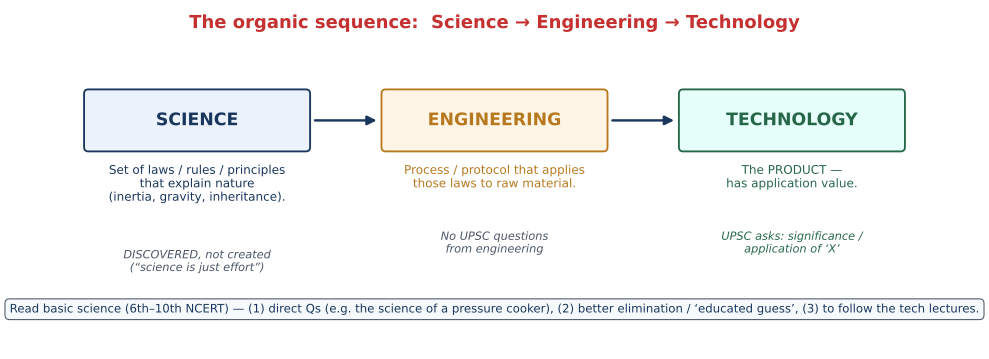
- Science = a set of laws, rules and principles that explain all the phenomena of nature — the law of inertia, the law of gravity, the laws of inheritance. Crucially, science is discovered (decoded), not created — "science is just effort." The laws already exist; we uncover them.
- Engineering = once you have laws that can be repeatedly used, you apply them to raw materials through a designed process or protocol. Engineering is that process/protocol — how you use the science on raw material.
- Technology = what the protocol leads to: the product — and it is this product, with value in application, that we call technology.
EXAM FOCUS / PYQ: Because the merit of a technology lies in its applications and significance, that is what UPSC most often asks. When you read a long, dense newspaper article and can't grasp its relevance, first ask: what is its applicational value? — get that, and "you've broken the back." No questions are ever asked from engineering. But UPSC can ask basic science — the science behind a technology. A couple of years ago it asked the science of the pressure cooker. So reading basic science pays off three ways: 1. direct questions on the underlying science; 2. better elimination / "educated guess" — the teacher has reservations about the term "elimination method," but agrees that solid basics make your guess far better (he likens an uneducated guess vs an educated one to "how educated is your guess — matric-pass, 12th-pass, graduate, or PhD?"); 3. getting the most out of the lectures, which are technology-focused — your basics must be clear, because the teacher will not re-teach inertia, momentum or velocity.
HOW TO REVISE THE BASICS: When you revise 6th–10th science, ignore all the numericals, equations, experiments and scientists' stories. Look only for the concepts, laws and principles. This makes revision much faster and brings every concept into your functional memory, ready to be used. (The same applies to CSAT — even a science background should revise it, just faster.)
TEACHER'S ANALOGY (the divorce with science): Those who "divorced" science in the 10th standard should "set aside the ego and give it one more chance" — and read the newspaper regularly, because that builds organic knowledge and the confidence to use what you know.
Part B — Space Technology Fundamentals
5. What Is "Space"? Outer Space & the Kármán Line
"Space" is a very generic term — any three-dimensional occupied region can be called space (like the space you book when you take a seat). But the moment you add "technology," it cannot mean just any 3-D region — it is implied that we mean outer space. So we must define outer space precisely.
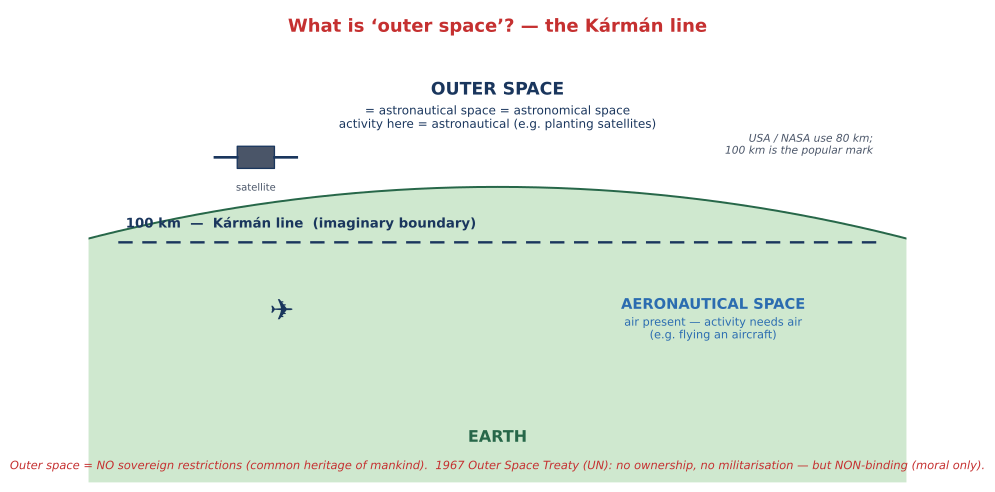
Take the Earth's curvature and go vertically up 100 km. That altitude is an imaginary boundary known as the Kármán line — named after the Hungarian-American physicist Theodore von Kármán.
- The region beyond the Kármán line is outer space — also called astronautical space or astronomical space (the two mean the same here). Activities done in this zone are astronautical activity — e.g. planting satellites or any spacecraft.
- The region below 100 km is aeronautical space, where activities that require air are conducted — e.g. flying an aircraft.
- Correspondingly: aeronautical engineers work within the Kármán line, astronautical engineers beyond it, and aerospace engineers work in both.
CLARIFICATION (100 km is not a rigid line): The 100 km figure is not a regional/legal certainty. The USA / NASA consider space to begin at 80 km. The 100 km mark is simply the more popular one (a clean, round number — "also abide, easy to take").
No sovereign restrictions — the 1967 Outer Space Treaty
A defining property of outer space: it has NO sovereign restrictions. No country can claim any part of outer space as belonging to it — nobody can fence off a patch of the Moon and declare it sovereign territory. Outer space is treated as the common heritage of mankind.
This had to be clarified because, when the space race began between the USA and the USSR, there was a real danger that militarisation and space warfare could take shape. So in 1967 the United Nations brought in the Outer Space Treaty, under which no country owns anything, every country can use it, and the militarisation of space is forbidden. But the Outer Space Treaty is non-binding — it is only a moral compass / moral suasion; there are no penalty provisions, so if a country went and claimed something, the treaty by itself could not punish it.
CONTRAST (air space is sovereign): Unlike outer space, a nation's air space is part of its sovereignty. That is why you need permission to fly an aircraft over another country, and why a country has the right to close its air space. India, for instance, announces a "no-fly zone" when conducting a missile test. (The teacher's aside: when India's BrahMos "went for an evening walk over Pakistan," Pakistan had every reason to protest — "it wasn't out for a stroll.")
6. Why Do Space Technology? Satellites and Their Applications
Space technology is highly cost-intensive — which is why not every country is "space-capable": although every country uses space technology, not every country has an independent space programme. The merit of any technology lies in its applications, and the applications of space technology are delivered through its mainstay: the satellites.
What is a satellite?
In the most generic sense, a satellite is any entity whose identity is derived around another body. That's why we speak of satellite cities (whose identity comes from being in the vicinity of a bigger megacity) or micro/mini satellites in other fields — these are not celestial and involve no revolution. But here we mean the celestial, artificial (man-made) sense:
Artificial satellite = a man-made object majorly placed around the Earth — where "majorly" ≠ "exclusively." You can have artificial satellites around other bodies: Chandrayaan around the Moon, Mangalyaan around Mars, Shukrayaan around Venus. (Contrast with natural satellites like the Moon.) We will cover the Earth-orbiting ones first.
The three functional categories of satellites
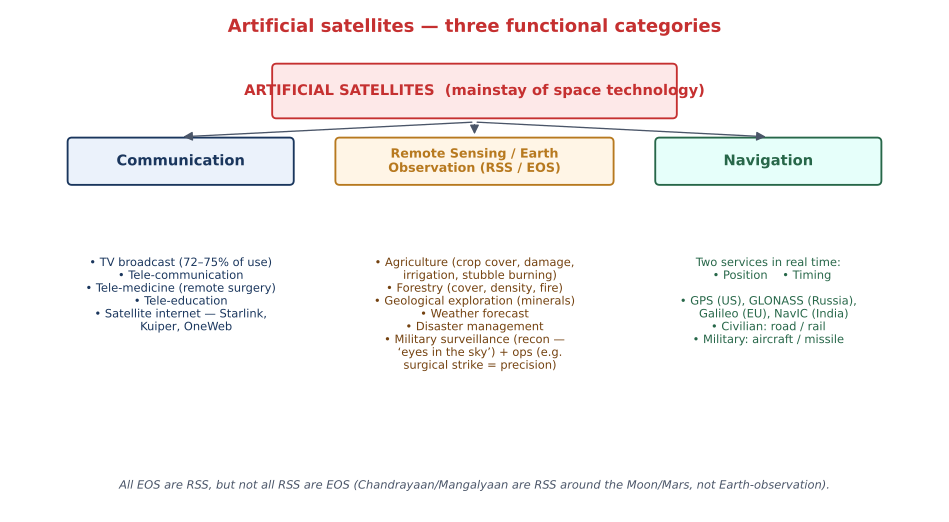
(1) Communication satellites. Their applications:
- TV broadcast — the single biggest use, ~72–75% of all communication-satellite application.
- Tele-communication — though this is primarily done through the network of towers, communication satellites contribute.
- Tele-medicine — a major surgery is needed at a small centre whose doctors aren't trained for it, so a major centre guides them through the satellite.
- Tele-education — conducting classes via satellite where the brick-and-mortar model isn't possible.
- Satellite-based internet — gaining huge popularity: the satellites act as routers in the sky beaming data to your home. The most popular is the Starlink constellation; others being built include Project Kuiper and OneWeb (Airtel and others are also collaborating on internet constellations).
(2) Remote-sensing satellites (RSS) / Earth-observation satellites (EOS). "Sensing from a remote distance." These days we increasingly use the term Earth-Observation Satellites (EOS).
CLARIFICATION (RSS vs EOS): RSS is the generic term; EOS is specific (Earth-observation). A remote-sensing satellite can sit around the Moon (Chandrayaan) or Mars (Mangalyaan). Therefore: all EOS are RSS, but not all RSS are EOS.
Remote-sensing satellites are the most diverse category by application — "name the field and they're used":
- Agriculture — every aspect: crop coverage, cropping intensity, crop damage, irrigation status, nutrition status, stubble burning.
- Forestry — forest cover, forest density, forest changes, forest fire.
- Geological exploration — yes, minerals are located using this.
- Weather forecasting.
- Disaster management.
- Military surveillance — these are also called reconnaissance ("recon") satellites, the "eyes in the sky." Your military preparedness is not formidable without them; they become even more important during war (tracking troop mobilisation, strategic positioning). And they don't only watch — they help plan and execute military operations, e.g. surgical strikes.
TEACHER'S ANALOGY (why "surgical"): A surgeon opens up a living person who must be "tailored back," so surgery demands extreme precision — any error in precision can be life-threatening. (Engineers ask why surgeons get "godly" respect when engineers also operate on hearts, lungs, kidneys — of machines; the difference is the surgeon operates with the engine running.) A surgical strike is all about that precision — which is exactly what remote-sensing/recon satellites enable.
(3) Navigation satellites. A navigation satellite gives two services, in real time:
- Position (where you are), and
- Timing (the time).
Navigation = knowing your position and the timing, in real time. The major systems: GPS (USA), GLONASS (Russia), Galileo (EU), BeiDou (China) and NavIC / IRNSS (India). Uses are both civilian (road navigation, rail navigation) and military (aircraft and missile navigation).
EXAM FOCUS / PYQ (tech and solitude): The teacher tied this to a recent Mains topic on whether technology is making humans more solitary / socially dependent. Earlier, visiting a new place meant asking strangers for directions — building social contact (some would invite you home for tea, some would offer wisdom). Now an "invisible voice" guides you. His cautionary example: GPS once routed two brothers onto a half-constructed bridge in UP as the "fastest route" — "the gravity brought them down, and the cosmos brought them up." Navigation gives you the confidence to venture into a new area without talking to anyone — convenient, but it is making us more solitary.
7. Why Plant Satellites Beyond 100 km? (Orbital Velocity, Inertia, Fuel)
Now the question "why 100 km?" can be answered. Picture two satellites: Sat-1 at a 30 km orbit and Sat-2 at a 400 km orbit (an object of repute at ~400 km is the International Space Station). An orbit is simply a path.
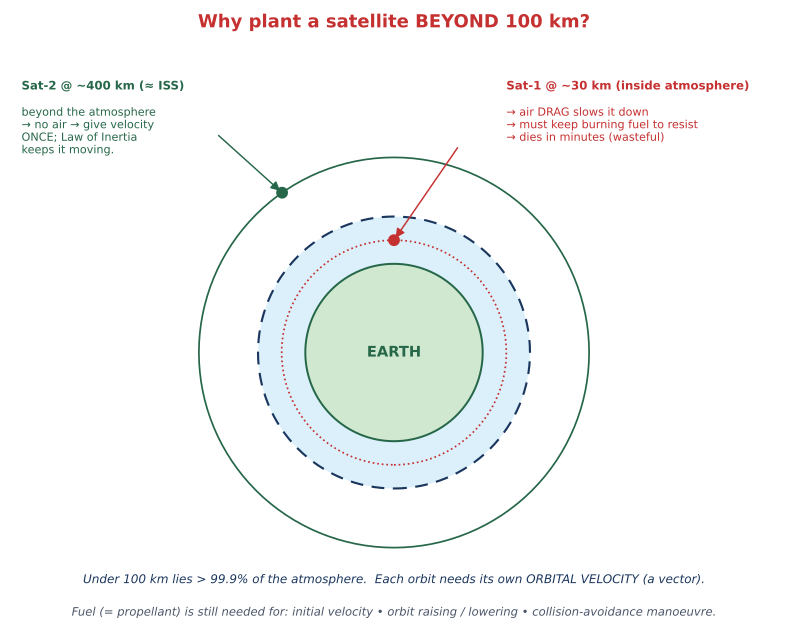
Key fact — orbital velocity. Any satellite, to sustain itself in a given orbit (to keep moving in the same orbit again and again), must possess a specific velocity. If its velocity is anything other than that specific value, it will not stay in that orbit. This is the orbital velocity — and it is different for every orbit (it is not a scalar; it is a vector — direction matters).
Why the atmosphere is the problem. Under 100 km lies over 99.9% of the Earth's atmosphere — thanks to gravity, all the gases, particles and water vapour are held there. So:
- Sat-1 (30 km), even if given its required velocity, faces air drag — the air tries to slow it down. To maintain its velocity against the drag, it would have to keep firing fuel — a "stupid" use of fuel: the propellant exhausts in minutes, and "you don't invest so much money for a few minutes of existence."
- Sat-2 (beyond 100 km), where there is effectively no atmosphere, needs the velocity only once — then it maintains it on its own, thanks to the Law of Inertia ("an object continues in its state of motion until an external force acts" — with no air, there is no external force, so it keeps moving). This is why we define space beyond ~100 km and plant satellites there.
Then do satellites carry no fuel? They do require fuel — and note the vocabulary: fuel here is called the "propellant," and the whole system is the "propulsion system." Fuel is needed not to sustain orbital motion, but for three things:
- To acquire the initial velocity the first time.
- To change orbits — pushing a satellite to a higher orbit is orbit raising; bringing it to a lower orbit is orbit lowering. Both require fuel.
- For collision avoidance. Outer space is "not a pleasant territory" — it is full of millions of natural and debris objects moving very fast (≈ 20,000–30,000 km/h, "more than the speed of a bullet"). To dodge these, a satellite must twist its body away like "a Rajinikant dodging bullets" — the technical term is the collision-avoidance manoeuvre.
EXAM FOCUS / PYQ: "Collision-avoidance manoeuvre" is flagged as a likely UPSC term.
Why satellites have a finite "life": The fuel a satellite carries can perform only a certain average number of manoeuvres / orbit-changes, so engineers make a rough estimate of how long it can last — hence every satellite has an average designed life span. But it's only an estimate (it depends on how many random objects forced a collision-avoidance manoeuvre): a satellite designed for 8–10 years might last 20. Note: a satellite's solar power is NOT used to generate thrust — solar energy powers the functioning of the components, not the propulsion.
8. Coverage — the Real Reason We Use Satellites
A crucial subtlety: none of the applications above are satellite-exclusive. TV, telecom, weather, navigation — all of these are also possible through ground-based systems. So what do satellites actually add?
Satellites give COVERAGE. They don't provide the function — they provide massive coverage, and because of that coverage they make the entire service far more efficient.
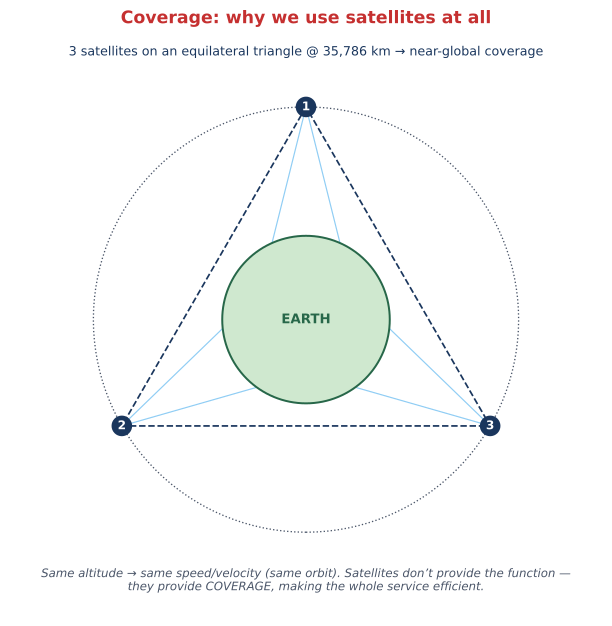
The teacher's striking technical illustration: place just three satellites on the vertices of an equilateral triangle, in an orbit at an altitude of 35,786 km from the Earth's surface (the science behind this specific altitude is covered later — this is the geostationary altitude). All three have the same speed / velocity (because they share the same orbit), and from that distance three satellites are enough to give near-global coverage of the entire world. That is what satellites buy you — coverage, and hence efficiency.
9. Evolution of Space Technology: Balloons → Sounding Rockets
Space technology is not old — barely a century — and its origins lie more in the political compulsions of the time than in the immediate needs of mankind.
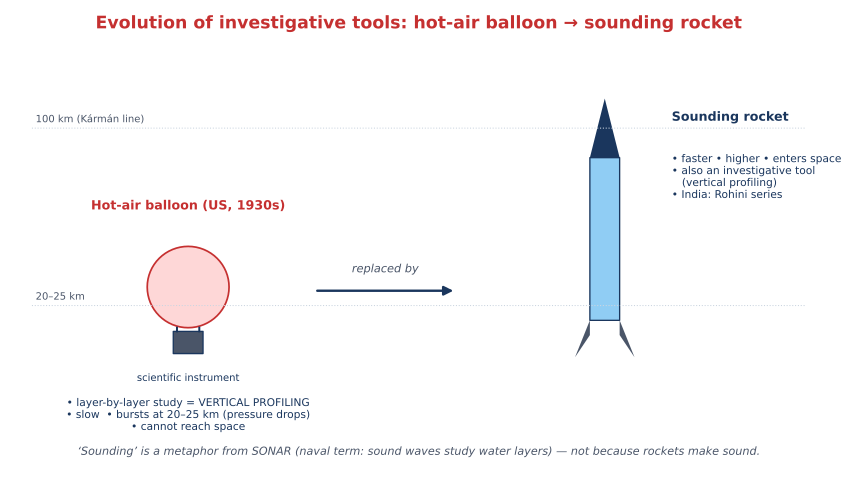
1930s — hot-air balloons. The US regularly used hot-air balloons for military surveillance. Scientists realised that since balloons move up through the atmosphere, you could mount scientific instruments on them to study a chosen parameter layer by layer as the balloon climbs — e.g. measuring carbon-dioxide variation, or water-vapour variation, every 5 km. This layer-by-layer study of the atmosphere is called vertical profiling.
But balloons have limits: they are slow, and they cannot go beyond ~20–25 km — as the balloon rises, the outside air pressure drops while the pressure inside stays higher, so the balloon ruptures. Technically, a balloon never enters space.
Replacement — sounding rockets. Hot-air balloons were therefore replaced by sounding rockets.
EXAM FOCUS / PYQ (sounding rockets): Expect a Prelims question. Sounding rockets are also investigative tools — they too are used for vertical profiling / atmospheric research — but with the advantage of being quicker and able to go higher, entering space. Why "sounding"? Not because they use sound waves, and not because they are loud (every rocket is). "Sounding" is a metaphor borrowed from the naval term sonar — in the sea, sound waves are used to study the different layers inside the water ("sounding"). The rocket was the aerial counterpart of that technique, so it was called a sounding rocket; the term is not technically meaningful.
India's sounding rockets — the Rohini series. India began its space journey with sounding rockets, in 1963. The first sounding rocket launched from India (from Thumba) was not Indian — it was an American rocket, the Nike-Apache. India then went on to develop and launch its own Rohini series of sounding rockets — investigative tools for studying the layers of the atmosphere and beyond.
10. Space Race 1.0 (Sputnik → Apollo)
The initial development of space technology grew out of antagonism and political compulsion — a race between the USA and the USSR to out-compete each other in the Cold War.
Why space? Because whatever happens in space is visible to the entire world — space is the most visible representation of a nation's technological progress. That is why space achievements top the list in political speeches ("we reached the Moon, we found water"): it's about the optics / symbolism. (Likewise, 23rd August 2023, when the Vikram lander touched the Moon, is celebrated as National Space Day — pure, justified national pride.) Space technology matters not only for its applications but for its symbolism.
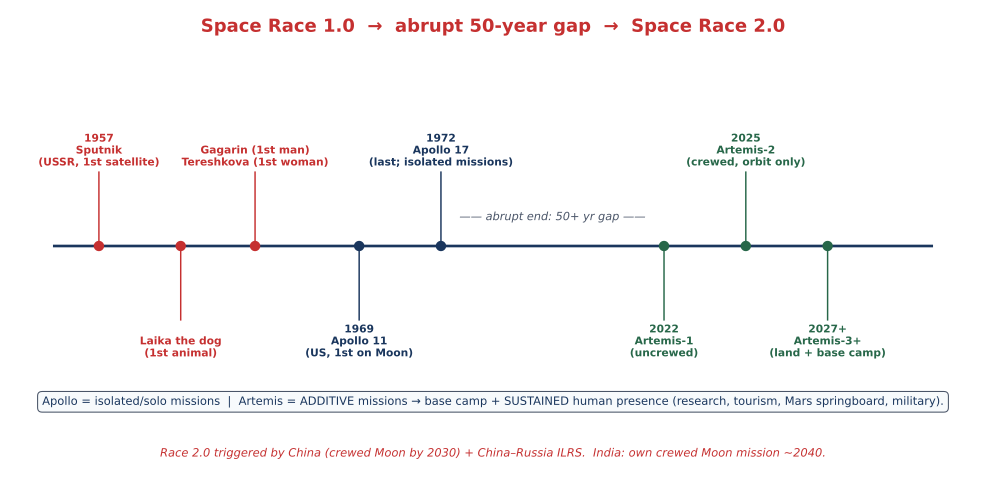
USSR's run of "firsts" (late 1950s–60s):
- 1957 — the first artificial satellite, Sputnik. It stunned the world; the capitalist USA found it very hard to accept that a communist country could beat it in a scientific achievement, and tried to downplay it (the US President dismissed it as "just one small ball in the air," as if Americans tossed such balls around daily).
- First man in space, then first woman in space — Valentina Tereshkova.
- First animal in space — the dog Laika.
TEACHER'S EXAMPLE (Laika): Laika was not a trained dog bred for the mission — she was a street dog ("a paraas"). Dogs wander uninvited into places if they catch a good smell, so she walked into the testing facility (perhaps drawn by chicken/mutton), was put through the simulation conditions "as if auditioning," and performed exceedingly well. She was taken up not to be brought back alive — she died, but she is registered in history.
The US response:
- 16 July 1969 — Apollo 11 launched; 20 July 1969 — the "giant leap of mankind" (Neil Armstrong's Moon landing).
CLARIFICATION (the Moon-landing "hoax" debate): For a rational, UPSC-preparing mind, the conspiracy theory has no scientific basis: Apollo 11 was not a solo mission — human landings continued up to Apollo 17 (1972). The fact that landings continued for several missions is itself the answer.
- After 1972 — an abrupt end. No human set foot on the Moon again for 50+ years. The reason was again optics: the whole effort ran on honour. Having "lost" the satellite/man/woman/animal races, the only way the US could stay relevant was to redefine the finish line as "who lands a human on the Moon." Once the US achieved that and confirmed the USSR had no immediate plan to land humans, it had no motivation to keep sending missions — so the programme stopped abruptly. (US taxpayers were asking why the money was being spent; President JFK's framing — "we do this not because it is easy…" — was political gesturing.)
TEACHER'S EXAMPLE (the Pakistani TV anecdote, 2008): When India launched Chandrayaan-1 in 2008, a Pakistani prime-time channel invited a "space scientist" and asked what he made of India sending something to the Moon "when we got independence at the same time." He replied, "I don't understand the need to send something to the Moon — can't we look at the Moon from here itself?" — and, after much pressing, conceded that for more detail "they could have used binoculars." (The teacher's point about contrast in scientific temper — the clip is on YouTube.)
11. Space Race 2.0 (Artemis, China, ILRS, India)
Fifty years on, technology had improved and private participation had grown, but that alone wasn't reason enough for the US to return to the Moon — until China formally announced a plan to land humans on the Moon. That triggered Space Race 2.0.
EXAM FOCUS / PYQ: "Space Race 1.0 vs Space Race 2.0" is flagged as a relevant Mains theme for the next two years — the changed circumstances, the differences, etc.
The US Artemis programme
After 54 years, the US restarted crewed lunar ambitions through Artemis:
| Mission | Year | Crew? | Outcome |
|---|---|---|---|
| Artemis-1 | 2022 | Uncrewed | spacecraft went to the Moon and came back |
| Artemis-2 | this year (1 April) | Crewed (4 members) | orbiting only — no landing |
| Artemis-3, 4, 5… | ~2027, 2028, 2029… | crewed | landing + building toward the goal |
Apollo vs Artemis — the key difference. Each Apollo mission was an isolated / solo mission with its own objectives. Artemis missions are additive / cumulative — each one builds on the last, with the end goal of establishing a base camp on the Moon and a sustained human presence (not just flag-planting visits).
CLARIFICATION (the naming symbolism): Apollo and Artemis are twins in Greek mythology — Artemis is Apollo's twin sister. Choosing a female name signals the US intent to put the first woman on the Moon (Christina Koch) and, more broadly, address past gender and racial discrimination in science — the programme also highlights the first person of colour, Victor Glover (who, orbiting the Moon on Artemis-2, recorded a message that "from here we see all humans as one race"). (Aside: the teacher called Apollo "the Greek god of war." In fact Apollo is the god of light, the Sun, music and prophecy, and Artemis is the goddess of the Moon and the hunt — which makes the choice of "Artemis" for a Moon programme even more fitting. The symbolism point — twin sister, first woman — stands.) Symbolism recurs across space: Russia even named its COVID-19 vaccine "Sputnik," evoking its satellite triumph.
Why build a base camp / sustained presence (a Mains question): - Research — the noblest face ("we are explorers by nature"): minerals, water, new knowledge. - Space tourism — "honeymoon could become literal — go to the Moon with the person you call honey." - A stop-over / springboard for longer journeys — chiefly to Mars. (Asked on a reality show why they were going, the Artemis-2 astronauts' first answer was "because we want to go to Mars" — the Moon is a padav, a way-station where you can refresh and refuel.) - A military base — China and the US already trade charges over this possibility.
China, ILRS and India
- China aims to land humans on the Moon by 2030. It is being especially aggressive because China and Russia are collaborating to establish the International Lunar Research Station (ILRS).
CLARIFICATION (what ILRS will be): ILRS could be either an orbital platform (like the ISS, but around the Moon) or a surface base camp — it is not yet finalised, because plans are changing fast. The US itself earlier planned a lunar orbital platform named Gateway, but cancelled it just before Artemis-2, deciding to go straight to a base. There is now effectively a race to grab the best patch of lunar land (some patches have more water, some more minerals).
- India has also formally committed to taking a human to the Moon — but not soon, around 2040 (and India may not openly admit it is "in the race"). The exact year is not the point; the intention is — it could happen earlier or later.
12. Why Do Science? Fundamental vs Applied
A deceptively simple question — useful for essay and interview, and a source of Prelims points: why do we do science at all? There are two drivers.
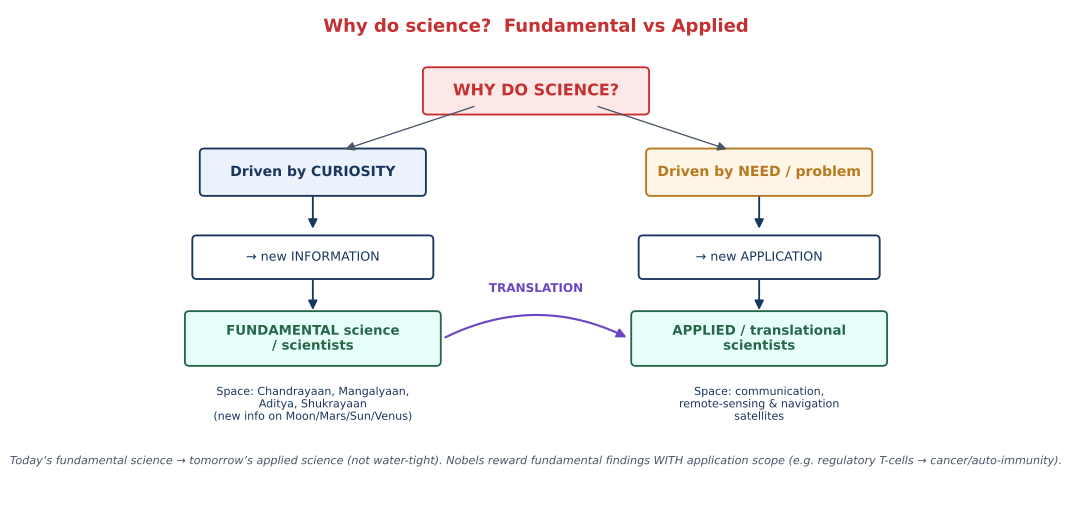
(1) Curiosity-driven → Fundamental science. As biological entities, all living forms are born with a high degree of curiosity; humans are distinguished by a better ability to chase that curiosity with tool-making. Chasing the how / when / what / where / why generates new information, and science that generates new knowledge is fundamental science (done by fundamental scientists).
Side discussion (science vs philosophy): A student noted philosophy also chases curiosity. True — which is why, when we teach science, we teach scientific method (how to frame a hypothesis, plan and conduct experiments, and derive knowledge), and that method is what distinguishes a scientific chase from a philosophical one. (It is also why a doctorate is a Ph.D — Doctor of Philosophy.)
(2) Need/problem-driven → Applied science. Sometimes you are guided not by curiosity but by the need of the hour / a problem to solve. You don't innovate a vaccine out of curiosity. Need-driven work generates new applications / solutions, and its practitioners are applied scientists (and translational scientists).
In space technology: the fundamental-science missions are Chandrayaan, Mangalyaan, Aditya, Shukrayaan (generating new information about the Moon, Mars, Sun, Venus — minerals, water, etc.); the applied-science assets are the communication, remote-sensing and navigation satellites. Every budget year there is a tug-of-war between the two camps over who deserves more funds.
The Sarabhai doctrine — and why India is moving beyond it
A logical question follows: ISRO does not have bottomless funds, and India does not have enough satellites to meet the whole country's demand — so should India spend on curiosity-driven fundamental-science missions instead of using that money to launch more satellites?
The Sarabhai doctrine. Dr. Vikram Sarabhai, the father of India's space programme, held that India — with little money — should use it only for nation-building (i.e. applied ends), and not fall into the trap of space-race-driven fundamental science. But decades on, India is rightly moving away from the Sarabhai doctrine.
EXAM FOCUS / answer line: If asked "should India invest in this (fundamental science)?", the answer is "Yes, we should" — you can even argue we should have started earlier. The reasoning: fundamental and applied science are not water-tight compartments. Today's fundamental science becomes tomorrow's applied science — this is called translation / translational science. That is exactly why Nobel Prizes in science are generally awarded for fundamental findings that carry application possibilities.
Example (last year's Nobel): The Nobel in Physiology / Medicine was awarded for the discovery of regulatory T cells (Tregs) — one of the immune cells in our body (peripheral immune tolerance). The discovery is fundamental, but the moment it was made, it opened the possibility of using it to treat cancer and auto-immune disorders — i.e. translation into application.
13. New-Age Applications of Space
Beyond the classic three (communication, remote-sensing, navigation), the world is evolving new ways of exploiting space. India cannot afford to miss them.
(i) Outer-space mining
Several dimensions drive this:
- Minerals are exhaustible — supply is finite, while human demand is endless and ever-increasing, so we keep needing new territory.
- Minerals are non-uniformly distributed — and this non-uniformity is the fulcrum of geopolitics. Geopolitics evolves around resource distribution (the Middle East and oil; lithium and the power economy). That geopolitics of resources will not be removed — only replaced, so any country that gains the technical ability to break free of that dependence will do so first.
- Mining is a dirty, highly polluting job — so the day humanity can shift it off-Earth, it will.
Sample-return missions (get comfortable using this in answers). These bring a sample back from an extra-terrestrial body. - TEACHER'S ANALOGY: like visiting a restaurant — after the meal and paying the bill, you get the mouth-freshener in a tissue and bring it home; a sample-return mission brings a "sample" home. - Overt purpose = research; the undercurrent = mining. Why suspect mining? Because you increasingly read that "a particular asteroid is worth x trillion dollars" — and the only basis for an economic valuation of a celestial body is the minerals it contains and their cost on Earth.
EXAM FOCUS / PYQ (who has done sample-returns — likely Prelims): | Body | Countries that have returned samples | |------|--------------------------------------| | Asteroid | USA and Japan | | Moon | USA, USSR/Russia, China (India not yet — planned in the upcoming Chandrayaan-4) | | Mars | Not yet (China and the US are aiming for it) |
ISRU — In-Situ Resource Utilisation. Outer-space mining is not only about bringing material back to Earth. As humans plan sustained presence on extra-terrestrial bodies, they will need minerals and water there — and carrying it as cargo is absurdly costly (~$1 million to carry 1 litre of water to the Moon). So you extract and use the resource at the site itself — this is In-Situ Resource Utilisation (ISRU). It explains the race to grab the best lunar patches (more water + more minerals → easier human sustenance).
(ii) Outer-space tourism
Already happening — but today's tourism does not land you on any extra-terrestrial surface; it takes humans into space for a few minutes ("by the time they say wow, they're brought back"), for which the rich pay millions of dollars. It is a revenue-generating activity. (The teacher's wry pitch: add "going beyond the Kármán line to behold the cosmos" to the pilgrimage list of the super-rich who don't know what to do with their money.)
(iii) Outer-space warfare
Most capable countries already have a dedicated Space Command in their military — India, France, the USA, China and Russia all have one. This is not new: when the USSR launched Sputnik (1957), the US developed the ability to shoot it down — because hitting a satellite in a low orbit (a few hundred km) is "no big deal," requiring only the political will: orient a long-range missile vertically and hit. Once the US developed it, the USSR did; China tested it in 2007; and India in 2019 used an Agni-missile derivative to hit one of its own dead, very-low-orbit satellites as a target practice — Mission Shakti.
EXAM FOCUS / PYQ (ASAT): The strategy of hitting an enemy's satellite by physically striking it = the hard-kill method (kinetic — "go and bang"). The technology is called ASAT — Anti-Satellite technology. Mission Shakti (2019) is India's test. (When India tested it, the US, Russia and others voiced "concern" over debris; India responded that it deliberately hit a very low satellite so the fragments fall back and don't linger — though a BBC report later called India "a major source of space debris," and Pakistan too complained — "pot calling the kettle black," the teacher noted.)
Hard-kill vs soft-kill. The hard-kill method is least likely to actually be used in war (it's mostly deterrence / show — "an elephant's display tusks"), because hitting a satellite isn't a "solo hit" — the fragments can take down others. So countries focus on the soft-kill strategy: no kinetic effort — just hacking the satellite's communication. You feed it a deviating signal (e.g. "turn 5 degrees") so that a satellite aimed at one target now points at Venus — no noise, but the damage is done.
Space warfare ≠ only fighting in space. It also includes using space assets (your satellites) to increase the efficiency of conventional warfare. The best recent evidence is Operation Sindoor — India pulled satellite photographs, identified targets precisely by their structural symmetry (e.g. a square layout with a dome at the centre), struck them, and then released before/after photos to show the precision. ("Having assets in space" lets you fight not just on land, air and water, but beyond the Kármán line.)
(iv) Outer-space colonisation
A little far-fetched at the moment — but "the way we are consuming the Earth," looking for an alternate territory will ultimately be the goal.
A note on collaboration
The information generated by curiosity-driven projects is for all mankind (when Newton discovered gravity, he couldn't say "only I stay on Earth, the rest float"). So curiosity-driven projects should be collaborative — collaboration decreases the individual cost borne by each participating nation and increases the scientific output.
Example: On the Prime Minister's recent visit to Europe, India secured Sweden's collaboration for its upcoming Venus orbital mission (Shukrayaan), planned for ~2028–2030. (Sweden had also collaborated on Chandrayaan-1.) (The treaties START, SALT and the Anti-Ballistic Missile Treaty are likewise expressions of collaborative coexistence — the same impulse that, in space, produced the ISS.)
14. "Houses in Space" — Space Stations
During the space race, the next frontier became who could build the biggest "house in space" — a space station, i.e. an orbital platform: a capsule inside which humans can stay sustainably for long periods. (Note: Gaganyaan is a crewed mission, not a space station — a station is for sustained presence.)
A space station = a research platform — a laboratory in space. Why go to space to do research? Nothing secretive — space simply provides conditions that are prerequisites for certain research:
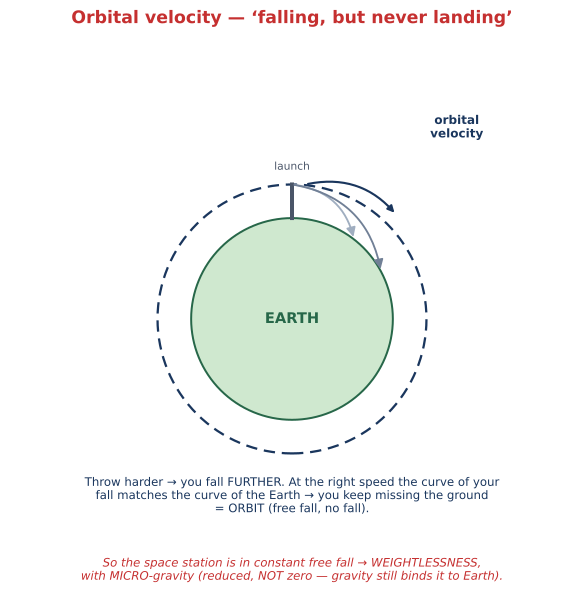
(1) Micro-gravity — NOT zero gravity.
EXAM FOCUS / PYQ (a classic Prelims trap): "A space station provides zero-gravity conditions" — FALSE. Had it been zero gravity, what would keep the station revolving around the Earth? It is gravity that keeps the station bound to Earth. Gravity reduces with distance from Earth but never becomes zero — so the station experiences micro-gravity (reduced gravity), not zero gravity.
(2) Weightlessness. "A space station provides weightlessness" — TRUE. But understand why, despite gravity being non-zero: we feel weight not because of gravity but because of the counter-reaction to gravity — standing on Earth, you press on the ground and the ground pushes back, and that is what you feel. In the station there is no platform to stand on, because the station is in constant free fall → so you feel weightless even though gravity is present.
TEACHER'S EXAMPLE (the painful test): Anyone wanting to test "weightlessness despite gravity" could jump from the 12th floor — weightless in the middle of the fall — "only to feel the weight one final time." Anything in free fall should ultimately hit the ground.
So why has the station been "falling" for ~25 years without ever falling? This is the orbital-velocity idea again (school physics, revised):
TEACHER'S EXAMPLE (the tower throw / Newton's cannonball): Imagine a tower on Earth, and someone throws you off it. Gravity pulls you back, so you fall some distance, land, and walk back. Thrown harder, you fall further before landing. Thrown at the right (orbital) velocity — a vector, given horizontally — as you fall, the Earth's surface curves away beneath you by the same amount. So the curvature of your fall becomes parallel to the curvature of the Earth, and you keep "missing" the ground — that is an orbit. Hence the station is in perpetual free fall with no fall. (And since each orbit has its own orbital velocity, orbital velocity is not a scalar.)
(3) High-frequency radiation. The Earth's atmospheric blanket shields us from harmful UV, X-ray and gamma radiation. But to research those radiations you must go out to where you get them free and perpetual — far cheaper than building costly simulations on Earth.
From rival platforms to the ISS
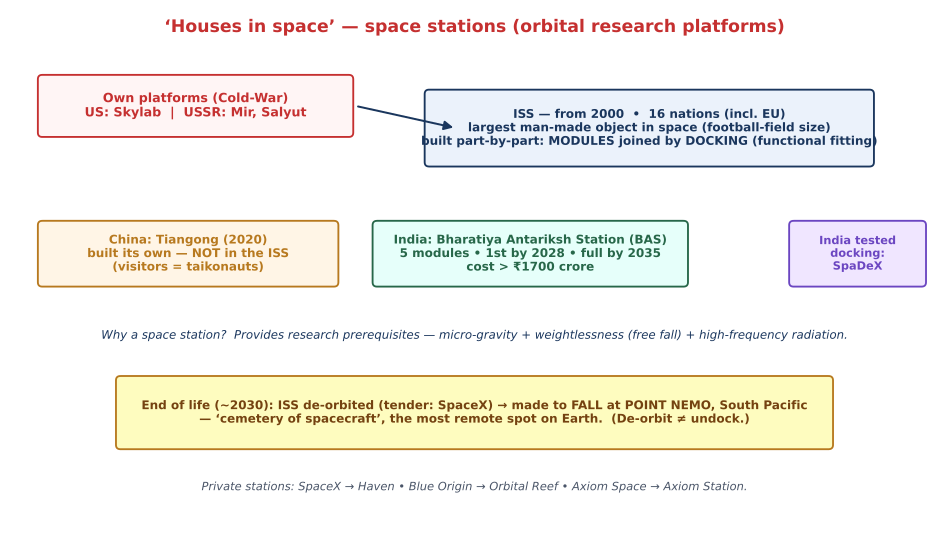
Initially — out of "attached stupidity" / Cold-War antagonism — the US and USSR each built their own platforms:
- USA → Skylab (the teacher said UPSC probably won't ask this).
- USSR → Mir (and also Salyut).
Wisdom arrived later: why not pool the investment into one common research platform? This produced the International Space Station (ISS) — the biggest-ever collaboration in space. First elements went up in the late 1990s and the station became operational/continuously crewed from 2000. It is an orbital research platform / laboratory in space, with Russian and American segments plus common living-and-working units.
Key facts about the ISS: - It is the largest man-made object in space, about the size of a football field. - It was taken up not at once but part by part — each part is a module, defined as a component with a defined, unique function. - Modules are joined in space by docking, which means functional fitting — not loose fitting. TEACHER'S ANALOGY: putting a cap on a pen isn't docking (it falls off); docking is like a plug in a socket where the bulb clicks on — a functional connection. - It is funded and built by 16 nations (a multinational assembly, including EU nations).
India's docking test — SpaDeX. India has tested docking in the Space Docking Experiment (SpaDeX). Docking is very sophisticated: two objects move at high, different velocities (different velocities ⇒ different orbits), but docking requires them in the same orbit — so one must change to match the other, chasing until the relative velocity is almost zero, then gently fit together. TEACHER'S ANALOGY: the Singham car-chase — Ajay Devgn closes on the criminal until there's zero relative velocity, both moving together, then they meet (in reality it must be very soft, not forceful).
China's Tiangong, and India's BAS
- China is not part of the ISS. A 2012 proposal to include China did not materialise, so China built its own station — Tiangong (operational from 2020). The world therefore now has two stations: the ISS and Tiangong.
- Names for space visitors: astronauts (USA), cosmonauts (Russia), taikonauts (China). India's are called Gaganyatris (a student once jokingly proposed "Vyomanauts").
- India's own station — Bharatiya Antariksh Station (BAS): 5 modules, with the first module by ~2028 and the full assembly by 2035; the project is to cost more than ₹1,700 crore. (India is not part of the ISS.)
End of the ISS → Point Nemo
The ISS has already outlived its ~two-decade design life; with repairs it has been extended and may operate until about 2030, after which it will be decommissioned. Two options were considered:
- Leave it in space as a "testimony to human endeavour" — rejected, because such a huge object would become a collision platform, shattering into ever more fragments/debris.
- De-orbit and let it fall — chosen. SpaceX has the tender. It will be brought down to fall into the South Pacific, at Point Nemo.
EXAM FOCUS / PYQ (Point Nemo — Prelims-relevant): Point Nemo, in the South Pacific, is the most remote ("most deserted") place on Earth — the closest humans to it are often aboard the ISS (~400 km up), not on Earth (the nearest land is ~3,000 km away). It is known as the "cemetery of spacecraft" (upgrahon ki kabra). De-orbit ≠ undock: de-orbit means taking it out of orbit to fall; undock means to detach a module.
Current-affairs tie-in (expect a question): Last year, two Indian Navy officers — both women, Roopa and Dilna — became the first Indians (and the only ones from their class of sailing vessels) to cross Point Nemo, aboard the INSV Tarini, on the mission Navika Sagar Parikrama; the achievement was publicly appreciated by the Prime Minister on X.
Private space stations
The ISS is no longer an exclusive, government-only domain — private companies are developing orbital platforms. The three most popular (as the teacher listed them):
- SpaceX → "Haven"
- Blue Origin → "Orbital Reef" (a reef, like a coral reef, means a platform)
- Axiom Space → the "Axiom Space Station" (the teacher noted the CEO of Axiom Space is an Indian, Tejpaul Bhatia)
HOMEWORK set by the teacher: Write the significance of a space station. (The teacher's standing commitment: however long the class runs, he never teaches more than one page per class.)
15. Quick Revision & Prelims Pointers
| Concept | One-line pointer |
|---|---|
| Kármán line | imaginary boundary at 100 km (NASA: 80 km); named after Theodore von Kármán; above it = outer/astronautical space, below = aeronautical space |
| Outer Space Treaty, 1967 (UN) | no ownership, no militarisation of space; non-binding (moral only). Air space, by contrast, is sovereign |
| Satellite categories | Communication (TV ~72–75%, tele-medicine/education, sat-internet: Starlink/Kuiper/OneWeb); Remote-sensing/EOS (agri, forestry, geology, weather, disaster, recon); Navigation (position + timing: GPS/GLONASS/Galileo/BeiDou/NavIC) |
| RSS vs EOS | all EOS are RSS, not all RSS are EOS |
| Why beyond 100 km | >99.9% of atmosphere is below 100 km → air drag; above it, Law of Inertia sustains motion after one push |
| Orbital velocity | the specific (vector) velocity each orbit needs; different for every orbit |
| Fuel = propellant | needed for initial velocity, orbit raising/lowering, collision-avoidance manoeuvre — not to sustain orbital motion; solar power runs components, not thrust |
| Coverage | 3 satellites on an equilateral triangle @ 35,786 km → near-global coverage |
| Sounding rocket | investigative tool for vertical profiling; "sounding" = metaphor from sonar; India = Rohini series (first launch from India = US Nike-Apache, 1963) |
| Space Race 1.0 | Sputnik (1957, USSR) → Laika → Gagarin/Tereshkova → Apollo 11 (1969) → Apollo 17 (1972) → abrupt 50-yr end |
| Space Race 2.0 | Artemis (1: 2022 uncrewed; 2: 2025 crewed orbit; 3+: land + base) — additive missions for sustained presence; China crewed Moon by 2030 + China–Russia ILRS; India ~2040 |
| Fundamental vs Applied | curiosity → information (Chandrayaan/Mangalyaan/Aditya/Shukrayaan) vs need → application (satellites); translation; India moving beyond the Sarabhai doctrine |
| New-age uses | space mining (sample-return; ISRU; Chandrayaan-4 to return Moon samples), tourism, warfare (ASAT/Mission Shakti, hard-kill vs soft-kill, Operation Sindoor), colonisation |
| Space station conditions | micro-gravity (not zero) + weightlessness (free fall) + high-frequency radiation |
| ISS | largest man-made object in space (football-field size); modules joined by docking (India = SpaDeX); 16 nations; from 2000; de-orbit ~2030 → Point Nemo (cemetery of spacecraft) |
| China / India stations | China = Tiangong (2020, not in ISS); India = BAS (5 modules, 1st by 2028, full by 2035, >₹1,700 cr) |
| Point Nemo | most remote point on Earth (South Pacific); nearest humans often on the ISS; INSV Tarini / Navika Sagar Parikrama crossed it |
Current Affairs
(Updated as relevant news/magazine content comes in)
| Date | Source | Headline | Connection to this topic |
|---|---|---|---|
| 15-06-2026 | The Hindu | SpaceX IPO — Musk becomes the first trillionaire; SpaceX ~$2T market cap (merged Starlink + xAI); biggest IPO in history | Space commercialisation / private-space economy — extends Space Race 2.0 & private space-station players (Haven, Orbital Reef, Axiom) |
| 18-07-2026 | The Hindu (news + editorial 20-07) | Skyroot's Vikram-1 reaches orbit from Sriharikota — India's first PRIVATE orbital launch (mission "Aagaman") | The single most important development for this note. India becomes the third country (after the US and China) to host a private enterprise with demonstrated orbital capability. The rocket: four-stage, ~7 storeys, three solid stages + a liquid "kick" stage, ~350 kg to LEO, built on carbon-composite structures. The company: Skyroot Aerospace, Hyderabad, founded 2018 by two ex-ISRO engineers; engine tests 2020 → Vikram-S suborbital 2022 → orbit 2026; Vikram-2 planned. The business model: a "cab service" for satellites — customers choose their own orbit and schedule at a premium instead of accepting a rideshare's drop-off point; target price below PSLV, above (projected) SSLV. The reform chain: ISRO held a state monopoly for ~6 decades (private firms were suppliers only) → 2020 reforms (IN-SPACe, NSIL) → Indian Space Policy 2023 (freeing ISRO for R&D/science) → 2024: 49% FDI in launch vehicles via the automatic route. Target: space economy ~$8 bn → $44 bn by 2033. |
| 20-07-2026 | The Hindu (editorial, "Spreading wings") | The gap between engineering triumph and commercial viability — and India's missing Space Activities Act | The critical angle to pair with the launch above, for a balanced answer. Four risks: (1) repeatability and stable launch costs in a crowded market (SpaceX, Rocket Lab, rapidly scaling Chinese firms); (2) rideshares on larger rockets remain cheaper per kg to orbit, so the premium-for-choice model depends on a market of uncertain size; (3) batch-to-batch variability becomes harder to control as production scales; (4) India has NO Space Activities Act — liability for a launch or orbital mishap rests on policy, contracts, existing law and international commitments (Outer Space Treaty 1967, Liability Convention 1972) rather than statute, leaving long-term regulatory uncertainty. Editorial's line: "The Vikram-1 launch is an engineering triumph. Whether it translates to commercial success, which is the real national ambition, is now the question." Reader caution: space is "an unforgiving frontier", reflected in the high failure rate of launch startups worldwide. |