Judiciary — Judicial Control over Executive, Supreme Court Jurisdiction & Presidential Reference 2025
GS Paper: GS Paper II | Subject: Polity | Last updated: 2026-06-05
Covers Class 3. Continues from the last class (methods of judicial control, the writs table Habeas Corpus/Mandamus etc.). This class has three parts: (1) limitations of judicial control + reforms — i.e. why our criminal-justice / judicial system is slow; (2) the jurisdiction of the Supreme Court; (3) the Presidential Reference, 2025 on the Governor's powers (a live application of Advisory jurisdiction).
Table of Contents
- Judicial Control over the Executive — the Stakeholders
- Limitations / Challenges of Judicial Control (causes of delay)
- Suggestions for Reforms
- Jurisdiction of the Supreme Court — Overview
- Original Jurisdiction (Art 131)
- Appellate Jurisdiction (Arts 132–134, 136 SLP)
- Revisory Jurisdiction (Art 137 — Review & Curative)
- Advisory Jurisdiction (Art 143)
- Presidential Reference 2025 — Background & the 14 Questions
- Quick Revision Tables
EXAM FOCUS / PYQ (frames this whole first part): "Justice delayed is justice denied" — a very popular Mains framing (~15 marks): highlight the causes of delay and suggest measures for reform. The teacher's method: think from the stakeholders' point of view — for each stakeholder, ask at which level can delay arise? This keeps the answer administrative, not politically motivated. Causes → in Section 2; matching reforms → in Section 3.
1. Judicial Control over the Executive — the Stakeholders
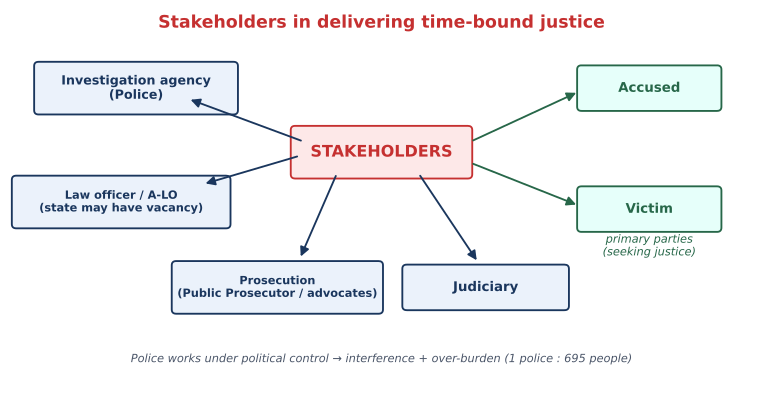
In judicial control over administration, the judiciary and executive agencies ultimately serve two primary parties in any dispute/crime:
- the accused (against whom there are charges), and
- the victim (whose rights were violated).
Both want time-bound justice. Between them sit several intermediaries, which become the stakeholders of the institution that delivers justice:
| Stakeholder | Role | Where delay creeps in |
|---|---|---|
| Investigation agency (Police) | investigation + prevention/law & order | works under political control → interference; over-burdened |
| Prosecution (Public Prosecutor / advocates) | argue the case; PP = govt advocate on govt payroll | vacancies in PP offices → over-burden |
| Judiciary | conducts trial, delivers judgment | vacancies, holidays, complex process |
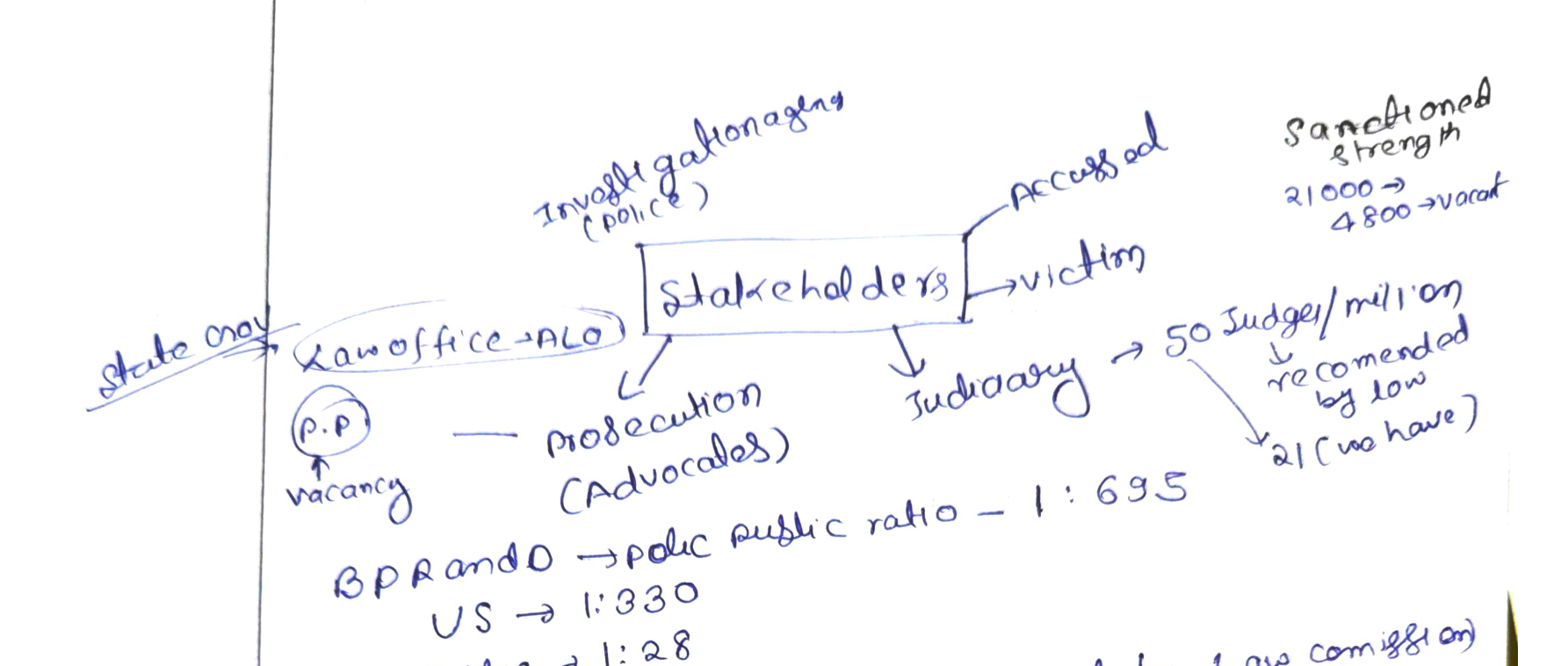
DIAGRAM (board): "Stakeholders" in the centre, with the accused and victim as the two primary parties on one side, and investigation agency (police), prosecution / advocates, law officer (A-LO, state may have vacancy) and judiciary branching off as intermediaries; alongside, the police–public ratio (1:695) and sanctioned-strength data.
Class board notes (scan):
Clean version:
TEACHER'S EXAMPLE (political interference): When matters are against a ruling-party member (state or centre), the speed of investigation slows down. If investigation isn't completed, the judge has no basis to punish anyone, so the trial keeps getting delayed. The teacher cited Umar Khalid's bail petitions (since 2020) — trials still not completed at the lowest level — as an illustration that delay amounts to a denial of justice.
TEACHER'S EXAMPLE (the prosecution hierarchy — who argues for the government, and where): People focus only on the top two law officers, but most cases are run far below them: - Attorney General of India — legal advisor to the President; defends the Central Government at the Supreme Court (assisted by the Solicitor General and Additional Solicitors General, working as a team). - Advocate General of a State — highest legal advisor; defends the State Government before the courts. - Public Prosecutor (PP) — actually fights the state's cases at the district / lower courts. A PP is a government advocate on the government payroll, also called a law officer, and is assisted by an Assistant Public Prosecutor (Assistant Law Officer). PPs are recruited by the State Government, and vacancies in their offices mean the few available PPs are over-burdened. The teacher's fix (see reforms): PPs must work as a team like the Solicitor-General's office, so a missing date in one court doesn't force an adjournment elsewhere.
TEACHER'S EXAMPLE (two types of advocates): The judicial process is slow partly because there are two types of advocates — "one who fights for justice, and one who fights only for the next date." The second type deliberately drags the case because per-hearing charges are earned on each date. This lack of professional behaviour on the part of legal advisors is itself a major cause of unnecessary adjournments and delay (criticism point #9 below).
2. Limitations / Challenges of Judicial Control (causes of delay)
These are the criticisms / causes of delay, organised stakeholder-wise. (Numbered as on the board.)
-
Political interference in the work of the investigation agency causes delay in the justice system.
-
Poor police–public ratio. As per the Bureau of Police Research & Development (BPR&D), under the Ministry of Home Affairs, India's ratio is 1 : 695 (1 police person per ~695 people), versus UK/USA ≈ 1 : 330 and Russia ≈ 1 : 28. This reflects the heavy workload on police, who must do both investigation and prevention/law-and-order — hurting efficiency.
-
Vacancies at the lower judiciary. Sanctioned strength at district & sessions courts ≈ 21,000 judges, of which ~4,800 are vacant (~22–23%). This reduces judicial efficiency and causes delay. (Pendency: >4 crore cases at the subordinate level; ~1 lakh even at the Supreme Court.)
-
Operating below the prescribed judge-strength. India has ~21 judges per million population against the Law Commission's recommended 50 per million — i.e. operating at only ~42% of the prescribed strength. (As per the Law Minister's reply to Parliament, 2025 monsoon session.)
-
Absence of an All India Judicial Service (AIJS). Without AIJS, lower-court judges are recruited by States (like a State PCS), so salary, allowances and service conditions differ state to state → fails to attract talented law graduates to aspire for the judiciary → overall quality of justice suffers.
-
The process of judicial control is complex and time-consuming — many stages: filing → reply → argument → cross-argument → final argument → decision.
-
Too few working days. Judiciary works only ~200 days a year due to 5-day weeks + gazetted holidays + summer vacation + winter break → adversely affects speed of trial / judicial efficiency.
-
Excessive use of PIL has resulted in judicial overreach; PIL has effectively become "Publicity Interest Litigation", diverting court time from regular pending cases → affects judicial efficiency.
-
Lack of professionalism on the part of law officers → unnecessary adjournments of cases → delay in trial.
-
Vacancies in the office of Public Prosecutor → increases workload on the limited number of PPs → more adjournments.
-
Lack of scientific investigation and evidence adversely affects the justice system.
TEACHER'S EXAMPLE (the "British hangover" of summer vacation): Long court vacations are a colonial leftover — European judges could not survive the Indian summer and travelled home to Europe by ship (no UDAN then): ~1–2 weeks each way + family time → hence extended holidays. The teacher's counter: the first qualification to be a judge is to be a citizen of India, who can bear the Indian summer and now travel anywhere the same day via UDAN — so why such long holidays when pendency is in crores? Supreme Court summer vacation ≈ 6 weeks; High/lower courts ≈ 4 weeks; plus a ~2-week winter break.
TEACHER'S EXAMPLE (the holidays editorial): An advocate's editorial defended the holidays ("judges need peace of mind"). Counter: "an intellectual can justify anything" — weekends already give rest; police work 24×7; you can't bifurcate the criminal-justice system so that the criminal and the investigating agency keep working while two agencies (judiciary) go on leave. A vacation bench exists, but typically only 1–2 benches (~7–8 of ~38 judges) sit, so the Constitution Bench does not assemble during vacations. Last year ~20+ Supreme Court judges reportedly went together to a tiger reserve (≈ Ranthambore) and held court there — criticised as an extended holiday.
CLARIFICATION (SC strength raised by Ordinance): The Supreme Court's strength was recently revised from CJI + 33 → CJI + 37 (4 extra judges) via an Ordinance last month. It is temporary until both Houses ratify it in the monsoon session (the ratification clock runs from reassembly of Parliament, not from the date the Ordinance was promulgated).
TEACHER'S EXAMPLE (the "rats ate the evidence" — proves point #11): A string of cases where custody evidence vanished, blamed on rats — used to show how lack of scientific investigation/evidence lets the accused walk free (a person is presumed innocent until proven guilty): - Bihar (dry state): ~30,000 litres of confiscated liquor "consumed by rats". - Maharashtra: tonnes of sugar missing from FCI warehouses — "eaten by rats". - NCT of Delhi: smuggled gold bricks seized by DRI (excise) went missing — "gold-eating rats". - Punjab & Gujarat: seized drugs missing — again "consumed by rats". (Teacher's tip: spread examples across states/parties so the answer doesn't look anti-one-party.)
CLARIFICATION (corruption-in-judiciary remark): A sitting Madras High Court judge openly stated there is corruption within the judiciary (also the Justice Verma corruption episode). In an answer, do not name the judge (contempt risk) — just write "a High Court judge from Madras has stated that corruption exists within the system."
3. Suggestions for Reforms
For every problem there can be a proportional solution; these are the top-priority ones:
-
Introduce the All India Judicial Service (AIJS) to attract talented law graduates to aspire for the judiciary, who would then be promoted to the higher judiciary — transforming judicial efficiency. (Recommended by the Law Commission of India, the 2nd ARC, and the M.M. Punchhi Commission on Centre–State relations; first recommended way back in the 1st Law Commission, 1950s — still pending.)
-
Adopt the proposal for DJRE — District Judges Recruitment Examination — proposed by the Ministry of Law & Justice; also known as the Central Selection Mechanism (to fill the ~4,800 vacancies of the 21,000 sanctioned strength).
-
Increase the number of judges to the Law Commission's 1987 recommendation of 50 judges per million (from the present ~21).
-
Reduce the number of holidays for the judiciary (summer vacation + winter break) — as per Law Commission of India, 2012 — to increase working days and overall judicial efficiency.
-
Fill Public-Prosecutor vacancies in a time-bound manner, and provide Assistant Public Prosecutors so PPs work as a team and prevent unnecessary adjournments (cf. Solicitor General assisted by Additional Solicitors General).
-
Improve the police–public ratio to international standards to reduce workload on police administration (BPR&D data) — at least move toward the ~1:330 level.
-
Capacity-building of police administration — which includes infrastructure + professional training for investigation staff + scientific collection of evidence — for an efficient criminal-justice system.
TEACHER'S EXAMPLE (why vacancies stay unfilled — freebies vs salaries): PP/judicial recruitment is done by State governments, which are busy with freebies. One PP salary ≈ ₹70,000–₹1,00,000/month × 12 months ≈ ₹8–12 lakh/year per person — money that could instead "buy" 35–50 votes via cash transfers. Hence states prefer freebies and don't fill vacancies. He noted competitive freebie "bidding" across parties (the Delhi example: BJP vs AAP promising rising monthly sums) and the rising state debt — Tamil Nadu's debt ≈ ₹9 lakh crore (highest) — despite buoyant GST revenue. (Use as comparative analysis / sarcasm, not as anti-party.)
TEACHER'S EXAMPLE (capacity-building = infra + skills, not just training): "Capacity building" is a broad term — it includes infrastructure + number of recruits + training (if it were only training, you'd say "skills"). Concretely: - Increase police strength so it can split cleanly into two streams: public order / prevention of crime (the staff put on protocol & VIP-movement duty) and crime investigation (generally called CID, or CB-CID in some states). Right now investigators get pulled into VIP/protocol duty, which hurts efficiency. With more strength, dedicated, professionally-trained Investigating Officers (IOs) can do scientific collection of evidence and coordinate with the Public Prosecutor → better trials; routine policing can use an average-skilled workforce. - Expand Forensic Science Laboratories / Central FSLs in every region/state, so evidence need not be shipped north→south and back.
On the police service structure (why he compared IPS to the field force): the IPS / higher officers' work is largely administrative and they are mostly promoted-and-retired at that level; the actual field policing is done by the constabulary (constable / head constable). CAPF personnel are the professionally-trained force, deputed for specific purposes (e.g. election duty). And the All India Service design keeps police from becoming "regional": ~1/3 of posts go to home-cadre officers and ~2/3 to outsiders — because an officer is a citizen of India first, this guards sovereignty & integrity and prevents regional/linguistic loyalties from killing an investigation (e.g. a Kerala victim wronged in Tamil Nadu must still be investigated on a standard, non-regional pattern). (He flagged this as relevant to "All India Service" generally, then returned to the judiciary.)
TEACHER'S EXAMPLE (legal aid / ADR as a reform): Free legal aid exists under NALSA — National Legal Services Authority → State Legal Service Authorities → District Legal Service Authorities; headed by the CJI (national) and the state Chief Justice, with district judges and advocates working at the ground level. It is available mainly at the lower courts (and works only for the marginalised — annual income < ₹1 lakh). The idea: resolve matters by mediation / consultation so they don't reach a full trial; promote Lok Adalats (where all pending cases can be settled) and alternative redressal tribunals. The catch: people have less trust in Lok Adalats and want a proper trial, so unresolved matters bounce back to court. (Note: if legal aid were given at every level, people would keep filing unnecessary appeals up to the Supreme Court — hence it is kept to the lower levels.)
TEACHER'S EXAMPLE (a debated reform — 3-year practice before judgeship): A new rule makes 3 years of practice mandatory before appearing for the lower judiciary. The teacher's case for it: today many judges enter straight through the exam without practice/experience and end up applying provisions that the courts have already struck down or prohibited (e.g. in domestic-violence and maintenance/family disputes) — lack of awareness of how a trial actually works hurts justice. Some experience first → they learn the procedure → then sit the exam. Seats can be filled in a phased way (say 10–30% in year 1, more the next year). The case against it: a citizen has a Fundamental Right under Art 19(1)(g) to choose any profession/occupation/trade/commerce; against that, the authority has the right to set parameters to improve system efficiency — so it's a two-way balance. It may also reduce women's participation (marriage-age pressure during those 3 years). The court's worry is that "judges are coming only from coaching" — but the counter is that even 3 years can be spent in coaching (just as civil-services aspirants are accused of "only reading Lakshmikant for prelims").
CLARIFICATION (why the executive can't just fill the vacancies itself — Art 50): Sanctioned strength is an administrative figure; the government can only fill it. Parliament (by law) decides such matters only after consultation with the judiciary (e.g. on a committee's recommendation) — otherwise the executive stepping into judicial administration would violate Art 50 (separation of judiciary from the executive) and count as interference. (Related: the CJI has set up a committee on judicial infrastructure at lower courts, reportedly seeking ~₹50,000 crore — but its report isn't public yet, so don't quote it as a firm reform.)
4. Jurisdiction of the Supreme Court — Overview
EXAM FOCUS: This part is largely Prelims-oriented — remember the keywords + article numbers.
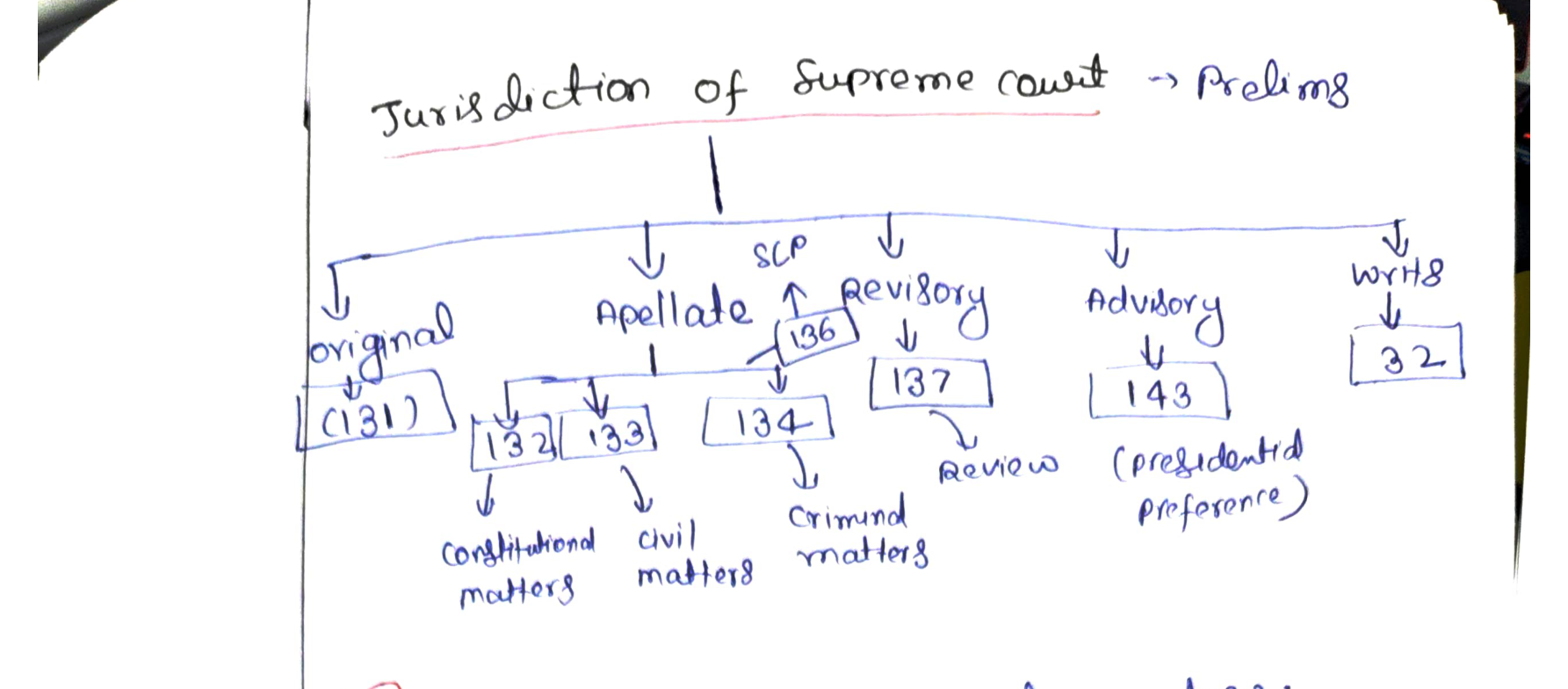
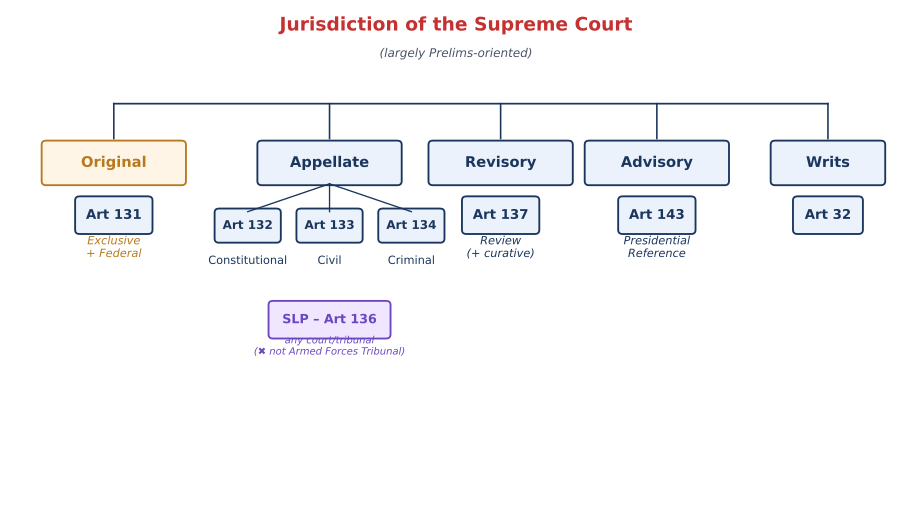
The Supreme Court's jurisdiction is divided into five heads:
| Jurisdiction | Article | Key idea |
|---|---|---|
| Original | 131 | Federal disputes; exclusive |
| Appellate | 132 / 133 / 134 (+ 136 SLP) | appeals: Constitutional / Civil / Criminal |
| Revisory | 137 | Review petition (+ curative) |
| Advisory | 143 | Presidential Reference |
| Writs | 32 | enforcement of Fundamental Rights |
DIAGRAM (board): A tree — "Jurisdiction of Supreme Court → Prelims" branching into Original (131), Appellate (132/133/134 + 136 SLP), Revisory (137 — Review), Advisory (143 — Presidential Reference), Writs (32).
Class board notes (scan):
Clean version:
5. Original Jurisdiction (Art 131)
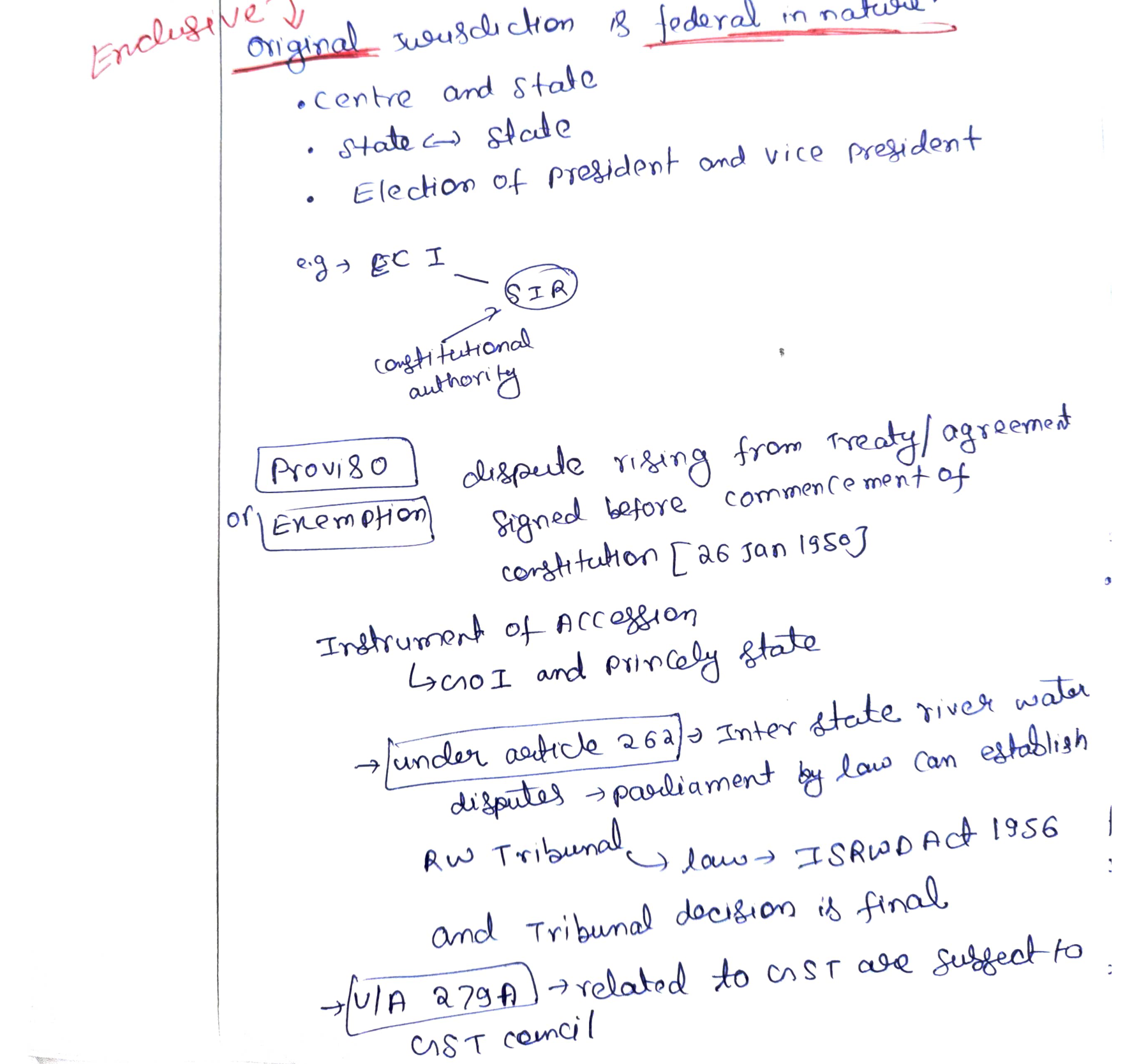
Keyword: Original jurisdiction is Federal in nature (and exclusive — only the SC can deal with it).
Federal disputes =
- between Centre and State(s),
- among two or more States, or
- disputes regarding the election of President & Vice-President (MPs + MLAs vote → represents people + states).
TEACHER'S EXAMPLE (SIR / ECI): Several states approached the SC challenging the Election Commission's authority to conduct SIR (Special Intensive Revision) of electoral rolls. Last week the SC upheld SIR as constitutionally valid and held ECI has the authority to update rolls (special or periodic — not done for ~two decades). Such Centre/State-vs-constitutional-authority litigation falls under original jurisdiction.
Provisos / Exemptions to Original Jurisdiction
Even though these are "federal" in flavour, the Constitution carves them out:
| Exemption | Why excluded |
|---|---|
| Dispute from a treaty/agreement signed before commencement of the Constitution (26 Jan 1950) | e.g. Instrument of Accession (GoI ↔ princely states, incl. J&K). States have no right to secede (indestructible Union of destructible states) — not entertained. |
| Inter-State River Water disputes (Art 262) | Parliament by law may set up a River Water Tribunal → Inter-State River Water Disputes Act, 1956; tribunal's decision is final. |
| GST disputes (Art 279A) | Federal GST disputes go first to the GST Council; its decision is to be followed. |
CLARIFICATION: A tribunal decision being "final" only bars direct original jurisdiction — an appeal/SLP (Art 136) can still go to the SC. (See the River Water Tribunal example in Section 6.)
DIAGRAM (board): "Original = Exclusive + Federal in nature" with the three federal-dispute types, then a "Proviso / Exemption" box listing pre-Constitution treaties (Instrument of Accession), Art 262 (ISRWD Act 1956), and Art 279A (GST Council).
Class board notes (scan):
6. Appellate Jurisdiction (Arts 132–134, 136 SLP)
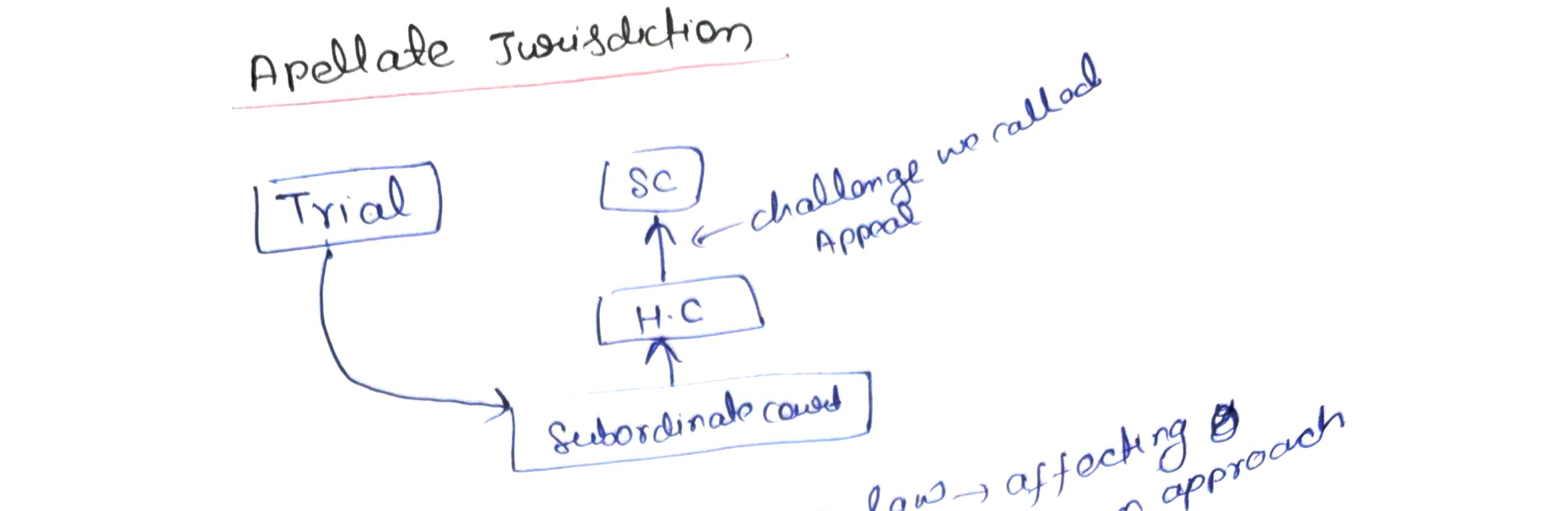
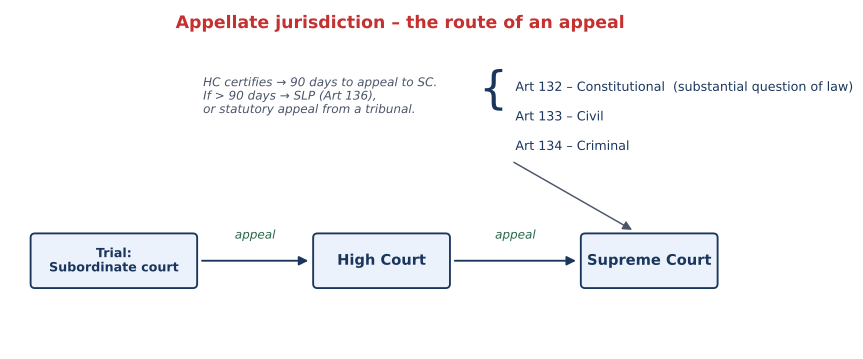
A trial generally starts at the subordinate court → appeal to High Court → appeal to Supreme Court. This challenge upward is an appeal.
DIAGRAM (board): Trial → Subordinate Court → High Court → Supreme Court, with "challenge = appeal" on each upward arrow.
Class board notes (scan):
Clean version:
Appeals split into three matter types + SLP:
| Article | Matter | Notes |
|---|---|---|
| 132 | Constitutional | needs substantial question of law (e.g. amendment affecting Fundamental Rights). Trial can start at HC (Art 226) or directly via Art 32. |
| 133 | Civil | SC acts as a Court of Record in civil matters; HC certification mandatory that a substantial question of law is involved. |
| 134 | Criminal | e.g. lower court acquits, HC awards death sentence → SC appeal (question of life → goes to SC with/without certificate). |
| 136 | SLP (Special Leave Petition) | SC may grant special leave to appeal against any court or tribunal; discretionary; not applicable to the Armed Forces Tribunal. |
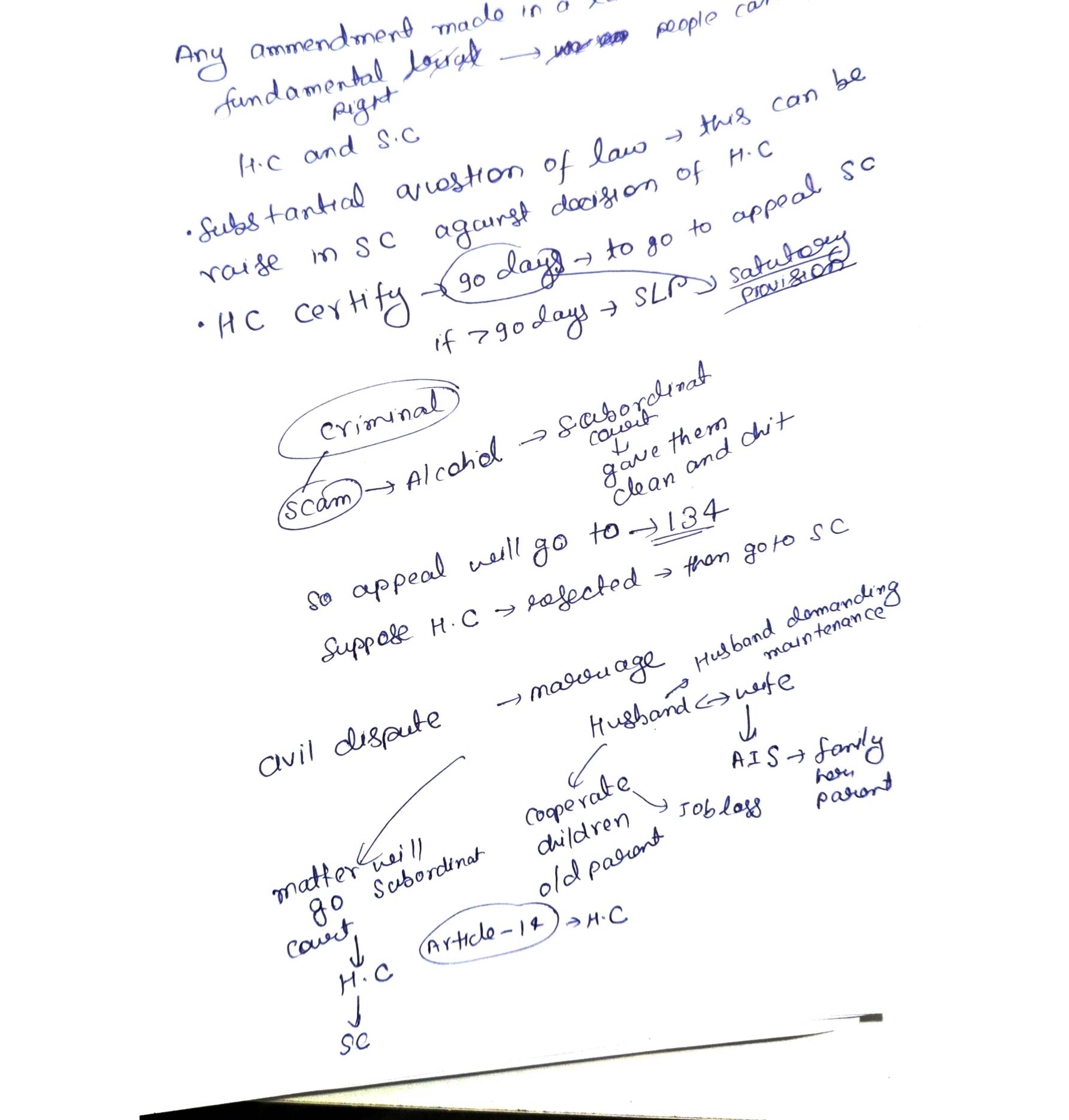
Certification: the HC certifies a window (commonly up to 90 days, can be 45/60 — fixed in the order) to appeal to the SC. Within the window → it's your right (Arts 132/133/134). After the window expires → only SLP (Art 136), which the court may entertain on genuine grounds (principle of natural justice — not in the bare Act).
TEACHER'S EXAMPLE (criminal — the Delhi excise "scam"): A special court (= subordinate-court level) gave a clean chit to the former CM/Dy CM; ED/CBI's appeal goes to HC, then to SC under Art 134 (criminal, bribery — not a civil maintenance matter).
CLARIFICATION (appeals within the High Court, and "institutional memory"): - An appeal can also go to a larger bench inside the same High Court: a matter decided by a single-judge bench can be taken to a higher bench of the HC — this is still called an appeal, not a review. The highest HC bench is usually three judges (the Chief Justice + 2 senior-most judges). Only after that does the matter go to the Supreme Court. - When a case moves up (or a judge is transferred/retires), the trial is not restarted — it continues from the court records / "institutional memory." This is why every hearing is recorded: otherwise a case would never end as judges keep changing. (This continuation is a statutory provision — now the BNSS, earlier the CrPC — not a constitutional one.)
TEACHER'S EXAMPLE (civil — reverse maintenance): A husband (lost job to an AI lay-off; children + old parents dependent) seeks maintenance from a working wife (All India Service). Subordinate court rejects → HC (raising Art 14 equality) → if HC certifies a substantial question of law, appeal goes to SC under Art 133. (SC acts as Court of Record in civil matters — its decision becomes a reference for HCs/subordinate courts.)
DIAGRAM (board): The two worked examples — Criminal (the "scam" → subordinate court clean chit → appeal under 134) and Civil dispute (marriage → husband demanding maintenance, Art 14 → HC → SC) — with the "HC certify → 90 days → else SLP → statutory provision" note.
Class board notes (scan):
How appeals from tribunals reach the Supreme Court (teacher's explanation)
A tribunal decides cases too, and it sits roughly at the level of a subordinate court. So when you are unhappy with a tribunal's decision, you go up by way of appeal — and the teacher's point was that which court you go to, and under which article, depends on the particular tribunal. He walked through four:
1. CAT — the Central Administrative Tribunal. This deals with civil-services matters (service disputes of government employees). Because it works at the subordinate-court level, its decision is first appealed to the High Court, and only then can the High Court's decision be appealed onward to the Supreme Court under Article 133. Note two things: this is a civil appeal, and it reaches the SC as an appeal against a High Court decision (it is not an SLP).
2. NGT — the National Green Tribunal. Here the route is different. The decision of the NGT is challenged directly in the Supreme Court — it does not go through the High Court first. This too is treated as a civil appeal.
3. AFT — the Armed Forces Tribunal. Its decision can also be challenged in the Supreme Court (again as a civil or criminal appeal). But there is one important exception to remember: you cannot file an SLP (Article 136) against an AFT decision. Against every other court or tribunal you may move an SLP — the Armed Forces Tribunal is the lone exception. So an AFT matter still reaches the SC, just never through Article 136.
So the unifying idea: all of these are appeals (civil or criminal), and SLP under Article 136 is the discretionary "catch-all" the Supreme Court may grant against any court or tribunal — except the AFT.
TEACHER'S EXAMPLE (River Water Tribunal — why a "final" award can still come back to the SC): A River Water Tribunal's decision is, by law, final — and these tribunals are ad-hoc / temporary: once they deliver the award, they are dissolved and cease to exist. Now picture the Cauvery dispute (involving Karnataka, Kerala, Tamil Nadu and Puducherry). The tribunal gives its award, but a year or two later Karnataka stops releasing the promised water and refuses to honour it. Since the tribunal that decided the matter is gone, the aggrieved state has two ways forward: it can ask the Centre to constitute a fresh tribunal, or it can approach the Supreme Court through an SLP (Article 136). This is exactly why a "final" award is not the dead end it sounds like — the SLP is the one door still open. (And consistent with the AFT exception above, the SLP route works here because a River Water Tribunal is not the Armed Forces Tribunal.)
CLARIFICATION (what a "statutory appeal" means): Many of these tribunal appeals are called statutory appeals — meaning the statute (law) that created the tribunal itself says its decision can be challenged before the High Court or the Supreme Court within a fixed number of days. That fixed-by-law route is the "statutory appeal." Since tribunals usually handle civil / taxation matters, these are generally civil appeals.
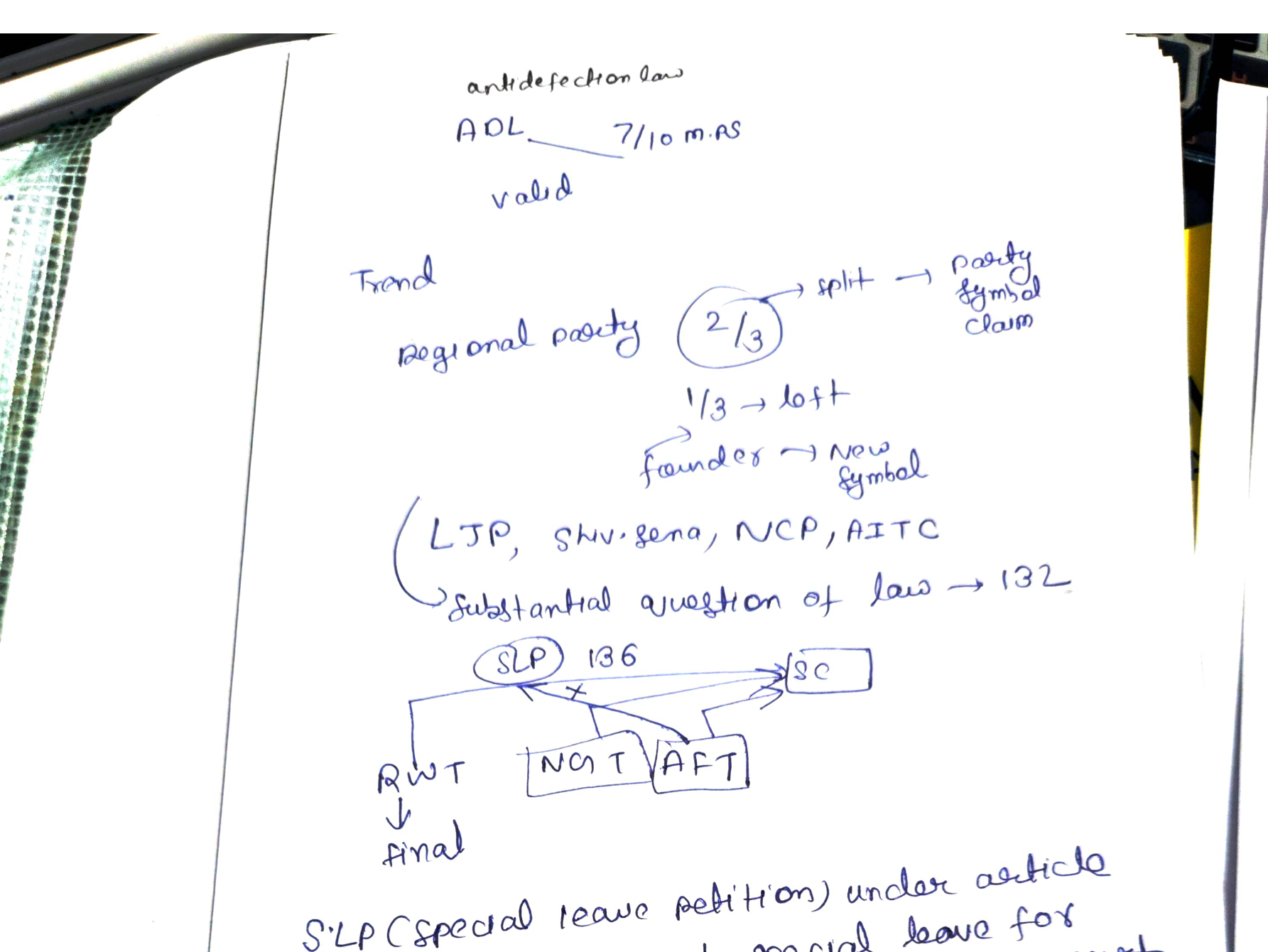
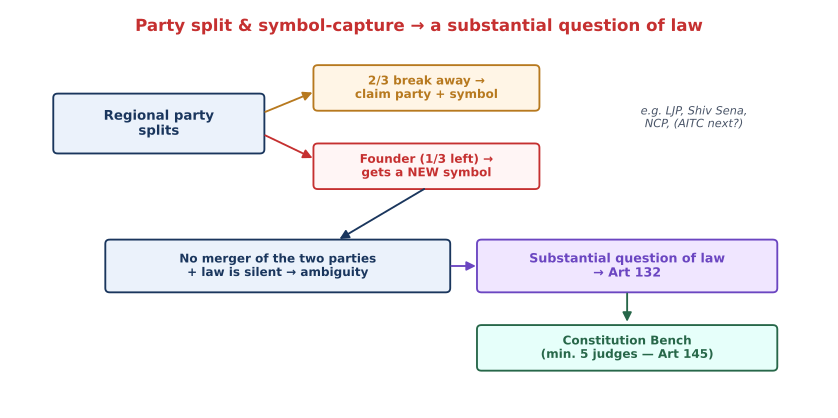
TEACHER'S EXAMPLE (constitutional matter — anti-defection): Recently 7 of 10 MPs of a party "merged" with another, but there was no merger of the two national parties themselves, and the law is silent on this → a substantial question of law that can be raised under Art 132 and referred to a Constitution Bench (min. 5 judges, Art 145). He linked this to the "party-symbol capture" trend: 2/3 of a regional party splits, claims the original symbol, founder gets a new symbol — seen with LJP (Chirag Paswan), Shiv Sena, NCP, and possibly AITC/Congress next.
DIAGRAM (board): Anti-defection ("AOL — 7/10 m.PS — valid"), the regional-party 2/3-split → symbol-claim trend (LJP, Shiv Sena, NCP, AITC), → "substantial question of law → 132"; and an SLP (136) box pointing to SC from "any court/tribunal" with ✖ over AFT and the RWT → final note.
Class board notes (scan):
Clean version:
7. Revisory Jurisdiction (Art 137 — Review & Curative)
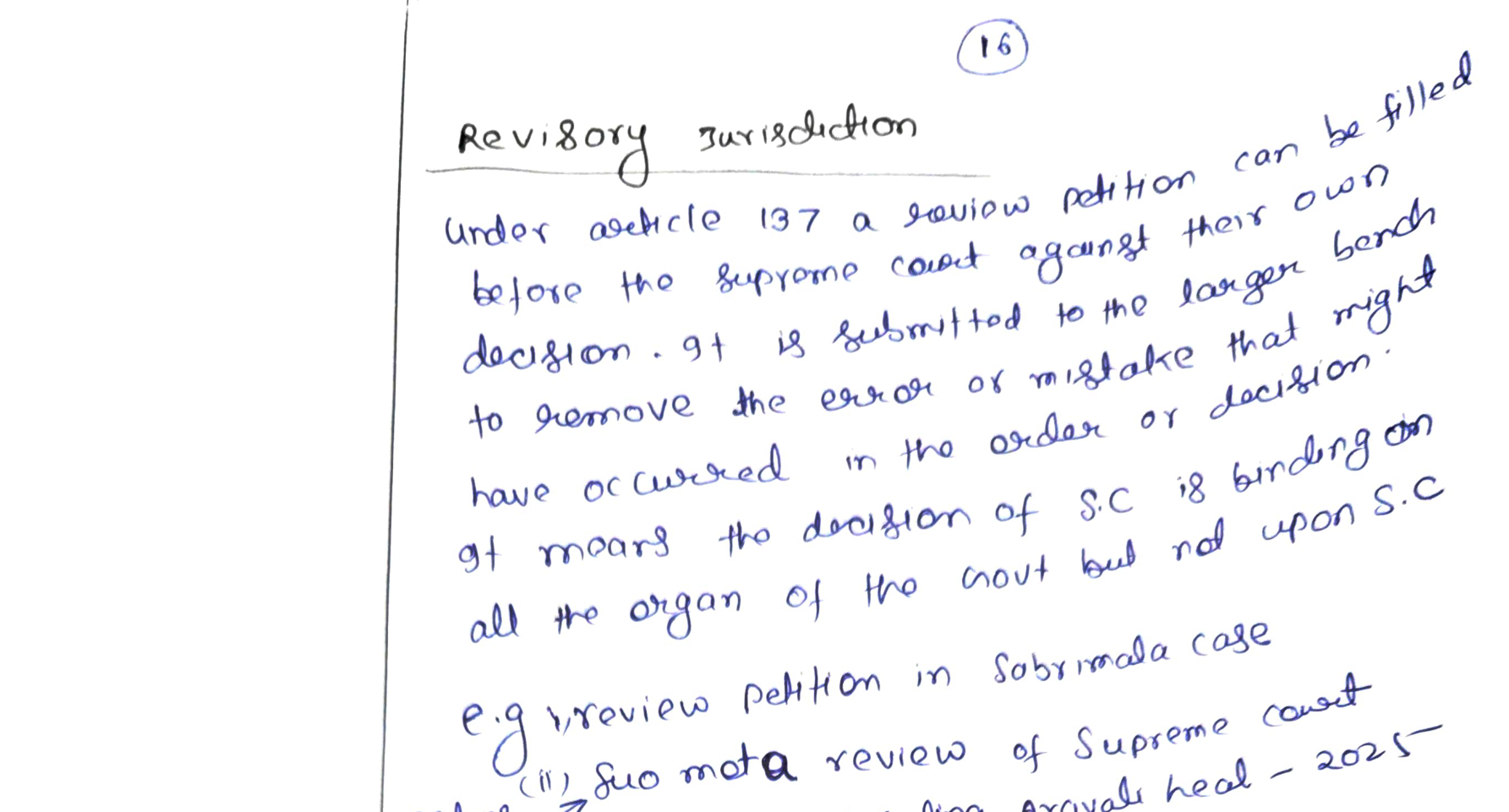
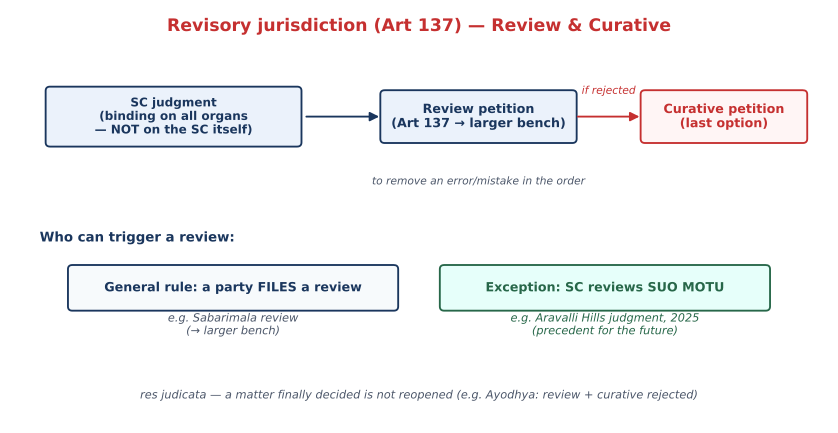
Under Art 137, a review petition can be filed before the Supreme Court against its own decision; it is submitted to a larger bench to remove an error or mistake in the order/decision.
- The SC's decision is binding on all organs of government — but not on the SC itself.
- If a review petition is rejected, the last option is a curative petition (filed in sequence after review).
TEACHER'S EXAMPLE(S): - Sabarimala review — referred to a larger bench (the original verdict was by a 5-judge Constitution Bench). - Suo motu review of the SC's own Aravalli Hills judgment (Dec 2025) after public/environmentalist criticism — shows review can be initiated by the court on its own, not only on a filed petition (a precedent for the future). - Ayodhya curative: the losing party used review → curative (both rejected). In 2025 a senior advocate tried a fresh review citing "new evidence" — that ex-CJI D.Y. Chandrachud said in a podcast he "prayed to God for strength" to decide the case. The SC rejected it and imposed a ₹7-lakh penalty (res judicata — a matter finally decided is not reopened; land vested in the deity via the Shri Ram Janmabhoomi Teerth Kshetra statute cannot be taken back). (The 2019 verdict was unanimous 5:0, incl. a judge from the minority community — hence near-impossible to disturb. Had it been a split 4:1, the one dissent would itself have been a ground for appeal.)
TEACHER'S EXAMPLE (stray dogs, Delhi-NCR — suo motu, but NOT a review): A worked example of the court acting on its own. The SC took up the stray-dog issue suo motu and ordered the dogs to be restricted to designated areas + given proper rehabilitation. Then social activists / animal-lovers appealed to reconsider — arguing the MCD lacks the capacity to house so many dogs. Society split into "dog lovers vs dog haters" (the teacher noted even neutrality wasn't allowed — you can be fine with a dog existing without being forced to show it affection). Points raised before the court: - In a gated society, a resident takes a pet dog into the lift — but the lift is meant for all residents; another person may be uncomfortable sharing it, and the dog may bite (a threat to others' safety). - The Solicitor General's analogy: "What if I bring a cow or a buffalo into the gated society? Will you allow it? If not, by what mechanism do you allow dogs?" — at least a cow/buffalo is productive (milk, healthy products). Disallowing cattle while allowing dogs creates a discrimination — as if loving a dog is "secular" but loving a cow is an "agenda" — a pseudo, artificial division of society, which is not good. - A gated society is for residents; common space should be for exercise. If you keep such animals, you bear the responsibility that they don't attack children playing there. - Punjab's Chief Minister claimed "the court gave permission to kill the dogs" — a misstatement of the official order (the teacher's aside: the CM may have been "under the influence of external substances," and when the opposition demanded a test he refused). (Key point: this was a suo-motu matter followed by an appeal — not a review petition in the strict sense; it's used here to show the court acting on its own motion.)
DIAGRAM (board): "Revisory — Art 137: review petition vs own decision → larger bench → remove error; SC decision binding on all organs but not on SC. e.g. (i) Sabarimala review (ii) suo motu review — Aravalli 2025."
Class board notes (scan):
Clean version:
8. Advisory Jurisdiction (Art 143)
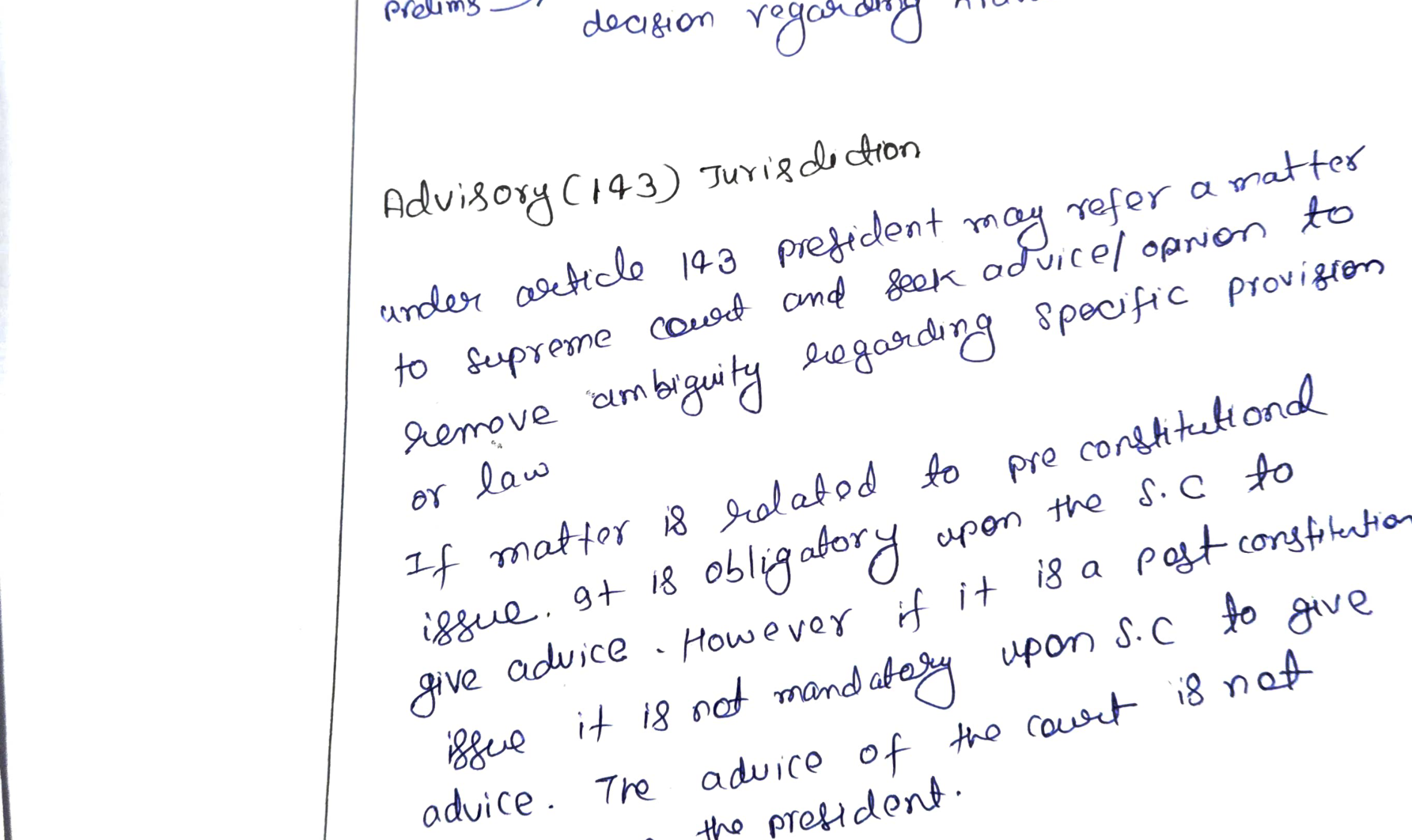
Under Art 143, the President may refer a matter to the Supreme Court and seek its advice / opinion to remove ambiguity about a specific provision or law.
| Type of matter | Is SC bound to advise? | Is the advice binding? |
|---|---|---|
| Pre-constitutional (treaty/agreement before 26 Jan 1950) | Obligatory — SC must give advice | Not binding |
| Post-constitutional | Not mandatory — SC may refuse | Not binding |
- The advice is never binding on the President; in a post-constitutional matter the SC can even decline to answer.
- Reference under Art 143 is advice, not adjudication — it does not "resolve a dispute".
EXAM FOCUS: This directly shows up in the Presidential Reference, 2025 — of the 14 questions, the SC fully answered 11, partly answered 1 ("11.5"), and returned 2 unanswered as irrelevant to the reference — a live illustration that in a post-constitutional matter the SC is not obliged to answer.
DIAGRAM (board): "Advisory (143): President may refer → seek advice/opinion → remove ambiguity. Pre-constitutional → obligatory to advise; post-constitutional → not mandatory. Advice of court not binding on President."
Class board notes (scan):
9. Presidential Reference 2025 — Background & the 14 Questions
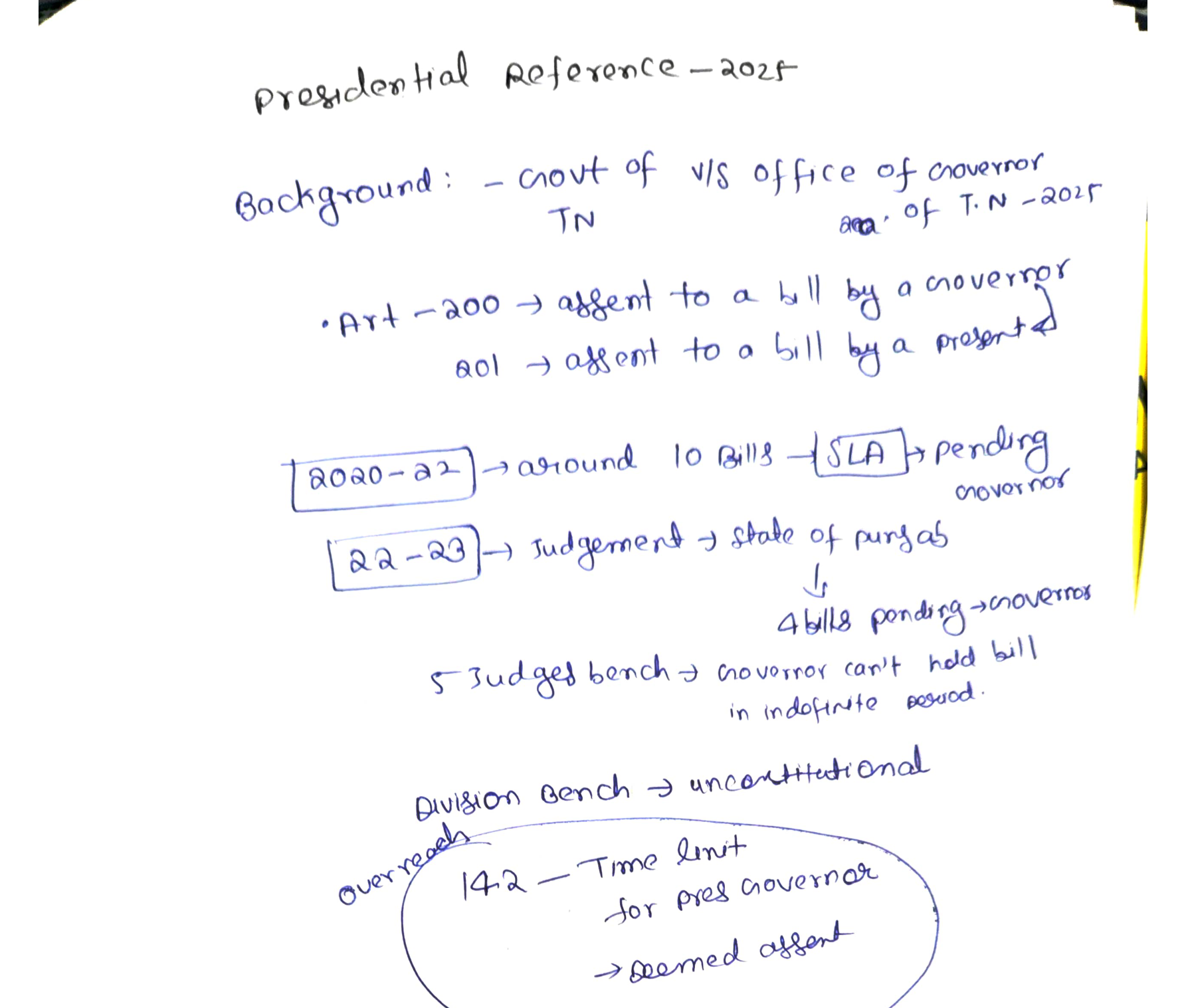
NCERT/CONSTITUTION BASE: Art 200 — assent to a State Bill by the Governor. Art 201 — assent by the President when a Bill is reserved by the Governor. (For a Parliamentary law it would be Art 111.)
Background
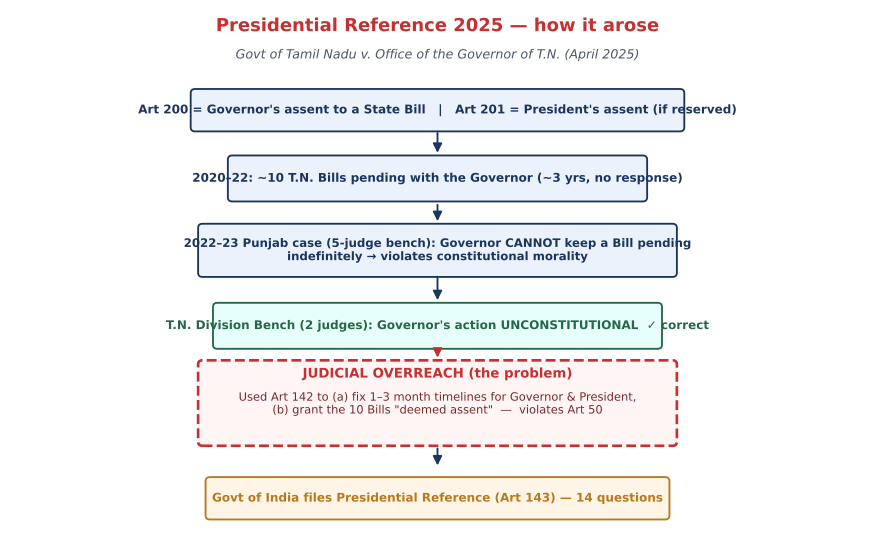
- Case: Govt of Tamil Nadu v. Office of the Governor of T.N. (April 2025), following the earlier Punjab case (Govt of Punjab v. Office of the Principal Secretary to the Governor).
- 2020–22: ~10 Bills passed by the T.N. Legislative Assembly were pending with the Governor (no response for ~3 years).
- 2022–23 (Punjab): a 5-judge bench held the Governor cannot keep a Bill pending indefinitely (no fixed time limit stated, but indefinite inaction violates constitutional morality); if he "withholds", he must return it for reconsideration.
- T.N. sequence: after the SC was approached, the Governor declared "withhold", did not return the Bills; the Assembly re-passed all 10 within ~3 months and sent them back; the Governor then reserved them for the President.
- A 2-judge Division Bench declared the Governor's action unconstitutional — this part is correct. The problem: the bench then used Art 142 to (a) prescribe time limits (1–3 months) for the Governor and President, and (b) grant the 10 Bills "deemed assent" — which is judicial overreach (violates Art 50, separation of judiciary from executive; only the Governor can assent). A substantial question of law should have gone to a Constitution Bench (≥5 judges), not 2 judges.
- The Government of India then filed a Presidential Reference under Art 143 (instead of a review petition) with 14 questions.
DIAGRAM (board): Background flow — "Govt of TN v. Office of Governor TN (2025); Art 200 = Governor assent, Art 201 = President assent; 2020-22 → 10 Bills pending; 2022-23 Punjab judgment (5-judge) → Governor can't hold a Bill indefinitely; Division Bench → unconstitutional; overreach box: Art 142 → time limits for Pres/Governor → deemed assent."
Class board notes (scan):
Clean version:
Article 200 — the Governor's options (the core)
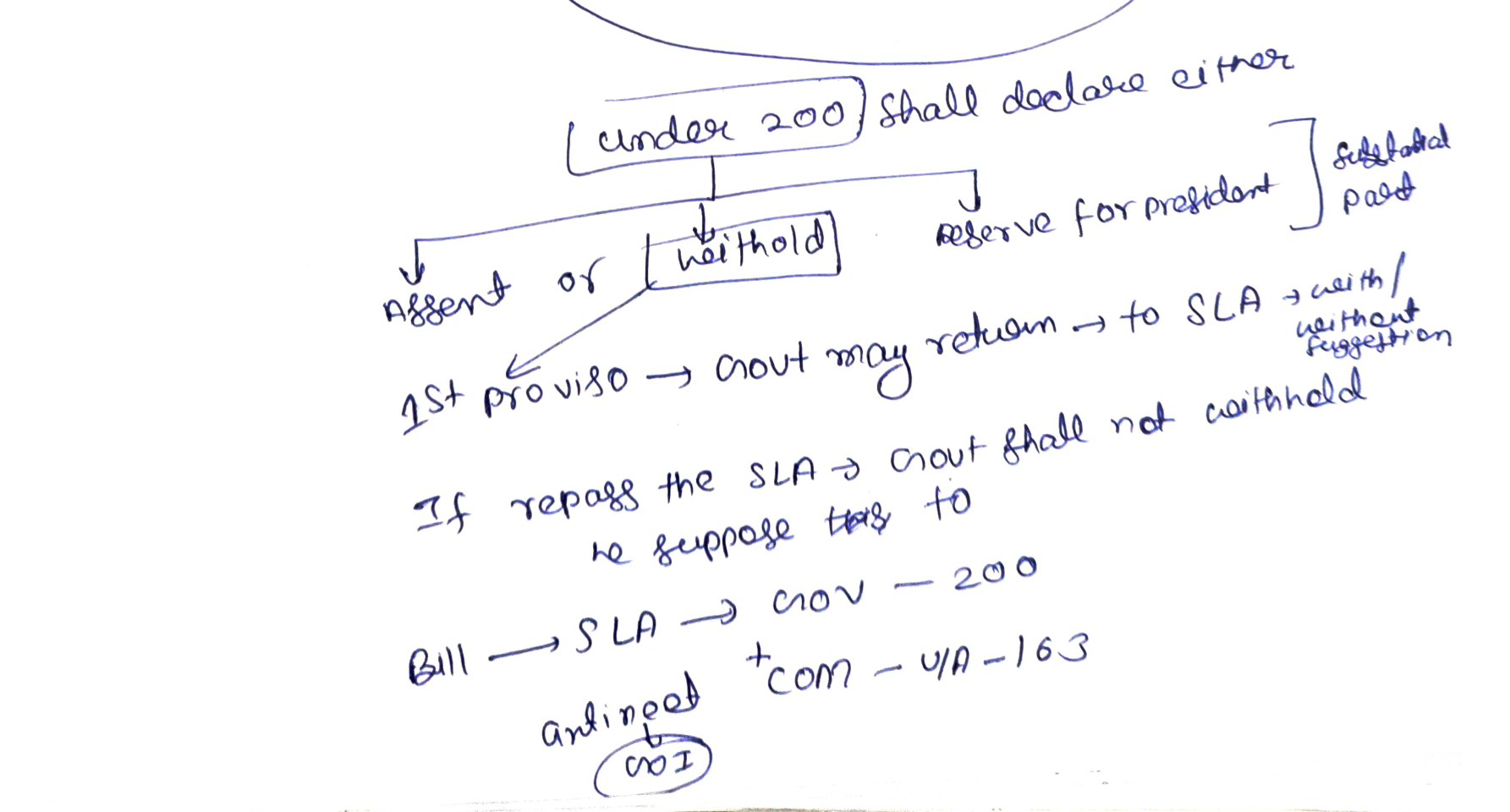
The substantive part of Art 200: on a Bill, the Governor "shall declare" either assent, withhold assent, or reserve for the President. The first proviso lets him return the Bill (with/without suggestions) — this is tied to "withhold", not a 4th option — and is not available for a Money Bill. If the House re-passes, the Governor "shall not withhold" assent.
DIAGRAM (board): "Under 200 — shall declare either Assent / Withhold / Reserve for President (= substantive part); 1st proviso → Govt may return to SLA (with/without suggestion); if re-passed → Governor shall not withhold. Bill → SLA → Gov (200) + advice of CoM (Art 163)."
Class board notes (scan):
Clean version:
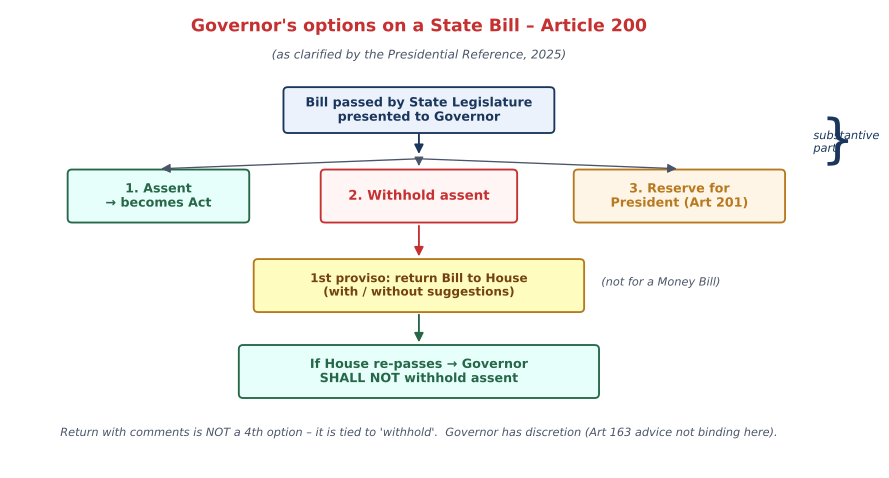
TEACHER'S EXAMPLE (Governor's discretion — the NEET Bill): Under Art 163 the Council of Ministers aids & advises the Governor, except where he must act in his discretion. T.N.'s anti-NEET Bill (seeking exemption from NEET; education is in the Concurrent List) was reserved by the Governor and rejected by the President on the Union CoM's advice — showing the Governor's Art-200 choice is not bound by the State CoM's advice.
The 14 questions — answers (from the Vajiram & Ravi handout)
| Q | Issue | SC's answer (gist) |
|---|---|---|
| 1 | Governor's options under Art 200 | Three — assent / reserve for President / withhold-and-return (proviso). Return is not a 4th option; withhold-and-return not for Money Bills. |
| 2 | Bound by aid & advice of CoM? | No — Governor has discretion under Art 200 (not bound by Art 163 advice here). |
| 3 | Is the Governor's Art-200 discretion justiciable? | Not justiciable on merits. But on prolonged, unexplained, indefinite inaction, the court may issue a limited mandamus to act within reasonable time (no merits review). |
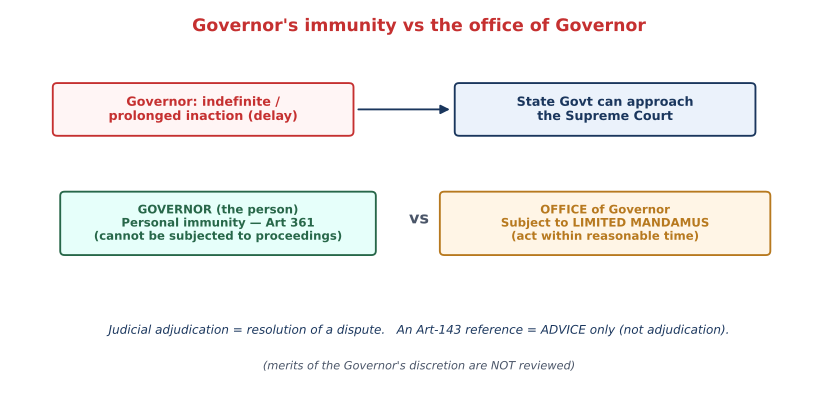
| 4 | Is Art 361 an absolute bar to judicial review of Governor's Art-200 acts? | Art 361 bars personally subjecting the Governor to proceedings (personal immunity), but the office of Governor is subject to the court's limited review for prolonged inaction. |
| 5 | Can courts impose timelines on the Governor (Art 200)? | No — not appropriate for the SC to judicially prescribe timelines. |
| 6 | Is the President's Art-201 discretion justiciable? | Not justiciable. |
| 7 | Can courts impose timelines on the President (Art 201)? | No — President not bound by judicially prescribed timelines. |
| 8 | Must the President seek SC advice (Art 143) whenever a Governor reserves a Bill? | No — President's subjective satisfaction suffices; may refer under Art 143 only if needed. |
| 9 | Are Governor/President decisions justiciable before the Bill becomes law? | No — courts can't adjudicate a Bill's contents before it is law. (An Art-143 reference is not "judicial adjudication".) |
| 10 | Can Art 142 substitute the President's/Governor's orders? | No — Art 142 does not allow "deemed assent" of Bills. |
| 11 | Is a State law in force without the Governor's assent (Art 200)? | No — the Governor's legislative role cannot be supplanted by another authority. |
| 12 | Must such questions first go to a 5-judge bench (Art 145(3))? | Returned unanswered — irrelevant to this reference. |
| 13 | Scope of Art 142 (procedural vs substantive)? | Partly answered — "overly broad"; the Governor/President aspect already covered in Q10. |
| 14 | Any SC jurisdiction over Union–State disputes outside Art 131? | Returned unanswered — irrelevant; federal disputes are expected under Art 131. |
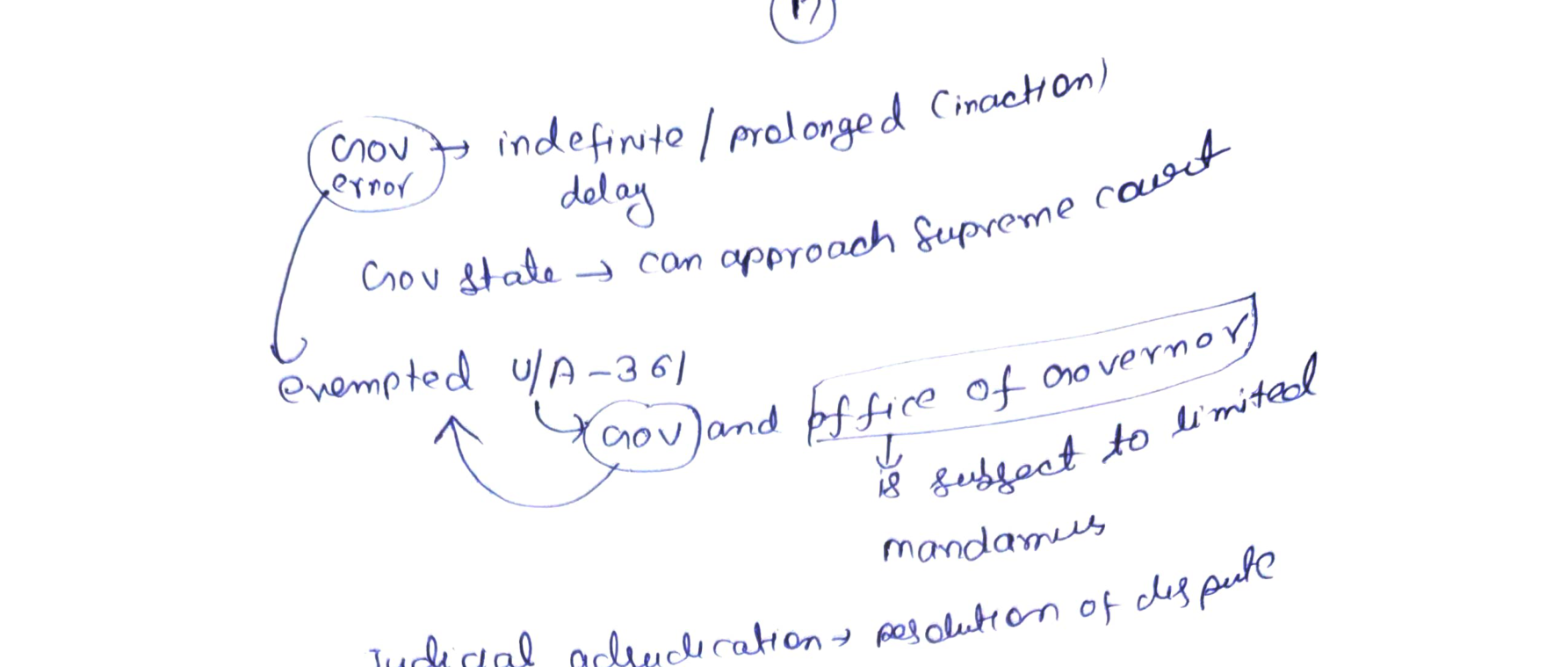
CLARIFICATION (Governor vs office of Governor): The court split immunity in two — the Governor enjoys personal immunity (Art 361), but the office of Governor is subject to limited mandamus in cases of prolonged inaction. "Judicial adjudication" = resolution of a dispute; an Art-143 advice is not adjudication, so it must be adopted by the President to take effect.
DIAGRAM (board): "Gov → indefinite/prolonged (inaction) delay → Gov of State can approach SC; exempted U/A 361 (Gov) and office of Governor → subject to limited mandamus. Judicial adjudication = resolution of dispute; 143 → advice."
Class board notes (scan):
Clean version:
EXAM FOCUS (impact of the reference — from the handout): - Application of Constitutional Morality with Separation of Powers. - No time limit for President & Governor for assent to a Bill. - On unreasonable delay, the court may apply a limited mandamus. - The 10 T.N. Bills already notified remain applicable for now, but the "deemed assent" given to them can be challenged on the basis of this reference. - The court cannot use Art 142 to grant assent to a Bill.
REFERENCE (notable past Presidential References — handout list): Delhi Laws Act (1912); Kerala Education Bill (1957) — Arts 29/30; Berubari Union (I) — Art 3 / India-Pakistan territory cession; Sea Customs Act — Art 289; Keshav Singh (UP Legislature vs Allahabad HC, contempt); Presidential Poll — Arts 56/62/70/71; Special Courts Bill (1978); Cauvery Water Disputes Tribunal; Special Reference 1993 (Ram Janmabhoomi-Babri — returned unanswered); Special Reference 1998 — judges' appointment / CJI recommendation; J&K Resettlement Bill (1980) — returned unanswered (efflux of time); Special Reference 2001 — natural gas/LPG vs Union List; Special Reference 2002 (Gujarat Assembly election — Arts 174/324); Natural Resources Allocation, 2012 (2G); Punjab Termination of Agreement Act, 2004.
10. Quick Revision Tables
Article-number cheat sheet (Prelims)
| Article | Topic |
|---|---|
| 131 | Original (federal) jurisdiction — exclusive |
| 132 / 133 / 134 | Appeals: Constitutional / Civil / Criminal |
| 136 | Special Leave Petition (SLP) — discretionary; ✖ AFT |
| 137 | Review (revisory) jurisdiction |
| 143 | Advisory jurisdiction (Presidential Reference) |
| 32 | Writ jurisdiction (Fundamental Rights) |
| 142 | SC's power to do "complete justice" — no deemed assent of Bills |
| 145(3) | Substantial question of law → bench of ≥5 judges |
| 163 | CoM to aid & advise the Governor (except discretion) |
| 200 / 201 | Assent to a State Bill — Governor / President |
| 262 | Inter-State River Water disputes → tribunal (ISRWD Act 1956) |
| 279A | GST Council |
| 361 | Personal immunity of President / Governor |
Key data points (for answer-writing)
| Metric | Value | Source |
|---|---|---|
| Police : public ratio (India) | 1 : 695 | BPR&D (MHA) |
| — UK/USA / Russia | 1 : 330 / 1 : 28 | BPR&D |
| Judges per million (India) | ~21 (vs 50 recommended) | Law Comm. 1987; Law Min. reply 2025 |
| Sanctioned lower-court judges | ~21,000; ~4,800 vacant | — |
| Pendency (subordinate courts) | >4 crore cases | — |
| Judicial working days/year | ~200 | — |
| SC strength (revised) | CJI + 37 (was +33) | Ordinance, 2025 |
| T.N. highest state debt | ~₹9 lakh crore | — |
Current Affairs
(Updated as relevant news/magazine content comes in)
| Date | Source | Headline | Connection to this topic |
|---|---|---|---|
| 2025 | — | Presidential Reference 2025 (Art 143) on Governor's powers (Arts 200/201) | Core of §8–9 — advisory jurisdiction in action; deemed-assent / Art-142 overreach |
| 2025 | — | SC upholds SIR (Special Intensive Revision) of electoral rolls as constitutional | §5 — original jurisdiction (states vs ECI, a constitutional authority) |
| Dec 2025 | — | Suo motu review of the Aravalli Hills judgment | §7 — revisory jurisdiction; suo-motu review precedent |