Elections — Part XV (Articles 324–329): ECI, Suffrage, RPA & the Electoral Process
GS Paper: GS Paper II | Subject: Polity | Last updated: 2026-07-20
Class 6 (Samarjit Mishra, 23-06-2026) — the opening of the Elections unit. The teacher's plan: elections is a huge, current-affairs-driven topic that no single textbook covers, so he will hand out printed material every class and build the topic over the next several classes. This class lays the whole framework: why Part XV is built the way it is (the 3 opening questions), and then the 5 general principles (Articles 325–329) plus the electoral process. Article 324 — the Election Commission of India in detail is where the next class begins.
Per the user's instruction, this single note also folds in all of today's printed handout — including the parts the teacher deferred to coming classes (ECI composition, the 1991 & 2023 appointment Acts, the symbols order, party recognition, election-petition grounds, the Section 8 disqualification list). Those handout sections are clearly marked
(HANDOUT — to be elaborated in a later class)and will be enriched with the teacher's spoken explanation when those classes are taught.
Table of Contents
- Why elections matter, and how to study the topic
- The three opening questions — why Part XV looks the way it does
- Part XV at a glance — one body + five principles
- Article 325 — Universal Suffrage (the general electoral roll)
- Article 326 — Adult Suffrage (who is a voter) + nature of the right to vote
- Article 327 — Power of Parliament; RPA 1950/1951; delimitation; the officials
- Article 328 — Power of State legislature (the dormant article)
- Article 329 — Bar on courts during the electoral process
- Article 324 — the Election Commission of India (HANDOUT, next class)
- Quick-revision tables
- Current Affairs
0. Why elections matter, and how to study the topic
Elections, the teacher began, is one of the most important topics for the whole UPSC journey — heavy in Mains, with a good share of Prelims, and almost always surfacing in the interview. His reasoning runs through current affairs: roughly 60% of the question paper now has a current-affairs orientation, and our primary source for current affairs is the newspaper. Ask any serious aspirant who has read the paper daily for the last six or seven months whether they can recall even a single day with no election-related news — there isn't one. That has been true not just for months but for seven decades since Independence, because India is the largest democracy (about 1.4 billion people, ~96 crore voters), with four to five general (state) elections in a typical year and local-body polls running constantly. India and Indians are always "in election mode." Because something on elections is reported every single day, it is a dynamic, ever-evolving topic — and therefore central to current affairs.
EXAM FOCUS / how to build the resource: There is no single book that does justice to elections — most polity books give only a chapter on the Election Commission and a chapter on political parties, "barely 10% of what UPSC asks." So the teacher's method is: his class teaching + the printed handout given each class = your complete, permanent resource. Anything new that appears in the newspaper later, you add into these notes / the handout yourself. (This matches the repo's own working style — keep updating the note as current affairs come in.)
Election is the means; democracy is the end. We are a representative democracy — 1.4 billion people cannot sit together to make laws, so we choose representatives, and choosing them is what elections are. Those representatives speak our "yes" and our "no," so the person must be genuine and qualitative — and the only way to raise the chance of getting a qualitative representative is to make the process of choosing qualitative. As with the UPSC exam, when the process is tough/qualitative, the chance that the product (the selected person) is qualitative is high — chances, not a guarantee. Hence: qualitative elections → a qualitative democracy.
TEACHER'S EXAMPLE (elections ≠ democracy — China & North Korea): Elections are the most visible symbol of democracy — point at any political setup and the first thing you check is whether elections happen regularly. But elections do not guarantee democracy. Go north of India to China: voting happens, but it is a single-party system — voters come out, yet have no real choice. Further north, North Korea: Kim Jong-un is "re-elected" with 99.97% because the assembly votes at gunpoint. Both hold elections but neither is a substantive democracy. So elections give at best a procedural democracy (you follow the motions — come out once in five years, vote, go home) unless the elections are qualitative, which is what converts a procedural democracy into a substantive one (the spirit, not just the form). Our founding fathers wanted India to be a substantive democracy, so they inserted Part XV (Articles 324–329, six articles) to keep the election process qualitative.
"Largely free and fair" — the pragmatic truth about Indian elections. The teacher ran a live poll in class: of ~200 students, ~50–100 felt Indian elections are not free and fair, far fewer had personally seen unfairness, and only three had seen it in more than one polling booth (you physically cannot enter more than one booth anyway — though unfairness is visible outside booths too: criminals, booth-capturing, distribution of cash/liquor/intoxicants). Even generously assuming those three had each seen unfairness in 2,000 booths, that is tiny against the ~10 lakh polling booths in a general election.
CLARIFICATION (don't ask binary questions about social processes): "Are Indian elections free and fair?" is the wrong question, because it demands a binary (yes/no) answer, and socio-political processes are never binary — just as "Is Indian society progressive or aggressive?" has points on both sides. The right question is: "Are Indian elections largely free and fair?" — and the honest answer is an absolute yes. The word largely adds a "pinch of pragmatism": across 10 lakh booths you cannot claim every one was perfect, but the overwhelming majority conduct free and fair polls. It also means: of the 543 MPs in Parliament, not all reached there by wrong means — and not all by purely right means. That is what largely honestly captures.
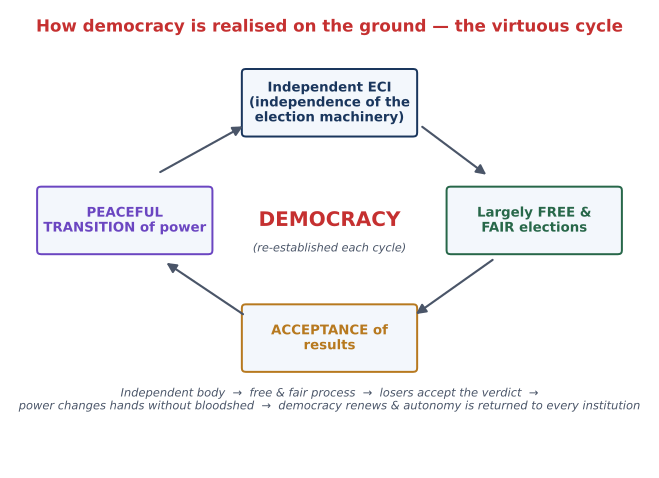
Why does "largely free and fair" matter so much? Because it produces acceptance of results, which in turn produces the peaceful transition of power — and that is how democracy is realised on the ground.
TEACHER'S EXAMPLE (acceptance of results): In 2024 (18th Lok Sabha) the BJP got ~36% of the vote — so ~36 of every 100 eligible voters said "yes" to it forming the government and ~64 said "no" — yet when Mr Modi took oath there was no protest that "two-thirds of us said no." Governments have formed with as little as ~29%. When Dr Manmohan Singh took his second-term oath in 2009, ~71% had not voted Congress, but again no strike anywhere. Even Mamata Banerjee, after the recent West Bengal election, ultimately had to accept the verdict ("EVMs got burnt — that's a separate fight, but the process is largely free and fair"). The parallel he drew: when UPSC's "unconventional" paper failed ~4.87 lakh of ~5 lakh aspirants, hardly anyone protested at the gates — because the process is largely free and fair, and that is because UPSC is an independent body. Contrast a State PSC, where results are challenged in the High Court the very next day, because the body is not as independent. Acceptance flows from a free-and-fair process, which flows from an independent body.
This is the cycle to memorise — it is "how you practically realise democracy in a country," no matter how beautiful a textbook definition you know:
DIAGRAM (board): A cycle — Independence (of the ECI) → largely Free & Fair elections → Acceptance of results → Peaceful Transition of power → (back to) Independence, with Democracy sitting at the centre, re-established each time the cycle turns.
TEACHER'S EXAMPLE (advising Russia): Imagine you clear this exam and, as a Secretary working with the ECI, Russia asks India to help it "become a democracy like India." Your advice: you need an independent Election Commission; to make it independent you write certain principles inside the Constitution that guarantee that independence; you do not write everything inside the Constitution because elections are extremely dynamic — the dynamic bits go into ordinary laws that can be changed as the times demand. That single design choice is what Part XV encodes.
1. The three opening questions — why Part XV looks the way it does
Looking at Part XV, the teacher posed three questions that look different but share one underlying logic:
- Are six provisions enough? Democracy is so important, and elections are the means to it — yet there are only six articles (324–329). Even a "useless" part like Fundamental Duties has ~11 provisions. So are six enough?
- Why the division — some things inside the Constitution, some outside (in ordinary laws like the RPA)? Why not put everything in one place?
- Why is the Election Commission of India a constitutional body and not a statutory body? (A favourite UPSC framing.)
Answering Q2 first (the division). Elections are a dynamic, ever-evolving subject. When a subject matter keeps changing, you want it where it is easy to amend — and ordinary laws are far easier to amend than the Constitution. So the dynamic part of elections is placed in ordinary laws (the RPA family); whatever is placed inside the Constitution is therefore the non-dynamic part — and since the Constitution is a sacred document, it is also necessarily the most important part. That is the basis of the inside/outside division.
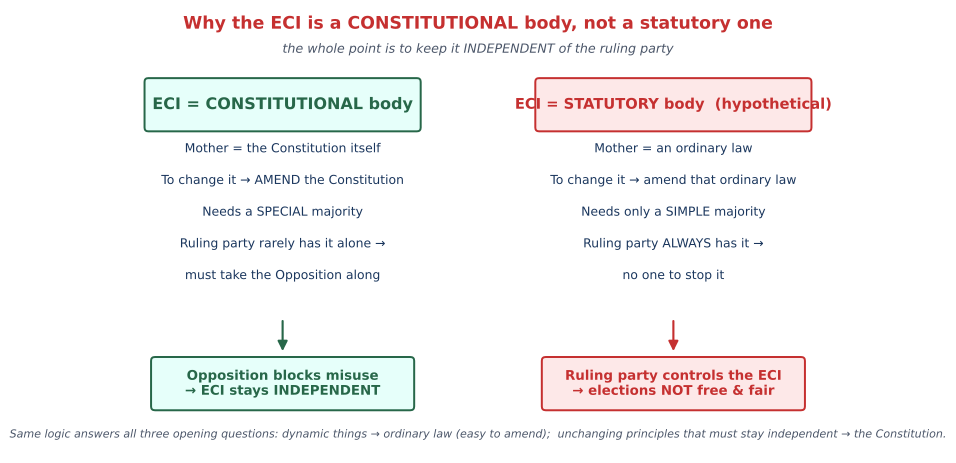
Answering Q3 (constitutional vs statutory body) — the same logic. Take two bodies, A (constitutional) and B (statutory). The "mother" of a constitutional body is the Constitution; the mother of a statutory body is some ordinary law. To change a constitutional body you must amend the Constitution → special majority; to change a statutory body you only amend an ordinary law → simple majority. Now, the ruling party always has a simple majority, but rarely a special majority on its own. So if the ECI were merely statutory, the ruling party alone could rewrite the law controlling it — capturing the ECI. By making the ECI constitutional, any change needs a special majority, which forces the ruling party to carry the Opposition along, and the Opposition will not allow biased changes. That is why the ECI is constitutional — to guarantee its independence.
DIAGRAM (board): Body A = constitutional (mother = Constitution → amend by special majority → ruling party needs the Opposition → independent) versus Body B = statutory (mother = ordinary law → amend by simple majority → ruling party always has it → controllable). The board wrote "RP — not always [special majority]" against A and "simple [majority]" against B.
Answering Q1 (are six enough?). Now the first question answers itself. We are not trying to write everything about elections into the Constitution — only the non-dynamic, important, independence-guaranteeing principles. Things that do not change with time but are important and assure independence are exactly principles — so the six provisions deal with principles for conducting free, fair and independent elections. Are six enough? They are more than enough — in fact one of them (Article 328) turns out to be effectively useless (see §6), so just five principles run India's elections.
CLARIFICATION (why "independence" is the single value being protected): Why pour all the constitutional weight into just one value — independence? Because only an independent body can run a free and fair process — true of the ECI, and equally of the Supreme Court (it delivers fair justice because it is independent). The teacher acknowledged the obvious tension students feel — recent press conferences (e.g. the CEC refusing to share CCTV footage / digital footprints of polling, citing voters' right to privacy, even though the ECI itself records footage and promotes booth selfies) make the ECI look less than independent. His point: a CEC's seemingly biased or illogical conduct is rooted not only in his personal value system but in the constitutional design itself — which is why you must understand the provisions before judging the behaviour.
2. Part XV at a glance — one body + five principles
For study, Part XV is split into Article 324 (the body that conducts elections) on one side and Articles 325–329 (five general principles) on the other. (This split is only for our understanding; the Constitution itself doesn't divide it.)
DIAGRAM (board): Part XV (XV) branches into Art 324 → ECI (autonomous constitutional body; job = S.D.C. of elections) and Art 325–329 → the general principles.
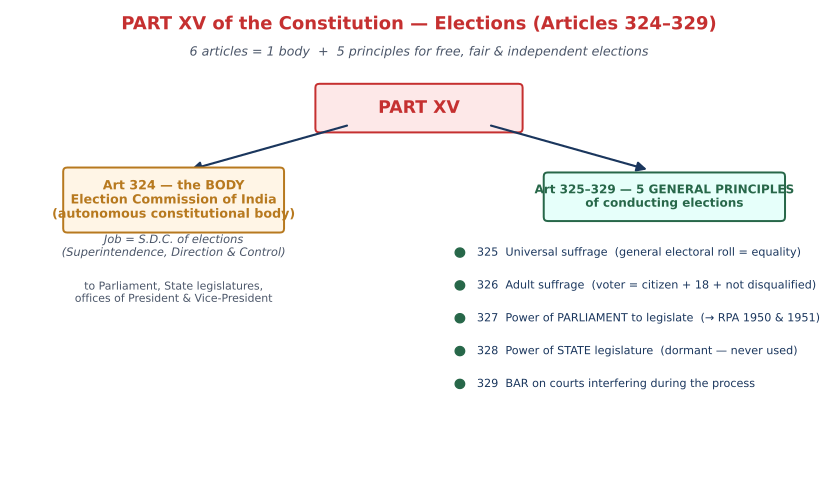
Article 324 — the Election Commission of India is an autonomous (= independent) constitutional body. Autonomous matters: the ECI is not part of any organ of the State — neither legislative, nor executive, nor judicial. The common confusion that "the ECI comes under the Government of India" is wrong — there is no Ministry, Minister or Department of Elections in India. Its present composition is a three-member body: the Chief Election Commissioner (CEC) plus two Election Commissioners (ECs). Its job is the Superintendence, Direction and Control (SDC) of elections — the teacher said to write it as "SDC of elections" because the phrase recurs so often across the next five classes that, like NPK in agriculture, you'll stop expanding it.
EXAM FOCUS: The ECI conducts elections to Parliament, the State legislatures, and the offices of the President and Vice-President — not local-body (panchayat/municipality) polls, which are run by the separate State Election Commissions (see §5). The detailed treatment of Article 324 — composition, appointment, removal, the 1991 and 2023 Acts, powers, the "reservoir of power" — begins in the next class; all of it from the handout is collected in §8 below.
The five general principles (Articles 325–329) are taken up next, in order.
3. Article 325 — Universal Suffrage (the general electoral roll)
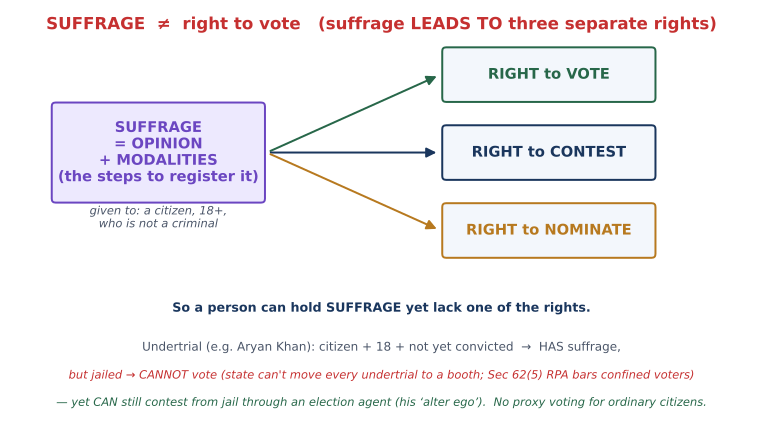
Principle 1 (Art 325): Universal Suffrage. Universal = everyone. Suffrage — and here is the crucial point Ambedkar deliberately chose — suffrage is NOT the same as the right to vote. Suffrage is your opinion about a matter (in an election, your opinion about the representative); but an opinion sitting inside your head changes nothing. To register it you must perform certain steps/actions — "modalities." So:
suffrage = opinion + the modalities to express it — and suffrage then gives rise to three separate rights: the right to vote, the right to contest, and the right to nominate.
TEACHER'S EXAMPLE (the modalities of voting — Modi from Varanasi): Suppose you strongly believe Mr Modi should be the MP from Varanasi, and you are an eligible Varanasi voter. Your opinion today helps him in no way. It helps only if you still hold it on polling day, and you physically go to your booth in Varanasi (not your house in Delhi) carrying your voter ID, the booth officer checks your name in the electoral roll against your ID and ticks it, security directs you to a room (usually ~2 EVMs per room), and at the EVM you can see each candidate's name ("Narendra Modi"), party symbol ("Lotus"), and — this is the "something new" of recent elections — the candidate's photograph (see clarification on the year), then press the blue button beside it; a red light glows (sometimes a beep), and a VVPAT slip (Voter-Verifiable Paper Audit Trail — like a card-transaction receipt) is printed, which you must leave in the box, not carry home. Miss any one modality and your opinion is not registered. Opinion + all these modalities = suffrage.
CLARIFICATION (candidate photographs — the correct year): The teacher placed the candidate-photo feature at the 2019 general election. Verified: the ECI introduced photographs of candidates on the ballot paper/EVM display from 2015 (first used in the Bihar Assembly polls), so by 2019 it was standard. Use 2015 as the year of introduction. (Source: ECI; Manorama Yearbook.)
Suffrage ≠ right to vote — the proof. Because suffrage merely leads to the right to vote, there can exist a person who has suffrage but lacks the right to vote. Who has suffrage? (Full answer under Art 326, but in brief:) any Indian citizen, 18+, who is not a criminal.
TEACHER'S EXAMPLE (Aryan Khan, the undertrial): When Aryan Khan (Shah Rukh Khan's son) was arrested in the ~2021 narcotics case and jailed in Mumbai, he was accused but not convicted — legal status "undertrial." (Undertrial = the status between accusation and conviction.) He was an Indian citizen, 18+, not (yet) a criminal — so he had suffrage. But could the state take him from jail to his polling booth and wait while he votes? No — it cannot do that for lakhs of undertrials (booths can be hundreds of kilometres away; the rest are criminals who would flee). Bringing the booth/EVM into the jail is also rejected: jails already see more corruption than outside, hold actual criminals, and we are already fighting the "not free and fair" allegation outside — so why risk it for ~1 crore undertrials when ~95 crore voters are outside? Hence the undertrial has suffrage but not the right to vote. (The teacher's tip: real reforms must make practical sense, not just theoretical sense.)
CLARIFICATION (the accurate rule — Section 62(5), RPA 1951; verified): The teacher's framing (undertrial on bail can vote, and a convict out cannot, because the convict's name is struck off) needs precision. The actual bar is Section 62(5) RPA 1951: no person confined in prison — whether under sentence, an undertrial, or in lawful police custody — may vote. The one exception is preventive detention. So the rule is about confinement, not the name: an undertrial out on bail CAN vote, and a convict out on parole CAN also vote (each is no longer confined and, if his name is on the roll and he is not otherwise disqualified, may vote). The separate matter — a convicted criminal sentenced to 2+ years is disqualified from contesting (Section 8, see §8) — is about candidature, not voting. (Source: Section 62(5) RPA 1951; Bombay HC and commentary.)
TEACHER'S EXAMPLE (you can contest from jail — the election agent): Strangely, an undertrial can contest elections from jail even though he can't vote. How, when contesting also needs modalities (talk to a party, get a ticket, canvass, rallies, speeches…)? Because voting is a simple, individual act, but contesting is a complex, tiring, collective process — so the law gives every candidate an election agent. An election agent can be a spouse, relative, close friend or party colleague you blindly trust, because during the election the agent becomes the alter ego (an exact replica/"second self") of the candidate — the ECI even treats their two bank accounts as one during the election. So a jailed Aryan Khan can tell his father Shah Rukh, "Papa, be my election agent" — get the ticket, canvass, hold processions — while Aryan stays inside. (If he wins from jail, "exception, not the norm"; the state must fast-track such cases. And note — "there are hundreds of criminals already sitting in Parliament," to be covered under criminalisation of politics later.)
CLARIFICATION (no proxy voting for ordinary citizens): If we allow an election agent, why not a voting agent (let Shah Rukh cast Aryan's vote)? That would be proxy voting, and proxy works on one principle — trust. In India that trust is missing: elections are so politicised and polarised that even family members keep their vote secret — call your grandparents and ask whom they voted for; they won't tell you truthfully. (Voting behaviour aside: the elderly/rural voters are India's most reliable voters; youngsters treat polling day as a holiday and don't vote.) Because trust is absent, proxy voting is NOT available to ordinary citizens — it exists only for classified service voters (e.g. armed-forces personnel under the Army Act). Otherwise "Papa, vote 14 times for X" becomes possible.
Now the text of Article 325 (universal suffrage of the roll). "No person shall be ineligible for inclusion in, nor claim to be included in any special, electoral roll, on grounds of religion, race, caste, sex, or any of them." "No person" = all persons = universal. The two halves mean we can neither discriminate against any person nor show favouritism to any person for entry into the roll. And since the roll is not "special," it is the general electoral roll — built on the principle of equality, with no discrimination on Religion, Race, Caste or Sex (RRCS).
CLARIFICATION (compare Article 15 — the "place" difference): Article 325 looks like Article 15 (which bars discrimination on religion, race, caste, sex and place of birth). The key difference: under Article 325 discrimination on the basis of place IS allowed — a voter of Itanagar should not be voting in Surat. So the country is divided by place into 543 territorial constituencies, and each constituency has one general electoral roll → 543 general electoral rolls, every one of them built on equality with no RRCS discrimination. (House strength figure used in class: 543.)
HANDOUT — NRIs and the right to vote: An NRI can be registered on a special overseas electoral roll based on the address in a valid passport — under Section 20A of the RPA 1950, inserted by a 2010 amendment. The Act still requires NRIs to be physically present in India to vote. In 2021 the ECI proposed ETPBS (Electronically Transmitted Postal Ballot System) for them, but it is not yet in effect (as of 2026). Presently ETPBS (postal-ballot) voting is allowed only for: members of the Armed Forces on duty, Central Armed Police Forces, staff of Indian Embassies / diplomatic missions, notified media persons, voters aged 80+ or with disabilities, and persons under preventive detention. Preparation of electoral rolls: a person who is an ordinary resident of a constituency is enrolled there (service voters get exceptions).
4. Article 326 — Adult Suffrage (who is a voter) + nature of the right to vote
Principle 2 (Art 326): Adult Suffrage. Adult = based on age (18+ in India). Article 326 text: "Every person who is a citizen of India and is not less than 18 years of age, and is not disqualified under the Constitution or any law on the grounds of non-residence, unsoundness of mind, crime, or corrupt or illegal practice, is to be registered as a voter in India." Such a registered voter has suffrage — and therefore can vote, contest and nominate.
Unpack the four disqualifying grounds: non-residence (not ordinarily resident in India), unsound mind (a competent court has declared you unable to make rational decisions), crime (a court has convicted you — you are now a criminal), and corrupt or illegal practices (defined under the RPA — covered later).
CLARIFICATION (325 vs 326 — the roll vs the entries): Article 325 = the roll itself — the general electoral roll, built on the principle of equality (no RRCS discrimination). Article 326 = the entries inside that roll — each entry is a voter, and every voter has suffrage (→ vote, contest, nominate). Think of 325 as the register and 326 as the names written in it.
CLARIFICATION (terminology traps): (1) "Universal adult suffrage" is technically a misnomer — something cannot be universal (everyone) and adult (only 18+) in the same breath. (2) Adult suffrage ≠ adult franchise: franchise concerns voting only, whereas suffrage is the larger term covering voting + contesting + nominating.
TEACHER'S EXAMPLE (the criminal — name struck off): If a Maharashtra court convicts Aryan Khan, his status changes undertrial → criminal; ground (3) "crime" now applies, so his name is struck off the general electoral roll of his constituency. With the name gone, he is no longer a voter → no suffrage → cannot vote, contest or nominate. Criminals in India have no suffrage. Important nuance: the erasure lasts only for the sentence period — once the sentence is served, the name is reinstated and suffrage returns. (Quick mix-and-match for Prelims: undertrial — has suffrage, can't vote, can contest; criminal — no suffrage, can't do any of the three; undertrial out on bail — can vote. The teacher noted he'd have to check the status of residents of mental-health facilities.)
The nature of the right to vote — a genuine, unsettled debate (PYQ 2017). UPSC asked in 2017 whether the right to vote is a Fundamental, Natural, Constitutional or Statutory right. It is clearly not fundamental or natural; the real fight is statutory vs constitutional. The teacher explained why even the Supreme Court seems to send mixed signals: no case has ever directly asked "what is the nature of the right to vote?" — instead, in landmark election cases the judges drop passing (obiter) remarks, some calling it statutory, some constitutional, which is the source of the confusion. The way to weigh Supreme Court positions: more judges on the bench + more recent judgment = more authoritative.
DIAGRAM (board) + verified case law: Two schools — - Statutory-right school: the right flows from RPA 1951 (its voting section), not the Constitution. Voiced by divisional benches and, importantly, by a Constitution Bench in Kuldip Nayar v. Union of India (2006). - Constitutional-right school: the right's origin is the word suffrage / Article 326, which the Constitution itself confers. Voiced in PUCL v. Union of India (2003) (Justice P.V. Reddy: "if not fundamental, certainly a constitutional right"), and the teacher cited Anoop Baranwal v. Union of India (2023) (CJI Chandrachud's bench) as calling it "more than statutory — a constitutional claim."
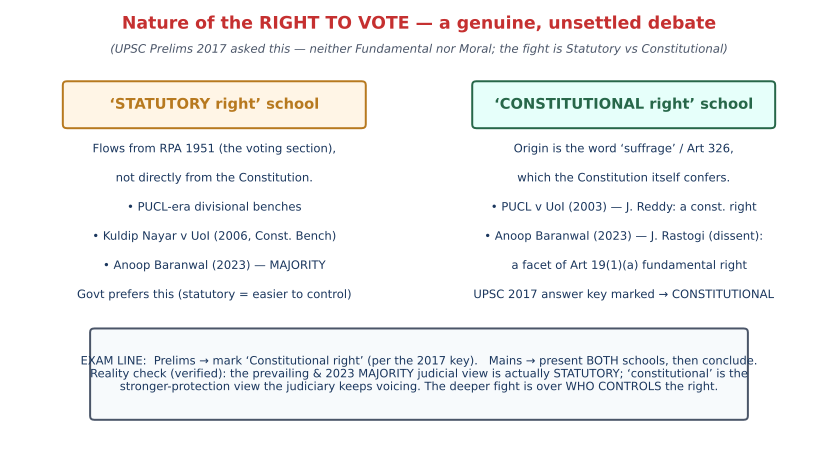
CLARIFICATION (accuracy check on the cases — important; verified): Be careful, because the judicial position is the opposite of how it is sometimes simplified. The prevailing view is statutory (Kuldip Nayar, 2006, Constitution Bench), and in Anoop Baranwal (2023) the MAJORITY actually reaffirmed that the right to vote is statutory; it was Justice Ajay Rastogi, in partial dissent, who held it to be a facet of the Article 19(1)(a) fundamental right. So "constitutional/fundamental" is the stronger-protection minority/obiter view the judiciary keeps voicing, not the binding majority ratio. Exam line: in Prelims, mark "Constitutional right" — that was the official UPSC 2017 answer key; in Mains, present both schools (statutory per Kuldip Nayar / Anoop Baranwal majority; constitutional per PUCL / Rastogi J.) and then conclude. (Sources: PUCL 2003; Kuldip Nayar 2006; Anoop Baranwal 2023.)
EXAM FOCUS (the deeper point — who controls the right): This is not merely about where the right is written — it is about who controls it. If voting is "statutory," the ruling party alone can tinker with it; if "constitutional," it is insulated. That is why, in the newspapers, the government tends to argue "statutory" while the judiciary keeps pushing back that it is more than statutory. (The Supreme Court has also clarified that the RPA's voting section only lists who can/cannot vote and the qualifications/disqualifications — it does not deal with the origin or nature of the right; the origin lies in suffrage, traceable to the Constituent Assembly debates, which is why "constitutional" is defensible.)
5. Article 327 — Power of Parliament; RPA 1950/1951; delimitation; the officials
Principle 3 (Art 327): Power of Parliament to make enabling legislation. "Parliament may, from time to time, make laws with respect to all matters relating to or in connection with…" — four heads, plus a residual clause:
- Elections to the Houses of Parliament (bicameral — Lok Sabha & Rajya Sabha).
- Elections to the House or Houses of a State legislature ("house or houses" because most States are unicameral, some bicameral).
- Preparation of electoral rolls (the general electoral roll of Art 325).
- Delimitation of constituencies. …and "any other matter for the due constitution of the Houses."
Delimitation (Article 82). Delimitation is the redrawing/readjustment of constituency boundaries to ensure political justice — "one person, one vote, one value" — using population as the parameter. It is performed by a dedicated Delimitation Commission, a three-member, very high-powered judicial body: a retired Supreme Court judge (chair) + the Chief Election Commissioner + the State Election Commissioner of the State concerned. Because it is essentially "a judge, a judge and a judge," its work gets special protection: once the Commission's report is submitted to the President, who tables it before Parliament, the report becomes immune from judicial review — it cannot be challenged in any court.
EXAM FOCUS (judicial review is the rule; this is a rare exception): Judicial review is part of the basic structure (Kesavananda Bharati, reaffirmed in Minerva Mills), and ~99.99% of state action is reviewable. Only a handful of things are immune — e.g. the advice of the Council of Ministers to the President — and the Delimitation Commission's report is one of them.
CLARIFICATION (State Election Commission ≠ subordinate to the ECI): The CEC and the SEC sound similar and both sit on the Delimitation Commission, but they head two entirely separate, autonomous constitutional bodies — there is no reporting relationship. The ECI runs Lok Sabha/State-legislature/President/VP elections (CEC's rank = a Supreme Court judge); the State Election Commission runs local-body polls (panchayats, municipalities) — out of UPSC scope — and the SEC's rank = a High Court judge.
EXAM FOCUS (Delimitation Commission Acts — verified): Delimitation Commissions have been constituted four times, under the Delimitation Commission Acts of 1952, 1962, 1972 and 2002 (based on the 1951, 1961, 1971 and 2001 censuses respectively). No delimitation followed the 1981 or 1991 censuses — a freeze on readjusting seats was imposed (42nd Amendment, 1976) and extended by the 84th/87th Amendments until the first census after 2026 — largely because of the North–South population divide (southern States that controlled their population fear losing seats). The present constituencies still rest on the 2001 census (Delimitation Act, 2002). (The teacher noted this was asked recently — "how many delimitations till date?")
The two big laws — RPA 1950 and RPA 1951. Heads (1), (2) and (3) are taken care of by two comprehensive laws — the Representation of the People Act, 1950 and the Representation of the People Act, 1951 — while head (4) is handled by the Delimitation Commission Acts above. Though their names are nearly identical, they are two completely different laws (the Parliament of 1950 was "of educated people who knew what they were doing").
EXAM FOCUS (RPA is explicitly named in the GS2 syllabus): The teacher stressed that the GS2 syllabus expressly names very few laws — the RPA is one of them (he associated the other with transparency/RTI). Because it is explicitly listed, a question from the RPA / elections is almost guaranteed every year. His homework: download RPA 1950 and 1951 — you'll find they are "thick books," with "everything under the sun about elections" written inside; we will not read them cover to cover but will pull the important, conceptual parts into class, and the static parts get printed in the handout (today's handout carries Section 8 — disqualification as static "read-at-home" material; see §8).
The clean way to tell the two laws apart is chronology — 1950 comes before 1951, so 1950 handles what happens before the actual election, and 1951 handles during and after:
| Representation of the People Act, 1950 | Representation of the People Act, 1951 |
|---|---|
| Activities before the conduct of actual elections | Activities during and after the conduct of actual elections |
| Allocation of seats; delimitation of constituencies | Actual conduct of elections & by-elections |
| Preparation of the general electoral roll | Voting |
| Qualifications of candidates | Political parties (their role runs during & after) |
| The officials/architecture & manpower planning | Disqualification of members (Section 8) |
| Filling of Council-of-States seats allotted to UTs | Election petitions (filed after the result) |
HANDOUT — key features (static): RPA 1950 — allocation of seats, delimitation of constituencies, officers for the conduct of elections, preparation of the electoral roll, manner of filling Council-of-States seats for UTs; Lok Sabha seats allotted to States on the basis of population as per the latest census. RPA 1951 — regulates the actual conduct of elections and by-elections; qualifications for contesting; disqualifications for membership of Parliament and State legislatures.
The architecture of officials. Because "the two permanent things in a civil servant's life are transfers and elections," and because ~543 IAS officers effectively run India's democracy, the teacher said you must know the election machinery cold. It is best pictured as three concentric circles:
DIAGRAM (board): ECI at the centre (×1) → CEO at the State/UT level (×1 each) → DEO / ERO / RO at the constituency level (×543) — the core is the ECI, the middle ring the CEOs, the periphery the ROs.
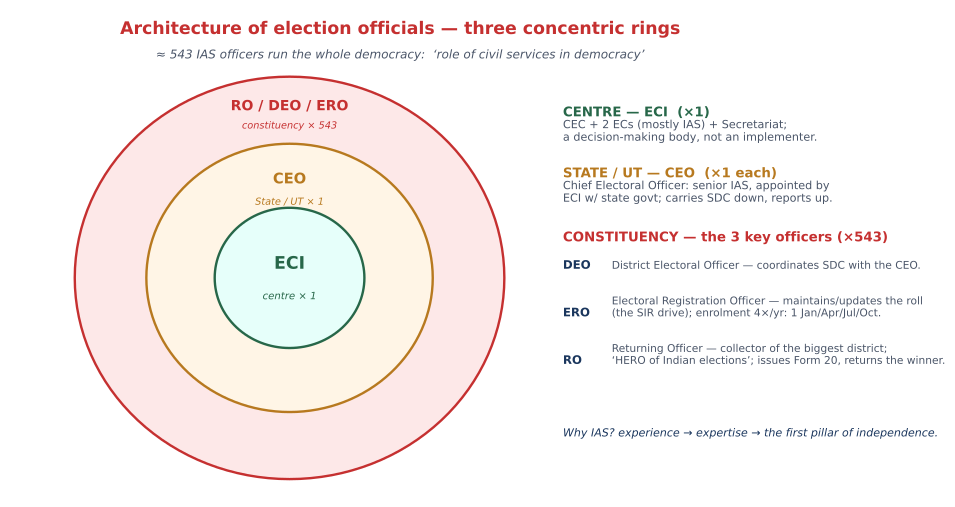
- ECI (centre, ×1): CEC + 2 ECs (almost always IAS; rarely an IRS officer), plus deputy/assistant secretaries for secretarial support (civil servants, often IAS). The ECI is a decision-making body, not an implementing one.
- CEO — Chief Electoral Officer (State/UT with legislature, ×1): a senior IAS officer, appointed by the ECI in consultation with the State government. (For the ECI there is no difference between a State and a UT with a legislature — even Delhi has a CEO, appointed in consultation with the Delhi government.) The ECI passes SDC orders down to the CEO; the CEO reports back up.
- Elections are actually conducted at the constituency level (not central or State) — and constituency, not district, because delimitation can put more than one district, or part of a district, in a constituency. The three key constituency officials (each ×543):
- DEO — District Electoral Officer: an IAS officer who coordinates the SDC effort with the State CEO.
- ERO — Electoral Registration Officer: an IAS officer responsible for preparing, maintaining and updating the general electoral roll. (This is the officer behind the Special Intensive Review (SIR) drives in the news.) Enrolment happens four times a year — qualifying dates 1 January, 1 April, 1 July, 1 October. (Verified: the four qualifying dates were introduced by the Election Laws (Amendment) Act, 2021 — earlier there was only the 1 January date.)
- RO — Returning Officer: "the hero of Indian elections" and practically the most important election officer in India — the District Collector of the biggest district in the constituency (an IAS officer). The entire election in the constituency revolves around him: he "returns" to the people the winning candidate by issuing the certificate of election (Form 20) — even a "Narendra Modi" cannot enter the Lok Sabha without the RO's certificate, after which the ECI recommends the winner to the House. (Why "returning" will make full sense when nomination is taught.)
TEACHER'S EXAMPLE (why only IAS officers — experience → expertise → independence): Picture yourself as CEC after ~30 years of service (so ~2056, the 24th Lok Sabha). A 60-year-old, six-term MP barges in claiming he knows elections better and you "made his members lose." Your reply: a politician, even living 20 more years, will personally witness only a handful of elections, whereas you have conducted dozens — "don't teach me my job." That is exactly what the Supreme Court says: experience adds to expertise, expertise is the first pillar of independence — when I truly know my job, I don't depend on you; when I don't depend on you, I am independent. That is why experienced IAS officers staff the machinery — to give it the independence the Constitution wants. (The GS2 syllabus phrase is literally "role of civil services in democracy" — you are the instrument that establishes democracy, which is also why the RPA is in your syllabus.)
TEACHER'S EXAMPLE (bureaucracy on wheels — "getting-ready-to-get-ready" syndrome): On transfers, the teacher cited a study/paper (he attributed it to Vaishali Saksena, Bureaucracy on Wheels) describing the "getting ready to get ready" syndrome: a collector is transferred so often that before he can even unpack his bags in one district, the next transfer order arrives. In some northern States (UP, Rajasthan, MP) the average district-collector tenure briefly fell below 30 days — leaving no time to govern, which is why good governance suffers in India.
6. Article 328 — Power of State legislature (the dormant article)
Principle 4 (Art 328): Power of the State legislature to make enabling legislation. "…the Legislature of a State may, from time to time, make laws with respect to…" — only two heads:
- Elections to the House or Houses of the State legislature.
- Preparation of electoral rolls.
The text closely mirrors Article 327, but the State gets fewer subject-matters — logically, because the Centre is more powerful. The two heads missing for the State are Lok Sabha/Rajya Sabha elections and delimitation — both uniform, pan-country matters that no single State should decide. Moreover, Article 328 attaches a condition: a State can legislate on its two heads only if there is an absence of, or a void/gap in, the central law — otherwise there would be duplication and friction.
CLARIFICATION (why Art 328 is effectively useless): The State's two heads are the same as heads (2) and (3) of Art 327, and Parliament has already covered them comprehensively with RPA 1950 and 1951 — leaving no absence and no void. So the condition is never satisfied, and therefore no State has, to date, made any law under Article 328. This is the "useless" sixth provision — which is why the teacher said the six articles are "more than enough," with only five actually doing the work.
TEACHER'S EXAMPLE (the dormancy of Art 328 mirrors a power-hungry society — the saas–bahu analogy): Why did Parliament not leave any space for the States under Art 328? Because "we are a power-hungry society — we believe in the accumulation of power, not its devolution." Everyone in the class is there for one word — power (no one wants to be a "powerless IAS officer"); what you do with that power is your value system, but no one renounces power. He illustrated with the mother-in-law / daughter-in-law cycle: a 1980s educated bride resents her "uneducated, cruel" mother-in-law and vows to be different — yet 30 years later treats her own daughter-in-law the same way; it has nothing to do with education or era and everything to do with power — teaching the new entrant "where the power centre lies — all your files pass through me." "Saas bhi kabhi bahu thi." The same pattern repeats in our federal structure: under Schedule 7 the Centre keeps interfering in the States (funding, CBI, centrally-sponsored schemes); and under the 73rd/74th Amendments (Schedules 11 and 12 — 29 subjects for panchayats, 18 for municipalities) the States do exactly the same to local governments. All these institutions are made by Indians, "and Indians, by nature, are power-hungry — given a chance, we don't give power away, we take someone else's." So Parliament, under Art 327, kept all the power and left Art 328 a dead letter.
CLARIFICATION (a student's pushback — is only India power-hungry?): Asked whether the West (colonialism) isn't equally power-hungry, the teacher cautioned that "anything can be framed as a show of power," so the lens can be over-applied — but if you look at how governance actually runs in the UK, you can judge whether a society genuinely devolves power or merely hoards it. (His rhetorical point: why would Britain ever have devolved power to India?)
7. Article 329 — Bar on courts during the electoral process
Principle 5 (Art 329): Bar to interference by courts in electoral matters — during the electoral process. Two clauses:
- 329(a): the Delimitation Commission's report is immune from judicial review (repeats the point from §5 — it cannot be questioned in any court).
- 329(b): "No election to either House of Parliament or to the House/Houses of a State legislature shall be called in question except by an election petition presented to such authority and in such manner as the appropriate legislature provides by law." In plain terms: to challenge an election you must file an Election Dispute Petition (EDP) — and which authority, who may file, and when, are left to a law made by the "appropriate legislature." Since the States are dormant (§6), the appropriate legislature is Parliament, and the relevant law is RPA 1951 (because the challenge comes after the election).
RPA 1951 fills in the EDP details:
- Where: only before the respective High Court under which the constituency falls → this is the High Court's original jurisdiction (you go directly to the HC).
- Who: only "interested parties" — i.e. a voter of that constituency or a candidate who contested there. (A Surat voter cannot challenge the Patna election; only a Patna voter/candidate can.)
- When: within 45 days of the declaration of results.
The genius of the title — "during the electoral process." The teacher built the whole point around what the electoral process is. Turn the page horizontally and draw it as a 10-step flow that runs ~45 days from the ECI's announcement to the declaration of results:
DIAGRAM (board): the electoral-process flow — Announcement → Notification → Nomination → Scrutiny → Withdrawal → (the FRAME) → Campaigning → Silence period → Polling → Counting & Declaration, spanning ~45 days, with the Art 329 bar covering the whole window and the EDP coming only after results.
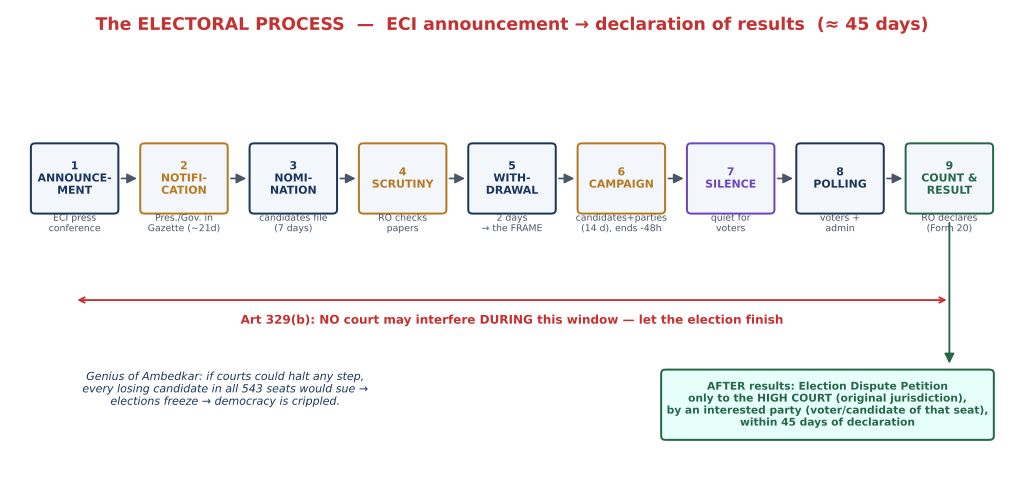
The ten steps, with the teacher's timings and explanations:
- Announcement (by the ECI). A press conference giving the overall picture — which State, how many voters and seats, how many phases (A/B/C), and the counting/result date.
- Notification (within ~21 days / 3 weeks). The President (for Parliament) or the Governor (for a State) publishes the notice of election in the official Gazette.
- Nomination (next 7 days). Interested candidates file their nomination papers. (Nomination is a full class on its own, later.)
- Scrutiny (day 7 or 8). The Returning Officer checks each nomination's correctness — so the RO is the first filter that stops an unwanted/criminal element from entering politics (one reason the RO must know the RPA well).
- Withdrawal (next 2 days). Candidates may withdraw — for an official reason (parties forming a coalition/alliance and sharing seats by their local strength) or an unofficial one (a "phone call in the evening" — pressure/threat).
- The FRAME. After withdrawals, the final set of contesting candidates is fixed — "the frame is ready."
- Campaigning (next 14 days). Candidates and parties campaign; it must stop 48 hours before the close of polling. (E.g. a Sunday poll in Delhi, booths 8:30 am–6 pm, means campaigning ends Friday 6 pm.)
- Silence period. From campaign-end until you vote — quiet time for voters to decide. ("Enough noise has been made; give voters silence." A real challenge in the age of social-media reels.)
- Polling. Voters vote with the help of the administration (the date is set by the ECI in consultation with the RO, who knows his district best).
- Counting & Declaration of results. Votes are counted and results declared — the last step.
EXAM FOCUS (the genius of Ambedkar): Read the title again — "bar on interference of courts… during the electoral process." Had Ambedkar omitted "during the electoral process," a court could intervene at any step. Imagine one person in constituency X challenges the scrutiny as unfair — with no bar, the High Court admits it, the matter becomes sub judice, and that constituency's election *halts until judgment. Since the losing candidate in every one of the 543 constituencies will feel cheated ("the EVM was rigged"), you'd get at least 543 simultaneous suits, all elections freeze, and democracy is crippled. So the Constitution bars courts during the process — let the election finish; if you feel it was unfair, file your petition only after the results (within 45 days, in the HC). "For democracy to breathe, the lungs — elections — must be in shape."*
CLARIFICATION (why so few petitions are actually filed): Although the law allows a post-result challenge in every seat, we hardly see ~5 cases, not 543. Why? Because the energy and emotion that peak during the campaign dissipate once results are out, replaced by acceptance of results — and that acceptance exists because the process is largely free and fair. (Full circle back to §0.)
8. Article 324 — the Election Commission of India (HANDOUT, next class)
The teacher will begin the next class with Article 324 in detail ("change the page, heading: Article 324 — Election Commission of India"). Everything below is from today's printed handout, collected here so the Elections note is complete; it will be expanded with his spoken explanation when taught.
➡ NOW ELABORATED: Article 324 was taught clause-by-clause in Class 7 — see lec07 — Article 324: the ECI in detail (composition, the chicken-and-egg start, T.N. Seshan & the EC Act 1991, the independence pillars, Anoop Baranwal & the CEC & Other ECs Act 2023, and reforms). The handout sections below on powers & functions, the reservoir of power, political parties and the election petition are still deferred to later classes.
HANDOUT — Article 324 (Superintendence, Direction & Control): The superintendence, direction and control of elections to Parliament, every State legislature, and the offices of President and Vice-President is vested in the Election Commission. Composition: a Chief Election Commissioner and "such number of other Election Commissioners as the President may from time to time fix"; the President makes the appointments (subject to any law made by Parliament). When other ECs are appointed, the CEC acts as Chairman. Regional Commissioners (Art 324(4)) may be appointed by the President, after consulting the ECI, to assist it. Conditions of service & tenure are determined by the President by rule, with safeguards: the CEC is removed only like a Supreme Court judge; the CEC's service conditions cannot be varied to his disadvantage after appointment; and an EC or Regional Commissioner can be removed only on the CEC's recommendation.
HANDOUT — the evolution of the ECI's composition (a recurring Prelims table):
Pre-1991 Act Post-1991 Act Composition Single-member body; briefly CEC + 2 ECs in 1989; back to single-member in 1990 Three-member body: CEC + 2 ECs Power CEC ranked as an SC judge, ECs as HC judges; ECs subordinate to CEC, so the CEC's decision was final Equal power to CEC and ECs; decisions taken unanimously / by majority / by casting vote Historically, the first election (1951–52) was conducted with no law, one CEC (Sukumar Sen) and no ECs. In 1991 Parliament passed the Election Commission (Conditions of Service of Election Commissioners and Transaction of Business) Act, 1991 to make it a genuine multi-member body and secure its independence (Article 324's intent).
HANDOUT — The CEC and Other ECs (Appointment, Conditions of Service and Term of Office) Act, 2023: Enacted to bring transparency to appointments, following the Supreme Court's direction in Anoop Baranwal v. Union of India (2023). Key features: - Replaces the 1991 Act. - CEC and ECs are appointed by the President on the recommendation of a Selection Committee. - Selection Committee = the Prime Minister + a Union Cabinet Minister (nominated by the PM) + the Leader of the Opposition / leader of the largest opposition party in the Lok Sabha. (Appointments stay valid even if there is a vacancy in the Committee.) - Search Committee proposes a panel of names to the Selection Committee. - Eligibility: holding (or having held) a post equivalent to Secretary to the central government. - Salary & service conditions equal to a Supreme Court judge. - Legal-proceedings safeguard for actions done in the discharge of official duties.
CLARIFICATION (two verified fixes to the handout): 1. Search Committee head: the handout says it is "headed by the Minister of Law and Justice with two secretary-level officers." The enacted 2023 Act actually has it headed by the Cabinet Secretary (plus two members not below the rank of Secretary, with election experience), proposing five names. Use Cabinet Secretary. (Sources: PRS, Wikipedia, Drishti IAS.) 2. Note on the Selection Committee: the SC in Anoop Baranwal (March 2023) had mandated PM + LoP + Chief Justice of India; the 2023 Act replaced the CJI with a PM-nominated Cabinet Minister — the very change being litigated, as it gives the government a 2-of-3 majority on the panel.
HANDOUT — Powers & Functions of the ECI: (1) Superintends, directs and controls the entire process of elections to Parliament, every State legislature and the offices of President & Vice-President — including deciding election schedules (general or bye-elections), preparing the electoral roll and issuing the Electronic Photo Identity Card (EPIC), and deciding the location of polling stations, the assignment of voters to them, the location of counting centres, and all allied arrangements. (2) Grants recognition to political parties and allots election symbols, and settles related disputes.
HANDOUT — "Reservoir of power" (Kanhaiya Lal Omar v. R.K. Trivedi, 1985): In this case the Supreme Court upheld the Election Symbols (Reservation and Allotment) Order, 1968 as valid and well within the ECI's jurisdiction. It held that "superintendence, direction and control" are broad terms to be given the widest possible meaning (principle of liberal interpretation); any part of the Symbols Order not traceable to specific rules is traceable to the reservoir of power under Article 324(1). So the ECI has effectively unlimited power — restricted only by constitutional provisions, valid electoral laws, court judgments, and the principles of natural justice — i.e. a "reservoir of power." (Case verified: (1985) 4 SCC 628.)
HANDOUT — political parties & their recognition: A political party is an association/body of Indian citizens registered with the ECI under Section 29A of the RPA 1951. Parties are classified as Recognised (National or State), Unrecognised, and Registered-but-Unrecognised (RuPPs). The Election Symbols (Reservation and Allotment) Order, 1968 governs symbol allotment.
Recognition as a STATE party — any one of these 5 criteria: (1) 6% votes in the Assembly + 2 MLAs; (2) 6% votes in Lok Sabha (from the State) + 1 MP; (3) 3% of Assembly seats or 3 seats, whichever is more; (4) 1 LS seat for every 25 LS seats allotted to the State; (5) 8% of total valid votes in the State (LS or Assembly). Recognition as a NATIONAL party — any one of: (1) 6% votes in 4+ States (LS or Assembly) + 4 LS seats (from any State/s); (2) 2% of total LS seats from at least 3 States; (3) recognised as a State party in 4+ States.
CLARIFICATION (counts — verified, handout is outdated): the handout says ~2,598 registered, 8 national, 50 state parties. As of the ECI's March-2024 list there are 6 national parties (BJP, INC, BSP, CPI(M), AAP, NPP), about 60 state parties, and roughly 2,790 registered (RuPPs ~2,000+) — the "8 national" figure pre-dates the 2023 de-/re-recognitions. Keep the criteria (durable) and update the numbers.
HANDOUT — perks of a recognised (National/State) party: (1) exclusive use of its reserved symbol across India; (2) land/buildings from government for party offices in the capital; (3) two free sets of electoral rolls (and a free copy to its candidates during general elections); (4) needs only one proposer to file a nomination; (5) the election is countermanded if its candidate dies after nomination but before the poll; (6) up to 40 "star campaigners" whose travel/expenses are not counted in the candidate's election expenditure; (7) free airtime on national/State TV & radio; (8) priority on ballot display; (9) (proposed) state funding of elections.
HANDOUT — Election petition (after the result; under Art 329(b) / RPA 1951): The ECI's role ends with the declaration of results — once the Returning Officer signs the final result sheet (Form 20). Thereafter the only legal remedy is an election petition, filed within 45 days of the poll result in the High Court of the State. - Section 100, RPA 1951 — grounds: the winner was not qualified on poll day; the winner (or his agent, with consent) indulged in a corrupt practice; improper acceptance/rejection of a nomination; malpractice in counting (improper reception/refusal/rejection of votes, or reception of a void vote); non-compliance with the Constitution/RPA/rules. - Section 123, RPA 1951 — "corrupt practices" include bribery, force/coercion, and appeals to vote (or not) on grounds of religion, race, community or language. - Section 84, RPA 1951 — reliefs: the petitioner may seek to have the result/winner declared void, and may also ask the court to declare himself or another candidate duly elected.
HANDOUT — disqualification from contesting (Section 8, RPA 1951; "static," read at home): A person is disqualified if convicted of, among others: promoting enmity between groups (caste/colour/religion/birthplace) and disturbing harmony; bribery, undue influence or personation in elections; rape or cruelty to a woman by husband/relative; hate-provoking statements on religion/community/class; promoting/preaching untouchability (abolished by Article 17) / offences under the Protection of Civil Rights Act, 1955; breach of the Dowry Prohibition Act, 1961 or the Commission of Sati (Prevention) Act, 1987; offences under the Prevention of Insults to National Honour Act, 1971 (insulting the National Flag/Constitution or obstructing the National Anthem); contravening FERA, 1973; hoarding/adulteration of food & drugs; terrorism / unlawful activities (UAPA). Imprisonment: a sentence of 2 or more years disqualifies from the date of conviction until 6 years after release — and per ECI guidelines this holds even if the person is on bail or awaiting appeal. Corrupt practices: disqualification on this ground is determined by the President. Failure to lodge election expenses without reasonable cause can disqualify.
Remedies for a disqualified person: challenge the ground in the relevant High Court (and on appeal, the Supreme Court); file an election petition if malpractice is suspected; under Section 11, RPA 1951 the ECI may remove or reduce a disqualification — except one under Section 8A (corrupt practices); a person disqualified under 8A may petition the President; and a legislator disqualified under the Anti-Defection Law (10th Schedule, 1985) may, like any other, appeal in the higher courts.
9. Quick-revision tables
Part XV — article-by-article cheat sheet
| Article | Title | One-line essence |
|---|---|---|
| 324 | Election Commission of India | Autonomous constitutional body; SDC of Parliament/State/President/VP polls; CEC + 2 ECs |
| 325 | Universal suffrage | One general electoral roll per constituency; no RRCS discrimination (equality); place-based division allowed → 543 rolls |
| 326 | Adult suffrage | Voter = citizen + 18+ + not disqualified (non-residence / unsound mind / crime / corrupt-illegal); voter has suffrage → vote, contest, nominate |
| 327 | Power of Parliament | Law on Parliament/State elections, electoral rolls, delimitation → RPA 1950 & 1951; Delimitation Acts |
| 328 | Power of State legislature | Only State-legislature elections & rolls, and only if central law is absent/void → never used (dormant) |
| 329 | Bar on courts during the process | (a) Delimitation report immune from JR; (b) challenge only by election petition (HC, interested party, 45 days) |
Suffrage vs the three rights (Prelims mix-and-match)
| Status | Suffrage? | Vote? | Contest? |
|---|---|---|---|
| Citizen, 18+, not a criminal (name on roll) | ✅ | ✅ | ✅ |
| Undertrial in jail | ✅ (has suffrage) | ❌ (confined — Sec 62(5)) | ✅ (via election agent) |
| Undertrial out on bail | ✅ | ✅ (not confined) | ✅ |
| Convicted criminal, while confined (2+ yr sentence) | teacher: name off roll → ❌ | ❌ (confined — Sec 62(5)) | ❌ (disqualified — Sec 8) |
| Convict out on parole | — | ✅ (not confined — Sec 62(5)) | (still Sec-8 barred if 2+ yr) |
| Person in preventive detention | — | ✅ (Sec 62(5) exception) | — |
The teacher framed a criminal as "name struck off the roll → no vote/contest/nominate." The verified position separates the two: voting turns on confinement (Sec 62(5) — jail = no vote, bail/parole = can vote, preventive detention exempt), while contesting turns on conviction (Sec 8 — 2+ yr sentence disqualifies). See the Sec 62(5) clarification in §3.
The electoral process — timings at a glance: Announcement → (≤21 days) → Notification (Gazette, by President/Governor) → (7 days) → Nomination → Scrutiny (RO) → (2 days) → Withdrawal → FRAME → (14 days) → Campaigning (ends 48 h before poll close) → Silence period → Polling → Counting → Declaration. Whole window ≈ 45 days; no court interference during it; election petition only after, within 45 days, in the HC.
Current Affairs
(Updated as relevant news/magazine content comes in — see CLAUDE.md current-affairs rule.)
| Date | Source | Headline | Connection to this topic |
|---|---|---|---|
| 2026 (ongoing) | News | Special Intensive Review (SIR) of electoral rolls | Done by the ERO (§5); tests Art 325/326 roll-preparation and the ECI's "reservoir of power" (§8) |
| 2023 → | News | CEC & Other ECs Act, 2023 challenged in the Supreme Court | Selection Committee dropped the CJI for a Cabinet Minister (§8); independence-of-ECI debate (Anoop Baranwal) |
| 21-06-2026 | The Hindu | CEC Gyanesh Kumar met ~700 BLOs & supervisors in Jaipur on improving the electoral process | The ECI → CEO → DEO/ERO/BLO field machinery (§7); BLO's role in roll preparation/SIR (§5, §8) |
| 20-07-2026 | The Hindu (News Analysis) | Delimitation returns to the agenda — the Centre must align what it says with what the Bill says | The live delimitation dispute. What was moved in April 2026: the Constitution (131st Amendment) Bill + Delimitation Bill, together proposing to (a) raise Lok Sabha strength to max 850, (b) allot seats among States on the "latest Census" (i.e. 2011) and delimit constituencies immediately — whereas the Constitution allows this only after the Census of 2027 — and (c) reserve one-third of LS seats for women. Outcome: the 131st Amendment Bill was DEFEATED in the Lok Sabha on 17-04-2026 — 298 of 528 present and voting were in favour, short of the two-thirds required; the Delimitation Bill was not put to vote. The three Census references in Arts. 81 & 82 (learn these): the first Census after 2026 governs when delimitation may occur; the 1971 Census governs the inter-State proportion of LS seats; the 2001 Census governs constituency populations within a State. The freeze has twice run 25 years — 1976→2001 (42nd Amendment) and 2001→2026 (84th Amendment) — and ends automatically (a sunset clause) once first-Census-after-2026 data is published. Why it failed: the Bills removed all three references and tied everything to the "latest Census", contradicting the government's oral assurance that each State's proportion (and a uniform 50% seat increase) would be preserved — Art. 81(2)(a) is the provision embedding that guarantee. The technical fix: amend "first Census after 2026" → "after 2051", retain the 1971 reference, and change the 2001 → 2011 reference, which extends the federal guarantee while still permitting intra-State redrawing and triggering women's reservation. Positions: Congress backs a further 25-year freeze; DMK wants 33% women's reservation within the existing strength; TDP (a BJP ally) wants the 1971 reference retained. Revived because the government's LS strength rose after the TMC and Shiv Sena (UBT) splits. (Full treatment in current-affairs/syllabus-wise/GS2/polity/constitutional-features-amendments.md.) |
Note for linking: any CA on the ECI / appointment of CEC-ECs / SIR / electoral rolls / NRI voting / delimitation / political-party recognition / right-to-vote debate maps to this note. CA on Governor's assent / SC jurisdiction / judicial reforms maps instead to the Polity Judiciary note (lec03, veren shaarma).