Lecture 1 — Early Medieval India: Nature of the State, Kingship & Dharmashastra, and Indian Feudalism
GS Paper: I (Art & Culture / Ancient–Medieval History) | Teacher: Rohan Sir | Lecture: 1 of the Medieval series (28 July 2024) | Covers: course intro → the "nature of the state" → kingship & Dharmashastra → schools of Hindu law → the early-medieval transition & Indian Feudalism → administration & land grants → rise of the Rajputs | Last updated: 2026-06-14
How to use this note. It is written to be self-sufficient: it follows Rohan Sir's Lecture-1 sequence and framing, and fills in accurate, exam-ready detail from standard scholarship (chiefly R.S. Sharma's Indian Feudalism and standard epigraphy). Class-specific framings are flagged as TEACHER'S FRAMING; added background is flagged as CONTEXT. (The provided NCERT in this folder is "Modern India" — it becomes relevant only for the later socio-religious-reform lectures, not this one.)
Table of Contents
- Course orientation & syllabus
- The "Nature of the State": Politics vs Religion
- Why 750 CE is cast as a "Dark Age / Kalyug"
- Foundations: Rajdharma, Varnashrama, the Dvija & the Purusha Sukta
- Ideals of kingship
- Dharmashastra & the two schools of Hindu law (Mitakshara vs Dayabhaga)
- The early-medieval transition — "changing conditions"
- The trade & coinage collapse (the economic trigger)
- Indian Feudalism — the debate and the Europe/India comparison
- The administrative pyramid (Gupta model)
- Types of land grants
- The King–Brahmin nexus
- Rise of the Rajputs
- Exam focus
- Current Affairs
1. Course Orientation
Rohan Sir opened by fixing the scope and the readings of the course:
- Early-medieval political history: ≈ 750 CE – 1885 CE.
- Art, Culture & Architecture: ≈ 750 CE – 1947 CE (this strand runs right into the colonial period).
- Readings: the new NCERT (Themes in Indian History) as the base; the old NCERT for two chapters on socio-religious reform (Class XII, Modern India, Bipan Chandra); plus current-affairs/CSAT linkage later.
TEACHER'S FRAMING — why the syllabus stretches to 1885/1947. Because the "medieval" course is built around culture, religion and society (not just dynasties), it deliberately carries the thread of religious and social change forward into the socio-religious reform movements of the 19th century. That is why a Modern India NCERT sits in the reading list.
2. The "Nature of the State"
The lecture's conceptual anchor is the changing relationship between Politics (P) and Religion (R) across the three great periods of Indian history.
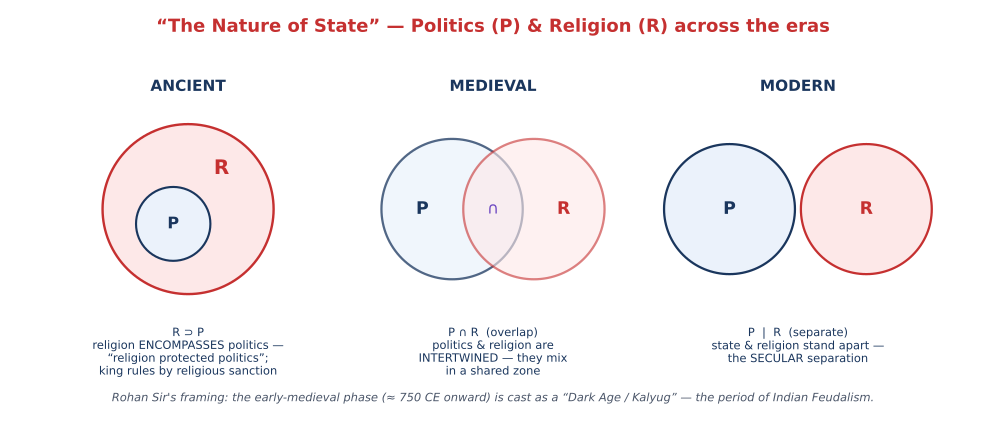
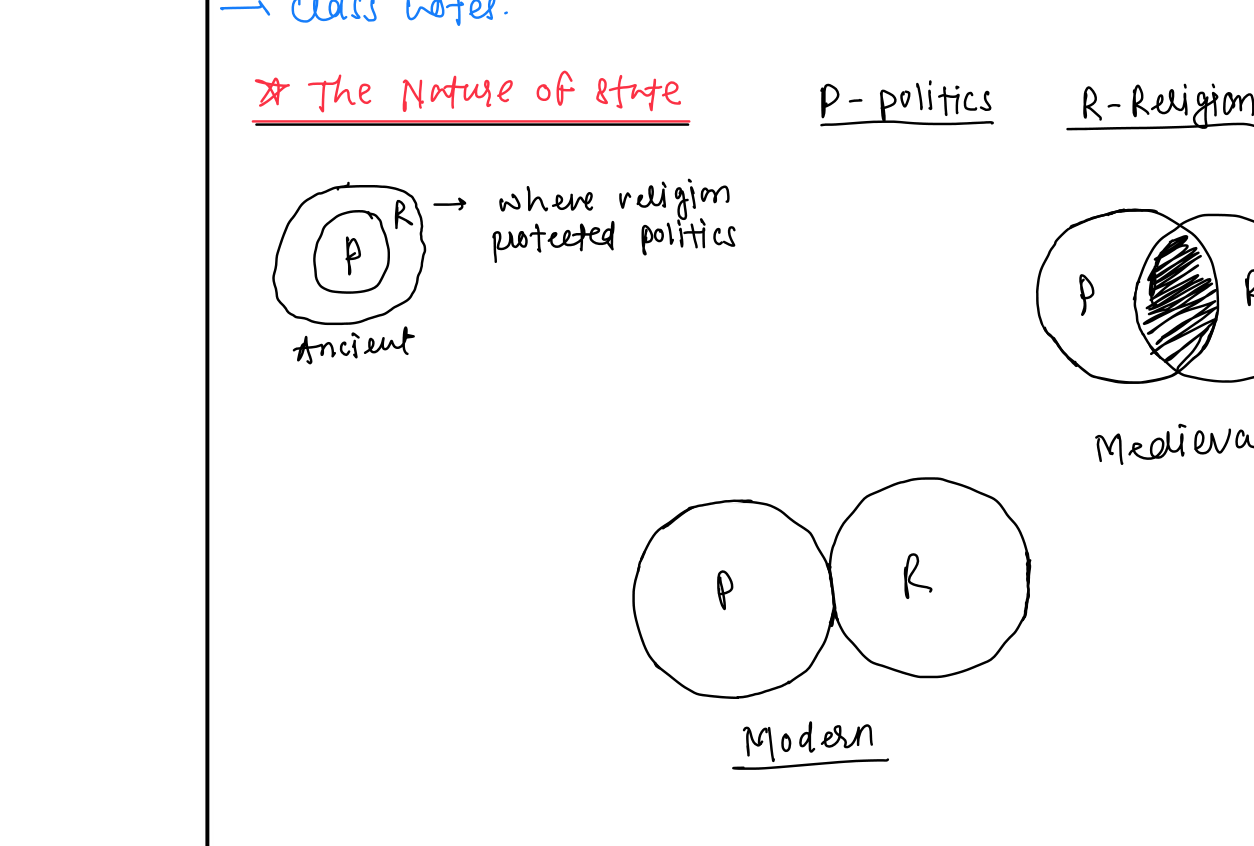
- Ancient — R ⊃ P (religion encompasses politics). Politics sits inside religion: the king rules by religious sanction, and statecraft is patterned by dharma. In the teacher's phrase, "religion protected politics."
- Medieval — P ∩ R (overlap / intertwining). Politics and religion overlap in a shared zone — religion legitimises and is in turn patronised by the state, but the two are visibly entangled (temple-building states, religious endowments, contests over orthodoxy).
- Modern — P | R (separation). The two stand apart; this is the secular separation of state and religion.
DIAGRAM (board). The clean redraw above is the primary version; the faithful class scan (note the medieval circles deliberately overlap with a shaded lens, while the modern circles are separate):
3. Why 750 CE = "Dark Age"
TEACHER'S FRAMING. Rohan Sir labels the early-medieval centuries (≈ 750 CE onward) a "Dark Age / Kalyug" — borrowing the older nationalist-historiography image of decline. The label is a teaching device, not a verdict: it flags the cluster of changes (de-urbanisation, a cash crunch, political fragmentation, a more rigid social order) that historians group under "Indian Feudalism." Modern scholarship treats the period as one of transformation, not simple "darkness" — but the changes it names are real, and they organise the whole lecture.
To understand the transformation, the lecture compares three reference points — the ancient ideal, the ideal of kingship, and what actually emerges in the early-medieval centuries. Those are unpacked in §§4–6.
4. Foundations
Before the transition, the lecture lays down the classical vocabulary of state and society.
- Rajdharma — the king's dharma (duty): to protect the social order, uphold law, and rule righteously rather than arbitrarily.
- Varnashrama-dharma — the dual scheme of varna (the four ranked orders) and ashrama (the four life-stages: Brahmacharya → Grihastha → Vanaprastha → Sannyasa). Together they define a person's duties by birth-order and by stage of life.
- The Dvija ("twice-born") vs the Ekajati ("once-born"). The three upper varnas — Brahmana, Kshatriya, Vaishya — undergo the upanayana (sacred-thread initiation), counted as a second birth, and so may study the Vedas ("go to school"). The Shudra is ekajati (once-born), excluded from initiation and Vedic study.
CONTEXT — the textual source of varna: the Purusha Sukta. The classic origin-myth of the four varnas is the Purusha Sukta (Rig Veda, 10th Mandala, hymn 10.90): the cosmic being Purusha is sacrificed, and from his mouth comes the Brahmana, from his arms the Rajanya (Kshatriya), from his thighs the Vaishya, and from his feet the Shudra. This hymn is the scriptural charter the later Smritis elaborate into a full social-legal code.
EXAM FOCUS. Dvija vs ekajati, the four ashramas in order, and "Purusha Sukta = Rig Veda 10th Mandala" are all repeatable Prelims one-liners.
5. Ideals of Kingship
The lecture builds the king's ideal-type from the Dharmashastra and the inscriptional record:
- Rajarshi ("sage-king") & Dharmavijaya ("righteous conquest"). The ideal monarch is part-sage; his conquests are meant to be dharma-vijaya — victory that restores order and accepts the defeated king's submission, rather than annihilation.
- The ambition of the Chakravarti. Every aspiring king dreams of becoming a Chakravartin — a universal, paramount sovereign whose authority "turns the wheel" over the whole earth.
- The king as Vyavasthapaka (regulator of the social order). A central royal duty is to uphold varna-order, including policing marriage:
- Anuloma ("with the grain") — a higher-varna man with a lower-varna woman — was tolerated.
- Pratiloma ("against the grain") — a lower-varna man with a higher-varna woman — was condemned. (This pair returns at the end, in the making of new castes — §13.)
- Taxation & the claim to sovereignty. Sovereignty was expressed through the right to collect and redistribute — the king takes a share (bhaga) of produce and shares it down the line of officials and grantees.
CONTEXT — sovereignty written in stone: the Allahabad Pillar inscription. The fullest early statement of imperial sovereignty is Samudragupta's Allahabad (Prayaga) Prashasti, composed by his court-poet Harishena. It catalogues his digvijaya / dharma-vijaya — the uprooted kings of Aryavarta, the "captured-and-released" kings of the Dakshinapatha, and the frontier states and foreign powers that paid homage — and is the textbook example of an inscription used to project paramount kingship.
Alongside taxation and protection, the king's duties included maintaining law and order, upholding dharma, public works (purta-dharma — wells, tanks, canals), and dana (gifts, temple-building) — drawing on the 18 Puranas and the Smritis as the normative literature.
6. Dharmashastra & Schools of Law
The Dharmashastra is the body of normative "law" texts (codes of conduct) that grew out of the earlier Dharmasutras. Two Smritis matter most:
- Manu Smriti (Manava Dharmashastra) — compiled roughly 2nd c. BCE – 2nd c. CE; the most influential code of varnashrama law.
- Yajnavalkya Smriti — slightly later and more systematic, especially on vyavahara (civil law / procedure).
What makes this exam-critical is that medieval commentaries on these Smritis produced the two great schools of Hindu law, which governed inheritance and family for centuries (and which the British later codified):
| MITAKSHARA | DAYABHAGA | |
|---|---|---|
| Author / text | Vijnaneshwara — a commentary on the Yajnavalkya Smriti (≈ 11th–12th c., Kalyani Chalukya court) | Jimutavahana (≈ 12th c., Bengal) |
| Where it applied | All of India except Bengal & Assam | Bengal & Assam |
| Son's right in ancestral property | By birth — the son is a coparcener from birth (right by survivorship) | Only on the father's death — no right by birth |
| Father's control | Limited — son can demand partition of ancestral property | Absolute during his lifetime |
| Partition | Of the joint estate; shares fluctuate with births/deaths | Allowed, with defined, fixed shares |
| Position of women | Weaker — the widow/wife is largely dependent (a share only in some conditions) | Better — the widow can inherit and co-share her husband's property |
| Family type | Tends to the joint family | Tends to the nuclear family |
TEACHER'S FRAMING. The class ties the Dayabhaga's dominance in Bengal to the Pala age, and the Mitakshara's spread across the rest of India to the Chalukya period (12th c.) — a neat regional map of the two systems. (Standard caution: these are scholarly commentaries, interpreted further by later jurists such as Vijnaneshwara himself.)
EXAM FOCUS. Remember the four anchors: Mitakshara = Vijnaneshwara, on Yajnavalkya, right by birth, all-India-except-Bengal; Dayabhaga = Jimutavahana, right on father's death, Bengal/Assam, better for widows. The "better-for-women" point on Dayabhaga is a favourite.
7. The Early-Medieval Transition
Rohan Sir's pivot: a bundle of "changing conditions" turns the classical order into the early-medieval one. These are the symptoms historians fold into "Indian Feudalism":
- Decline of the urban / money economy — towns shrink and the coin (cash) economy contracts → an economic/monetary crisis.
- Revival of a rural, barter economy — self-sufficient villages, with services exchanged in kind (the Jajmani system of hereditary service relations).
- Political fragmentation — large empires disintegrate into many small kingdoms.
- Emergence of new intermediaries — a layer of samantas / sub-lords appears between king and peasant.
- Religious change — the rise of the Bhakti movement and of Tantrism.
- New jatis (castes) crystallise — most famously the Rajputs (§13).
- Greater exploitation of the peasantry — peasants are tied down and squeezed.
The end-state of all this — in the teacher's words — is "Kalyuga / Dark Age / Indian Feudalism." The next sections explain the economic trigger (§8) and then the system itself (§9).
8. Trade & Coinage Collapse
Why did the cash economy contract? The lecture's answer is the collapse of long-distance trade that had pumped gold into India.
- India sat in the middle of the Silk Route, the intermediary between Byzantium (the West) and China (the East); Indian merchants and ports (e.g. Tamralipti on the east coast) thrived on this transit trade.
- That trade brought in gold. The Gupta "Golden Age" minted famous gold coins (the dinara / suvarna), modelled on Roman–Byzantine gold and high in purity. (The class compares the Byzantine gold coin with the Gupta gold coin to make the point about an India awash in bullion at its peak; the later, lighter silver coin of early-medieval India was the* dramma — from the Greek drachma.)*
- ≈ 550 CE — the turning point: Byzantium learned to make its own silk (sericulture reached the Mediterranean), so the demand for the Indian intermediary trade fell sharply; the great ports declined.
- After ≈ 600 CE: the inflow of gold dried up → a shortage of coined money → exchange shifts back to land and produce. With cash scarce, rulers began paying officials and rewarding priests with grants of land instead of salaries — and that is the seed of Indian feudalism.
CONTEXT. This "paucity of coins → land grants → ruralisation → feudalism" chain is the core of R.S. Sharma's Indian Feudalism thesis — the single most examinable interpretation of the period. (It has critics — e.g. on whether coins truly disappeared — but it remains the default framework.)
9. Indian Feudalism
What is "feudalism," and was India's version the same as Europe's? The lecture sets up a careful comparison.
| EUROPEAN FEUDALISM | INDIAN FEUDALISM | |
|---|---|---|
| Core grant | the fief — land given by a lord to a vassal in lieu of military service | land grants — to Brahmins/temples (religious) and, later, to officials (secular) |
| Hierarchy | King → Lord/Baron → Vassal → Serf (tied to the manor) | King → Samanta / Mahasamanta (sub-lords) → peasants/tenants |
| Obligations of the holder | military service, loyalty, attendance | (for secular grants) revenue & service; religious grants were duty-free |
| The peasant | the serf, bound to the soil; owed corvée (unpaid labour) | the tenant/peasant, increasingly tied down; owed vishti (forced/unpaid labour) |
| Coins / cash | weak money economy | acute cash shortage — land is the medium of reward |
| Earliest grants | post-Roman Europe | religious grants from c. 1st–2nd c. CE (e.g. Satavahana grants to Buddhist monks); secular grants spread from the Gupta age |
TEACHER'S FRAMING — "what makes a grant feudal?" Land by itself is not feudal. A grant becomes feudal when, with the land, two rights are transferred: (1) the right to administer (civil/judicial authority over the inhabitants), and (2) the right to get the land cultivated (i.e. to sub-let it). When the state alienates governance along with the soil, it is fragmenting its own sovereignty — the essence of feudalisation.
CONTEXT — the king's "symbolic" reserved rights. Even after granting land, the crown notionally kept (a) sub-soil / mining rights and (b) criminal jurisdiction — though over time even criminal justice was handed to the grantees (bhogika), deepening the fragmentation. Early grants transferring such rights appear under the Vakatakas (e.g. Pravarasena II, 5th c.). Forced labour (vishti) and tax-exemptions (often for a fixed term, e.g. "12 years") are the recurring fine-print of these charters.
10. The Administrative Pyramid
Under the Guptas and their successors, the realm was governed through a tiered structure — which, as central control weakened, became the very ladder down which power decentralised.
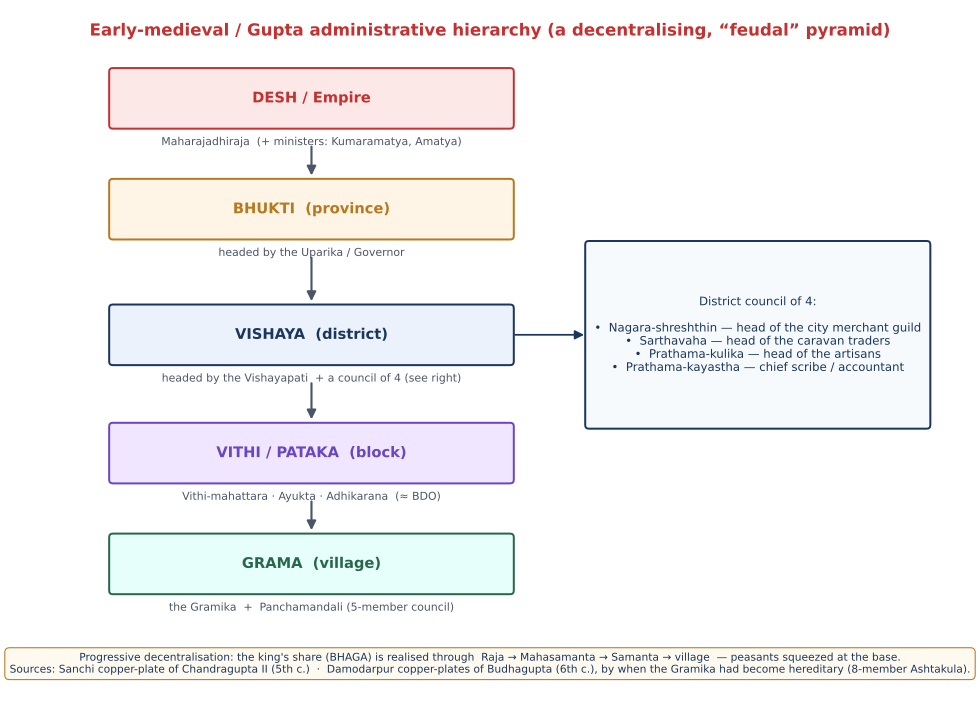
Reading the pyramid top-to-bottom:
- Desh / Empire under the Maharajadhiraja, advised by ministers (Kumaramatya, Amatya).
- Bhukti (province) under a governor, the Uparika.
- Vishaya (district) under the Vishayapati, assisted by a district council of four drawn from urban society — the Nagara-shreshthin (head of the city merchant guild), the Sarthavaha (head of the caravan-merchants), the Prathama-kulika (head of the artisans), and the Prathama-kayastha (chief scribe/accountant).
- Vithi / Pataka (block) — managed by figures like the Vithi-mahattara, Ayukta and Adhikarana (roughly a block-level officer).
- Grama (village) under the Gramika, with a five-member village council (Panchamandali).
CONTEXT — the epigraphic sources (high-value for Prelims). This structure is reconstructed largely from copper-plate inscriptions: the Sanchi copper-plate of Chandragupta II (5th c.), and especially the Damodarpur copper-plates of Budhagupta (6th c.) from north Bengal (Pundravardhana bhukti) — which name the district council above. By the 6th c. the village headship had become hereditary (an eight-member "Ashtakula" body, non-transferable), a clear marker of feudal localisation.
TEACHER'S FRAMING — decentralisation in motion. As the centre weakened, the king's share (bhaga) was increasingly realised through a chain of Raja → Mahasamanta → Samanta → village, each keeping a cut. Polity becomes a coalition of sub-lords; the peasant at the base is squeezed hardest.
11. Types of Land Grants
The grants that drove feudalisation fall into three families:
| Family | Examples | Character |
|---|---|---|
| To Brahmins | Brahmadeya, Agrahara | tax-free and hereditary; the gold-standard of pious endowment |
| Religious (institutional) | Devadana (to temples/deities); grants to Buddhist & Jain establishments | duty-free, in perpetuity |
| Secular (to officials) | bhoga / bhogika service grants | taxable, transferable, non-hereditary (at least initially) |
EXAM FOCUS. Brahmadeya/Agrahara = to Brahmins; Devadana = to temples. The drift over time — secular grants becoming hereditary and tax-free like the religious ones — is exactly how "officials" hardened into a landed aristocracy of samantas.
12. The King–Brahmin Nexus
Why did kings give away so much land — and revenue — to Brahmins? The lecture identifies a two-way bargain:
- What the king got: (1) Legitimacy — Brahmins were the "story-creators," the genealogists who manufactured prestigious (often divine or solar/lunar) descent for new dynasties; and (2) agrarian expansion / more revenue — settling learned Brahmins on virgin or forest land brought new areas under the plough and under brahmanical culture.
- What the Brahmin got: a tax-free, hereditary estate (Brahmadeya) and a settled household (Grihastha; the joint family unit called kutumba in the north, kudumbu in the south).
CONTEXT — a new caste from this process: the Bhumihar. Brahmins who took directly to agriculture and landholding (an occupation classically assigned to the Vaishya) gave rise, in the north, to the Bhumihar (Babhan) caste — a Brahmin-by-origin, landlord-by-function group. New land-categories named in the grants include Vastu (habitable land with water), Khila (fallow/infertile land), Aprahata (forest/uncleared land), and Gotha/Gau-yutha (pasture/cattle land); the actual tillers were often war-captives and non-Brahmins (Shudras, and others) reduced to cultivators.
13. Rise of the Rajputs
One of the early-medieval period's most consequential developments is the formation of a new ruling caste — the Rajputs — and the lecture uses it to show how brahmanical society absorbed outsiders.
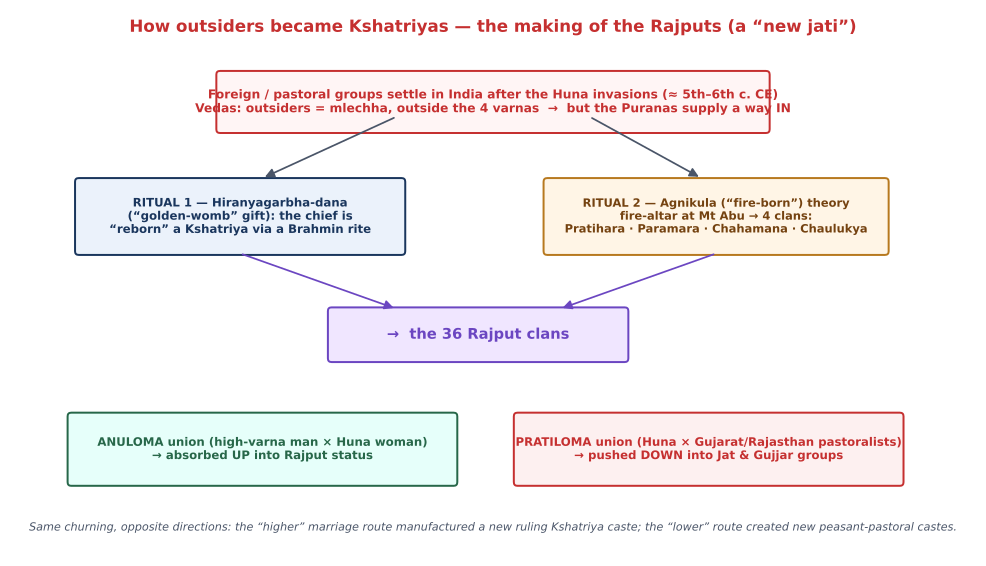
The problem and the solution:
- The problem. Waves of Hunas (White Huns / Hephthalites) invaded from ≈ the late 5th–6th c. CE (Toramana, Mihirakula) and helped break the Gupta empire; many then settled in north-western India, alongside Gurjara pastoralists. By the letter of the Vedas, such outsiders were mlechhas — outside the four varnas.
- The solution. The Puranas supplied a mechanism to bring them in as Kshatriyas:
- Ritual 1 — Hiranyagarbha-dana ("the golden-womb gift"): the chief is symbolically "reborn" a Kshatriya through a Brahmin-performed rite — the priest legitimises, the chief becomes "respectable," and both gain.
- Ritual 2 — the Agnikula ("fire-born") theory: four clans are said to have sprung from a sacrificial fire-altar at Mount Abu — Pratihara (Parihar), Paramara (Parmar), Chahamana (Chauhan), and Chaulukya (Solanki) — and from these grew the celebrated "36 Rajput clans."
- Marriage as the sorting mechanism (note the return of §5's pair):
- Anuloma unions (high-varna man × Huna woman) pulled groups upward into Rajput status.
- Pratiloma unions (Huna men × the pastoralists/nomads of Gujarat & Rajasthan) pushed groups downward, helping form the Jat and Gujjar peasant-pastoral castes.
EXAM FOCUS / DEBATE. The "foreign-origin" theory of the Rajputs (from Hunas/Gurjaras, via Agnikula legitimation) is examinable, but it is contested — scholars like C.V. Vaidya / G.H. Ojha argued for an indigenous Kshatriya origin. For UPSC, present it as a debate: the Agnikula myth and the assimilation of outsiders on one side; indigenous descent on the other. The Gurjara-Pratiharas are the bridge case often cited.
14. Exam Focus
- One-liners to bank: Purusha Sukta = Rig Veda 10th Mandala (10.90); Dvija = three upper varnas (upanayana), Shudra = ekajati; four ashramas in order; Mitakshara (Vijnaneshwara, on Yajnavalkya, right-by-birth, all-India-except-Bengal) vs Dayabhaga (Jimutavahana, right-on-death, Bengal/Assam, better for widows).
- The big interpretive theme — Indian Feudalism (R.S. Sharma): trade decline (Byzantine sericulture ≈550 CE) → paucity of coins → land grants with administrative & judicial rights transferred → ruralisation, samantas, vishti, tied peasantry. Be ready to compare with European feudalism and to critique the thesis.
- Sources & epigraphy (Prelims gold): Allahabad/Prayaga Prashasti (Harishena, Samudragupta); Damodarpur copper-plates (Budhagupta); Sanchi copper-plate (Chandragupta II); Vakataka grants (Pravarasena II). Know what each documents.
- Administration ladder: Bhukti–Uparika / Vishaya–Vishayapati (+ the council of four) / Grama–Gramika–Panchamandali.
- Grants vocabulary: Brahmadeya, Agrahara (Brahmins) · Devadana (temples) · bhoga (secular); vishti = forced labour.
- Society: rise of the Rajputs (Agnikula vs indigenous-origin debate; Hiranyagarbha; Anuloma/Pratiloma producing Rajputs vs Jats/Gujjars); the Bhumihar caste.
Current Affairs
(Updated as relevant news/magazine content comes in — e.g. ASI/epigraphy finds, copper-plate discoveries, debates on temple endowments or caste-origin historiography that connect to this lecture.)
| Date | Source | Headline | Connection to this topic |
|---|---|---|---|