Ashoka & Mauryan Administration
GS Paper: GS Paper I | Subject: History — Ancient India | Last updated: 2026-06-09
Covers Class 8 (the board carries both "Lec-7" and "Class-8" — the political history finishes Lecture 7 and the administration begins Lecture 8). It continues straight on from Bindusara (end of lec01). Two halves: (A) Mauryan political history — the First Jain Council, Ashoka's civil war, the Kalinga War and his Dhamma policy, the Ashokan inscriptions, the Third Buddhist Council, and the later Mauryas; and (B) Mauryan administration as described in Kautilya's Arthashastra (territorial, central, spy, judicial, municipal, military, coinage, revenue).
NOTE ON SOURCES (teacher's framing — keep this in mind throughout Part B): Everything about administration rests on three sources, each with a "personality": - Arthashastra of Kautilya — like our Constitution / Lakshmikant: it gives great administrative detail, but it is overly theoretical — a normative text (how things should be), so in the optional there is a standing debate on whether it was actually applied. - Ashokan inscriptions — like the PM's "Mann ki Baat": the king's own top-down account of what he wants (every king is told by his ministers that the moment he appealed for non-violence, people stopped — so treat it with care). - Megasthenes' Indica — like a casual traveller's blog ("hello guys, I've reached Magadha"): entertaining and casual rather than precise, and repetitive (he gives the same "six committees of five" for both the city and the army — which is why municipal & military administration are taught together).
Table of Contents
Part A — Political History
- First Jain Council (Pataliputra)
- Mauryan Civil War & Ashoka's Accession
- Ashoka & the Kalinga War
- Ashoka's Change of Policy — the Dhamma Policy
- Ashokan Inscriptions (edicts, language & script)
- Third Buddhist Council
- Ashoka's Caves & the Later Mauryas
Part B — Mauryan Administration (Arthashastra)
- Territorial Administration
- Central Bureaucracy
- Spy System
- Judicial System
- Municipal Administration
- Military Administration
- Coinage
- Revenue System (land, taxes, forced labour)
- Quick Revision Tables
Part A — Political History
1. First Jain Council (Pataliputra)
- Time: c. 298 BCE (≈ 12 years after the start of the great Magadha famine, in Chandragupta Maurya's reign — the teacher flagged that a wrong date floats around in some books/websites, "because it happened 12 years after Chandragupta").
- Place: Pataliputra
- President: Sthulabhadra
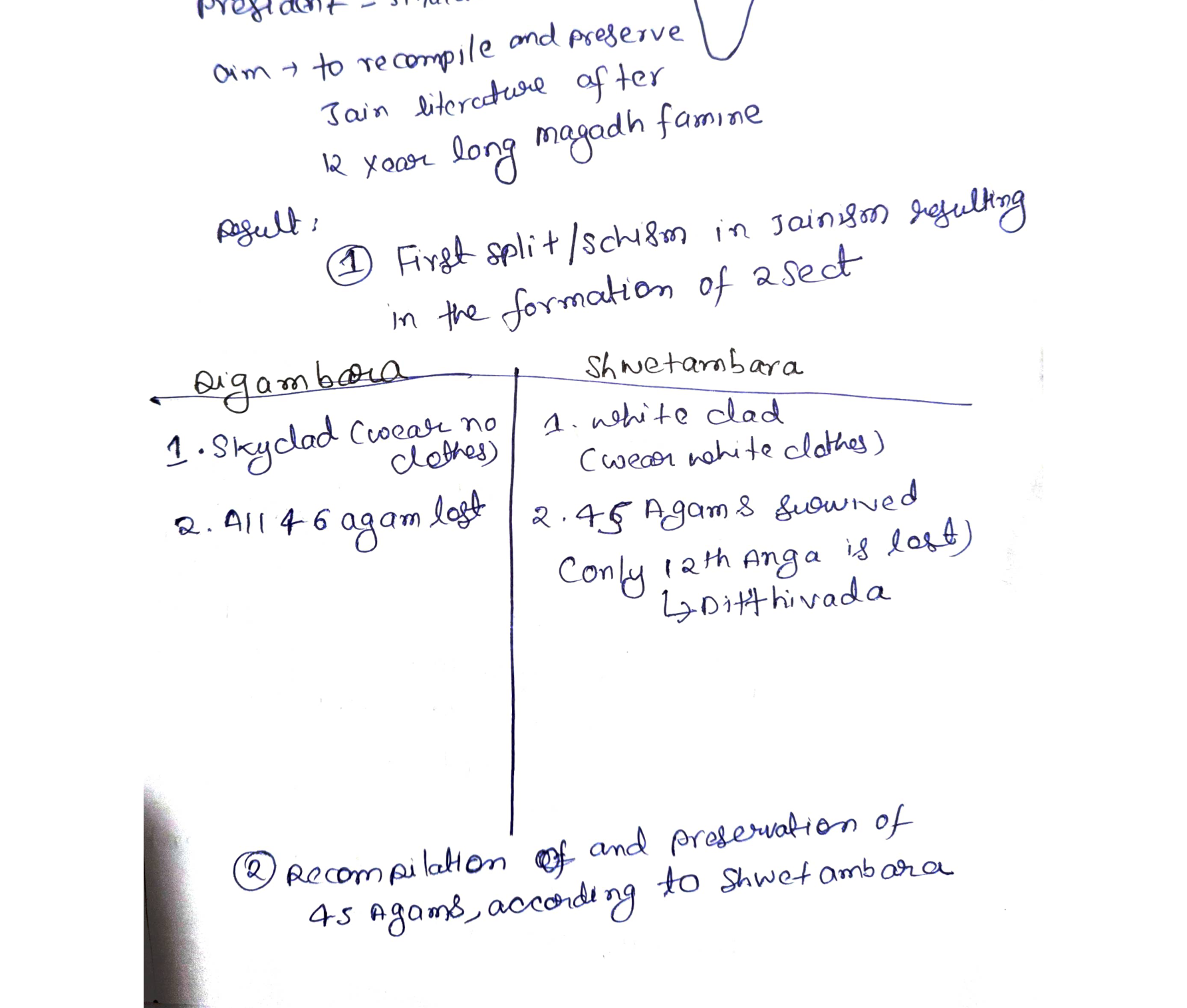
- Aim: to recompile and preserve Jain literature after the 12-year-long Magadha famine.
What happened (the teacher's narrative): A 12-year famine was prophesied in Magadha, so Bhadrabahu led a large body of monks south (to Shravanabelagola) to survive, taking the memorised literature with them. Remember — no single monk remembered the entire literature; each remembered only some chapters. So when, after 12 years, many of the monks who had stayed back (and many who went south) had died, there was real anxiety that the literature would be lost. On top of this, the two groups had developed a disagreement over clothing — one group now wore white cloth, the other none. To preserve the literature and settle the dispute, the council was called.
Result 1 — the first split (schism) in Jainism → two sects
This is the very famous result: Jainism split into Digambara and Shvetambara.
| Digambara | Shvetambara | |
|---|---|---|
| Meaning | "sky-clad" (dig = direction / also sky; here shunya = nothing) → wear no clothes | "white-clad" → wear white clothes |
| Basis | follow Mahavira's absolute aparigraha (non-possession = no property, and so no cloth either) | the 23rd Tirthankara Parshvanatha wore white cloth, so wearing white is acceptable |
| View on the literature | hold that all 46 Agamas are lost | hold that 45 Agamas survived (could be recompiled); only the 12th Anga is lost |
CLARIFICATION (the lost text): The original central literature of Jainism = the Agamas (≈ 46). Of these, 45 survived and only one was lost — the 12th Anga, named Drishtivada (in Prakrit, "Ditthivada"). (There were 12 Angas; it is the 12th that is lost.)
Result 2 — recompilation
- Recompilation and preservation of the 45 Agamas, according to the Shvetambara tradition.
DIAGRAM (board): Council details (time/place/president/aim) with a small sketch of Bhadrabahu moving south during the 12-yr famine, then the Digambara | Shvetambara two-column table.
Class board notes (scan):
NOTE (board leftover — the four southern peoples): The board opened with (i) Chola, (ii) Pandya, (iii) Keralaputra (Chera), (iv) Satyaputra — the independent southern peoples named in Ashoka's edicts (they bordered the empire but were not conquered). Carried over from the previous discussion; placed here for continuity.
2. Mauryan Civil War & Ashoka's Accession
- Mauryan Civil War (c. 272–268 BCE). The 100 sons of Bindusara fought a civil war among themselves. Ashoka won this war by killing all his brothers except one — Vitashoka / Tissa (the one surviving brother). (The ~4-year gap between Bindusara's death and Ashoka's coronation is this war.)
3. Ashoka & the Kalinga War
- Ashoka: c. 268–232 BCE.
- Kalinga War (c. 268–262 BCE). Kalinga = part of Odisha + part of Andhra Pradesh. After becoming king, Ashoka launched an invasion of Kalinga and conquered it after a long war. This conquest marked the territorial peak of the Mauryan empire.
- According to the Buddhist text Ashokavadana, Ashoka adopted Buddhism after the Kalinga War, renounced violence, and changed many of his policies.
- But the Minor Rock Edicts indicate that he was already a Buddhist when he became king. So we don't know exactly when he converted — but both sources agree that he changed his policies after the Kalinga War.
CLARIFICATION (Avadana): Avadana = "stories of great charities / great deeds." So Ashokavadana literally means the stories of Ashoka's great charitable deeds. These works are also called Upadana (note: not Apadana — apadana is a grammar/vyakarana concept, the ablative case).
4. Ashoka's Change of Policy — the Dhamma Policy
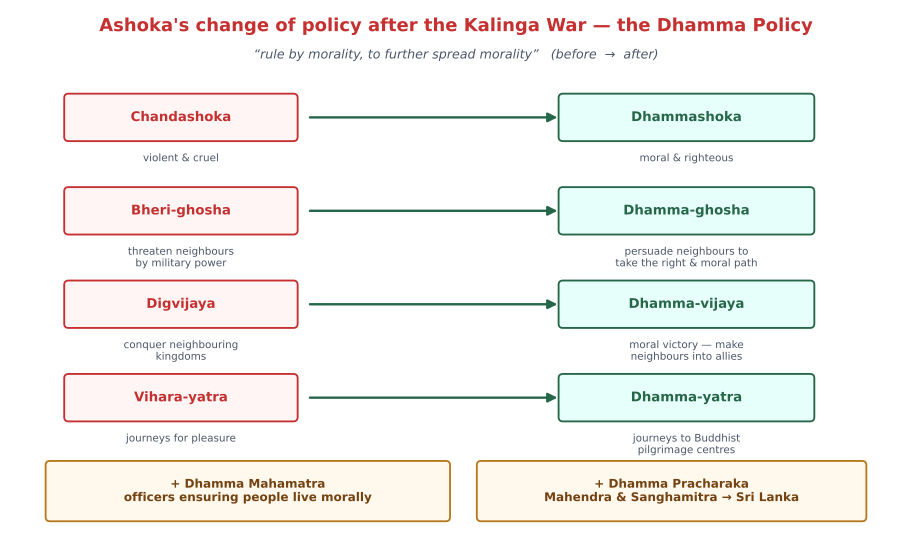
After Kalinga, Ashoka transformed each of his old, war-based instruments into a moral counterpart. The whole change is called his Dhamma policy — "rule by morality, to further spread morality."
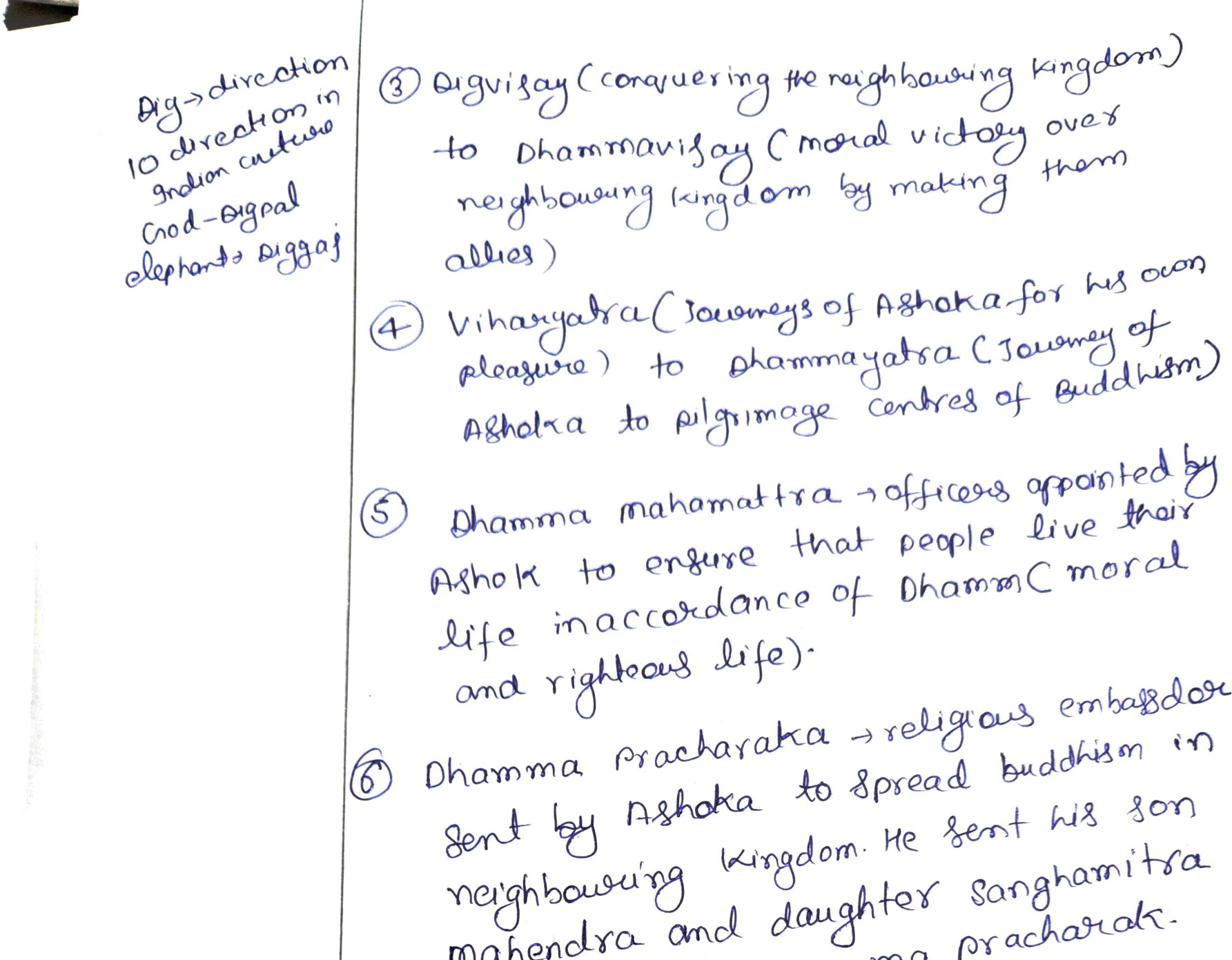
DIAGRAM (board): Six "before → after" pairs (Chandashoka→Dhammashoka, Bherighosha→Dhammaghosha, Digvijaya→Dhammavijaya, Vihara-yatra→Dhamma-yatra) plus the two new institutions (Dhamma Mahamatra, Dhamma Pracharaka).
Class board notes (scan):
Clean version:
The six points, one by one (this is how the teacher dictated them):
- Chandashoka → Dhammashoka. From "Chanda" Ashoka (violent and cruel) to "Dhamma" Ashoka (moral and righteous).
- Bherighosha → Dhammaghosha. Ghosha = sound / proclamation; Bheri = the war-trumpet/drum (blown when the army marches — i.e. scaring others with the sound of the military). So Bherighosha = threatening neighbouring kingdoms by military power → replaced by Dhammaghosha = persuading neighbouring kingdoms to take the right and moral path.
- Digvijaya → Dhammavijaya. Dig = direction (see box). Digvijaya = conquering the neighbouring kingdoms [militarily] → Dhammavijaya = moral victory over neighbouring kingdoms by making them allies.
- Vihara-yatra → Dhamma-yatra. Vihara-yatra = journeys of Ashoka for his own pleasure → Dhamma-yatra = journeys to the pilgrimage centres of Buddhism (Tirtha-yatra).
- Dhamma Mahamatra — officers appointed by Ashoka to ensure that people live their life in accordance with Dhamma (a moral and righteous life).
- Dhamma Pracharaka — religious ambassadors sent by Ashoka to spread Buddhism in neighbouring kingdoms. For example, he sent his son Mahendra and daughter Sanghamitra to Sri Lanka as Dhamma Pracharakas.
TEACHER'S EXAMPLE (what "Dig" means — directions in Indian culture): Dig means direction (and also sky). Indian culture has 10 directions (the four sides, four corners, plus up and down = a 3-D space of directions). The god of each direction is a Digpala, and the elephant of these gods is a Diggaja (gaja = elephant). This is why "Digvijaya" literally means conquest in all directions.
The big debate — did "Dhamma" mean morality or Buddhism?
EXAM FOCUS / PYQ: This is a famous Prelims trap. UPSC once gave an option asking what Ashoka wanted to spread through Dhamma — with "morality" as one option and "Buddhism" as another. A serious scholar gets confused (because there's a genuine scholarly debate); a non-serious one simply writes "morality." At GS level, take Dhamma = morality, which was for the welfare of the people — and move on. (The deeper debate is for the optional.)
TEACHER'S EXAMPLE (the logic of the debate — don't write it, just understand it): The argument for "Buddhism" is: Ashoka sent his son and daughter to spread Buddhism in Sri Lanka; his Dhamma-yatras went to Buddhist pilgrimage sites; the animals and symbols on his pillars are Buddhist — surely a king spreading Buddhism abroad was spreading it at home too. The argument for "morality / consolidation" is: he had just won everything, so he wanted to peacefully consolidate his empire, and morality (like a self-rule ideal) is good for the people. There was even a recent public spat over Ashoka's image — an economic-advisor figure (in a podcast) called him "Chandashoka," an evil/violent man, while others insisted he was "Dhammashoka." (Teacher: we have no psycho-analysis of Ashoka; at GS level, treat Dhamma as morality for the people's welfare.)
TEACHER'S EXAMPLE (would you accept "morality officers"? — why Dhamma must be benevolent): If the Dhamma Mahamatras were oppressive moral police — arresting you for a harsh word on the phone with your mother — no one would accept such a kingdom. So Dhamma, to have worked, must have been morality for the people's welfare, not oppression.
TEACHER'S EXAMPLE (Gandhi was built on Jainism): Mahatma Gandhi's philosophy drew more on Jainism than on Buddhism. The five vows of Jainism — aparigraha (no wealth), asteya (no stealing), satya (truth), ahimsa (non-violence) and brahmacharya — are essentially Gandhi's philosophy (including his much-debated "experiments with brahmacharya"). (Caveat the teacher added: every great person broadly says similar things — no great person ever preached beating the poor or stealing.)
TEACHER'S EXAMPLE (revision — how karma transfers without a soul; the robot/pen-drive analogy): Bollywood reincarnation scenes show the body, soul and karma all reborn (the same actor returns, looking identical) — only so the audience isn't confused. In reality only karma carries forward. Think of a robot that, over its life, auto-writes 10 million lines of code (= its learning = its karma). When the machine is about to die, you copy the code into a new machine — what transfers is the code (karma), not the old machine (the body); even its wrong learning carries over. Now, if you copy the code via a pen-drive, think of that pen-drive as the soul — that's the Jain view (a soul-packet carries the karma). Buddhism says there is no pen-drive at all — the code (karma) transfers directly (like typing it in), with no soul-packet. And how does the karma finally end? Through Upeksha-bhava — a feeling of indifference: staying non-emotional whether good or bad happens; then the accumulated karma slowly disappears. (True in both Jainism and Buddhism.)
5. Ashokan Inscriptions
Ashoka's inscriptions fall into three groups, distinguished by when in his reign they were cut, what they focus on, and where they were placed.
- Minor Rock Edicts — inscribed in the early years of his rule, with the main focus on his devotion to Buddhism. These are non-descriptive (they don't describe things elaborately), which is why they are called "minor." They were written on rocks and placed on highways and trade routes.
- Major Rock Edicts — inscribed in the middle years, with the main focus on his message to his people on how to live life in accordance with Dhamma. These are descriptive in nature, which is why they are called "major." Also on rocks, placed on highways and trade routes.
- Pillar Edicts — inscribed in the later years, with the main focus on his message to later kings on how to rule the subjects and the empire (e.g. he advised them to treat their subjects as a father treats his own children). Both descriptive and non-descriptive ones are found — Major Pillar Edicts and Minor Pillar Edicts. They were inscribed on stone pillars and placed at centres of Buddhism.
CLARIFICATION (what exactly is an "edict"?): An edict = a message / an article (its content) — not the stone. If 10 messages are written on one stone, that is 10 edicts; if the same 10 messages are written on another stone, they are still the same 10 edicts. Analogy: the 14th "edict" of the Indian Constitution is about equality — it remains the same edict whether there is 1 copy or 100 copies of the Constitution. So an edict is the message, regardless of how many stones carry it.
Language and script
- Language: mainly Prakrit — (Sanskrit, Greek and Aramaic languages are also found).
- Script: mainly Brahmi — (Kharoshthi, Greek and Aramaic scripts are also found).
TEACHER'S EXAMPLE (language ≠ script — the point most students get wrong): Language is what we speak; script is what we write. Take the word "language" itself: its language is English, its script is Roman. Hindi is written in the Devanagari script (Hindi is the language, Devanagari is the script) — and Hindi can also be written in Roman (e.g. "Ram"). This is why people in Bangalore once broke a board "in an anti-Hindi protest" without realising the board might have been Hindi or English — they confuse Hindi with Devanagari. Two more points he stressed: (1) it is a myth that Hindi/Devanagari has matras the way English has vowels — matra is a way of writing, not of speaking; (2) language is broader than script — many spoken things have no script at all (e.g. the casual "have tea?" sound, or "tch", "kch" — we speak them but can't neatly spell them). So the one-word answer: language of Ashokan inscriptions = Prakrit; script = Brahmi.
6. Third Buddhist Council
- Time: 250 BCE
- Place: Pataliputra
- Patron: Ashoka
- President: Moggaliputta Tissa
- Aim: to end the sectarian divide in Buddhism (recall — the result of the Second Buddhist Council was a divide, so every devout ruler wants to end the divide in his own religion).
CLARIFICATION (two different "Tissa"s — a classic confusion): Do not confuse Moggaliputta Tissa (the council's president) with Tissa / Vitashoka (Ashoka's surviving brother). They are different people — Nehru's Discovery of India (and Bharat Ek Khoj) famously mixed them up.
Results
- The sectarian divide could not be ended. (It is easy to say "I'll end the divide," but Ashoka himself got angry at the council.) In fact Ashoka expelled 60,000 monks on the very first day of the council. (What happened: the monks began debating whether the soul exists. Some insisted the soul exists — which is against Buddhism (the Buddha himself stayed silent on the soul). Ashoka, who believed in "no soul," grew so angry he said they should be executed; he was reminded that killing monks is wrong, so they were instead made to leave — and they then formed their own sect.)
- Addition of a new chapter / book named Kathavatthu ("points of controversies in Buddhist philosophy") in the Abhidhamma Pitaka.
- Final compilation of the Abhidhamma Pitaka in its present form.
TEACHER'S EXAMPLE (why Kathavatthu was written as "controversies"): The fight was over philosophy — and the Pitaka of philosophy is the Abhidhamma (recall: Vinaya Pitaka = rules for monks; Sutta Pitaka = teachings of the Buddha; Abhidhamma Pitaka = philosophy). The Abhidhamma had six chapters. If they had simply added a 7th chapter stating one side as "right," the other group's book would have only six chapters → a split in the holy book itself. So instead of declaring a winner, they wrote down both views — the debates — as Kathavatthu (the "points of controversy"), so that everyone could accept the Abhidhamma. Hence Kathavatthu records controversies rather than verdicts.
CLARIFICATION (whose disciple was Ashoka? — depends on the tradition): According to the Hinayana, Ashoka was the disciple of Moggaliputta Tissa. According to the Mahayana, Ashoka was the disciple of Upagupta.
DIAGRAM (board): A yin-yang-like sketch of the Buddhist split, with the Abhidhamma's "6 → +1 = 7th chapter" problem leading to the new chapter Kathavatthu.
Class board notes — see the Third Buddhist Council page in the board PDF (council details + split sketch).
7. Ashoka's Caves & the Later Mauryas
Ashoka's good works (caves): Ashoka donated a group of four caves to the monks of the Ajivika sect; this cave complex is the Barabar Caves (Jehanabad, Bihar).
The later Mauryas:
- Dasharatha Maurya (c. 232–224 BCE) — a grandson of Ashoka. He donated a group of three caves to the Ajivika monks; this complex is the Nagarjuni Caves (near the Barabar Caves, Jehanabad, Bihar).
- Samprati Maurya (c. 224–215 BCE) — a grandson of Ashoka; a follower of Jainism. (In current affairs because a Jain museum has been named after him.)
TEACHER'S EXAMPLE (Ashoka's three famous sons — why grandsons ended up ruling): Ashoka had no direct ruling son, so the throne passed to grandsons. Three sons are remembered: (1) Mahendra — became a monk and went to Sri Lanka; (2) Kunala — was blinded: his step-mother Tishyaraksha (a wife of Ashoka, not Kunala's mother) sent a forged order bearing Ashoka's signature to the local commander to blind Kunala, who duly did so. Years later Kunala, now blind and a singer, came to meet his father; on learning the truth Ashoka was devastated, and when Kunala's son was born Ashoka granted him the kingdom — that son was Samprati; (3) Jalauka — ruled the Kashmir region (per Kalhana's Rajatarangini).
- After Ashoka, many Mauryan kings ruled the empire; however, different sources give a conflicting list of the later Mauryas — so we agree only on the last name.
- Brihadratha Maurya (c. 192–185 BCE) — the last Mauryan king. He was assassinated by his own military general, Pushyamitra Shunga, who founded the Shunga dynasty. (Political history will be picked up from Pushyamitra Shunga in a later class.)
Part B — Mauryan Administration (Arthashastra of Kautilya)
8. Territorial Administration
In Mauryan administration the topmost authority is the King and the bottom-most is the village head. The empire was organised into nested territorial units:
DIAGRAM (board): Vertical hierarchy — Rashtra → Vishaya → Ahara → Janapada → Grama — with the officer(s) heading each level.
Class board notes (scan):
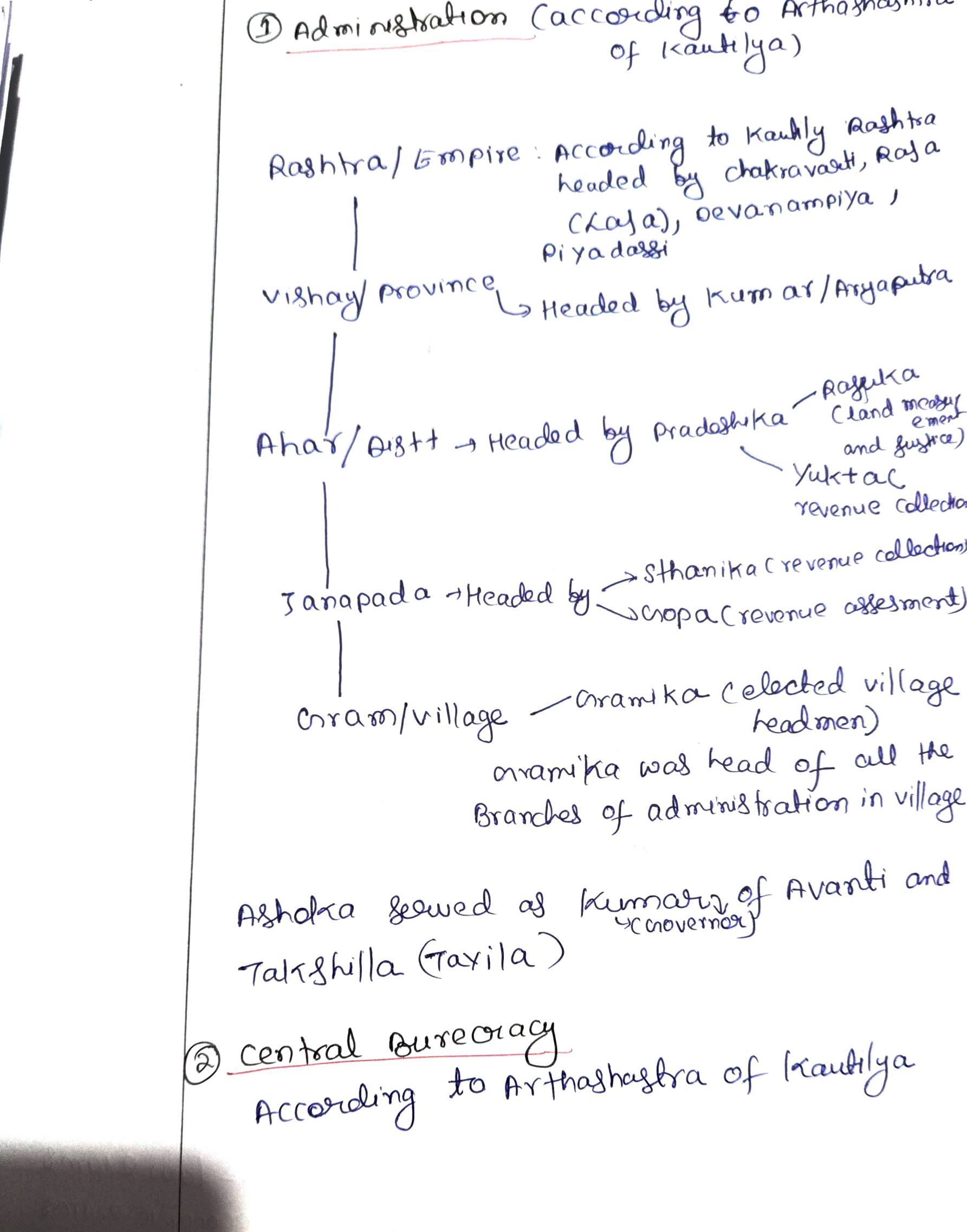
Clean version:
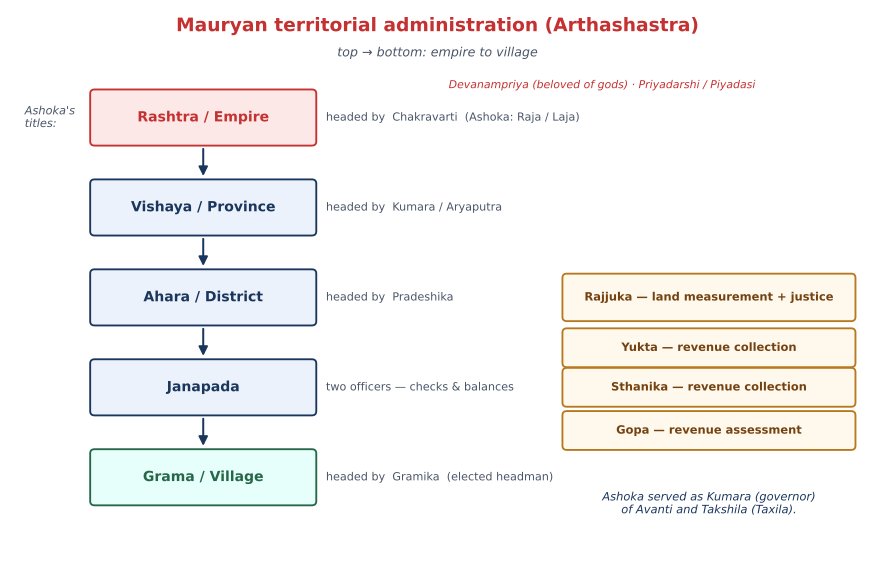
- Rashtra / Empire — headed by the Chakravarti (Arthashastra's term). Ashoka's inscriptions use "Raja" (and "Laja" — R and L are interchangeable in his Prakrit). Ashoka's titles were Devanampriya ("beloved of the gods" — placing the king just below the gods) and Priyadarshi / Piyadasi ("pleasant to look at"). (Teacher's aside: Ashoka was said to be ugly-looking, which is why he took the title "pleasant to watch"!)
- Vishaya / Province — headed by a Kumara or Aryaputra.
- Ahara / District — headed by a Pradeshika, supported by two officers: Rajjuka (rajju = rope → land measurement, and also justice — Ashokan inscriptions mention his justice role) and Yukta (revenue collection; yukta = qualified/appropriate, opposite ayukta).
- Janapada — headed by two officers working as checks and balances: Sthanika (revenue collection) and Gopa (revenue assessment) — i.e. one assesses, the other collects.
- Grama / Village — headed by the Gramika, an elected village headman, who was the head of all branches of administration in the village.
CLARIFICATION (governors were princes): In the Mauryan age the provincial governors were princes. For example, Ashoka himself served as the Kumara (governor) of Avanti and Takshila (Taxila) before becoming king. So Kumara = governor (its literal meaning is "prince").
9. Central Bureaucracy
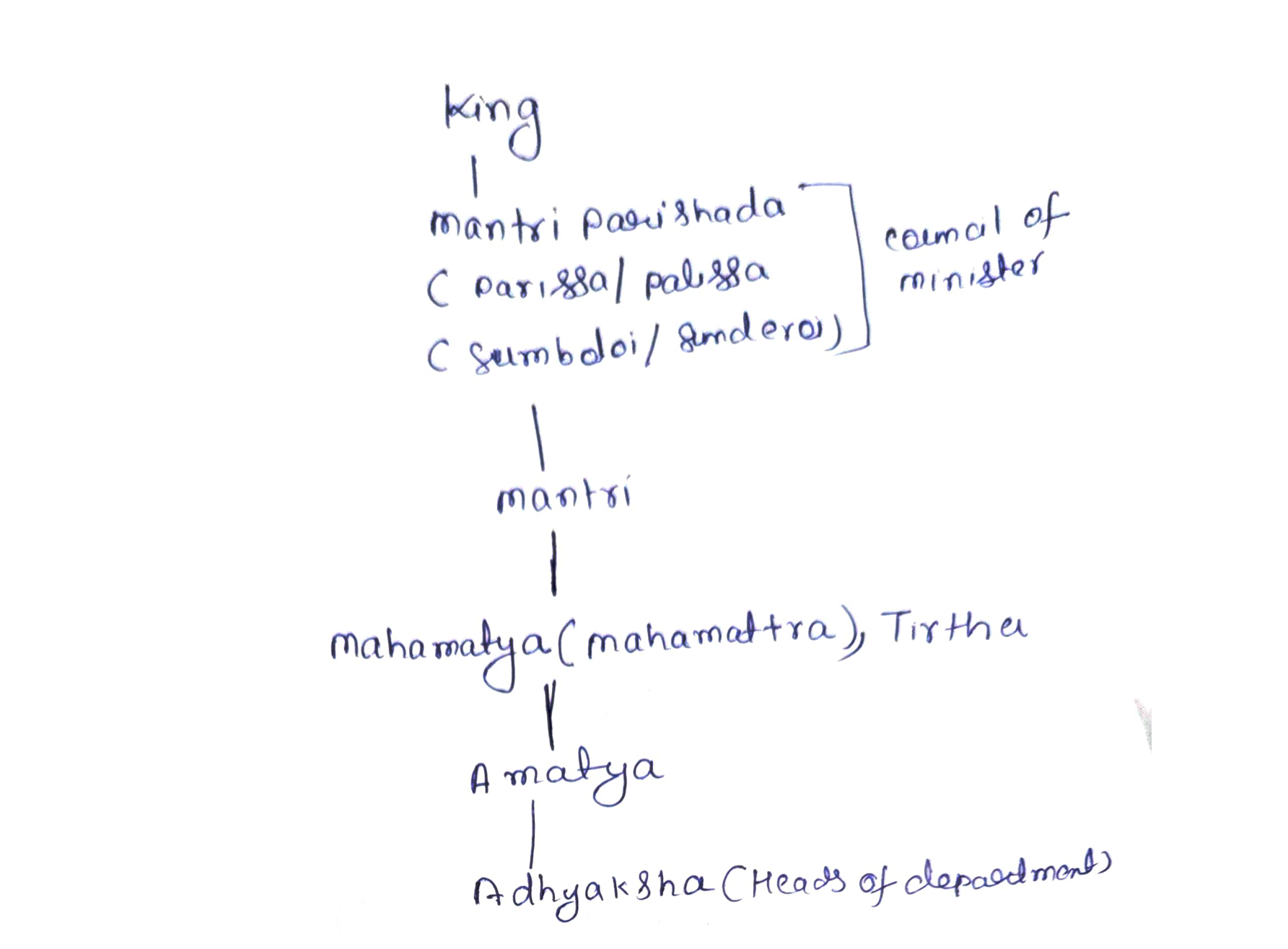
DIAGRAM (board): Vertical chain — King → Mantri Parishad → Mantri → Mahamatya (Mahamatra)/Tirtha → Amatya → Adhyaksha.
Class board notes (scan):
Clean version:
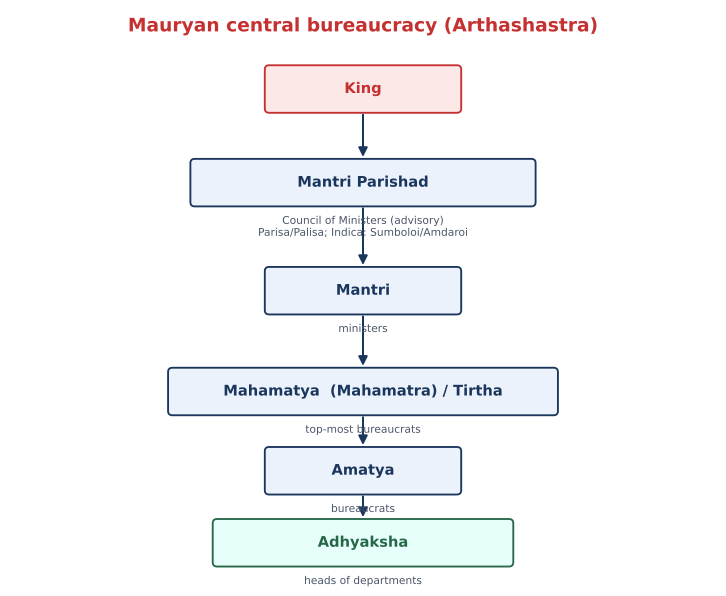
From top to bottom:
- King.
- Mantri Parishad — the Council of Ministers (an advisory body). It is mentioned across the sources: the Arthashastra and the Ashokan inscriptions call it the Parisha/Parishad, and Megasthenes' Indica mentions it too.
- Mantri — the ministers (below the council).
- Mahamatya (in Ashokan Prakrit, Mahamatra), also known as Tirtha — the top-most bureaucrats. ("Maha" = great; the term for a bureaucrat in the Mudrarakshasa is Amatya, and the top one is the Maha-amatya. The Dharma Mahamatra we met earlier are the morality-officers.)
- Amatya — the bureaucrats.
- Adhyaksha — the heads of departments.
Defining features of Mauryan administration (write these as one block): no office was hereditary except the King; there were enough provisions of checks and balances; officers were paid in cash (land-payment to officers begins only in the Gupta age); there was an elaborate spy system; and there were exams to select officers. Together, these indicate a highly efficient administration.
TEACHER'S EXAMPLE (why a department, not a territory — and what the DM still is): There are two ways to assign work — give an officer a territory, or give him a department. Giving a territory is dangerous: the officer "locks his room," lets no one in, and effectively builds his own little kingdom (and could one day revolt). Giving a department keeps central control and accountability. That is why the Arthashastra organises the bureaucracy by departments under Adhyakshas. The modern echo: of the four territorial posts in India (controlling country / state / district / village), the District Magistrate is the one non-elected, territory-holding officer — which is exactly why it is such a coveted post (sometimes sarcastically called the "Indian feudal service"), and why, on democratic principle, territory is otherwise given to elected people.
TEACHER'S EXAMPLE (why exams beat heredity and favouritism): Merit (exams) is the best system we have so far — not because top-rankers provably make better DMs (you can't prove the top 25 ranks outperform the last 25), but because the alternatives are worse. Heredity would have a son inherit his father's post regardless of ability; "lateral"/favouritism sounds attractive ("bring in a great industrialist") but in practice brings favouritism instead of professionalism. An exam-selected officer from a humble background stays loyal to the state because the job is the only source of his family's status — which is why, the teacher noted, none of India's ~200 ambassadors has ever switched sides to the country they were posted in.
The four entrance exams (Upadha) for bureaucrats
The Arthashastra mentions four exams to select bureaucrats — and a candidate had to pass the one exam relevant to the post, not all four:
- Dharmopadha-shuddha — the law / dharma exam (for law-related posts such as the judiciary).
- Arthopadha-shuddha — the economic exam (for revenue/tax posts).
- Bhayopadha-shuddha — the fear exam (a test of courage — e.g. for someone to be sent alone as a messenger on a remote night journey).
- Kamopadha-shuddha — the love exam (a test of character / resistance to temptation).
TEACHER'S EXAMPLE (why character & courage were tested only for some posts — Chanakya's Vishakanya): Not every post needs a character/fear test — but some are far more critical (an ambassador in a foreign country, exposed to honey-trapping, must be incorruptible). The story he told: a neighbouring king, asked by Chanakya to ally with Chandragupta, instead demanded to lead the alliance and ignored the message. A year later, at his own court, his beloved dancer revealed on the eve of his death: "I am a Vishakanya (poison-maiden); my lovers die — I am telling you only because Acharya [Chanakya] said you should know before you die." Chanakya had ten such Vishakanyas working daily near Chandragupta to keep him safe. The shamed king then wrote to his son to accept the alliance and left for the forest. Moral: poor character (and courage) genuinely mattered for sensitive offices — and still does.
10. Spy System
DIAGRAM (board): Spy types by source — Arthashastra (Sanchari, Samstha); Ashokan inscriptions (Prativedaka, Pulisani); Megasthenes (Episkopoi/Ephoroi).
(Board: "Spy System" page — see the board PDF.)
The teacher gave the spy system source by source:
- According to the Arthashastra of Kautilya — two types of spies:
- Sanchari — the junior / field (wandering) spies (the ones who roam, like an undercover agent slipping into enemy territory).
- Samstha — the senior / stationary spies who sit in office, verify the information, and pass it on to the state / king.
- According to the Ashokan inscriptions:
- Prativedaka — a reporter (reporting to the king; prativedana = report — the word survives in modern usage).
- Pulisani — spies (police).
- According to Megasthenes (Indica):
- Episkopoi / Ephoroi — the head of the spy system (overseers).
11. Judicial System
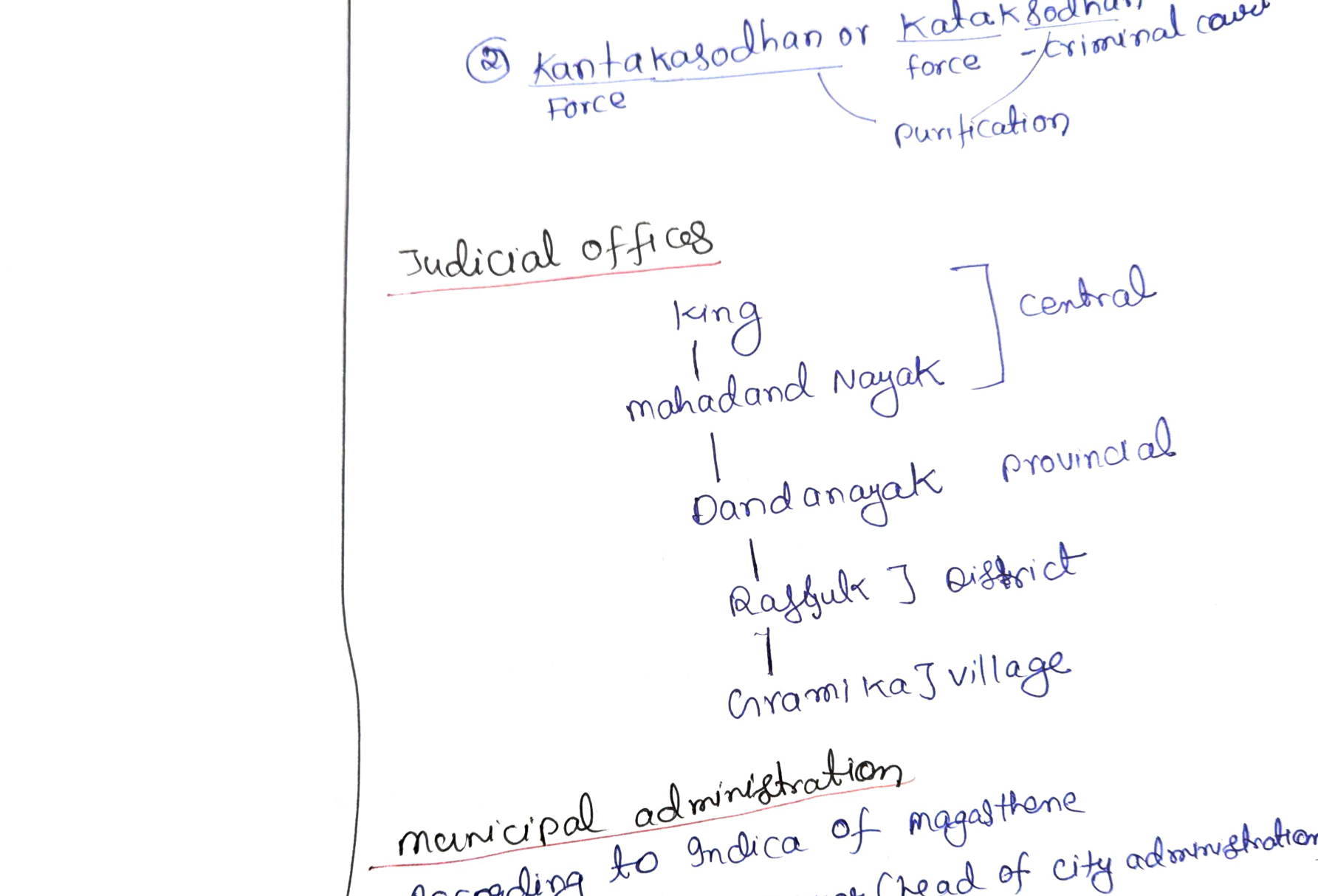
DIAGRAM (board): Two courts (Dharmasthiya / Kantakashodhana) + the judicial-officer hierarchy King → Mahadandanayaka → Dandanayaka → Rajjuka → Gramika.
Class board notes (scan):
Clean version:
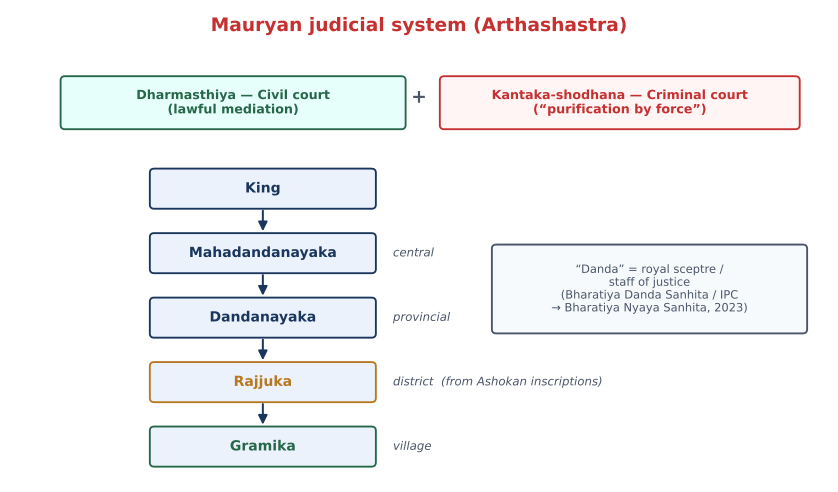
According to the Arthashastra of Kautilya, there were two types of courts:
- Dharmasthiya — the Civil court (lawful mediation).
- Kantakashodhana (Kantaka-shodhana) — the Criminal court. (Kantaka = thorn; shodhana = purification by force. The old belief was that beating a criminal "purifies" him so he won't repeat the crime — hence "purification by force.")*
TEACHER'S EXAMPLE (the "force" root — and the origin of "Cuttack"): Words like cantonment, contain, Cuttack/Katak share a root meaning force / military force. Katak (near Amravati was the Satavahana capital; Cuttack in Odisha) comes from this same idea — and the North-Indian threat "main tujhe maar ke shuddh kar dunga" ("I'll purify you with a beating") is exactly kantaka-shodhana. The origin of the name Cuttack was asked in the 2023 Prelims.
Judicial offices (top to bottom): King → Mahadandanayaka (central) → Dandanayaka (provincial) → Rajjuka (district — the Arthashastra does not mention a district level, so this comes from the Ashokan inscriptions) → Gramika (village).
CLARIFICATION ("Danda" = justice): "Danda" literally means a stick — the Rajdanda is the king's sceptre / staff of justice, which is why all these justice-officers carry "danda" in their titles. The word survives in the old Bharatiya Danda Sanhita (the IPC) — now replaced (2023) by the Bharatiya Nyaya Sanhita.
12. Municipal Administration
According to Megasthenes' Indica, every city had six committees of five members each — this is the single most important fact (almost every author highlights it).
CLARIFICATION (the six city committees — what each did): 1. Census — register the city's births and deaths. 2. Foreigners — help and keep vigilance over foreigners. 3. Industry / production ("excise") — (metal, mines and salt were state monopolies, which is perhaps why an "excise" function existed). 4. Check the market — every shop had to mention the date and price of its goods. 5. Tax the market sales. 6. Custom / tax on goods entering the city. (The teacher said you need not memorise all six — but "six committees of five members each" is fundamental.)
- Head of city administration = Mayor. Megasthenes (Indica) calls him the Astynomoi; the Arthashastra calls him the Nagaraka; the Ashokan inscriptions call him the Nagara-Vyavaharika. (Because all three have "Nagar/city," the term is easy to guess and therefore less likely to be asked.)
CLARIFICATION (Megasthenes' Indica is lost): Megasthenes' own Indica is lost; we have it only as fragments preserved in later works like those of Arrian and Strabo.
13. Military Administration
DIAGRAM (board): Indica's "6 committees of 5" for the army + the Arthashastra's four branches (each under an Adhyaksha) → Chaturangini Sena → Chaturanga → Shatranj → Chess.
Class board notes (scan):
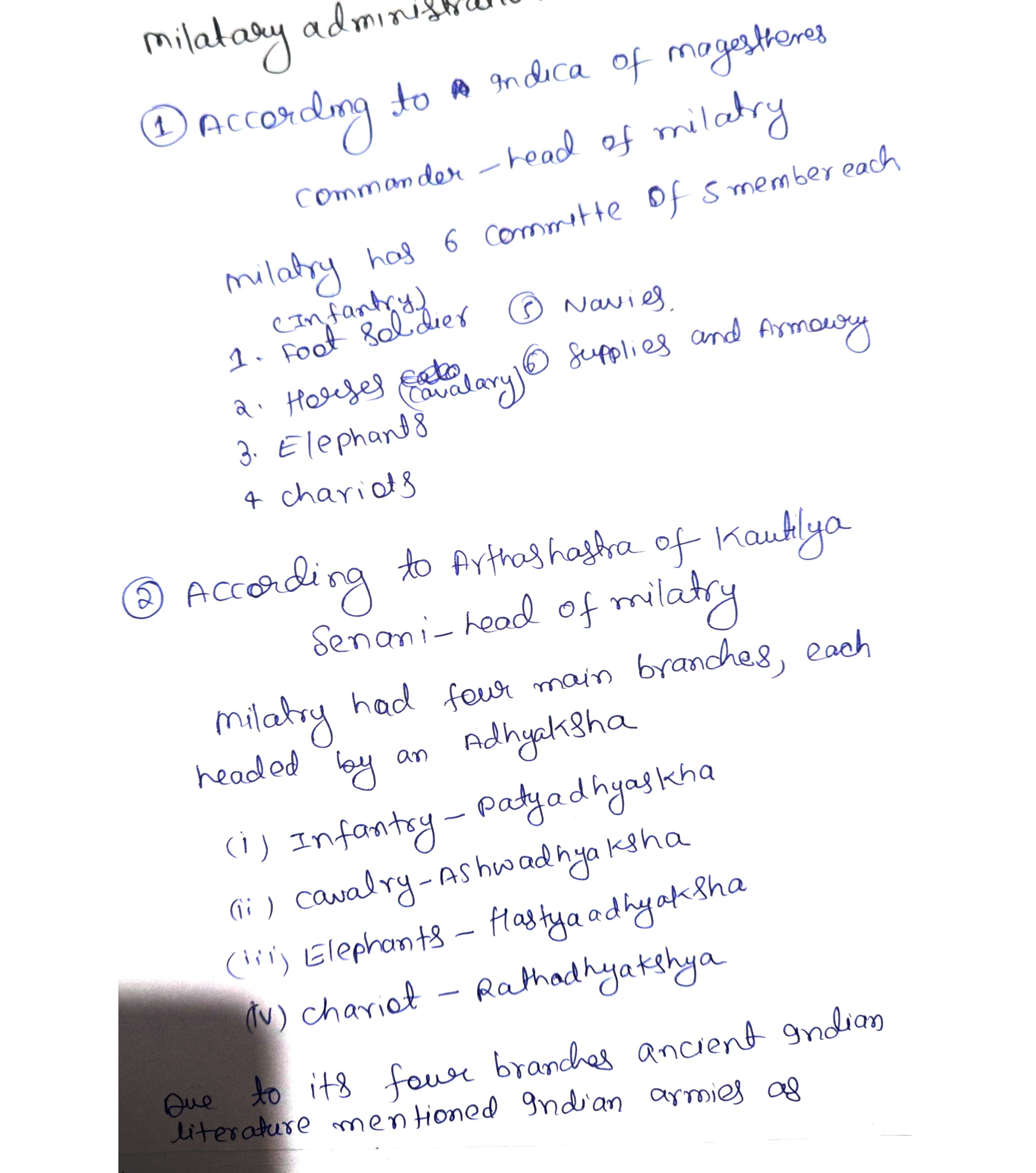
Clean version:
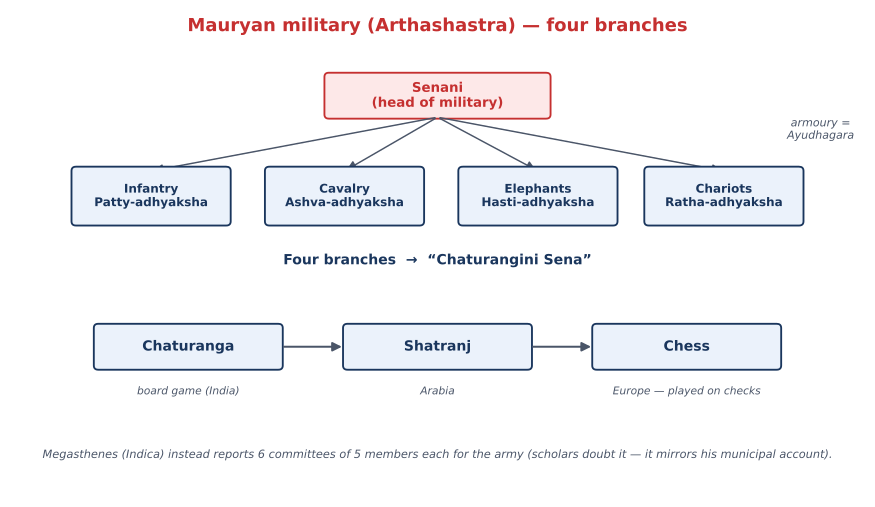
- According to Megasthenes (Indica): the commander is the head of the military, and — interestingly — the military also had six committees of five members each. Scholars doubt this (no other source corroborates it); it looks like Megasthenes lazily repeated the same "six committees of five" he used for the city. The six (as he gives them): infantry/soldiers, cavalry/horses, elephants, chariots, navy, and supplies & armoury. So remember: army = six committees of five members each (per Megasthenes).
- According to the Arthashastra of Kautilya (more believable, and matching other sources): the Senani is the head of the military; there is an armoury (Ayudhagara); and the military had four main branches, each headed by an Adhyaksha:
- Infantry → Pattyadhyaksha
- Cavalry → Ashvadhyaksha
- Elephants → Hastyadhyaksha (hasti = elephant)
- Chariots → Rathadhyaksha
TEACHER'S EXAMPLE (four branches → "Chaturanga" → Chess): Because of these four branches, ancient Indian literature called the army the Chaturangini Sena. From this came the board game Chaturanga (a game based on the four branches of the Indian army). The word travelled: ch tends to become sh in Arabic, so Chaturanga → Shatranj in Arabia, and from there it reached Europe as Chess (played on "checks"). One nice detail: in Indian Chaturanga/Shatranj the Mantri / Wazir moved only one step; in Spain they sped up the game by turning the Wazir/Mantri into the Queen with all her super-powers — giving the modern game.
14. Coinage
DIAGRAM (board): Denomination chain — Pana → Ardhapana → Pada → Ardhapada (Ashtabhagika) → Mashaka.
Class board notes (scan):
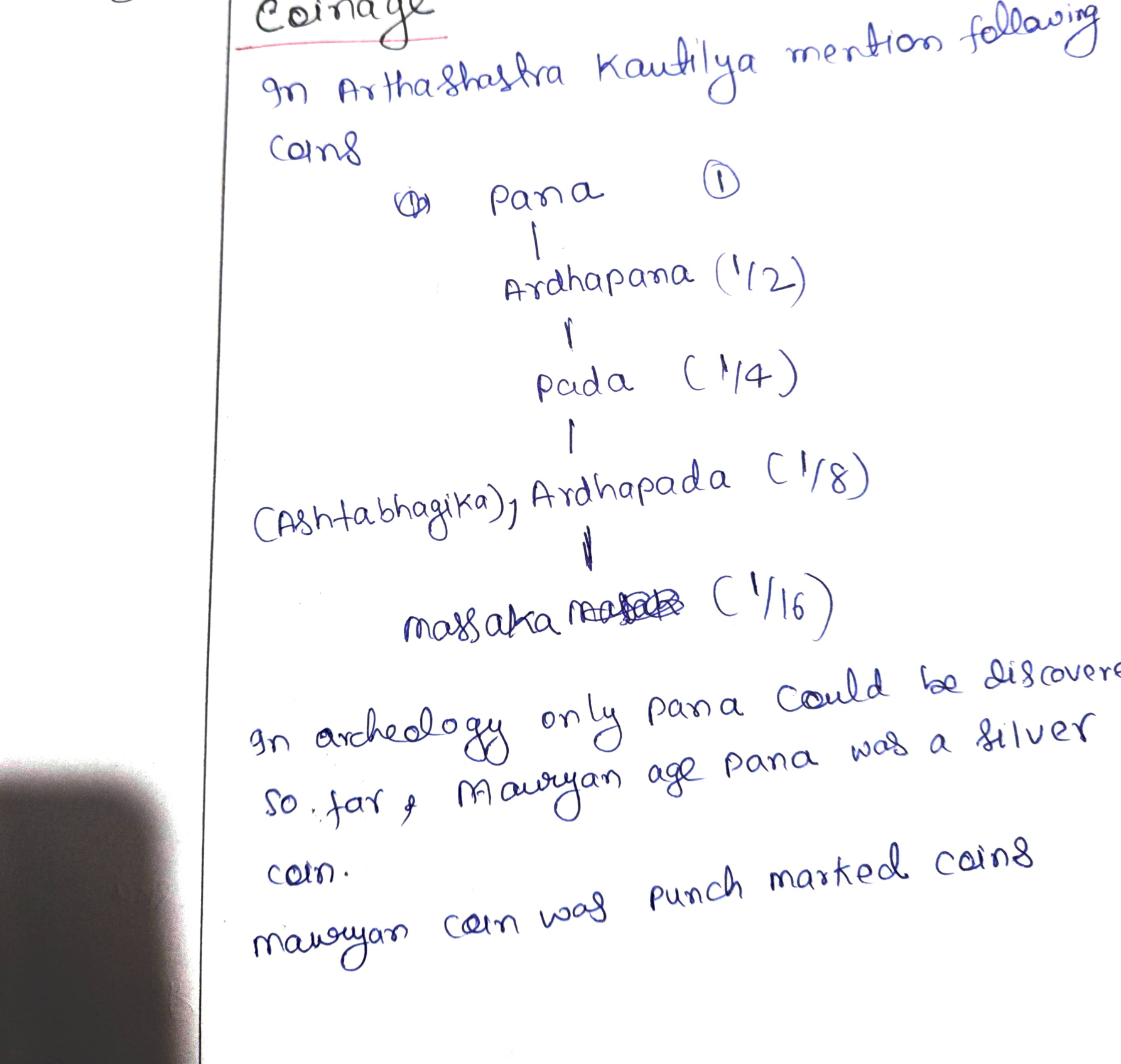
Clean version:
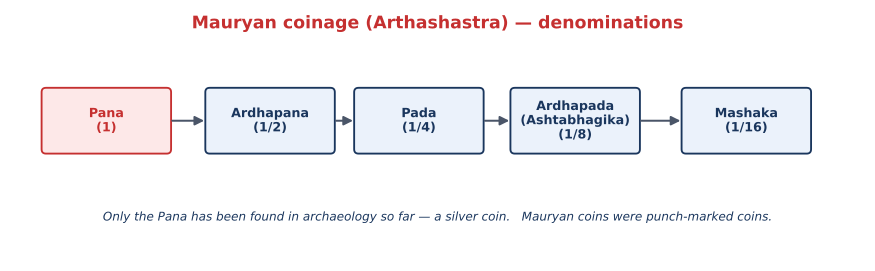
- In the Arthashastra, Kautilya mentions these coins (largest to smallest): Pana (1) → Ardhapana (½) → Pada (¼) → Ardhapada, also called Ashtabhagika (⅛) → Mashaka (1/16).
- In archaeology, only the Pana has been discovered so far; the Mauryan Pana was a silver coin.
- Mauryan coins were punch-marked coins (the coin-type used in India before the arrival of the Greeks).
CLARIFICATION (words that grew from these terms): "pada" later became "padamsha" → the root of "paisa"; and "Samanta", which originally meant a neighbouring king (sama = equal, anta = border → "contemporary/same-time," samkalin), later came to mean a feudal lord / subordinate king — but feudalism (Samantavada) appears only later (Gupta / post-Gupta), not in the Mauryan age.
15. Revenue System
DIAGRAM (board): "No feudalism"; two central revenue officers (Samaharta, Sannidhata); Indica's Agronomoi (with the road-into-the-forest sketch); the two land types; and the list of taxes.
Class board notes (scan):
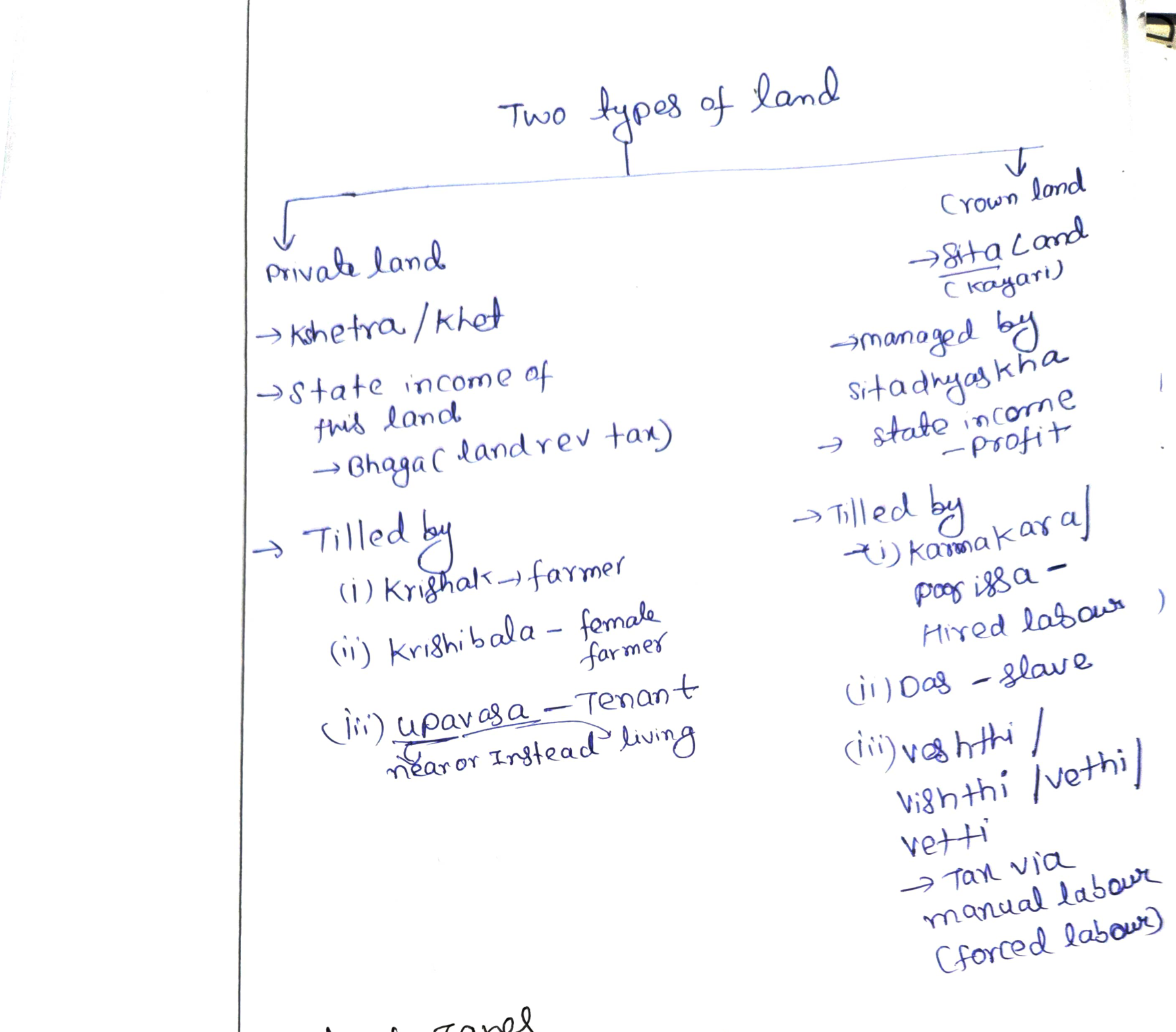
According to the Arthashastra of Kautilya:
- No feudalism / no landlords in the Mauryan age. (Samanta still meant "neighbouring king"; feudalism comes later — see §14.)
- Two central revenue officers: Samaharta / Samahartri = head of revenue collection; Sannidhata / Sannidhatri = head of the revenue treasury (tax was paid in kind, so the Sannidhata built godowns to store it).
- According to the Indica: Agronomoi = head of the rural regions / tax collection. One of his duties was the construction of rural roads.
TEACHER'S EXAMPLE (why a tax-collector built roads — Palm & Finger theory): Don't picture the Mauryans controlling every inch of the map. By the "Palm and Finger" theory, they firmly held the important cities, the highways, and the villages around the highways — they did not go deep into the forest to collect tax. So if an officer wanted to increase the tax base, he built a road into the forest — and that road brought more villages under taxation. That is why tax-collectors constructed rural roads (he is not a pure road-building officer). Modern echo: the Pradhan Mantri Gram Sadak Yojana is mainly about connecting villages, not building highways.
Two types of land
CLARIFICATION (private vs crown land): - Private land = Kshetra (which over time became "Khet"; Kshetra → Khet as Lakshman → Lakhan, Dakshin → Dakkhin). The state's income from it is the Bhaga (the land-revenue tax). It is tilled by the Krishak (farmer)* / Krishibala (female farmer), and a tenant on it is an Upavasa. (Note: upavasa also means fasting, and "to dwell near/instead" — a likely exam trick on the word "tenant.") - Crown land = Sita land (Sita literally = the furrow made by the plough — the line in which seed is sown; this is the land King Janaka was ploughing when he found the infant Sita). It is managed by the Sitadhyaksha. Here the state's income is the entire profit (so the rate doesn't matter). It is tilled by Karmakara* (hired/paid labour) and Dasa (slaves).
CLARIFICATION (forced labour = Vishti): Vishti (also Veshthi / Vethi / Bethi) — an able-bodied man who pays no tax was made by the state to work 3–4 days a month on its fields or projects (road-making etc.). Ancient books call this "tax via manual labour"; modern scholars call it "forced labour." UPSC asked it (~2017–18) as "tax via manual labour" — so remember both framings.
List of taxes (Arthashastra)
The teacher gave each tax by the root word so it's easy to remember:
| # | Tax | Root / meaning | What it was |
|---|---|---|---|
| 1 | Bhaga | bhaga = share | land-revenue tax; main rate 1/6 (Shadbhaga → "Chhath") |
| 2 | Udaka-bhaga | udaka = water | the Bhaga when the state provides irrigation — higher than Bhaga; a new tax, not a cess |
| 3 | Senabhaktam | sena = army, bhakti = devotion | tax on army movement (villages fed/supplied a passing army; later became "Bhatta" = allowance, e.g. Sena Bhatta) |
| 4 | Pindakara | pinda = village | tax on the whole village (collective — for using forest, highways, rivers) |
| 5 | Pranaya | pranay = love | love-tax in any state emergency (voluntary — like a war-bond paid out of love for the state) |
| 6 | Bali | bali = sacrifice/offering | an old, religious-origin levy ("giving something") |
| 7 | (famine region) | — | a famine region is exempt from tax (the rest of the empire is taxed) — not a tax on famine |
| 8 | Shulka | — | toll tax (Chungi / Naka — the bamboo barrier on the road) |
| 9 | Hiranya | hiranya = gold | any of the above tax taken in cash |
| 10 | Vishti (Veshthi/Vethi) | — | tax via manual labour = forced labour (see above) |
TEACHER'S EXAMPLE (tax named by its rate — and why armies were "quartered"): A famous tax is often named after its rate: the Maratha Chauth was 1/4; the European tithe was 1/10; a hair-tax of 1/16 became "shift" — and here Bhaga's main rate was 1/6. On Senabhaktam: an army 500 km from the capital couldn't wait a month for food, so it demanded food (and even housing) from nearby villagers — exactly the "quartering" that provoked the Quartering Act in the American Revolution (army houses are still called "quarters," from this one-fourth levy).
16. Quick Revision Tables
Key dates & people
| Item | Detail |
|---|---|
| First Jain Council | c. 298 BCE, Pataliputra, president Sthulabhadra → Digambara/Shvetambara split; 45 Agamas preserved |
| Mauryan civil war | c. 272–268 BCE; Ashoka killed all brothers except Vitashoka/Tissa |
| Ashoka | c. 268–232 BCE |
| Kalinga War | c. 268–262 BCE; Kalinga = Odisha + part of Andhra; territorial peak |
| Third Buddhist Council | 250 BCE, Pataliputra, patron Ashoka, president Moggaliputta Tissa → Kathavatthu added to Abhidhamma Pitaka |
| Dasharatha Maurya | c. 232–224 BCE; Nagarjuni caves to Ajivikas |
| Samprati Maurya | c. 224–215 BCE; Jain follower |
| Brihadratha | c. 192–185 BCE; last Maurya; killed by Pushyamitra Shunga |
Edicts at a glance
| Edict | Years | Focus | Placed |
|---|---|---|---|
| Minor Rock | early | his devotion to Buddhism (non-descriptive) | rocks; highways & trade routes |
| Major Rock | middle | message to people — how to live by Dhamma (descriptive) | rocks; highways & trade routes |
| Pillar | later | message to later kings — how to rule (both major & minor) | stone pillars; centres of Buddhism |
Language = Prakrit (also Sanskrit, Greek, Aramaic); Script = Brahmi (also Kharoshthi, Greek, Aramaic).
Administration — officers by source
| Wing | Arthashastra | Ashokan inscriptions | Megasthenes (Indica) |
|---|---|---|---|
| Empire head | Chakravarti | Raja / Laja; Devanampriya, Priyadarshi | — |
| Council of Ministers | Mantri Parishad | Parisha | mentioned |
| Top bureaucrat | Mahamatya / Tirtha | Mahamatra | — |
| Dept. heads | Adhyaksha | — | — |
| Spies | Sanstha (stationary), Sanchari (field) | Prativedaka, Pulisani | Episkopoi/Ephoroi (head) |
| City head | Nagaraka | Nagara-Vyavaharika | Astynomoi |
| Revenue | Samaharta (collection), Sannidhata (treasury) | Rajjuka, Yukta | Agronomoi (rural) |
| Military head | Senani (4 branches under Adhyakshas) | — | Commander (6 committees of 5) |
Current Affairs
(Updated as relevant news/magazine content comes in)
| Date | Source | Headline | Connection to this topic |
|---|---|---|---|
| 2023 | UPSC Prelims | Origin of the name Cuttack (Katak) | §11 — Kantaka-shodhana (criminal court / "force") |
| ~2017–18 | UPSC Prelims | Vishti as "tax via manual labour" | §15 — forced labour in the revenue system |
| recent | — | Jain museum named after Samprati Maurya | §7 — Samprati, the Jain-follower grandson of Ashoka |