Jainism, Buddhism, Foreign Invasions & Mauryan Age
GS Paper: GS Paper I | Subject: History — Ancient India | Last updated: 2026-06-04
Covers class 6 & 7. The Jainism section begins from karma & the vows (Triratna/Anuvrat); the introductory Jainism (24 Tirthankaras, Mahavira's life, Digambara/Svetambara) was done in earlier classes and is given below only as an NCERT BASE frame so the note is self-contained.
Table of Contents
- Jainism — Core Path (Karma, Moksha, Triratna, Anuvrat)
- Jainism — Principles
- Jainism — Philosophies (Anekantavada, Syadvada, Saptabhangi)
- Jainism — Levels of Monkhood
- Jainism — Literature (Agamas)
- Buddhism — The Universe, the 7 Buddhas & Names of Buddha
- Buddhism — Life of Gautama Buddha
- Buddhism — Four Basic Principles
- Buddhism — Triratna & the Sangha
- Buddhism — Middle Path, Upeksha & the Eightfold Path
- Buddhism — No-Blessing Doctrine & Pratitya Samutpada
- Buddhist Councils & the Tripitaka
- The First Schism — Sthaviravadin vs Mahasanghika (→ Hinayana / Mahayana)
- Chronology of Foreign Invasions
- Persian Invasion
- Greek Invasion (Alexander)
- Mauryan Age — Foundation & Sources
- Chandragupta Maurya
- Bindusara
- Quick Revision Tables
NCERT BASE (frame for this note): Jainism and Buddhism arose c. 6th century BCE in the Mahajanapada age as part of a wave of heterodox (shramana) movements that rejected Vedic ritualism, animal sacrifice and Brahmanical authority. Jainism had 24 Tirthankaras — 1st Rishabhanatha (Adinatha), 23rd Parshvanatha, 24th Vardhamana Mahavira (last). It later split into two sects — Digambara ("sky-clad", naked) and Svetambara ("white-clad"). Buddhism was founded by Siddhartha Gautama. Both are nastika (do not accept Vedic authority), believe in karma and the cycle of rebirth, and aim at liberation by personal effort, not by a creator God's grace.
1. Jainism — Core Path (Karma, Moksha, Triratna, Anuvrat)
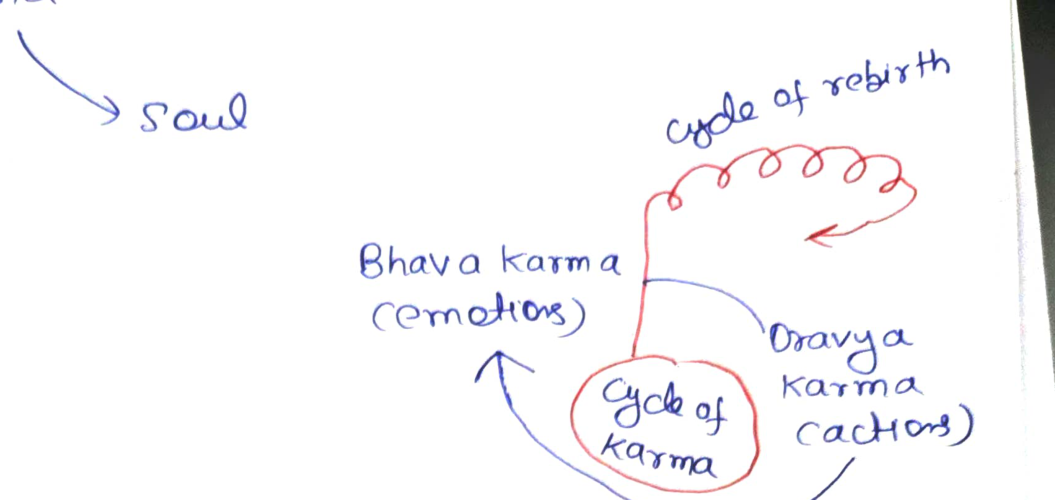
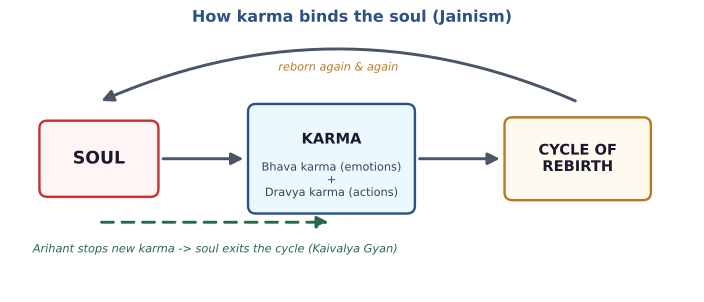
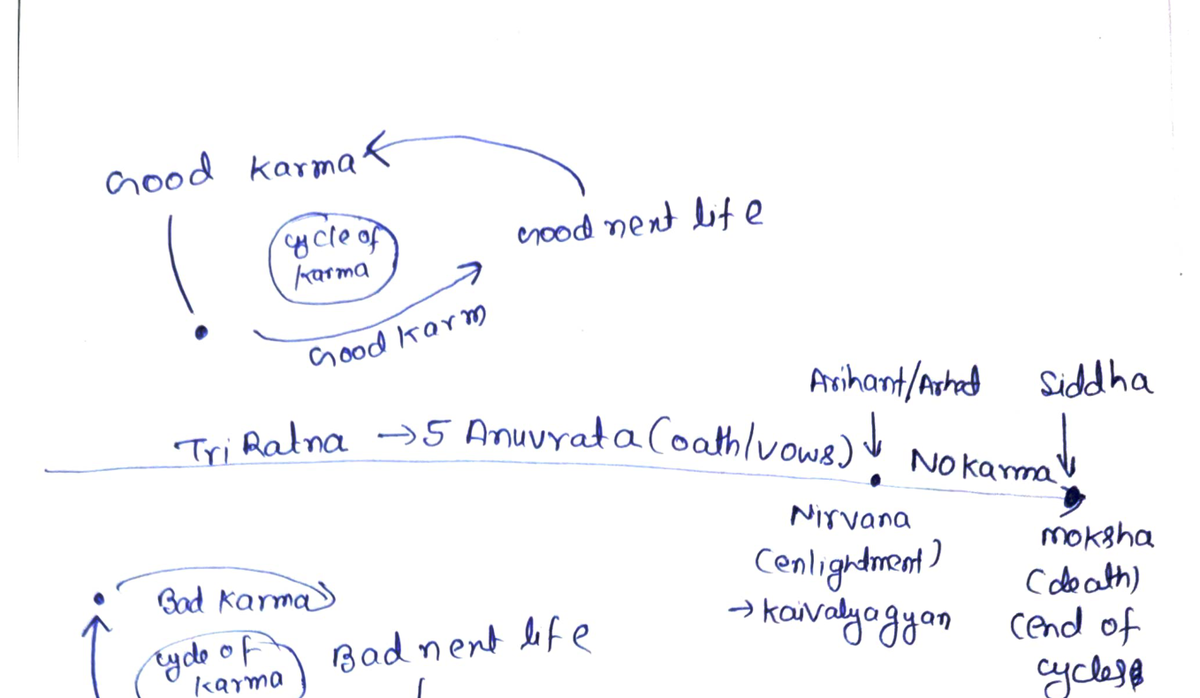
How karma works: Karma reflects in the cycle of rebirth. The soul accumulates karma; good karma → good next life, bad karma → bad next life. The soul keeps cycling through rebirth until it stops accumulating karma.
DIAGRAM (board): Soul at the centre, surrounded by bhava karma (created) feeding into the cycle of rebirth; the soul collects good karma and bad karma, which decide the next life. A person who frees the soul from this karmic cycle exits rebirth.
Class board notes (scan):
Clean version:
Arihant & Siddha:
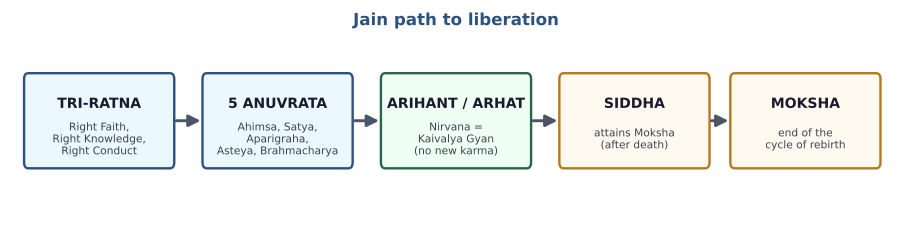
- An Arihant is one who is free from the cycle of rebirth because his soul can stop new karma from entering. Therefore no emotion is generated and no karma is performed.
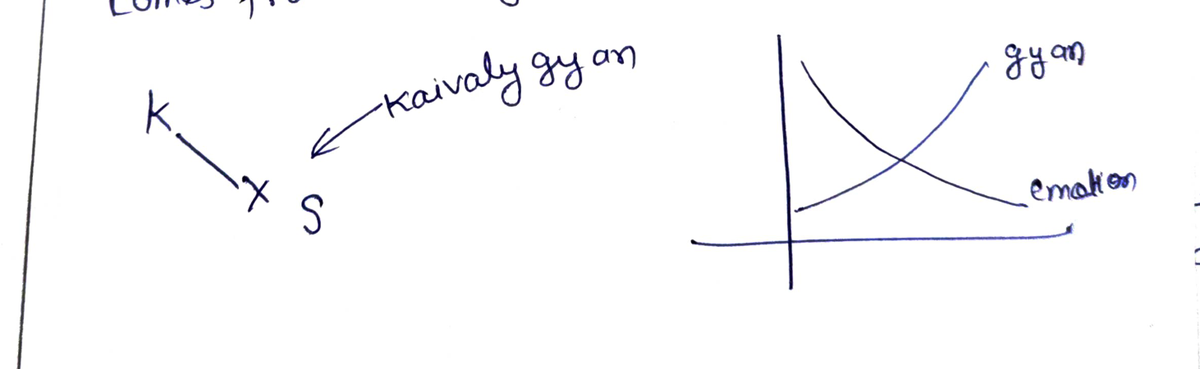
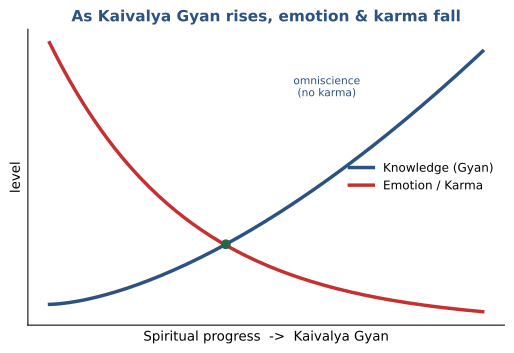
- The ability to stop karma comes from Kaivalya Gyan (omniscience / all-knowledge).
- After the Arihant's death — free from all of this — he becomes a Siddha.
DIAGRAM (board): A graph (K on y-axis vs S/time on x-axis) showing the kaivalya gyan curve — as kaivalya gyan rises, karma/emotion falls toward zero.
Class board notes (scan):
Clean version:
Triratna (Three Jewels)
The three jewels of right living:
- Right Faith (Samyak Darshana)
- Right Knowledge (Samyak Gyan)
- Right Conduct (Samyak Charitra) → expressed through the 5 Anuvrat
Five Anuvrat (Oaths / Vows)
| # | Vow | Meaning |
|---|---|---|
| 1 | Ahimsa | Non-violence |
| 2 | Satya | Truth |
| 3 | Aparigraha | Non-possession ("GR" = ghar — don't fill the house with possessions) |
| 4 | Asteya | Non-stealing |
| 5 | Brahmacharya | Chastity / purity → a life of discipline |
- Only monks and nuns must follow the Anuvrat absolutely.
- Upasaka (lay followers) follow the Anuvrat as much as practically possible.
CLARIFICATION: Brahmacharya is NOT only sexual abstinence — that is just one part. It means a life of discipline with more than 30 rules. Sleeping in late in the morning, wasting food, mocking/laughing at a woman — all break Brahmacharya.
EXAM FOCUS / PYQ: - Relevance of Jainism in present day (2025 Mains, GS): the 5 Anuvrat are themselves a key "relevance" — the entire Gandhian philosophy is essentially these five Anuvrat of Jainism. - Who are Upasaka (2020 Prelims): lay followers who follow the vows only as far as practically possible.
CLARIFICATION: The first four Anuvrat existed up to the 23rd Tirthankara (Parshvanatha). The 5th, Brahmacharya, was added by the 24th Tirthankara, Mahavira.
DIAGRAM (board): The whole Jain path on one line — Tri-Ratna → 5 Anuvrata → Arihant/Arhat (Nirvana = Kaivalya Gyan, no karma) → Siddha → Moksha (end of the cycle of rebirth) — with the good-karma and bad-karma rebirth loops on either side.
Class board notes (scan):
Clean version:
2. Jainism — Principles
- There is no creator God; the universe runs on universal law.
- There is soul in everything — both living beings and non-living beings.
- Gods exist, but below the Tirthankaras. Indra, Mitra, Vayu, Varuna, Brahma, Vishnu, Mahesh, Lakshmi etc. exist — but as gods of specific departments (god of air, fire, water), not the creator. Hence small-"g" gods; the creator "God" (which Jainism denies) would be capital-"G".
- Neither gods nor Tirthankaras can bless anyone in attaining Nirvana/Moksha (Kaivalya Gyan). It is achieved only by personal effort of the individual. Therefore monks and nuns do NOT worship; only upasakas worship, due to personal devotion.
TEACHER'S EXAMPLE (why gods were created): 3,000 years ago, when someone asked "why does rainfall happen?", no one could answer with the water cycle, monsoon winds or plate tectonics. So gods were created to explain the unknown — Indra Dev, Vayu Dev, Varun Dev moving the rains. One definition of "god" is precisely a device to explain what was then unknown.
TEACHER'S EXAMPLE (sacred vs sacrificed — the cow debate): There is no contradiction between an animal being sacred and being sacrificed. If you have one pure and one impure animal, you offer the pure one to god — so a sacred animal is exactly the kind that gets offered. "Sacrifice" means giving up something dear to you (Abraham was asked to sacrifice his most beloved — his son; the Bakrid goat). Sacredness never stopped people from sacrifice: Durga's tiger/lion are killed, Ganesh's mouse (mouse-poison is sold in every shop), Shiva's snake is killed openly, and in the film Kantara people both worship the boar (varaha) and eat it. So whether the cow was killed or not, both the "sacred" and "sacrificed" camps are internally consistent.
3. Jainism — Philosophies (Anekantavada, Syadvada, Saptabhangi)
(1) Anekantavada — "Truth has multiple faces"
Anek = multiple. Truth has multiple faces and we can see only one face of truth; therefore we should accommodate the views of others. Only a Kevalgyani can see all the faces of truth.
TEACHER'S EXAMPLE — 7 blind men & the elephant: Seven blind men were asked to describe an elephant. - Touched the head → "elephant is hard as rock" - Touched the stomach → "soft as a mattress" - Touched the tusk → "sharp like a spear" - Touched the tail → "like a rope" - Touched the ear → "a fan — wind comes from it"
None is wrong; none is wholly right either — each holds one face of truth. Only the man with sight (the Kevalgyani) can see the whole elephant. We live in a "blind world" and can only guess reality.
TEACHER'S EXAMPLE (politics): Ask why a party won an election and you'll get many answers — anti-incumbency, local issues, delimitation, migration concerns, cow/identity issues. By Anekantavada all of these can be true at once; instead of fighting over the "one true reason," understand the other's version.
(2) Syadvada — "Philosophy of Maybe"
From the word "Shayad" (maybe). We not only see only one face of truth — even that one face cannot be fully described by us. Our description is not the truth; it is just our perception.
TEACHER'S EXAMPLE: Never casually tell a junior/child, in front of his parents, "I think one should study early in the morning," and then leave. Your casual perception will be taken by the parents as a hard-defined theory from a "gyani," and they may wake the child at 4 a.m. and make his life hell. So always register that your statements are just your perception, not the absolute truth.
(3) Saptabhangi — Truth has Seven Modes
Truth has seven modes (Saptabhangi). Something generally "good" may contain some bad; something generally "bad" may contain some good. Therefore we should judge our statements and refrain from giving extreme statements.
4. Jainism — Levels of Monkhood
From top to bottom:
| Level | Who they are |
|---|---|
| Tirthankara | The one who guides others on how to attain Moksha |
| Siddha | Those who have attained Moksha (when an Arihant dies, he becomes a Siddha) |
| Arihant / Arhat | Those who attained Kaivalya Gyan (Nirvana) and deserve Moksha |
| Bhikkhu (monk) | Those who renounced the world (family) in search of Moksha |
| Upasaka (lay follower) | Those who did NOT renounce the world in search of Nirvana/Moksha |
- We can never meet a Siddha — because the moment a person becomes a Siddha, he is already dead. (Death of an Arihant makes him a Siddha.)
- Most Jains you meet are Upasakas. For them, this life is more important than Moksha; that is why they keep wealth, do not practise extreme Ahimsa (they'll hit back if attacked), and do not follow Aparigraha/Brahmacharya strictly (if everyone followed Brahmacharya the population would not survive).
CLARIFICATION (Tirthankara from birth): A Tirthankara is a Tirthankara from birth — nature decides it; you cannot choose to become one (just as Rama was an avatar of Vishnu from the day he was born). Mahavira was: an Upasaka till age 30, a monk from 30–42, an Arihant from 42–72, and a Siddha thereafter — yet he was always a Tirthankara; he only knew it at 42 when he got Kaivalya Gyan. There were 24 Tirthankaras; the 24th is already gone. The next Tirthankara (in the next utsarpini, the rising half-cycle) is said to be the rebirth of Bimbisara, named Mahapadma.
5. Jainism — Literature (Agamas)
- The central literature of Jainism = 46 Agamas.
- Of these, the 12 Anga Agamas are the most fundamental — they contain the messages and teachings of the 24 Tirthankaras, and were compiled by the 11 Gandharas.
- The remaining 34 Agamas are the works of later Jain monks (interpretations).
The 11 Gandharas: the 11 main disciples of the last Tirthankara, Mahavira. 10 died during Mahavira's lifetime; only one — Arya Sudharma Swami — lived after his death.
Shruta Kevalin: one who knows / remembers all 46 Agamas (orally; shrut = oral). Bhadrabahu was the last Shruta Kevalin.
CLARIFICATION: After Bhadrabahu no one can ever be a Shruta Kevalin again — because the 12th Anga was lost in the First Jain Council, so only 45 Agamas survive today. (Search online and you'll find only 45 listed.) You cannot remember all 46 — that door is closed. (The First Jain Council itself will be covered next class, under Chandragupta Maurya.)
6. Buddhism — The Universe, the 7 Buddhas & Names of Buddha
The Buddhist universe: has no creator, no destroyer, and no governor. It always existed, although it constantly transforms from one form to another.
To make us aware of the laws of the universe, 7 Buddhas have appeared.
- 1st Buddha → Vipassi Buddha
- 7th Buddha → Siddhartha Gautama (563 BC – 483 BC; 80 years of life)
- 8th Buddha → the Future Buddha, Maitreya
EXAM FOCUS / PYQ: Who is the future Buddha → Maitreya (asked in 2017 Prelims).
CLARIFICATION (7 vs 28 Buddhas): The 7 Buddhas of antiquity are the original list, mentioned in the Pali Tripitaka and depicted on the Sanchi stupa (the 7th = Siddhartha Gautama; the one just before him = Kashyapa Buddha; the future one = Maitreya). The 28 Buddhas list is a later, Mahayana development (around the 1st century). The teacher cautions that NCERT / R.S. Sharma / Upinder Singh are strong on the economy & society of the period but are not the authority on Buddhist religious technicalities — for "who was the first Buddha" they give the later interpretation.
Names / Titles of Buddha
| Title | Meaning |
|---|---|
| Buddha | The enlightened one / "light" |
| Shakyamuni | Monk (muni) of the Shakya kingdom |
| Thera | Elder Monk (respectful term for "elder") |
| Sugata | The one who "gone with bless" / happily gone (su-gati, opposite of dur-gati) |
| Tathagata | (i) The one who came to end our suffering (aagat = arrived); and (ii) the one who attained Moksha and gone forever (gat = gone) |
7. Buddhism — Life of Gautama Buddha
TEACHER'S NOTE: A 4-page life-history handout was uploaded — read it. It is rarely asked directly, but UPSC asks peripheral facts (name of the girl who fed him, his wife's name, his father's name, the rishi whose ashram he joined), so know these.
-
At Buddha's birth a great monk (saint) came to the house. The newborn walked seven steps. The saint told the father: this son will become either a great king or a great monk. The father, wanting a king, surrounded him with all luxury.
TEACHER'S EXAMPLE: To make someone love luxury, keep him in adversity, not luxury. Because he was kept in luxury, he never respected it later — the father's mistake.
-
Married Yashodhara; son named Rahul. At age 29, while roaming with his charioteer Channa, he saw the four sights: an old man, a sick man, a dead body, and a monk. Channa could not explain why all this suffering exists. Buddha resolved that his job was to find the way to end suffering, and left home.
- Joined the ashram of Alara Kalama, learned meditation, but disagreed and left.
- Then tried starving himself (the Jain method). One day, walking, he fell unconscious and would have died of weakness. A girl named Sujata (taking food to her farmer father) gave him kheer (milk-rice). On recovering, he discovered the Middle Path — too much luxury is bad, but no food is also bad; always take the middle path.
- Meditated under the Bodhi tree at Bodh Gaya and at age 35 attained enlightenment.
- Came to Sarnath, found the five monks (his former companions from Alara's ashram), gave them his first sermon → the Dharma Chakra Pravartana (the start of Buddha's journey of teaching).
- Gave sermons for the next 45 years; took his last meal near Kushinara at a place called Pawa; died at age 80 at Kushinagar.
8. Buddhism — Four Basic Principles
| # | Principle | Meaning | Also known as |
|---|---|---|---|
| 1 | Anatta | No Soul. Non-living = no soul + no consciousness; Living = no soul + consciousness | Naratmavada / Anatmavada |
| 2 | Anitya | No permanence — everything is temporary and ever-changing | Kshanikavada |
| 3 | Shunya | Emptiness — there is no self | Shunyavada |
| 4 | Dukkha | Suffering — elaborated in the Four Noble Truths | — |
TEACHER'S EXAMPLE (Shunyavada — "there is no self"): - We celebrate "100 years of independence" though we weren't born in 1947 — we celebrate as a continuing collection, carrying a legacy. "India" is not a single person but a collection of people: some die, some are born, and there is no single point where the population changes — yet the collection continues (like the Indian cricket team across 1983/2007/2011/2023, with players coming and going). - Melt a pen's plastic into a toy — where is the "pen"? There never was a "pen", only plastic in a shape we labelled "pen". A building is just walls; a wall is just cement and brick; cement... and so on (cf. the Nagasena–Chariot dialogue of the Milinda Panha — there is no "chariot," only parts we identify). - "This shirt is green" is only our identification — an alien race would not even recognise it as a shirt. Nothing ever truly existed; it is only our labelling of things.
TEACHER'S EXAMPLE (Dukkha): Life is a suffering to endure, not a party to enjoy (the Charvaka view). The more conscious/intelligent you are, the more suffering you perceive; very happy people often just have lower consciousness. Suffering also chains on: 10th board → 12th board → college → this preparation; each time we think it will end, and it doesn't.
The Four Noble Truths (Chattari Arya Satya)
- Life is a suffering (dukkha).
-
There is a cause of suffering — and the cause is external. (Suffering is reality and external; it is not the inherent nature of the soul to suffer. Contrast: "inherent depression" is rejected.)
TEACHER'S EXAMPLE: Which is the bigger suffering — hunger or disrespect? Disrespect — physical illness/hunger is more bearable than mental suffering.
-
The suffering can end — and in our lifetime (this agrees with the Upanishads).
- There is a method to end suffering. A "method" is replicable — anyone who follows it gets the result (unlike luck).
TEACHER'S EXAMPLE: Winning at gambling once (green shirt, lucky number) is not a method — your friend copying every detail won't be guaranteed a win. Most philosophies say ending suffering also needs purity of heart / a blessing; Buddhism gives an exact method — follow it and anyone can attain it. The method = the Triratna.
9. Buddhism — Triratna & the Sangha
The method is delivered through the Triratna (Three Jewels):
- Buddha — gives the message.
- Dhamma — the teachings of Buddha (our duty). Since no Buddha is alive, the teachings are conveyed by his followers.
- Sangha — the organization of monks.
The Sangha:
- The first five monks to whom Buddha gave his first sermon were the earliest members of the Sangha.
-
Buddha did NOT allow many types of people to be inducted into the Sangha: criminals, slaves, the indebted (those who had taken a loan), lepers / people with communicable disease (kushtha rog), etc.
TEACHER'S EXAMPLE: The Sangha is like a library where everyone is trying to "study" (meditate toward Moksha) — not an NGO running to serve slaves, criminals or the sick. That is why such inductions were not allowed.
-
Buddha was reluctant to allow women, but later allowed them. His aunt / foster mother, Mahaprajapati Gautami (his mother had died at his birth), became the first female member of the Sangha.
TEACHER'S EXAMPLE / CLARIFICATION: Buddha reasoned, "for one woman, should I bar a thousand men?" — but warned that the Sangha's life would be shortened by ~1,000 years because concentration would suffer. Later, when the Sangha declined, women were blamed for the decline (e.g., the story of his half-brother Nanda, son of Mahaprajapati Gautami, who was newly wed and could not concentrate). The teacher flags this as the "new consciousness" of older times that blamed women for men's lack of focus.
10. Buddhism — Middle Path, Upeksha & the Eightfold Path
Middle Path (Madhyam Pratipada): to avoid all extremes and take the balanced view of life.
- Avoid both extremes — neither "baith kar khao" (idle indulgence) nor harsh self-denial.
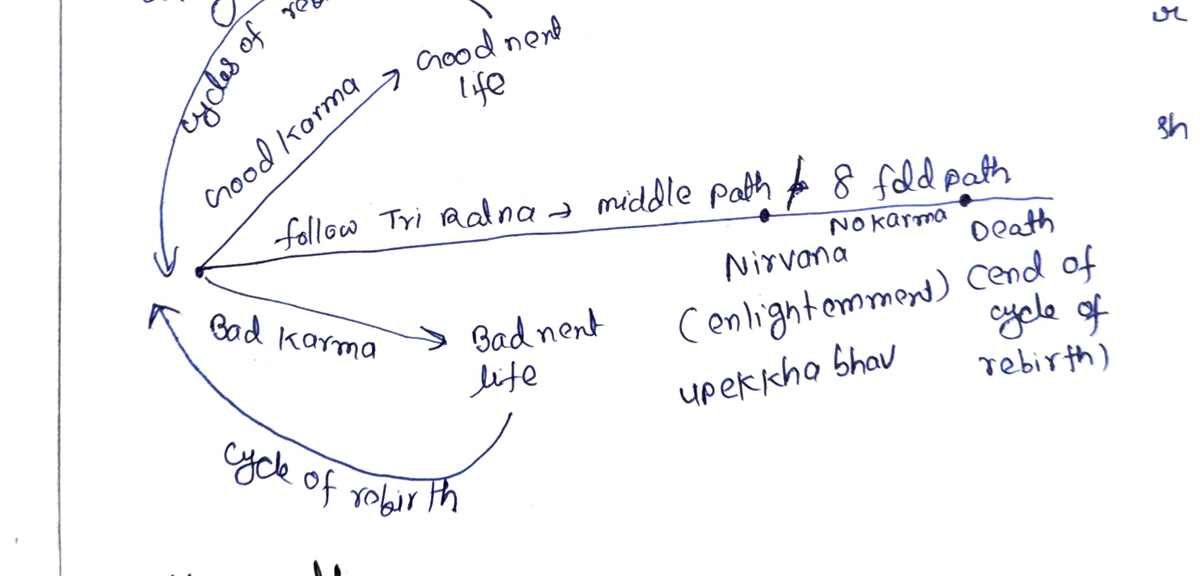
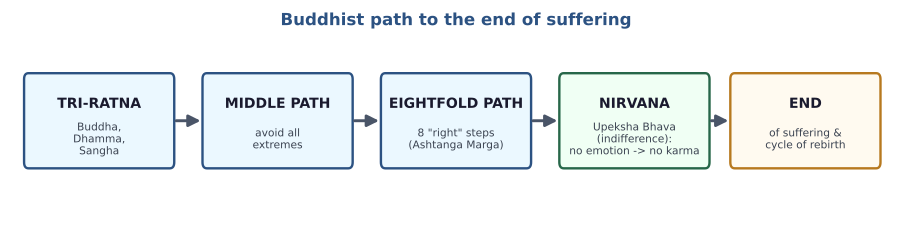
- Following the Middle Path leads to a state called Upeksha Bhava — a state of indifference: no emotion, no attachment. If someone praises you → indifference; if someone criticises you → indifference; nothing should affect you.
- This Upeksha Bhava IS Nirvana (enlightenment) in Buddhism. After it, no emotions are generated and no karma is performed → therefore it is the end of suffering.
CLARIFICATION (Nirvana — Jainism vs Buddhism): In Jainism, Nirvana = Kaivalya Gyan; in Buddhism, Nirvana = Upeksha Bhava (the state of indifference). In both, after Nirvana no new karma is created. In Buddhism, death is not very important because Nirvana itself (the ending of emotions and karma) is the goal — both have cycles of rebirth.
The Eightfold Path (Ashtanga Marga)
The elaboration of the Middle Path; every fold begins with "Right":
- Right Concentration
- Right Effort
- Right Mindfulness
- Right Speech
- Right Action
- Right Livelihood
- Right Thought
- Right Understanding
TEACHER'S EXAMPLE (Right Mindfulness & Vipassana): Without mindfulness you don't even notice your own suffering. Most people breathe through only one nostril their whole life and never notice. We instantly notice a single cut outside the body, but tumours grow inside unnoticed; when a car speeds, blood pressure rises inside and no one feels it. Vipassana (vipassi = "to see") trains you to see/feel inside the body — which is why everything starts with mindfulness.
TEACHER'S TANGENT (Right/Samyak Gyan — "not all knowledge is equal"): Knowledge must be the right knowledge. Rising literacy does not automatically make a society more tolerant; the teacher argues illiterate villagers are often more open-minded than half-educated city-dwellers, that knowledge alone makes no one moral or calm, and that we are driven by emotions/instincts, not thoughts (cf. rational-choice theory — we bargain less with a beautiful salesperson, behave more gently with an air-hostess; we say "beauty of thought matters more than beauty of body" but act otherwise). His point: composure comes from love/security, not from knowledge — "knowledge is overrated" for living a calm life. (Motivational aside, not directly examinable, but kept per the no-drop rule.)
11. Buddhism — No-Blessing Doctrine & Pratitya Samutpada
TEACHER'S EXAMPLE (no blessing needed): Some doctrines (e.g. Shuddha Advaita, Bhakti) hold that only God's blessing helps — that whether one is rich or poor depends on the blessing of Goddess Lakshmi, or that business in India runs on the blessing of politicians. Buddhism and Jainism are NOT based on any blessing. God cannot bless you; the gods themselves are bound by the universal law. Liberation comes from personal effort by following the method. Hence there is no need to worship Buddha or build his statue — just as you don't need a wallpaper of Newton or Einstein on your phone to use their laws; you just apply what they taught.
CLARIFICATION: Every religion started as a rigid reform movement and only later became a worship-religion. Buddha said one thing; his followers later did otherwise (building stupas, pagodas). Rational philosophies (Charvaka, Agyanavada, Uchhedavada, Shashvatavada) never turned into religions precisely because a religion needs reward/punishment and the explanation of the unknown to sustain itself.
Pratitya Samutpada — Philosophy of Dependent Origination
The universe is a complete web of cause and effect: everything is the effect of some cause, and is itself the cause of something else. Ignorance of this chain of cause-and-effect creates confusion, attachment, etc., and results in suffering.
12. Buddhist Councils & the Tripitaka
First Buddhist Council
| Field | Detail |
|---|---|
| Year | 483 BC (the year Buddha died) |
| Place | Saptaparni (Sattapani) Caves, Rajagriha (Rajgir) — Nalanda district, Bihar |
| Patron | Ajatashatru |
| Head Monk / President | Mahakashyapa |
| Aim | To compile and preserve the teachings of Buddha |
| Result | Compilation of the Tripitaka |
The Tripitaka ("Three Baskets")
Central literature of Buddhism (pitaka = basket / pitara):
- Sutta Pitaka — the messages and teachings of Buddha (sutta = sutra = formula/message; the Prakrit drops the "r"). Famous for 5 chapters/books called Nikayas: Digha, Majjhima, Khuddaka, Anguttara (Uttar), Samyukta.
- Vinaya Pitaka — rules and guidelines for monks and nuns (vinaya = humbleness).
- Abhidhamma Pitaka — the philosophy of Buddhism.
Jataka Tales: stories of the past lives of Buddha, mentioned within the Sutta Pitaka and Vinaya Pitaka.
CLARIFICATION (a common myth): It is wrong to say "the third Pitaka was compiled in the third Council." All three Pitakas were essentially compiled in the First Council. What actually happened: of the 7 chapters of the Abhidhamma Pitaka, 6 were compiled in the First Council; the 7th chapter — Kathavatthu — was added in the Third Council. (So 2nd Council ≈ for the 2nd Pitaka/Vinaya; 3rd Council adds Kathavatthu; 4th Council → for commentaries.)
Second Buddhist Council
| Field | Detail |
|---|---|
| Time | 383 BC (100 years after the First Council) |
| Place | Vaishali, Bihar |
| Patron (king) | Kalashoka |
| President | Sabbakami (Sarvakami) |
| Aim | To solve conflicts over the rules & guidelines for monks (the Vinaya Pitaka) — rigid vs liberal rules |
| Result | (1) Conflicts could not be solved → the first split / schism in Buddhism; (2) Formation of the first two sects |
13. The First Schism — Sthaviravadin vs Mahasanghika
DIAGRAM (board): Sangha → Triratna → Middle Path → 8-fold path → Nirvana (Upeksha Bhava) → end of the cycle of rebirth.
Class board notes (scan):
Clean version:
| Sthaviravadin | Mahasanghika |
|---|---|
| Follow rigid rules (rigid = sthir, fixed/unmovable) | Liberal rules (they were the majority → maha) |
| No new fact could be added in Buddhism | New facts and interpretations could be added |
| Buddha was a human (a Thera — elder monk) | Buddha was divine |
| ↓ Hinayana | ↓ Mahayana |
- The Hinayana / Mahayana divide formally appears in the 4th Council (2nd century AD).
- Mahayana = "great vehicle"; it mocked the others as Hinayana = "inferior vehicle" (heen). For Mahayana, Buddha was divine — he never really took birth and never died; it was just the illusion of a divine figure.
TEACHER'S EXAMPLE (interpretation): Mahasanghika's openness to interpretation is like asking a Gandhian "what would Gandhi's view be on cyber-hacking?" — Gandhi never spoke on it, but a philosopher must be able to interpret the principle for a new reality (it is bad — bura uddeshya). Closing your brain to new conditions defeats the purpose of philosophy; this is like a constitutional amendment adjusting for new reality — adjustment, not betrayal.
CLARIFICATION: Gautama Buddha and Mahavira are usually called contemporaries (a very famous question), but the teacher believes that the evidence (rarely placing them together) suggests they were perhaps NOT contemporaries — and warns against the lazy "everyone copied everyone / everything came from Sanatana Dharma" arguments.
14. Chronology of Foreign Invasions
| # | Invaders | Indian name | Approx. date |
|---|---|---|---|
| 1 | Persians | Parsika | 517 BC |
| 2 | Greeks | Yavana | 326 BC |
| 3 | Indo-Greeks | Yavana | 200 BC |
| 4 | Scythians | Shaka | 90 BC |
| 5 | Parthians | Pahlava | 1st century AD |
| 6 | Kushans | Tushara | 1st century AD |
| 7 | Huns | Hun | 5th century AD |
| 8 | Arabs | — | 712 AD (commander Muhammad bin Qasim, not exactly a ruler) |
TEACHER'S NOTE: These will be read one by one (not all at once). In India, Parthians came first, then Kushans (the Kushan king Kujula Kadphises defeated the Parthians) — though in the wider world they were contemporaries fighting each other, alongside the Roman Empire. (Detailed politics to come in the post-Mauryan age.)
15. Persian Invasion
- 517 BC: Persian king Darius crossed the Khyber Pass and conquered up to the Chenab river.
- Darius sent a Greek traveller named Skylax to survey the Indus region. In his book "Periplus of Skylax", the oldest mention of the term "India" is found.
CLARIFICATION (how "Sindhu" became "India"): Persians pronounce S as H (e.g. saptah → hafta), so Sindhu → Hindu. Greeks tend to make the initial H silent (e.g. honest → onest, honour → onour), so Hindu → Indu/Indus; and "land" (sthan / -land, as in Rajasthan, Pakistan, England, Scotland, Ireland) gives India — "land of the people of the Indus."
- 440 BC: the Greek scholar Herodotus (the "Father of History") wrote the book "History", giving the first detailed description of India. According to him the Persian Empire had 20 Satrapies, of which 3 were in India: Gandhara, Sattagydia, and Hindush (Sind).
- Satrap = a province / subordinate kingdom; Satrapa = a governor / subordinate king. The Indianized term for Satrap = Kshatrapa (Chhatrapa). (Distinct from "Chhatrapati"; here Kshatra = territory.)
-
395 BC: a Greek physician in the Persian court named Ctesias wrote a book "Indica", describing India — but due to its exaggerations even contemporary Greek authors rejected the work.
TEACHER'S EXAMPLE (Ctesias's absurd claims): people with two heads who talk to each other; ~25% of people with dog heads who bark; one-legged people whose single huge foot is used as an umbrella in the rain; horses with one horn (unicorns); headless people with eyes in the chest and mouth in the stomach; the Manticore (head of a human, body of a lion, tail of a scorpion); people with ears bigger than their body used to sweep; and Indians throwing river-water at the sun "to cool it down." Hence his account is not taken seriously.
-
331 BC: Alexander defeated Darius III, which led to the end of the Persian Empire. According to Greek sources, Indian soldiers were part of the Persian army.
Legacies of the ~2-century Persian rule in NW India:
- Arrival of a new religion — Zoroastrianism (today's Parsi faith).
- A new language — Aramaic; a new script — Aramaic script.
- Birth of a new script — Kharoshthi (by the fusion of Brahmi and Aramaic scripts; written right to left, the main Middle-Eastern script of the day).
- Various royal ceremonies in the Mauryan court were adopted from Persian royal ceremonies.
- Various features of Mauryan architecture were inspired by Persian architecture.
CLARIFICATION: "Parsi" is, strictly, the wrong label for the religion — the faith is Zoroastrianism; "Parsi" simply means "people who came from Persia" (like calling allopathy "angrezi dawai").
16. Greek Invasion (Alexander)
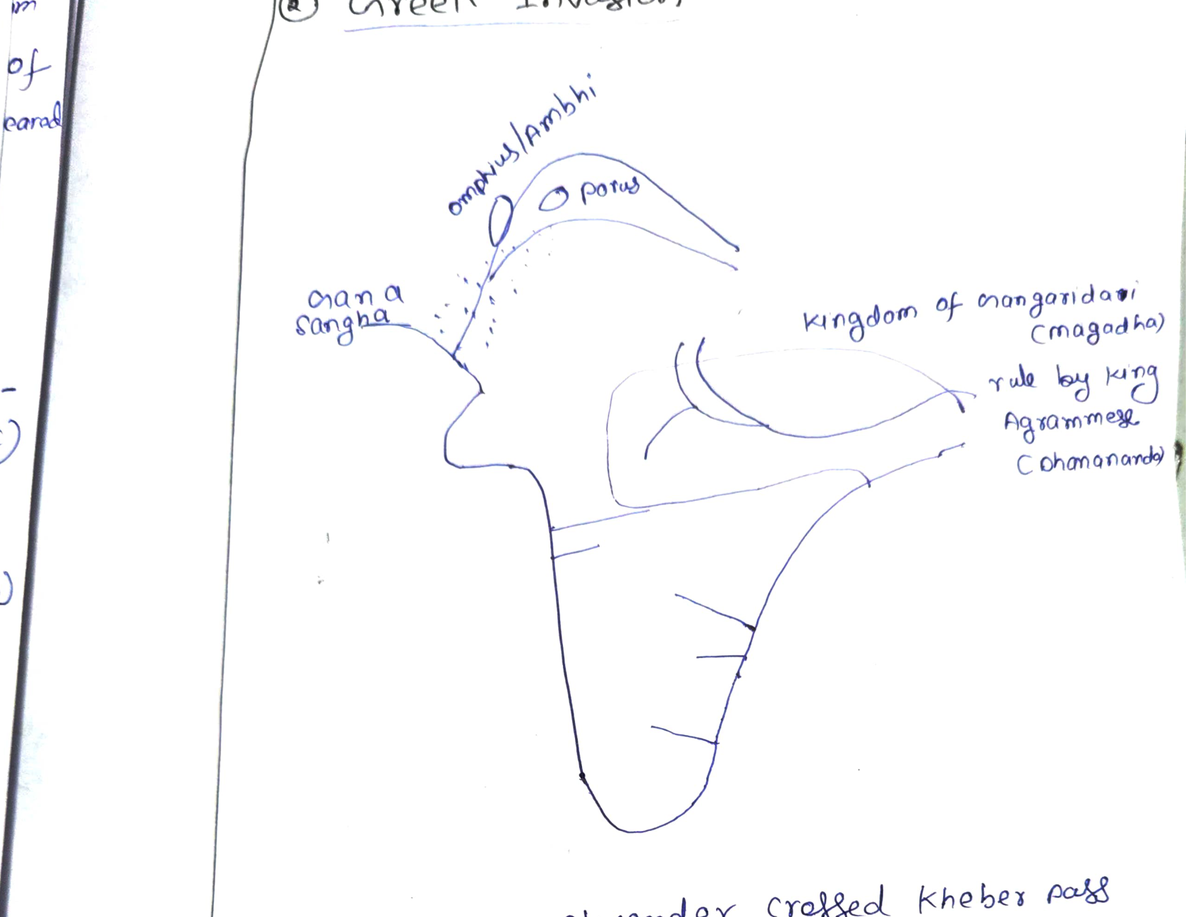
DIAGRAM (board): Map of NW India — Ambhi at Taxila, Porus between Jhelum–Chenab, and to the east the Kingdom of Magadha (Gangaridai) under the Nandas/Dhanananda; Ganasanghas marked as small dotted (jungle/small) states.
Class board notes (scan):
Clean version (built on the shared India base map — official GoI boundary — by real coordinates):
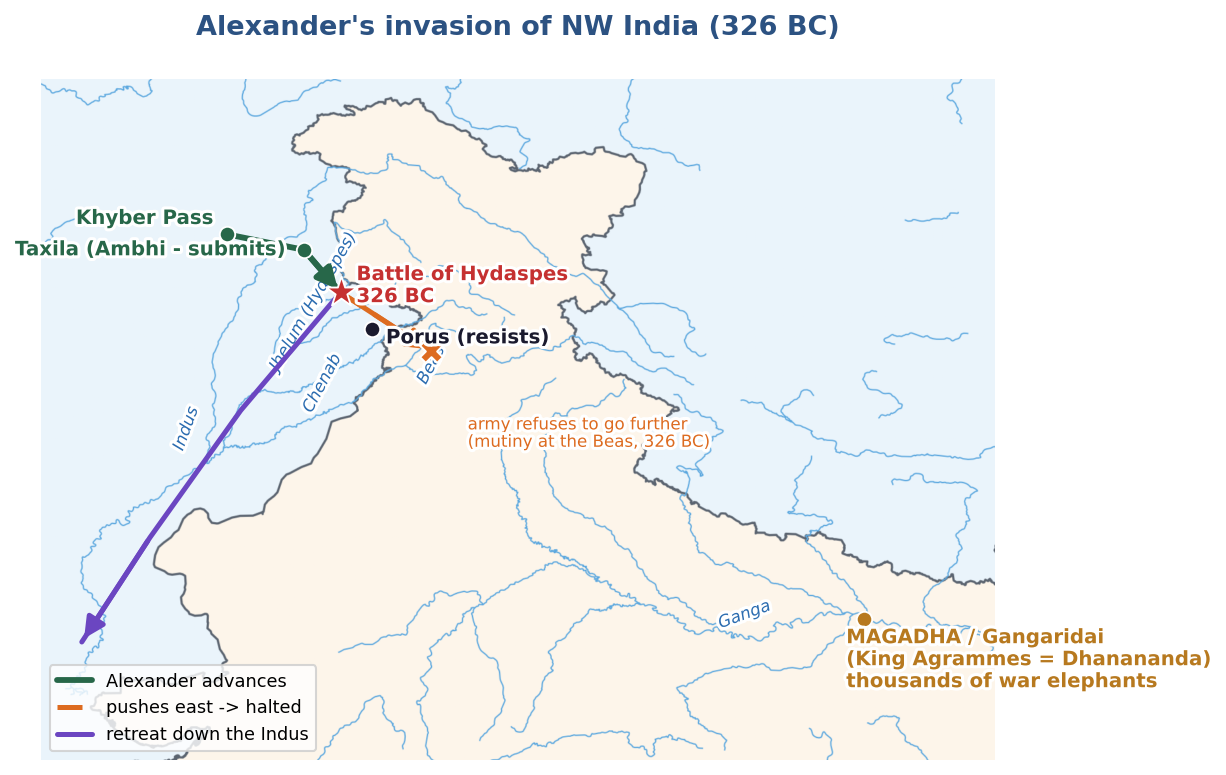
- 326 BC: Alexander crossed the Khyber Pass and entered India (after defeating the Persian Empire). In NW India he offered subordination to many Indian kings: Ambhi (Omphis) accepted; Porus rejected.
-
Battle of Hydaspes (Jhelum river), 326 BC: Alexander + Ambhi vs Porus. Alexander defeated Porus, but returned his territories during the post-war discussions.
TEACHER'S NOTE: The famous exchange — Alexander asked, "How should I treat you?" Porus replied, "Like one king treats another." Alexander was pleased and gave back his territories. (We have no precise record of what actually happened.)
-
Alexander wanted to move eastwards to conquer the Kingdom of Gangaridai (a Greek word for the Ganga–Yamuna plains), but the news of thousands of war elephants discouraged Alexander and his generals.
- So Alexander moved southwards through the Indus river, conquering various Ganasanghas. In one battle he was wounded, and because of it he died in Mesopotamia in 323 BC.
- After Alexander, his empire was divided among his Diadochi (military commanders). The eastern part (Syria to the Indus) was succeeded by his Diadochus Seleucus Nicator.
EXAM FOCUS / why Alexander matters: Alexander's invasion provides the fundamental anchor date of Indian history. Our dating of the Vedic age, the Upanishadic age, Buddha, Mahavira, the Buddhist Councils, the Gupta age — everything is pinned to this date. If this date changes, all of Indian chronology changes. (Word origin aside: Diadochi → Latin "Dictator"; Julius Caesar took over from the Romans in 57 BC.)
MEGASTHENES' UNITS: unit of weight = "talent" (10 talents); unit of length = "stadium".
17. Mauryan Age — Foundation & Sources (321–185 BC)
- The Brahman scholar Chanakya and his student Chandragupta Maurya defeated and killed Dhanananda, which ended the Nanda Empire.
- Source of this story: an 8th-century AD Sanskrit play, "Mudrarakshasa" (Mudra = ring; Amatya Rakshasa = the Prime Minister of Dhanananda), written by Vishakhadatta.
- In it, Chanakya stole the ring / seal of PM Rakshasa and used it to defeat Dhanananda. (Officers wore signet rings to stamp signatures on wax.)
CLARIFICATION (reliability): The event is 3rd century BC, but this story appeared ~1,100 years later (8th century AD), so it is generally considered not exact — but it is the only version we have, so we accept it. (Online claims that "Chanakya is a fictional character" arise because he appears in sources a few centuries later; we cannot deny he existed — only that the story is likely exaggerated.)
18. Chandragupta Maurya (321–298 BC, 23 years)
- 320–310 BC: Western expansion of the Mauryan Empire up to the western coast.
- In Junagadh, Chandragupta ordered his minister Pushyagupta (a Vaishya) to construct a lake — the Sudarshan Lake.
Four kings associated with the Sudarshan Lake:
| # | King | Note |
|---|---|---|
| 1 | Chandragupta Maurya | Built the lake |
| 2 | Ashoka | — |
| 3 | Rudradaman | Title Mahakshatrapa (Kshatrapa under the Kushans); repaired the dam — better than before |
| 4 | Skandagupta | Gupta ruler (son of Kumaragupta) |
CLARIFICATION (Junagadh rock inscriptions): The Junagadh rock carries 3 inscriptions — Ashoka, Rudradaman, Skandagupta. Interestingly, Chandragupta Maurya is mentioned in Rudradaman's inscription, NOT in Ashoka's — his own grandson Ashoka did not write about him. Ashoka's inscription is the oldest readable inscription in India (in Brahmi script; older inscriptions exist but are not readable). In Rudradaman's inscription (500 years later) the angular strokes appear that later became the matras of Nagari → Devanagari — the root from which Devanagari and many Indian scripts trace their origin.
- 305 BC: North-western expansion — Chandragupta conquered the Ganasanghas up to the Indus river, and defeated Seleucus Nicator in a battle (a fort near the Indus). By this victory he:
- gained the territories of the Afghanistan region,
- married Seleucus's daughter, Helena, and
- in return gave 500 war elephants to Seleucus.
- Seleucus sent his ambassador Megasthenes, who wrote the book "Indica" describing King "Sandrocottus" (the Greek name of Chandragupta Maurya) and the capital city "Palibothra" (Pataliputra).
CLARIFICATION (how "Indica" survives): Megasthenes' Indica is itself lost; the Greek originals are also lost. It survives only via Roman sources about Alexander — the so-called "Alexander Romance" — written 400–500 years later in Roman language, and therefore exaggerated (romance = how the world should be, vs realism = how it is). So treat its figures with caution.
Megasthenes' 7-fold division of Indian society (he called each a genos / "genes" — each hereditary and endogamous):
| # | Class | Role |
|---|---|---|
| 1 | Sophists | Men of knowledge (philosophers) |
| 2 | Councillors | Top government officers who make policies in councils |
| 3 | Overseers | Junior government employees who oversee/execute policy |
| 4 | Soldiers | Lived lavish lives; carried weapons even on vacation |
| 5 | Shopkeepers & Artisans | Urban commoners |
| 6 | Farmers | Rural commoners — the majority of India |
| 7 | Herdsmen | Live outside / at the periphery of society; wander with their cattle |
TEACHER'S EXAMPLE (why soldiers were lavish): Soldiers carried their weapons even at home on leave (like a cavalryman going home with his horse), which gave them power — the most influential commoners. He likens it to today: a bureaucrat/IPS officer in a colony is treated as more "influential" than a higher-paid private employee, because the state gives them power — exam-cracking gives that power. In army-based states (e.g. older Pakistan), soldiers live the most lavish life.
- 298 BC: Inspired by the Jain monk Bhadrabahu, Chandragupta Maurya renounced his throne and became a Jain monk. He moved southwards to Shravanabelagola (on the Chandragiri Hills, Hassan district, Karnataka), where he committed Sallekhana (also called Santhara) — religious fast-unto-death / "suicide" by starvation in Jainism.
CLARIFICATION: For a non-religious viewpoint, giving up one's life by starvation is technically suicide, which is why Sallekhana/Santhara is the subject of ongoing moral and legal debates (should the state allow or ban it?) in many states.
19. Bindusara (298–273 BC)
- Son of Chandragupta Maurya, mentioned in Greek sources.
- In his court a Greek ambassador Deimachus visited; the Greek traveller Dionysius also came. (Iambulus (Lambulous) also visited India.)
- Bindusara was a follower of the Ajivika sect, and a disciple of an Ajivika monk named Pingalavatsa.
- The Ajivika sect believed in Absolute Predestination — i.e. Fatalism / Niyativada: everything is predefined; you can make no change (even your thoughts are predefined); whatever has to happen will happen (Niyati = destiny).
- Bindusara expanded the Mauryan Empire southwards up to the lower Deccan. This southern expansion is mentioned in Sangam literature, where the Mauryans are called "Moriyar" (Moriyar literature = literature of the Tamil/southern region).
Sangam kingdoms mentioned in the Ashokan inscriptions:
- Chola
- Pandya
- Keralaputra (Chera)
- Satyaputra
CLARIFICATION (the birth legend): The popular story — that Bindusara's mother drank poison, a drop touched the child's head (→ "Bindu"), and Chanakya cut open her stomach to take the baby out — is dismissed by the teacher as a legend, not exam-relevant. "The bias of history" is that we remember the popular-but-trivial and miss the important.
Next class → First Jain Council (and the origin of Ashoka's name).
20. Quick Revision Tables
Jainism vs Buddhism — at a glance
| Aspect | Jainism | Buddhism |
|---|---|---|
| Founder/last great teacher | Mahavira (24th Tirthankara) | Siddhartha Gautama (7th Buddha) |
| Soul | Soul in everything (living & non-living) | No soul (Anatta) |
| Nirvana | Kaivalya Gyan | Upeksha Bhava (indifference) |
| Path | Triratna + 5 Anuvrat | Triratna + Middle Path / 8-fold Path |
| Liberation by | Personal effort (no blessing) | Personal effort, exact method (no blessing) |
| Central literature | 46 Agamas (12 Anga most fundamental) | Tripitaka (Sutta, Vinaya, Abhidhamma) |
| Extreme penance | Allowed (e.g. Sallekhana) | Rejected — Middle Path |
Buddhist Councils
| Council | Year | Place | Patron | President | Outcome |
|---|---|---|---|---|---|
| First | 483 BC | Saptaparni Caves, Rajagriha (Bihar) | Ajatashatru | Mahakashyapa | Compiled the Tripitaka |
| Second | 383 BC | Vaishali (Bihar) | Kalashoka | Sabbakami | First schism → Sthaviravadin & Mahasanghika |
Foreign accounts of India (Persian–Greek era)
| Author | Date | Book | Note |
|---|---|---|---|
| Skylax | c. 517 BC | Periplus of Skylax | Oldest mention of "India" |
| Herodotus | 440 BC | History | "Father of History"; 20 satrapies, 3 in India |
| Ctesias | 395 BC | Indica | Full of exaggerations; rejected |
| Megasthenes | c. 305 BC | Indica | On Sandrocottus (Chandragupta) & Palibothra; 7-fold society |
Current Affairs
(Updated as relevant news/magazine content comes in)
| Date | Source | Headline | Connection to this topic |
|---|---|---|---|