Governance — Introduction & the Role of Civil Services
GS Paper: GS Paper II | Subject: Governance | Last updated: 2026-06-23
Class 1 (19–20 June 2026) — the foundations of the Governance paper. The live class built up the subject from first principles: the welfare state → DPSP → why governance has no fixed definition → the World Bank's "good governance" (1989) → the dimensions of governance, and then Part B: the role of the civil services in a democracy (Max Weber, Articles 309–312, and the five roles). Issues with the civil services were deferred to the next class.
The printed handout (Vajiram & Ravi, by Sahil Goyal) is the entire "Governance & Social Justice" unit — NGOs/CSOs, SHGs, FCRA, Pressure Groups, the mechanisms for vulnerable sections, and the HDI/MPI indices. The teacher noted these Social-Justice topics will be taught in later classes (NGOs & SHGs possibly by a different faculty). Per the user's instruction, all of that handout is included here, in Part C, clearly marked
> **HANDOUT:**and tagged "to be elaborated in a later class."
Table of Contents
Part A — Foundations of Governance
- The welfare state — the starting idea
- DPSP (Part IV) — the welfare state inside the Constitution
- Why governance has no fixed definition — it varies across space & time
- The modern definition & the World Bank's "good governance" (1989)
- The three aspects of good governance
- The five dimensions of governance
Part B — Role of the Civil Services
- Max Weber, authority & the bureaucracy model
- Constitutional provisions (Articles 309–312)
- Role / relevance of the civil services
Part C — Handout (Social Justice unit, to be elaborated in later classes)
- Development indices (UNDP & NITI Aayog)
- Civil Society Organisations / NGOs + FCRA + RTI
- Self-Help Groups (DAY-NRLM)
- India in the UNDP HDR 2025
- Pressure Groups
- Mechanisms for vulnerable sections
Part A — Foundations of Governance
1. The welfare state — the starting idea
The class opened from the idea of welfare. Summing up the students' attempts, the teacher defined welfare as "the greatest good that can be done to the greatest number of people without any discrimination" — and noted that the Supreme Court has affirmed this very formulation as the meaning of a welfare state. The state's job is not merely to meet citizens' basic needs but the needs required to lead a life of dignity.
Where do we find this idea of the welfare state reflected in the Indian constitutional scheme? In Part IV — the Directive Principles of State Policy (DPSP).
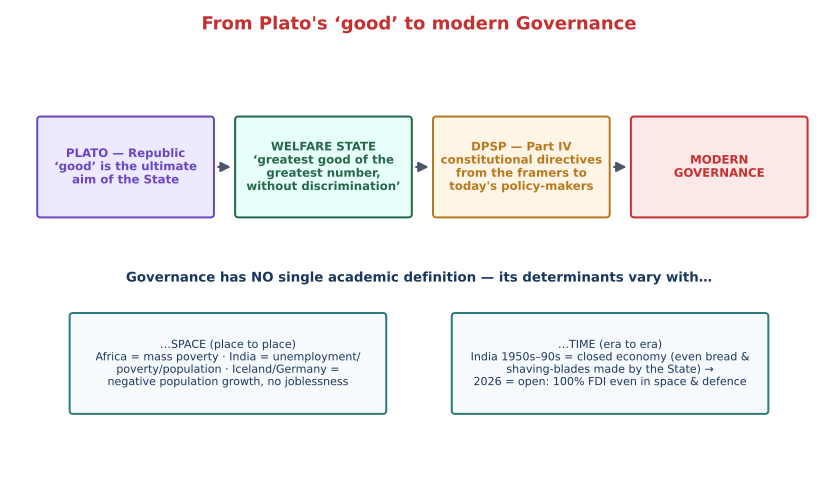
TEACHER'S EXAMPLE (the intellectual lineage — Plato): The idea that "the good should not be a slogan but the ultimate aim of the State" goes back to Plato's Republic; the modern continuation of that same idea is the welfare state. The board traced: Plato (Republic) → welfare state → DPSP → modern governance. (He also noted Kautilya wrote on the "traits of a king" — the indigenous strand of thinking about good rule.)
Clean version (study from this):
2. DPSP (Part IV) — the welfare state inside the Constitution
What are the DPSP? They are constitutional directives given by the framers of the Constitution to the policy-makers of today — visionary directives that carry the framers' idea of a futuristic, welfare India with diversified welfare activities. They are moral obligations in the form of constitutional directives. Crucially, the DPSP are a diversified set of principles that both cater to the needs of different sections of society and serve the needs of a dynamic, modern administration & governance.
To feel that diversity, the teacher read out a sweep of the Directive Principles (Articles 36–51), which is worth keeping as a reference list:
- Art 38 — the State shall secure a social order in which social, economic and political justice informs all institutions of national life; Art 38(2) — minimise inequalities in income, status, facilities and opportunities (a cardinal feature of a welfare state).
- Art 39 — principles of policy: right to an adequate livelihood for all without discrimination [39(a)]; a distributive economic system — material resources must not be concentrated in a few hands but distributed to serve the common good [39(b),(c)]; equal pay for equal work for men and women [39(d)].
- Art 39A — equal justice and free legal aid: a person must not be denied the opportunity of justice merely because of economic inability to pay.
- Art 40 — organisation of village panchayats — i.e. democratic decentralisation, resting on the principle of subsidiarity.
- Art 41 — right to work, education and public assistance in cases of undeserved want.
- Art 42 — just & humane conditions of work and maternity relief. Art 43 — a living wage so a person can live with dignity. Art 44 — Uniform Civil Code. Art 45 — early childhood care & education (below age 6). Art 46 — promotion of educational & economic interests of SCs, STs and weaker sections. Art 47 — raising nutrition & standard of living / public health, and prohibition of intoxicating drinks & drugs. Art 48 — agriculture & animal husbandry (cattle/cows); Art 48A — protection of environment, forests & wildlife. Art 49 — protection of monuments. Art 50 — separation of the judiciary from the executive. Art 51 — promotion of international peace & security.
TEACHER'S EXAMPLE (principle of subsidiarity): The whole concept of democratic decentralisation rests on the principle of subsidiarity — "the majority of powers and functions should be given to that tier of government which is nearest to the people." Before Panchayati Raj Institutions (PRIs) and Urban Local Bodies, power sat with the Union or the States — a centralised, top-down approach that hurt grassroots development, creating the need for an additional tier of local self-government. His test: which is the easier proposition for a villager — approaching the Gram Pradhan, or an MLA/MP? The Gram Pradhan — that is what grassroots democracy is about.
TEACHER'S EXAMPLE ("undeserved want" — why welfare has no upper cap): Undeserved want = "a situation you never wanted, but which can still happen to you." Examples: a physical disability; widowhood ("nobody chooses to be a widow"); even unemployment ("no one wants to be unemployed"). In each, it becomes the State's responsibility to provide assistance — hence unemployment allowances, and widow / divyang (disability) pensions in States like UP and Haryana. Welfare "cannot be garlanded to any single academic definition and has no upper cap."
TEACHER'S EXAMPLE (DPSP as live welfare policy): Art 47's prohibition is why Bihar banned alcohol (alcohol being a contributing catalyst to socio-economic crime against women; Bihar is among NITI Aayog's "aspirational"/backward states). Art 48/48A is reflected in Delhi's "DEVI" initiative — Delhi Electric Vehicle Interconnector — replacing old buses with electric (green) cluster buses for zero-carbon public transport.
The nature of the DPSP, and how they "monitor" the government. The DPSP are non-justiciable and non-enforceable — unlike Fundamental Rights, the courts cannot use their writ jurisdiction (Art 32/226) to enforce them. So in the Constituent Assembly, Ambedkar was asked: if they are so indispensable to good governance, why not put them in Part III to make them enforceable, instead of adding "extra luggage" to the Constitution? His famous answer:
CLARIFICATION (Ambedkar — "the court of the people"): "The Directive Principles may not be enforceable in the court of law, but they are certainly enforceable in the court of the people." Meaning: a party in power that fails to abide by the DPSP will be answerable to the people in the very next general election. That is precisely how the DPSP act as a monitoring mechanism on the government — by checking whether the government's policies are in concurrence with the directive principles.
TEACHER'S EXAMPLE: UPA (2004–2014) was voted out and replaced by the NDA in 2014; Tamil Nadu's long-ruling AIADMK regime can be displaced (he cited the rise of new outfits like TVK); West Bengal likewise. "Don't abide by the directives → you will be replaced" — the people are the enforcing court.
3. Why governance has no fixed definition — it varies across space & time
A central message of the class: governance cannot be pinned to a single academic definition, because its parameters, aspects and determinants vary over time and across places. No one model is universally feasible.
TEACHER'S EXAMPLE (variation across SPACE — India vs Africa vs Iceland): A governance model that suits India need not suit African nations or Iceland: - African nations — the common, overriding problem is mass poverty. (He cited a National Geographic documentary: in several African countries, during the rainy season people trap flies and mosquitoes, press them into a patty inside a burger, and eat it to meet protein requirements — "fly burger." Even in 2026, a square meal three times a day is a dream there. That is the extent of the poverty a governance model must address.) - India — a large, heterogeneous country, so its problems are diversified: unemployment, poverty, population, corruption. But India is not a poor nation — (per a NITI Aayog report, a huge number of Indians have been lifted out of poverty; see the verified figure below). - Iceland / Germany — face the opposite problem: negative population growth, and no unemployment challenge. So three countries → three different sets of determinants → no uniform governance model.
CLARIFICATION (the NITI Aayog poverty figure — verified): The teacher quoted "24.5 crore lifted from BPL to APL in ~19 years / 10 years." The accurate, citable figure: NITI Aayog's January-2024 Discussion Paper found ≈ 24.82 crore Indians escaped multidimensional poverty in 9 years, as the National MPI headcount fell from 29.17% (2013-14) to 11.28% (2022-23) — UP (5.94 cr) and Bihar (3.77 cr) saw the largest declines. (It is multidimensional poverty, not strictly the BPL→APL income line.)
TEACHER'S EXAMPLE (variation across TIME — closed → open economy): Governance determinants also change with the era. In the 1950s–1980s India ran a closed economy — having just won freedom, it pursued modernisation/industrialisation by indigenous means (1st & 2nd Five-Year Plans on the Harrod-Domar and P.C. Mahalanobis models). Until the New Economic Policy of 1991, even a breakfast bread and a shaving blade were manufactured/regulated by the State — that was the extent of state control. Contrast 2026: 100% FDI even in strategic sectors like space and defence, promotion of ease of doing business, competitive federalism (states holding investor summits), the automatic route of FDI (invest without prior RBI approval, only inform the RBI within 30 days), FTAs and MFN status. Same country — a totally different structure of governance — because the parameters varied over time.
4. The modern definition & the World Bank's "good governance" (1989)
From the modern perspective, governance is defined as:
"A system of values, institutions and policies through which a society manages its economic, political and administrative affairs, by interaction between formal and informal institutions."
The modern usage of the term was first put forward by the World Bank in 1989. The teacher gave the background, because it explains why the concept was born:
TEACHER'S EXAMPLE (how "governance" was coined): After the Second World War, the IMF and the World Bank were established (the Bretton Woods twins — IMF for short-term loans, World Bank for long-term loans) to restore war-torn economies. As part of this, the IMF/World Bank channelled financial packages to African nations under the Structural Adjustment Programme (SAP). But despite the money, no proportionate development followed in many African countries. The World Bank then studied the failure and compiled the reasons in a 1989 report — and it was here that the term "governance" was coined for the first time in modern development discourse.
CLARIFICATION (the report's correct title — verified): The teacher gave the title as "Sub-Saharan Africa: From Crisis to Sustainable Development." The actual World-Bank report (1989) is "Sub-Saharan Africa: From Crisis to Sustainable Growth" — which diagnosed a "crisis of governance". The reasons it highlighted (matching the board): poor public-sector management, rampant corruption, no free flow of information, and the lack of a legal framework for development.
5. The three aspects of good governance
From that report, the World Bank set out key aspects / determinants of good governance:
Clean version (study from this):
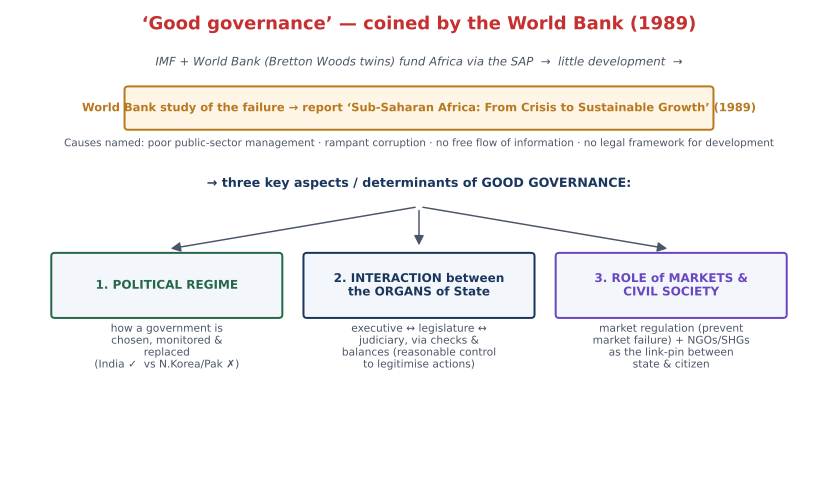
Aspect 1 — the political regime (the manner in which a government is chosen, monitored and replaced).
TEACHER'S EXAMPLE: In India this works properly by democratic means — we choose the government by exercising the right to vote under Article 326; we monitor it through RTI, media, social audit, PIL — and through the DPSP (checking whether policy concurs with the directives); and we can replace it at elections. Contrast North Korea (a dictatorship — a recent "election" saw ~99.7% vote, "the 0.3% may have died") and Pakistan ("a mockery of the very idea of democracy"). So judging different countries on the political-regime parameter tells you whether there is good governance or not.
Aspect 2 — interaction between the organs of the State (executive, legislature, judiciary).
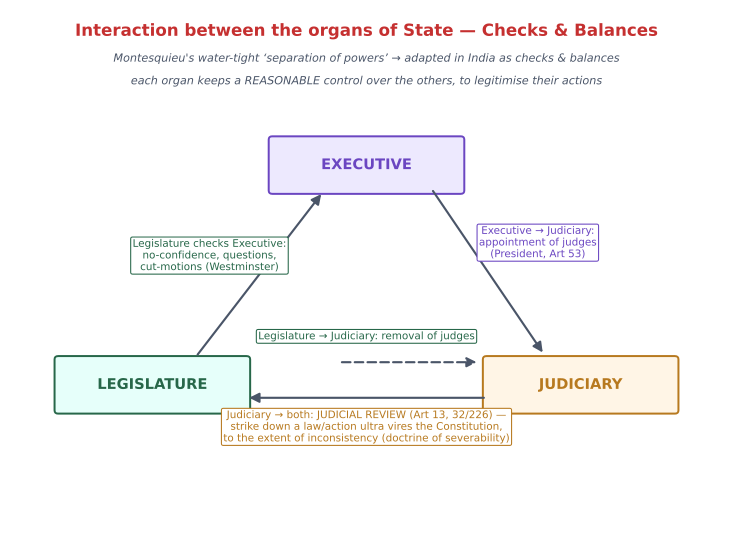
TEACHER'S EXAMPLE (separation of powers → checks & balances): Montesquieu's original separation of powers meant a water-tight compartment division of powers and functions among the three organs. India did not adopt it in the pure sense — we adopted it as checks and balances, where "each organ exercises a reasonable control over the other in order to legitimise their actions" (reasonable control, not control).
Clean version (study from this):
How each organ checks the others:
- Judiciary → executive & legislature: judicial review.
- Legislature → executive: in the Westminster model, the executive (the Council of Ministers, the PM being "first among equals / captain of the ship") arises from and is accountable to the legislature — through questions, motions, and the budget's cut motions (economy cut, token cut, policy cut).
- Legislature → judiciary: removal of judges (he cited the recent Justice Verma episode — he resigned before proceedings could begin).
- Executive → judiciary: appointment of judges — Supreme Court judges are appointed by the President, the head of the executive (Art 53: all executive power of the Union is vested in the President).
CLARIFICATION (definition of judicial review — flagged as a 2024 Prelims trap): "Judicial review is the power of the higher judiciary (Supreme Court & High Courts, under Articles 32 and 226) to declare any law or executive action null and void if it is ultra vires the Constitution — to the extent of such inconsistency." Note the nuances: not the whole law but even a fraction can be struck down (doctrine of severability); judicial review predates the basic-structure doctrine (Kesavananda, 1973) — it is an inherited power. The teacher flagged that this year's Prelims had an assertion-reason question on judicial review tied to Article 13 — minute details of basics matter.
Aspect 3 — the role of markets and civil-society organisations.
TEACHER'S EXAMPLE (market regulation — the Jio price war): The State regulates markets to prevent market failure (which can arise from negative externalities, a demand-supply mismatch, or a natural monopoly). When Jio launched, it offered free SIM, free incoming/outgoing, free roaming and free internet — a telecom revolution — and wanted to continue free services beyond one year. TRAI (the regulator) intervened and stopped it. Why, if Jio had bought its spectrum in the auction and merely wanted to give customers free service? Because continued predatory pricing would cause loss of revenue to rival operators (Idea posted a ₹1,300-crore quarterly loss; Vodafone and Idea ultimately merged unable to sustain losses), shrinking the field to a handful of private players (Jio, Airtel, Vodafone-Idea; BSNL the ailing PSU) — heading toward a natural monopoly, after which the lone survivor could charge anything ("pay ₹1,500/month for what was free") and the consumer would be exploited with no alternative. Hence TRAI mandated a basic floor pack for every operator. (That is the State playing its market-regulation role.)
Civil-society organisations (CSOs) — NGOs and SHGs — act as a "link-pin" between the State and citizens. The teacher noted the detailed treatment of NGOs and SHGs will be covered later (possibly by a different faculty) — that material is in the handout, Parts C-11 and C-12 below.
6. The five dimensions of governance
Pulling it together, the board listed five dimensions of governance, each with representative instruments:
Clean version (study from this):
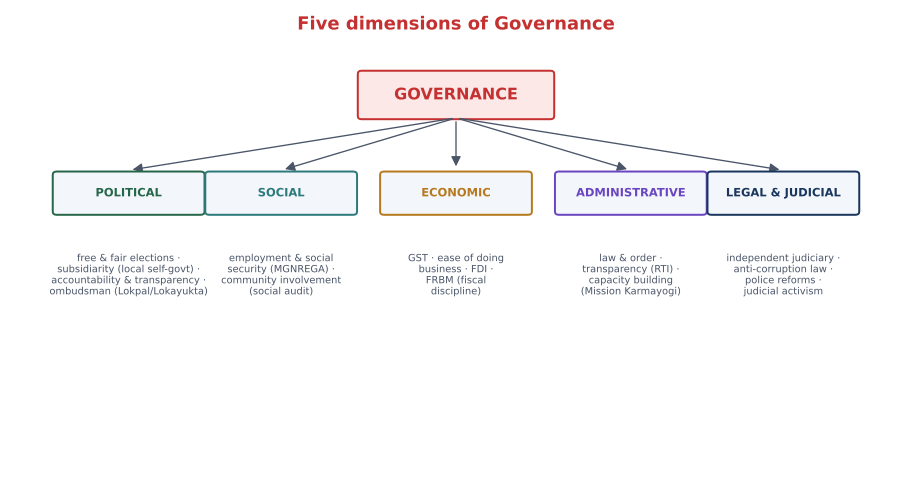
- Political dimension — free & fair elections; the principle of subsidiarity (local self-government); accountability & transparency; the ombudsman (the Swedish concept; in India the Lokpal at the Centre and Lokayukta at the State level).
- Social dimension — employment opportunities & social security (e.g. MGNREGA); community involvement via social audits.
-
Economic dimension — GST; ease of doing business; FDI; the FRBM Act.
CLARIFICATION (FRBM): the Fiscal Responsibility & Budget Management framework brings fiscal discipline by setting limits — e.g. on the fiscal-deficit-to-GDP ratio, and (via amendment) capping a State's borrowing at 3% of its GSDP — to stop States from over-borrowing to fund freebies.
-
Administrative dimension — maintenance of law & order; transparency & accountability (RTI); capacity building (Mission Karmayogi).
CLARIFICATION (Mission Karmayogi): A key criticism of the civil services — especially the IAS — is that they are generalists, sometimes "jack of all trades, master of none." Mission Karmayogi aims to transform a rule-oriented/rule-obsessed bureaucracy into a role-oriented one by building skills, so officials perform better in the field.
-
Legal & judicial dimension — independence of the judiciary; anti-corruption law; police reforms; judicial activism.
Part B — Role of the Civil Services in a Democracy
After the foundations, the second major topic was the civil services — the instrument that establishes democracy on the ground.
7. Max Weber, authority & the bureaucracy model
Like other modern and developing democracies, India has adopted the Max-Weberian model of bureaucracy. Weber studied forms of authority and classified them into three:
- Charismatic authority — possessed by an individual by virtue of his person / charisma and his followers' belief in it. (Teacher's examples: self-styled godmen — Bageshwar Baba Dhirendra Shastri, Asaram, Rampal — whose followers believe in their "charisma," true or not.)
- Traditional authority — possessed by virtue of prevailing traditions — caste-based or clan-based. (Examples: in a joint family the eldest member's authority prevails; khap panchayats and caste mahasabhas issuing pronouncements.)
- Legal-rational authority — backed by law and legal precedent. Weber considered this the best form, because it has the backing of a law. The Max-Weberian bureaucracy is the manifestation of legal-rational authority.
Features of the Weberian bureaucracy:
- Merit-based selection — candidates selected on the basis of qualifications ("you will be in the civil services because you possess certain qualifications").
- Promotion by seniority + achievement — climbing the ladder takes experience/time (you don't become DGP the day after joining as a probationer), with out-of-turn promotion possible for achievement.
- Fixed salaries.
- Impersonality — private and public goals must be kept separate. (Example: a District Magistrate is entitled to all official privileges for discharging his duties, but his son is not entitled to use the official vehicle — the son is not the DM. You must not use public office to satisfy private goals or to become a crorepati.)
- Hierarchy — a senior-subordinate relationship, a well-defined chain of command.
8. Constitutional provisions (Articles 309–312)
Clean version (study from this):
-
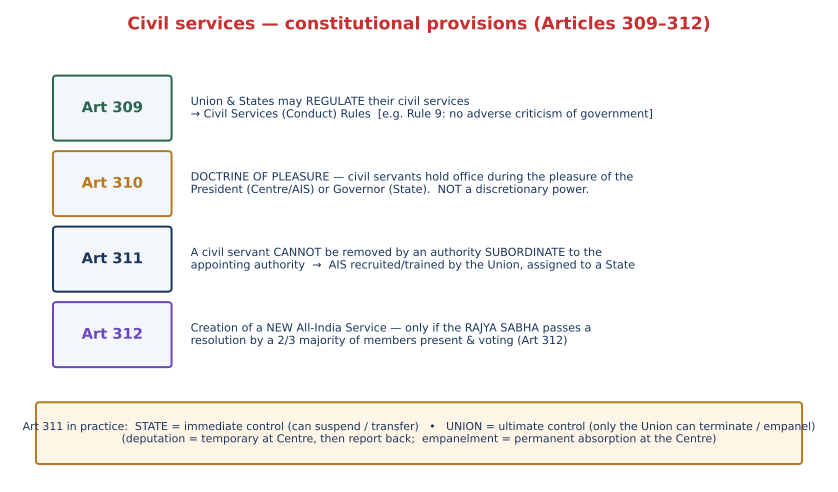
Article 309 — regulation of services. The Union and the States may regulate their civil services; accordingly they have framed the Civil Services (Conduct) Rules.
TEACHER'S EXAMPLE (Conduct Rule 9 — no adverse criticism of government): Rule 9 of the Conduct Rules says that no statement of fact, expression or opinion by a public servant should have an adverse, critical effect on any policy or action of the State — in plain terms, a civil servant cannot publicly criticise the government. He cited the IAS officer Smita Sabharwal (Telangana cadre), who took to social media to criticise a State government's decision and was issued a notice under Rule 9 — and the SC position that civil servants do have free speech (Art 19) but the State may reasonably regulate it. CLARIFICATION (two verified fixes): (1) The case the teacher named "Lipika Paul v. State of Odisha" is actually Lipika Paul v. State of Tripura (Tripura High Court, 2020): a government servant "is not devoid of her right of free speech, a fundamental right, which can be curtailed only by valid law," subject to the Conduct Rules. (2) The specific "Smita Sabharwal criticised the Gujarat Ishrat-Jahan encounter case" framing could not be verified; her well-documented run-ins are from 2025 (a tweet questioning disability quotas in the AIS; a police notice (BNSS) for reposting an AI-generated image in the Kancha Gachibowli forest row, after which she was transferred). Use her as a general example of a civil servant facing official action over social-media posts, without the unverified specifics.
-
Article 310 — the doctrine of pleasure. Civil servants hold office during the pleasure of the President (for Central/All-India Services) or the Governor (for State Civil Services) — i.e. as long as the President/Governor "wills." Importantly, this is not a discretionary power.
-
Article 311 — protection against removal. A civil servant cannot be removed by an authority subordinate to the authority that appointed him.
TEACHER'S EXAMPLE (cadre system; Union "ultimate" vs State "immediate" control): Officers of the All-India Services are recruited and trained by the Union and then assigned to States. Every State is a cadre (there are now five-plus cadre zones); the Union itself has no cadre — AIS/Central officers serve at the Union level either on deputation (temporary — they later report back to their home cadre) or by empanelment (permanent absorption at the Centre; e.g. in the IPS one becomes eligible to apply after ~14 years, screened by a 360-degree system). A State can at most suspend or transfer an AIS officer — it cannot terminate him, because the Union appointed him. So the State enjoys immediate control; the Union enjoys ultimate control (termination is the Union's prerogative). Illustrations: Dinesh M.N. (Rajasthan IPS, jailed ~7 years in a fake-encounter case, then reinstated → IG → empanelled as ADG at the Centre — the Union chose not to terminate); contrast an IPS officer terminated for abetment of suicide; Shah Faesal (2009 batch — resigned criticising the Article-370 abrogation, resignation kept pending for years, later reinstated); and Abhishek Singh (UP IPS, makes reels; husband of IAS Durga Shakti Nagpal) whose resignation was accepted the very next day — the timing is wholly the Union's discretion.
-
Article 312 — creation of an All-India Service. A new All-India Service can be created only if the Rajya Sabha passes a resolution supported by a two-thirds majority of members present and voting (recognising the federal interest of the States).
CLARIFICATION (related basics the teacher revised): Effective majority (= total seats minus vacancies) is used in 8 places — removal of the Speaker & Deputy Speaker of the Lok Sabha, the Chairman & Deputy Chairman of the Rajya Sabha, and the four State equivalents (Speaker/Dy-Speaker of the Assembly, Chairman/Dy-Chairman of the Council). Ratification by ≥ half the States is needed for rigid (federal) provisions — e.g. the election of the President (Arts 54–55), the extent of Union/State executive power, Article 368 itself, the Seventh Schedule, Art 241 (HCs for UTs). Flexible provisions can be amended by Parliament alone; rigid ones need the States' concurrence too.
9. Role / relevance of the civil services
Clean version (study from this):
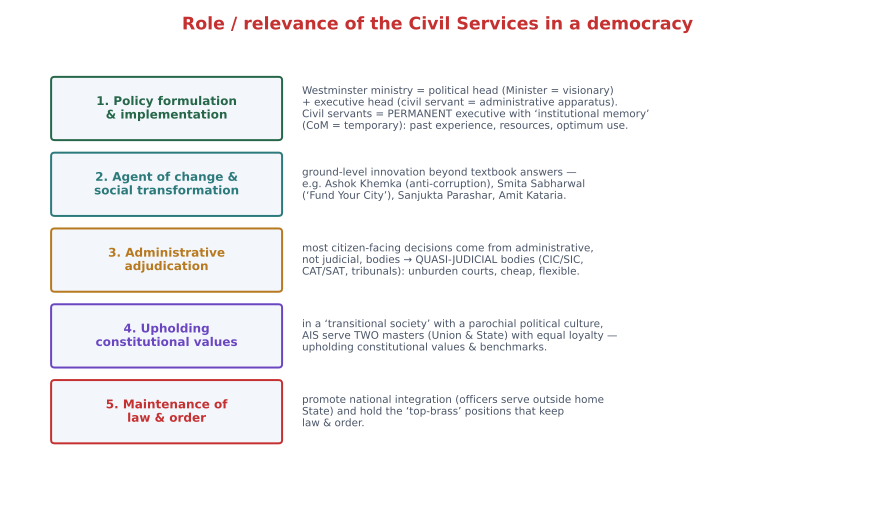
1. Policy formulation & implementation. Under the Westminster model, every ministry has two heads: a political head (always a Minister — a Cabinet Minister or a Minister of State with Independent Charge — who is the visionary, e.g. signs the ministry's vision document) and an executive head (the senior civil servant — the administrative apparatus that turns the vision into reality).
TEACHER'S EXAMPLE (institutional memory; permanent vs temporary executive): The executive head doesn't just give aid & advice to the Minister; he equips the Minister with inputs — the past experience of a policy, the availability of resources, and their optimum utilisation (maximum output from minimum input). He can do this because civil servants are the permanent executive with institutional memory, whereas the Council of Ministers is the temporary executive. (As the PM told probationers at LBSNAA: "We are temporary; you are permanent.") Governments come and go; the bureaucracy facilitates the smooth transition of power and, in the process, accumulates the institutional memory that lets it advise on past experience and resources. (If an IT Minister declares a vision — "five crore IT jobs in two years" — it is the civil servants, with experience the Minister lacks, who work out how to realise it.)
2. Agent of change & social transformation. Beyond textbook answers ("don't just say policy implementation, awareness, women empowerment" — the teacher pushed for innovative, ground-level change). His point: "there is always a choice — to be part of the crowd or the leader of the crowd; to guide or be guided."
TEACHER'S EXAMPLE (officers who became agents of change): Amit Kataria (Chhattisgarh, IIT-Delhi electrical engineer — positive change in Naxal-affected areas); an IAS officer from the same cadre (surrender-cum-rehabilitation policy for Naxal areas); Ashok Khemka (exposed the DLF land scam; 55+ transfers in a 30-year career — an average of one every ~six months); Prem Prakash Meena (the "Nyay Aapke Dwar" — justice at your doorstep — grievance-resolution initiative); Sanjukta Parashar (IPS, "Iron Lady of Assam", anti-insurgency operations); Smita Sabharwal ("Fund Your City" — voluntary public contributions used for community parks, traffic signals); Divya (clean drinking water as DM of Mirzapur); and a former Chief Election Commissioner (electoral reforms). (Counter-example, of how not to be remembered: Puja Khedkar.)
3. Administrative adjudication (quasi-judicial bodies). In modern governance, most decisions affecting citizens' lives come from administrative institutions, not judicial ones — a citizen visits the SDM/Tehsildar/SDO offices far more often than the district court, and administrative machinery has a greater grassroots connect. Hence a progressive idea: equip administrative institutions with quasi-judicial power (semi-judicial, not full judicial — full judicial power would violate the separation of powers and clash with the judiciary). This gave rise to quasi-judicial bodies.
CLARIFICATION (what a quasi-judicial body is, and why it matters): A quasi-judicial body is established by a law of Parliament or a State legislature, headed by administrative functionaries, and performs quasi-judicial functions. Examples: CIC / SIC (under the RTI Act, 2005; SIC is the apex RTI body at State level, CIC at the Centre), CAT / SAT, the GST Appellate Tribunal, the Income-Tax Appellate Tribunal; some tribunals have a constitutional origin under Articles 323A / 323B. These bodies hold the powers of a civil court under the CPC — to summon and enforce attendance, order the exchange of documents between parties, requisition public records, and receive evidence on affidavit (oath). Their advantages: they unburden the over-loaded courts, deliver cost-effective justice (minimal/zero fee — e.g. no fee for CIC/SIC appeals), and overcome the procedural rigidity of courts — because they are guided by the principles of natural justice (operational flexibility to decide the timing of their own meetings and their own procedure), not bound by CrPC/CPC (now BNSS). (The 2nd ARC criticised that the CIC/SIC are thickly populated by former bureaucrats.) Note: the NHRC (1993) is a statutory body; the National Commission for SCs (Art 338) is a constitutional body — both also discharge some quasi-judicial functions.
4. Upholding constitutional values. India is a transitional society with a parochial political culture, in which the officers of the All-India Services serve two masters — the Union and the State — with equal loyalty and dedication, and in doing so uphold constitutional values and benchmarks.
5. Maintenance of law & order. AIS officers promote national integration (they serve outside their home States) and play a pivotal role in law & order, holding the "top-brass" positions of the administration.
EXAM FOCUS (assigned questions — civil-services reform): The teacher dictated three Mains-style questions: (1) "New India would require a new and dynamic civil service — examine the need for dynamic reforms in the civil services." (2) "Civil services are regarded as the steel frame of the nation — discuss the role they play in nation-building." (3) "The steel is rusted and only the frame is left — critically examine." Issues with the civil services will be taken up in the next class.
Part C — Handout (Social Justice unit, to be elaborated in later classes)
Everything in Part C is from the printed Vajiram & Ravi handout (by Sahil Goyal). The live class did not cover these Social-Justice topics — the teacher said they will be taught in later classes (NGOs/SHGs possibly by a different faculty). It is reproduced here so the note is complete; treat it as reference until those classes add the spoken explanation.
10. HANDOUT — Development & the "development industry": indices
HANDOUT — UNDP publishes 5 reports to measure development: HDI, Inequality-adjusted HDI, Gender Development Index, Gender Inequality Index, and the (global) MPI. - HDI — the geometric mean of 3 dimensions (geometric mean is used to address inter-dimensional inequality): Health (life expectancy at birth), Education (mean years of schooling + expected years of schooling), Decent standard of living (GNI per capita). - Inequality-adjusted HDI (IHDI) — uses the Atkinson method to adjust for intra-dimensional inequality. - Gender Development Index (1995) — ratio of female HDI ÷ male HDI. - Gender Inequality Index (2010) — measures women's human development across Health (MMR, adolescent birth rate), Empowerment (share of women with ≥ secondary education; female share of parliamentary seats) and Labour market (female labour-force participation). - Global MPI — 3 dimensions: Health (nutrition, child mortality), Education (years of schooling, school enrolment), Living standard (cooking fuel, drinking water, sanitation, electricity, flooring, assets).
HANDOUT — National MPI (developed by NITI Aayog): the same 3 dimensions (Health/Education/Living standard) but with 12 indicators — Health adds maternal health; Living standard adds bank accounts — making it SDG-aligned.
11. HANDOUT — Civil Society Organisations / NGOs
HANDOUT — What is an NGO? One type of Civil Society Organisation — a non-state, voluntary association of people working for the welfare of others; a formal association (registered with the state) and regulated by the state.
Registration (any of 3 ways): Trust (Indian Trusts Act, 1880 [handout date]), Society (Societies Registration Act, 1860), or Charitable Company (Companies Act, 2013).
Scope — 4 areas NGOs work in: Environment (climate, tribal rights — Medha Patkar / Narmada Bachao Andolan, Greenpeace); Human Rights (minorities, prisoners — Amnesty International); Research & Survey (Pratham — RTE study; PRS; ADR); Filling the gaps left by the state (areas the state is unwilling to work in — tribals, beggars, LGBT, prisoners — or lacks resources for — disaster management, rural development, slum rehab, health, education).
Role of NGOs/CSOs in development: (1) Advocacy via PIL (Bharatiya Muslim Mahila Andolan — triple talaq; Young Lawyers' Association — Sabarimala; Naz Foundation — LGBT); (2) Partners of the state in policy formulation & implementation (feedback + ground knowledge → innovation & efficiency); (3) Improve citizen participation (via social audit); (4) Promote transparency & accountability (RTI; social audit); (5) Catalyst for social change (MKSS → RTI Act 2005; India Against Corruption → Lokpal Bill 2013; ADR → electoral reforms / NOTA / Lily Thomas 2013); (6) Service providers (Chhaanv Foundation — acid-attack victims; Bachpan Bachao Andolan — children; Sarthak — PwD; Missionaries of Charity — leprosy; Common Cause — critically ill).
Problems with NGOs: politicisation (funds from parties — legal but unethical); fund diversion / money-laundering / over-spending on admin; lack of transparency (resist RTI, no voluntary disclosure); working in silos (duplication); poor capacity building; poor state-NGO interaction.
State vs NGO friction: the state over-regulates (stringent FCRA), brands critics "anti-national/anti-development" (UAPA), and is wary of environment/tribal/minority/religion-based NGOs; the NGOs divert funds, "protest for the sake of protest," and engage in foreign-funded activism (flagged by the IB's 2014 report — alleged 2–3% GDP loss; e.g. Greenpeace halting coal plants, palm-oil, GM crops, Kudankulam). Solution: make NGOs partners/stakeholders (allow them to do EIA/SIA), don't over-regulate, accept that criticism ≠ anti-national; NGOs to be transparent, comply with FCRA, no foreign-funded activism.
HANDOUT — FCRA (Foreign Contribution Regulation Act), 2010 (amended 2020): - FCRA 2010: certain persons barred from foreign funds (judges, cartoonists, journalists, MPs, MLAs); organisations of a political nature barred; an NGO needs an FCRA licence + an FCRA account in SBI, renewed every 5 years; rules — no diversion, annual audit report, no anti-national/anti-development use; admin expenses ≤ 50% of foreign funds. - FCRA 2020: even bureaucrats barred from foreign funds; re-granting prohibited (anti-money-laundering); admin expenses ≤ 20%; FCRA account only at SBI New Delhi (Main) branch; Aadhaar of NGO employees required.
Do NGOs come under RTI? — DAV College Trust v. Director of Public Instructions (SC, 2019): only NGOs "substantially financed" by the state come under RTI; substantial = a "large portion" of funds (not necessarily > 50%), including indirect funding (e.g. land at subsidised rates) — though the Court did not objectively define "large portion."
12. HANDOUT — Self-Help Groups (SHGs)
HANDOUT — DAY-NRLM (Deendayal Antyodaya Yojana – Aajeevika): organise rural poor women into SHGs, nurture them, give them bank-linkage; federate SHGs at village and higher levels for space, voice and resources. (Handout figure: 8.39 cr women in 77 lakh SHGs.) Two components — livelihood (SVEP — Start-up Village Entrepreneurship; Mahila Kisan Sashaktikaran Pariyojana) and funds (Revolving Fund ₹10–12k/SHG; Community Investment Fund — seed capital; Vulnerability Reduction Fund; livelihood/layering funds).
Benefits: poverty alleviation (self-employment, out of the debt trap, ↑ household income, women's entrepreneurship); financial inclusion (SHGs as micro-finance institutions / last-mile financiers; financial literacy; SHG–business correspondents since 2006; Jan Dhan accounts); women empowerment (outside the home — leadership, entrepreneurship, ↑ PRI participation, community resource persons, gender sensitisation; within the home — income, reproductive rights, education/health); positive spin-offs (fighting social evils, ↑ child nutrition & education, ↓ child labour, ↓ fertility — South India's lower fertility is linked to a successful SHG movement).
13. HANDOUT — India in the UNDP Human Development Report 2025
HANDOUT (current affairs): The 2025 HDR, titled "A Matter of Choice: People and Possibilities in the Age of AI," places India at rank 130 of 193, with HDI rising 0.676 (2022) → 0.685 (2023) — the medium human-development band, nearing the high threshold (≥ 0.700). Life expectancy rose from 58.6 (1990) → 72 (2023) (credited to NRHM, Ayushman Bharat, Janani Suraksha, Poshan Abhiyaan); expected schooling 8.2 → 13 years (RTE, Samagra Shiksha, NEP 2020); GNI per capita ~$2,167 (1990) → $9,046 (2023, 2021-PPP); 135 million escaped multidimensional poverty (2015-16 → 2019-21). Challenges: inequality cuts India's HDI by 30.7%; gender gaps persist (low female LFPR & political representation — though the one-third women's reservation in legislatures offers promise). India is highlighted as a rising AI power (highest self-reported AI-skill penetration; 20% of Indian AI researchers now retained, up from ~0 in 2019). UNDP's three pathways: augment not replace human work; centre human needs; embed human values in AI.
14. HANDOUT — Pressure Groups
HANDOUT — what they are: organised bodies (interest / vested groups) that seek to influence government policy to promote or defend a common interest. Unlike political parties, they do not contest elections or seek power — they act as a liaison between government and their members. Characteristics: focus on specific issues; indirect influence (lobbying, advocacy, campaigns); voluntary & non-profit.
Indian examples by type: Business — FICCI, CII; Agrarian — Bharatiya Kisan Union, All India Kisan Sabha; Trade Unions — AITUC, BMS; Professional — Bar Council of India, IMA.
Role in democracy (5): Interest articulation (a "megaphone" — BKU/farm unions and the 2020 Farm Laws repeal); promoting pluralism (FICCI/CII vs AITUC → balancing capital & labour); watchdog (ADR on candidates' criminal/financial records); bridging gaps / liaison (NASSCOM shaping the IT Act & Digital India); safety valve (MKSS's peaceful Rajasthan struggle → the RTI Act, instead of revolt).
Problems (6): parochialism (caste/religion over nation — Karni Sena, Padmaavat); lack of internal democracy (self-appointed, "top-heavy" trade-union leaders); elite capture / inequality of influence (FICCI/CII vs tribal-rights groups in Bastar); extremism (anomic groups) (Jat-quota agitation 2016, Maratha Kranti Morcha — rasta roko, damage to property); politicisation (frontal student wings — ABVP/BJP, NSUI/Congress, SFI/CPM); foreign-funding concerns (Greenpeace India's FCRA cancellation).
India vs USA: in India PGs are less powerful / often subservient to parties, lobby the executive (Cabinet & bureaucracy), are often organised on caste/religion/region, focus on domestic policy, and lack a single lobbying law (regulated piecemeal, e.g. FCRA); in the USA PGs are extremely powerful ("the fourth organ"), lobby the legislature (Congress) & its committees, are organised on modern socio-economic/professional lines, take interest in domestic and foreign policy, and are regulated by the Lobbying Disclosure Act, 1995.
New & emerging PGs (2024–26): digital/social-media activists (Fridays for Future India — EIA 2020 consultations); gig-workers' associations (IFAT — social security under the Code on Social Security 2020); policy think-tanks (ORF, CPR, CCS); modern urban-environment coalitions (Save Aarey / Vanashakti; CANSA); tech & AI-governance lobbies (NASSCOM, start-up coalitions on the DPDP Act 2023).
For vulnerable sections: NCDHR (Dalit rights, SC/ST PoA Act); Niyamgiri Suraksha Samiti (tribal rights vs Vedanta — landmark SC verdict); SEWA (women & informal labour); Naz Foundation (LGBTQIA+ — Section 377, Transgender Persons Act 2019).
15. HANDOUT — Mechanisms, laws & institutions for vulnerable sections
HANDOUT (many to be discussed in Social Issues classes): - Constitutional: Art 15 & 16 (anti-discrimination + affirmative action 15(4)/16(4)); Art 17 (abolishes untouchability — the only absolute fundamental right); Art 21 (life with dignity — food/shelter/health); Art 23 & 24 (no trafficking/forced/child labour); Art 46 (DPSP) (educational & economic interests of weaker sections). - Legal (Special & Local Laws): SC/ST (Prevention of Atrocities) Act 1989; POCSO 2012; Forest Rights Act 2006 & PESA; Prohibition of Manual Scavenging Act 2013; Domestic Violence Act 2005; Rights of Persons with Disabilities Act 2016 (reservation 3% → 4%, 21 disabilities); Transgender Persons (Protection of Rights) Act 2019; Maintenance & Welfare of Parents and Senior Citizens Act 2007. - Institutional (watchdogs): NC for SCs (Art 338) & NC for STs (Art 338A) — constitutional; NCW, NCPCR, NHRC, Chief Commissioner for PwDs — statutory. - Executive/administrative: Ministry of Social Justice & Empowerment (nodal — SC/OBC/elderly/transgender); Ministry of Tribal Affairs; NITI Aayog (Aspirational Districts); State welfare departments; Tribal Advisory Councils (5th Schedule). - Judicial: PIL (Art 32 / 226); Legal Services Authorities (NALSA) — free legal aid.
Quick-revision tables
Governance — the spine of Class 1
| Block | Core idea |
|---|---|
| Welfare state | "Greatest good of the greatest number, without discrimination" (SC-affirmed); rooted in Plato's Republic |
| DPSP (Part IV) | Non-justiciable constitutional directives; enforceable in the "court of the people" (next election) |
| No fixed definition | Determinants vary by space (Africa/India/Iceland) & time (1950s closed → 2026 open economy) |
| Modern definition | "System of values, institutions & policies… via formal & informal institutions" |
| Good governance | Coined by the World Bank (1989), Sub-Saharan Africa: From Crisis to Sustainable Growth |
| 3 aspects | Political regime · interaction of organs (checks & balances) · markets & civil society |
| 5 dimensions | Political · Social · Economic · Administrative · Legal-Judicial |
Civil services — Articles 309–312
| Article | Provision |
|---|---|
| 309 | Union/States regulate services → Conduct Rules (Rule 9 = no adverse criticism) |
| 310 | Doctrine of pleasure (President/Governor); not discretionary |
| 311 | No removal by an authority subordinate to the appointing authority (Union = ultimate, State = immediate control) |
| 312 | New All-India Service created by Rajya Sabha resolution, 2/3 present & voting |
Current Affairs
(Updated as relevant news/magazine content comes in — see CLAUDE.md current-affairs rule.)
| Date | Source | Headline | Connection to this topic |
|---|---|---|---|
| 2024 | NITI Aayog | 24.82 cr escaped multidimensional poverty (2013-14 → 2022-23) | §3 (governance varies by space/time) + §10 (National MPI) |
| 2025 | UNDP | HDR 2025 — India rank 130, HDI 0.685, "Age of AI" | §13 (development indices) |
| 2025 | News | Smita Sabharwal — BNSS notice for an AI-image repost; transferred | §8 (Art 309 / Conduct Rule 9; civil-servant free speech) |
| 26-06-2026 | The Hindu | FCRA Amendment Rules 2026 (notified 22 June) — NGOs confined to 5 categories + named States/UTs, multiple fees, "political content" bar; Oppn. seeks rollback (cf. Noel Harper v UoI 2022 upheld 2020 FCRA) | Part C — NGOs/CSOs & FCRA (state–civil-society relations; the handout's voluntary-sector topic in action) |
| 26-06-2026 | The Hindu | "Bulldozer justice" — Muslim bodies challenge demolitions of mosques (Jaisalmer/Barmer/Bikaner); "government cannot act as judge" (cf. SC In Re: demolition 2024 guidelines) | §B — checks & balances / judicial review / separation of powers: executive encroaching on the judicial function (rule of law) |
Note for linking: CA on governance reforms / civil-services reform / Mission Karmayogi / Conduct Rules / All-India Services / quasi-judicial bodies / Lokpal maps to this note; CA on NGOs / FCRA / SHGs / DAY-NRLM / pressure groups / HDI-MPI / vulnerable-section laws will map here once Part C's topics are taught in detail (currently handout-only).