Indian Agriculture — Backward & Forward Linkages (Seeds & Fertilizers)
GS Paper: III (Agriculture; also GS1 Geography) | Subject: Geography — Indian Agriculture | Class: 4 (teacher folder SA) | Last updated: 2026-06-26
This note covers Class 4 of the Indian Agriculture series. It opens with a recap of how to raise agricultural production and productivity, formally introduces the three structural features of Indian agriculture (rainfed, limited mechanisation, missing linkages), and then does a deep dive into the first two backward linkages — SEEDS and FERTILIZERS — that the teacher says are largely "missing" in Indian agriculture. The solutions to the fertilizer problem, and the remaining linkages, were explicitly deferred to the next class.
Table of Contents
- Recap — how to raise production & productivity
- The three features of Indian agriculture
- What "backward & forward linkages" mean
- SEEDS — the first backward linkage
- 4.1 Why seeds matter (Green Revolution)
- 4.2 Challenge 1 — Availability & the low Seed Replacement Rate
- 4.3 Challenge 2 — Affordability (hybrids can't be reused)
- 4.4 Challenge 3 — The GM-crops debate
- FERTILIZERS — the second backward linkage
- 5.1 What fertilizers are
- 5.2 Problem 1 — Non-uniform distribution
- 5.3 Problem 2 — Urea overuse & the skewed NPK ratio
- 5.4 Problem 3 — Subsidy leakage
- Quick revision & exam pointers
- Current Affairs
1. Recap — how to raise production & productivity
The teacher began by closing the previous discussion on how to increase agricultural production and productivity. The headline answer is that we need to mechanise Indian farms — make them "nice", modern, machine-run farms — because that is what lifts yields. But he immediately added a crucial caveat, written almost word-for-word as a model answer point: mechanisation also throws people out of work, because so many Indians depend on farming for their livelihood. So mechanisation cannot be pursued in isolation; a number of other interventions are needed in parallel.
The central parallel intervention he stressed: the government should develop a strong manufacturing base that can absorb the "agricultural drop-outs" — the workers who leave farming as it mechanises. And to grow manufacturing you in turn need skill-training centres and clean-energy infrastructure. So the chain of reasoning is: mechanise farming → workers displaced → manufacturing must grow to absorb them → manufacturing needs skilled workers + clean energy.
TEACHER'S EXAMPLE — drought-prone districts in the news. He linked this to a current news item (The Hindu / Indian Express) in which the Agriculture Minister spoke about a large number of drought-prone districts that need focused attention. He pointed out that most of these districts are in Maharashtra — the state with the least irrigation and the maximum number of farmer suicides — and that many more lie in the dry tracts of Madhya Pradesh, Karnataka and Telangana. The takeaway for an answer: in such dry regions the focus must be on building irrigation support systems and providing machines that raise production. Monsoon performance this year has been a worry (an El Niño / deficit-rainfall concern up to June), which is why this matters now.
2. The three features of Indian agriculture
The teacher had been building a list of the defining features of Indian agriculture across lectures. By this class three were on the board:
- It is largely rainfed — dependent on the monsoon rather than assured irrigation.
- It has limited mechanisation — partly because holdings are small and fragmented (due to a rising population dividing land), machines are hard to use efficiently on small and rough-terrain plots, custom-hiring centres have poor penetration, and collective/cooperative farming has had limited success. These are the reasons for low farm mechanisation.
- Most of the backward and forward linkages are missing.
The whole rest of the class unpacks the third feature.
EXAM FOCUS. The teacher noted that GS Paper III's syllabus itself uses the words "upstream and downstream" linkages ("transport and marketing of agricultural produce and issues and related constraints"). So this is examiner vocabulary — use backward/forward and upstream/downstream interchangeably and correctly.
3. What "backward & forward linkages" mean
A linkage is simply a connection between a productive activity and everything that feeds into it or flows out of it. The teacher built the idea up from a river analogy and two industrial examples before applying it to agriculture.
DIAGRAM (board) — backward/forward as upstream/downstream.
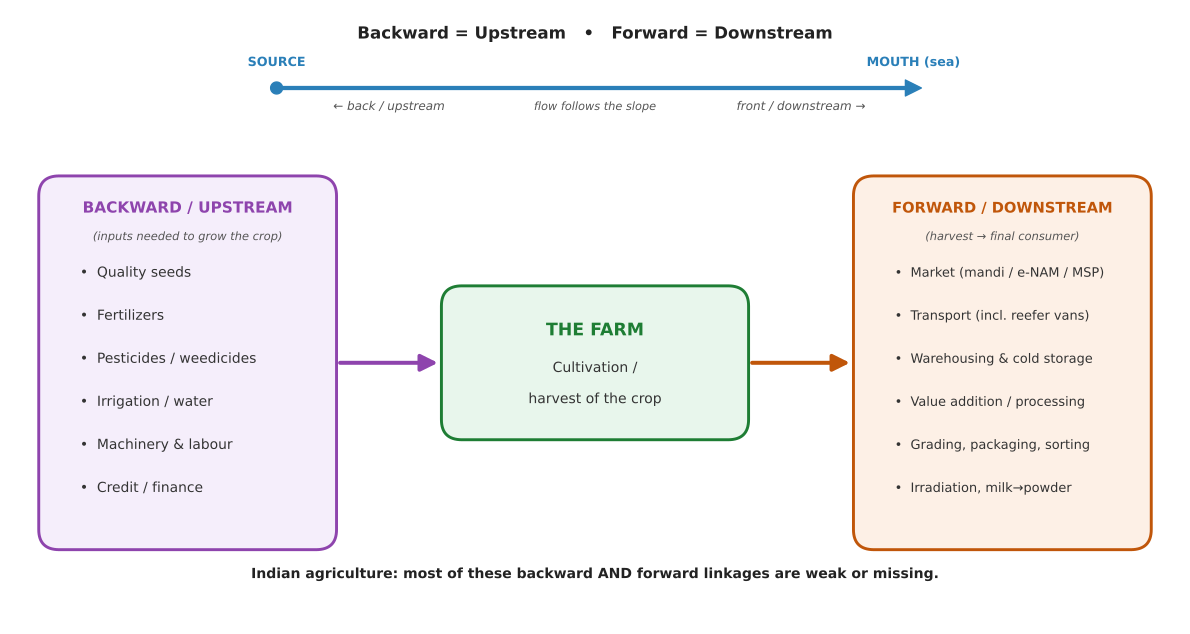
The river analogy. A river starts at its source and ends where it meets the sea — its mouth. Water always flows down the slope, from source to mouth. Now imagine a person standing in the river facing the mouth, with their back to the source. The area in front of them (towards the mouth) is downstream; the area behind them (towards the source) is upstream. The teacher's mapping: backward = upstream, forward = downstream. Every industry or sector has both.
TEACHER'S EXAMPLE — iron & steel industry. A steel plant takes raw material, converts it into steel, and sells that steel onward. Everything before the factory gate — mining the iron ore, coal and limestone, and transporting them from the mine to the factory — is the backward (upstream) linkage. Everything after the steel is made — where to sell it, at what price, how much for the domestic market versus the export market — is the forward (downstream) linkage.
TEACHER'S EXAMPLE — oil refinery. A refinery takes crude oil and converts it into petroleum products. Sourcing the crude — extracting it from a nearby oilfield or importing it from other countries — is the backward linkage. Deciding how much petrol vs diesel to make, whether to polymerise it into plastics, whether to route gas to LPG for households, and the pricing of all of these — is the forward linkage.
Applying it to agriculture
| Backward / upstream linkages (what the farmer needs to grow the crop) | Forward / downstream linkages (from harvest to the final consumer) | |
|---|---|---|
| Items | Quality seeds · fertilizers · pesticides/weedicides · irrigation · machinery & labour · credit/finance to pay for all of the above | Market to sell in · transport · warehousing/storage · value addition / processing |
The teacher then expanded the forward side with the detail he wanted captured:
- Market. After harvest the farmer keeps some produce and sells the rest, so he needs a place to sell. It can be a physical mandi, an electronic market like e-NAM (National Agriculture Market), or a price-support mechanism such as the Minimum Support Price (MSP) through which the government helps the farmer get a fair price.
- Transport. Produce must move field → market → processing unit / consumer. This ranges from a simple animal-drawn cart, to mechanised transport, to — because India is a huge producer of milk and meat — refrigerated transport ("reefer vans / reefer trucks").
- Warehousing. India is the largest producer of rice, but most rice is harvested in October–November and must last the whole year, so we need godowns to store grain. Because we are also the second-largest producer of horticulture in the world, we additionally need cold storage for milk, meat and perishables.
- Value addition. Anything that adds value to the farmer's crop. The teacher's examples:
- Primary processing: paddy → rice (removing the husk and bran layer); wheat → wheat flour. The farmer grows paddy/wheat; the consumer buys polished rice / flour, so processing must happen in between.
- Shelf-life extension via irradiation: potatoes and onions that start sprouting can't be stored long; irradiating them with X-rays / gamma rays stops sprouting and lets you store them longer.
- Milk surplus management: India produces more milk in winter than summer — the "winter flush" — and milk can't be stored long. So surplus milk is converted into ghee / butter-oil and into skimmed milk powder (SMP), which raises shelf life from a few hours to a few months.
- Even simple grading, packaging and sorting count as value addition.
The teacher's thesis for the whole class: in Indian agriculture most of these backward and forward linkages are weak or missing, and he set out to prove it linkage by linkage — starting with seeds and fertilizers.
4. SEEDS — the first backward linkage
4.1 Why seeds matter
Seeds are one of the most important inputs in cultivation, and using quality seeds by itself raises production and productivity. The teacher's proof is the Green Revolution: it made India self-sufficient in food, and what triggered it worldwide was the development of a high-yielding variety (HYV) of wheat in Mexico.
CLARIFICATION — Norman Borlaug. The transcript/board calls him an "American trader"; he was in fact an American agronomist/plant scientist at the Mexico wheat programme (later CIMMYT), and is rightly called the "Father of the Green Revolution" (Nobel Peace Prize, 1970). M.S. Swaminathan is the father of the Green Revolution in India. The point stands: a single better seed transformed output.
So if a better seed can lift production, then where the seed linkage is broken, production suffers. The teacher identified three challenges with seeds in India: availability, affordability, and the GM debate.
4.2 Challenge 1 — Availability & the low Seed Replacement Rate
Most Indian farmers do not have access to quality certified seeds; they depend on farm-saved seed. The teacher explained the mechanism: a farmer harvests, say, 100 kg of paddy — keeps 50 kg to eat, sets aside some grain to re-sow next year, and sells the rest. The grain he saved from his own previous crop and sows again is farm-saved seed. The same logic applies even more strongly to vegetatively propagated crops: sugarcane is planted not from seed but from cane "setts" (cut pieces of stem) or buds; potatoes are planted from saved tubers with sprouts. So a large share of India's cropped area runs on saved, uncertified planting material.
This is measured by the Seed Replacement Rate (SRR) — also called the seed replacement ratio.
DIAGRAM (board) — what SRR means.
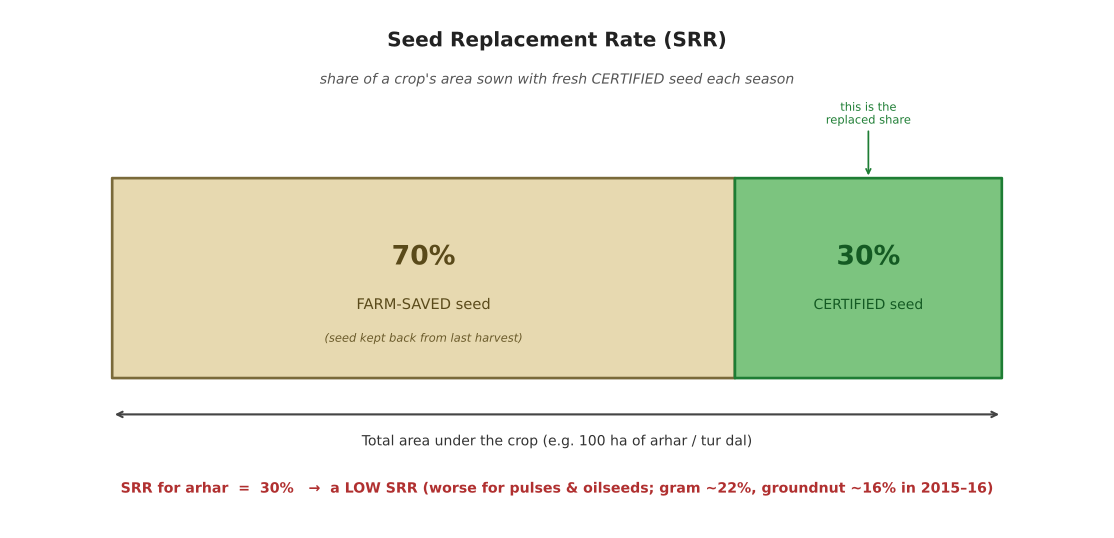
SRR = the share of a crop's total area that is sown with fresh certified seed (rather than farm-saved seed) in a season. Worked example as the teacher gave it: suppose 100 hectares are under arhar / tur (pigeon pea). If 70 ha are sown with farm-saved seed and 30 ha with certified seed (certified by an agency such as a State Seed Corporation), then SRR for arhar = 30%. Two centuries ago there were no research institutes, agricultural universities or seed companies, so SRR was effectively 0% (100% farm-saved). As more area shifts to certified seed, SRR climbs. The government wants to raise SRR, because certified quality seed lifts yields.
Where certified seed comes from (the seed-supply chain):
- National research institutes — e.g. ICAR institutes — and State Agricultural Universities develop the varieties. Example varieties named: Pusa-44 (a non-Basmati paddy; a long-duration IARI variety) and PR-121 (Punjab Agricultural University). These are then multiplied by National and State Seed Corporations.
- Private companies also develop seeds, which they sell as "truthful-label" / self-certified seeds — i.e. the company itself certifies them rather than seeking certification from a government agency.
TEACHER'S ANALOGY — what "self-certified" means. It is like signing a photocopy of your Aadhaar at a bank: by signing you are yourself declaring "this copy is true to the original and has not been tampered with." A truthful-label seed is the company's own declaration that the seed has the stated qualities — there is no third-party government certification.
HANDOUT / CURRENT AFFAIRS — the Draft Seeds Bill 2025. The teacher flagged news of a new Seeds law with "strict action against fake seeds": penalties up to ₹30 lakh, mandatory registration of seed companies, and traceability for instant identification of fake/poor-quality seed. (Verified:) This is the Draft Seeds Bill, 2025 (Ministry of Agriculture), meant to replace the Seeds Act, 1966. It proposes compulsory registration of every seed variety and of all producers/processors/dealers, QR-based traceability, and a penalty of up to ₹30 lakh + 3 years' imprisonment for selling spurious/unregistered seed — a huge jump from the 1966 Act's ₹1,000 fine / 6 months. It still protects the farmer's right to save, exchange and sell farm-saved seed (just not under a brand name). Context the teacher gave on why fake seeds persist: private seeds are self-certified, the government does not field-check every company, and seed/pesticide dealers are given marketing incentives — so farmers sometimes buy seed that does not deliver the promised traits. He added the regulatory reality: India lacks the infrastructure and manpower to inspect every company, and industry bodies resist inspectors as "creating unnecessary problems."
SRR is especially low for pulses and oilseeds. The teacher's key point: certified seed is least available precisely for crops grown in less-developed, drought-prone regions — because the Green Revolution's research focused almost entirely on rice and wheat (to beat the hunger crisis), neglecting pulses (arhar/tur etc.) and oilseeds (soybean, mustard, groundnut). Data he cited from the last Agriculture Census (released 2018, with 2015-16 data):
- Gram (the most important pulse): SRR ≈ 22% in 2015-16.
- Groundnut: SRR ≈ 16% in 2015-16.
NCERT BASE. Older NCERT texts list groundnut as India's most important edible oilseed; today mustard (rapeseed-mustard) is the largest edible oil produced in India (by production, not consumption). The teacher explicitly flagged this so students don't repeat the outdated NCERT line.
He tied the availability problem to two government missions aimed at exactly these neglected crops — both of which promise better quality seed to farmers:
- National Mission on Edible Oils (NMEO-Oilseeds) — for self-reliance in edible oils.
- Mission for Aatmanirbharta in Pulses — (verified:) a centrally sponsored scheme, ₹11,440 crore, for 2025-26 to 2030-31, announced in Budget 2025-26 and approved by the Cabinet/launched in October 2025, focused on tur (arhar), urad and masoor, with assured procurement by NAFED and NCCF under PM-AASHA's Price Support Scheme.
Availability isn't just about HYVs — we need climate-resilient seeds
The teacher stressed that with climate change, availability now means more than high yield: we need seeds that withstand a changing climate. Climate change has made rainfall erratic — more dry spells and heavier downpours within the same season — so both floods and droughts have become more common (it rains on fewer days, but very heavily on those days). He gave four categories of stress-tolerant variety:
-
Flood / submergence tolerance. The most important food crop, paddy, is grown in low-lying tracts where floods are common. A rice plant tolerates water-logging for about 7-8 days; beyond that it is damaged. ICAR has bred submergence/deep-water tolerant rice — the teacher named the Jaladhi and Jalnidhi types — that grow taller (so the crown stays above water) and can survive water-logging for 18-20 days.
CLARIFICATION. ICAR-NRRI (Cuttack) does maintain semi-deep-water / deep-water rice lines (e.g. CR Dhan 505/506 "Jaladhi 1 & 2", the Jalnidhi deep-water type, Jayanti Dhan / CR Dhan 502) with stem-elongation ability for stagnant flooding. The best-documented flash-flood submergence tolerance comes from the SUB1 gene (e.g. Swarna-Sub1), which lets a plant survive complete submergence for ~2 weeks (~14 days). Treat the teacher's "18-20 days" as the upper, deep-water-variety figure; the standard exam fact is the SUB1 gene / Swarna-Sub1, ~2 weeks.
-
Short-duration / early-maturing varieties (save water + nutrients). ICAR has released early-maturing rice that matures ~15-20 days sooner, using less water and fewer nutrients while yielding more. The teacher named "Kamla" and "DST Dhaan."
CLARIFICATION — these are India's first GENOME-EDITED rice varieties (May 2025). (Verified:) On 5 May 2025, Agriculture Minister Shivraj Singh Chouhan released two genome-edited rice varieties, making India the first country to develop genome-edited rice, using CRISPR-Cas9: - DRR Dhan 100 ("Kamala") — from ICAR-IIRR, Hyderabad; an edited (CKX2/Gn1a gene) version of Samba Mahsuri; more grains per panicle, matures ~20 days earlier, up to ~19% higher yield, with less water use and lower methane emissions. - Pusa DST Rice 1 — from ICAR-IARI, New Delhi; an edited version of MTU1010 (the board's "10010"); drought- and salinity/alkalinity-tolerant, giving ~9.7-30% higher yield in saline/alkaline soils. Note the distinction the teacher draws below: genome-edited ≠ GM (no foreign gene is added), so these are not treated as GM crops.
-
Salinity / alkalinity tolerance. Many soils are turning saline/alkaline (salinisation). The teacher explained the science: a root absorbs water by osmosis; if the surrounding soil is very salty, water is drawn out of the root instead — exactly like a raisin swelling in plain water but shrinking in a salt solution. Pusa DST Rice 1 (from MTU1010) tolerates such saline-alkaline soils.
-
Heat tolerance. Pigeon pea (arhar) grown as a summer crop suffers when temperatures rise. The teacher named a heat-tolerant variety from ICRISAT (International Crops Research Institute for the Semi-Arid Tropics, Hyderabad).
CLARIFICATION. The variety is ICPV 25444 (transcript "ICPV 2544" is garbled). (Verified, June 2025:) it is the world's first extreme-heat-tolerant pigeon pea, developed via speed breeding, matures in ~125 days, tolerates up to 45 °C, yields ~2 t/ha, and is photo-/thermo-insensitive (tested in Karnataka, Odisha, Telangana).
Seeds to fight "hidden hunger" — biofortification
Even though India produces plenty of food grain, it still has widespread malnutrition / "hidden hunger" (micronutrient deficiency). The teacher's data: ~57% of women of reproductive age are anaemic (iron deficiency) and ~30% of the population is zinc-deficient.
(Verified:) anaemia in women 15-49 rose from 53.2% (NFHS-4) to 57.2% (NFHS-5, 2019-21) — the figure the teacher used.
One fix is fortification: e.g. fortified rice under the Public Distribution System (PDS) — grains are crushed to flour, iron/vitamins are mixed in, and the flour is re-shaped into grains in a factory. But this is complex and investment-heavy. The cheaper, more elegant fix is biofortification — breeding seeds that are themselves rich in micronutrients:
- Golden Rice — rich in Vitamin A (rice is otherwise Vitamin-A deficient).
- Iron-rich biofortified potato — (verified:) developed by the International Potato Center (CIP, Peru) and being introduced in India (adapted by ICAR-CPRI Shimla; CIP's South-Asia centre is at Agra); the first batch has 40-80% more iron. Potato, like rice, is a staple in almost every Indian kitchen, so it is a good vehicle for fixing iron deficiency.
- Healthier oilseeds — "Pusa Double Zero Mustard 31." The teacher explained why ordinary mustard oil is not ideal: it has a sharp pungency caused by glucosinolates (the plant's own insect-defence), and it is high in erucic acid, which is a concern for people with high cholesterol / heart ailments (this is why olive oil is often recommended instead). Canada's canola is a mustard variant bred to have no pungency. India developed Pusa Double Zero Mustard 31, which is "double zero" — low glucosinolate (low pungency, wider acceptance) and low erucic acid (heart-friendly) — and gives higher yield, so the farmer earns a better price.
CLARIFICATION. (Verified:) Pusa Double Zero Mustard 31 (PDZM-31) — "double zero" means erucic acid <2% and glucosinolate <30 ppm (the "canola" standard) — was developed by ICAR-IARI, New Delhi (Division of Genetics). The transcript's location "Bijnor, UP" appears to be a mis-transcription; the developer is IARI Pusa, New Delhi.
Water-saving rice + herbicide-tolerant seed
To save water, the government promotes Direct Seeding of Rice (DSR) — sowing rice seed directly instead of raising and transplanting seedlings — which uses far less water (and cuts methane). Farmers resist DSR mainly because of a weed-management problem: in transplanted, flooded paddy, weeds are drowned by standing water, but DSR fields aren't flooded. The three weed-control options each have drawbacks — flooding (wastes scarce water), manual weeding by hired labour (costly, and labour is scarce), or herbicides (a normal herbicide kills the rice plants too, since they're closely spaced). The solution is a herbicide-tolerant rice: the teacher named Pusa Basmati 1985. Spray the herbicide and it kills the weeds while the rice — bred to tolerate that chemical — survives. This enables DSR (saving water + cutting methane).
CLARIFICATION — this is NON-GM. (Verified:) Pusa Basmati 1985 (from PB 1509) and its sibling Pusa Basmati 1979 (from PB 1121) are India's first imazethapyr-tolerant Basmati varieties, from ICAR-IARI. Crucially they are non-GM, made by mutation breeding (a mutated AHAS gene), and tolerate the herbicide Imazethapyr. This is the legal, non-GM counterpart to the illegal HTBt cotton discussed below — a key contrast for answers.
4.3 Challenge 2 — Affordability
Even where good seed exists, can the farmer afford to buy it every year? The problem is that hybrid seeds cannot be reused — their performance collapses in the next generation.
TEACHER'S EXAMPLE. Buy PR-121 from PAU in 2025, grow it, and save some grain to re-sow. In 2026 that saved seed gives a good crop in only half the field; in the other half the plants don't show the variety's benefits. So the farmer must buy fresh hybrid seed every year.
Why does this happen, and why do companies design it this way? The teacher tied it to seed law:
- In most developed countries, the governing law is UPOV (International Union for the Protection of New Varieties of Plants), under which farmers may not reuse protected seed — once you've sown it, you can't save and re-sow it.
- India is different — being a "farmers' country", our law is the Protection of Plant Varieties and Farmers' Rights (PPV&FR) Act, 2001, which protects the company's rights and gives farmers an explicit right to save, reuse and exchange seed an unlimited number of times.
The commercial consequence: a company that spends heavily on R&D wants to monetise its variety and recover its investment. But in India a farmer can legally reuse seed — so to protect their profit, breeders do not release the "parent lines." They release only hybrids engineered so that the next generation segregates — the desirable gene (e.g. the Bt trait) appears in only part of the offspring, so a reused crop under-performs on half the field. The teacher explained the genetics simply (crossing parents X and Y so that the trait-carrying gene is present in F1 but splits out in F2), and repeatedly noted that "the science teacher will explain this better." Net effect: the farmer is forced back to the market every year.
EXAM NUANCE. This is not the same as "Terminator" (GURT) seeds that are biologically sterile in the next generation — those are banned. The breeder achieves the same commercial effect legally by simply not releasing parent lines and selling only segregating hybrids. The government also gives some subsidy on seeds (and on seed transport).
4.4 Challenge 3 — The GM-crops debate
First, a definition the teacher was careful about — genome editing vs genetic modification:
- Genome editing — you switch a plant's own gene on or off (suppress it or make it more active). No foreign gene is introduced. Examples: Pusa Mustard 0031 (the glucosinolate gene is suppressed), and the genome-edited rice Kamala / Pusa DST Rice 1.
- Genetic modification (GM) / transgenic — a foreign gene from an unrelated organism is inserted into the plant, which cannot happen in nature (e.g. a bacterial gene, or an animal gene, put into a plant). Only this is "GM."
The only GM crop legally permitted for cultivation in India is Bt cotton.
How Bt cotton works (the case for GM)
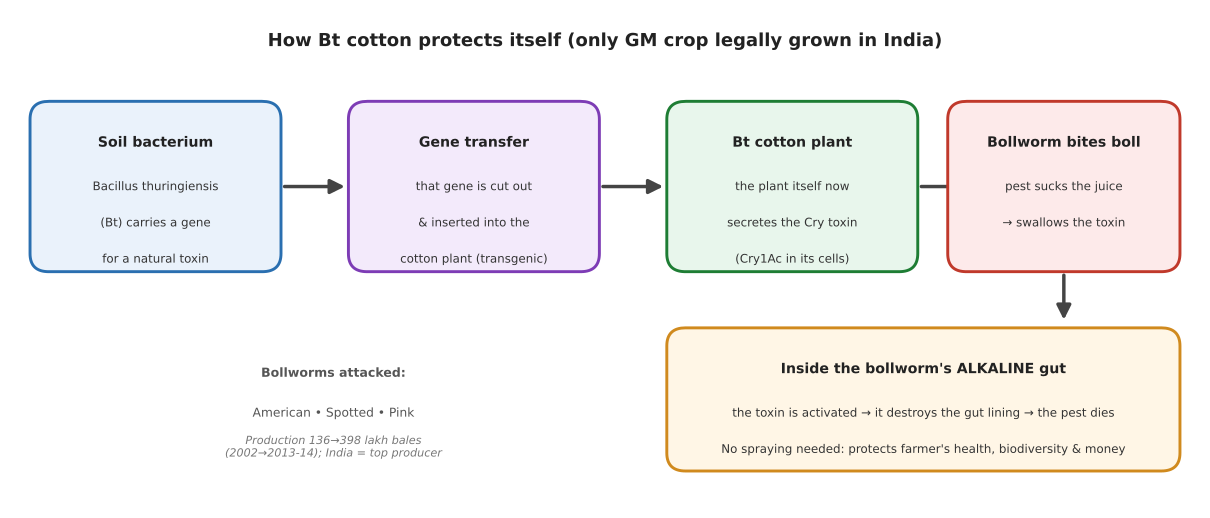
Cotton is highly prone to pest attack; the bollworm enters the cotton boll and sucks the seed's juices, damaging the crop. The old fix — spraying insecticide — has three problems the teacher spelt out: (1) the toxin is indiscriminate, killing useful insects (pollinators, soil-aerators) along with pests; (2) the spraying farmer inhales fumes, a health hazard; and (3) once the bollworm burrows inside the boll, it is shielded by the fibre, so the spray can't reach it.
The biotech solution: there is a soil bacterium, Bacillus thuringiensis (Bt), that naturally secretes an insecticidal toxin. The US company Monsanto first used this toxin to make a pesticide; then its scientists identified the gene responsible for the toxin, extracted it from the bacterium, and inserted it into the cotton plant. Because the cotton now carries a foreign bacterial gene, it is "Bt cotton" — and the plant itself now secretes the toxin (Cry1Ac). When the bollworm eats the boll, it swallows the toxin; in the insect's alkaline gut the toxin is activated, destroys the gut lining, and the pest dies — no spraying needed, so the farmer's health, the biodiversity of useful insects, and money are all protected.
TEACHER'S DATA — the payoff. Bt cotton was introduced in 2002. Cotton production rose from ~136 lakh bales in 2002 to ~398 lakh bales in 2013 (verified: peak ~398 lakh bales in 2013-14) — more than tripling in ~10 years — and India became the world's top cotton producer (verified: largest producer by ~2015). 1 bale = 170 kg. (For context: Monsanto's Bt cotton reached India via the JV Mahyco-Monsanto Biotech; Monsanto was acquired by Bayer in 2018.)
HTBt cotton — the illegal extension
The teacher used the same DSR/herbicide logic on cotton. Cotton is a kharif crop (grown in the monsoon, so weeds flourish) that grows in 50-100 cm rainfall, moderately warm areas — so you can't drown weeds by flooding (that would kill the cotton, which won't grow in very wet places like Kerala or the North-East). That leaves only costly, scarce manual weeding. Hence farmers want HTBt / HT cotton — "herbicide-tolerant" Bt cotton: spray the herbicide glyphosate (sold by Monsanto under the brand "Roundup" — "like paracetamol sold under different brand names") and it kills the weeds while the HT cotton survives, with no hired labour.
CURRENT AFFAIRS / TEACHER'S EXAMPLE — the civil-disobedience movement. HTBt cotton is not approved in India, yet (per news he cited) 15-20% of the ~120 lakh hectares of cotton area already grows this unauthorised variety. It started in Maharashtra (a "double dhamaka" seed sold overnight), spread to Gujarat, then to the Malwa plateau of Madhya Pradesh. Farmers' groups — notably the Shetkari Sanghatana — have openly cultivated it and challenged the government to arrest them, calling it a "civil-disobedience movement": just as Gandhi broke the unjust salt law, they say they will defy a rule that is against the common farmer's interest. (Verified: an official study put HTBt at ~15% of cotton area, later rising to ~25%; Shetkari Sanghatana members publicly sowed HTBt as satyagraha and pooled ₹50,000 for a farmer whose crop officials destroyed.)
TEACHER'S EXAMPLE — other GM crops. (a) GM tomato: tomatoes have a short shelf life and can't be grown in cold areas. Scientists took an antifreeze gene from an Arctic fish and inserted it into tomato, so the fruit can be grown in frost/snow areas (area expands) and stored frozen without the cells bursting (shelf life rises) — developed but not commercially cultivated. (b) GM mustard (DMH-11) — developed to fight India's edible-oil shortage. CLARIFICATION — GM mustard DMH-11. (Verified:) DMH-11 (Dhara Mustard Hybrid-11) was developed by Prof. Deepak Pental's team at the University of Delhi using the transgenic Bar-Barnase-Barstar system; GEAC recommended its environmental release in October 2022; it would be India's first GM food crop (cotton being a fibre crop). A Supreme Court split verdict (July 2024) referred the matter to a larger bench; commercial release is not yet permitted.
The case against GM — five concerns
The teacher stressed there is no conclusive evidence either way, and policy therefore varies by country (Brazil allows GM; the USA allows it case-by-case; Canada allows it; Western European countries strictly prohibit it). India permits Bt cotton but not Bt brinjal, because brinjal is often eaten raw/under-cooked, raising health concerns. The five concerns:
-
Human-health risk. Some studies call GM crops carcinogenic; others find them safe — neither side is conclusive. The teacher noted GM has likely already entered our food chain anyway: US GM soya/maize is fed to poultry, and chicken legs dumped into India (Americans prefer breast meat) carry that protein; cottonseed from Bt cotton is crushed for oil and the protein-rich cake is fed to cattle, so milk drinkers are indirectly exposed.
CLARIFICATION — glyphosate/Roundup carcinogenicity. The teacher said it is "proven beyond doubt" that glyphosate causes cancer, citing a US farmer who won against Monsanto. (Verified, more precisely:) the WHO's IARC classified glyphosate as "probably carcinogenic to humans" (Group 2A) in 2015 (linked to non-Hodgkin lymphoma); a San-Francisco jury found for Dewayne Johnson v. Monsanto (2018) (award later reduced). But it is contested — the US EPA holds it is "not likely" carcinogenic — so the accurate phrase is "probably carcinogenic," not "proven."
-
Biodiversity loss. As >98% of India's cotton area is already under Bt hybrids, the indigenous cotton varieties grown before 2002 risk being lost forever if it reaches 100%. (For GM mustard, a specific worry is the untested effect on honeybees that depend on mustard nectar.) This is why GM approval sits with the Genetic Engineering Appraisal Committee (GEAC) under the Ministry of Environment, Forest & Climate Change (MoEFCC) — an environment body, not just agriculture.
- Loss of efficacy over time (the resistance "treadmill") — the teacher's most detailed point:
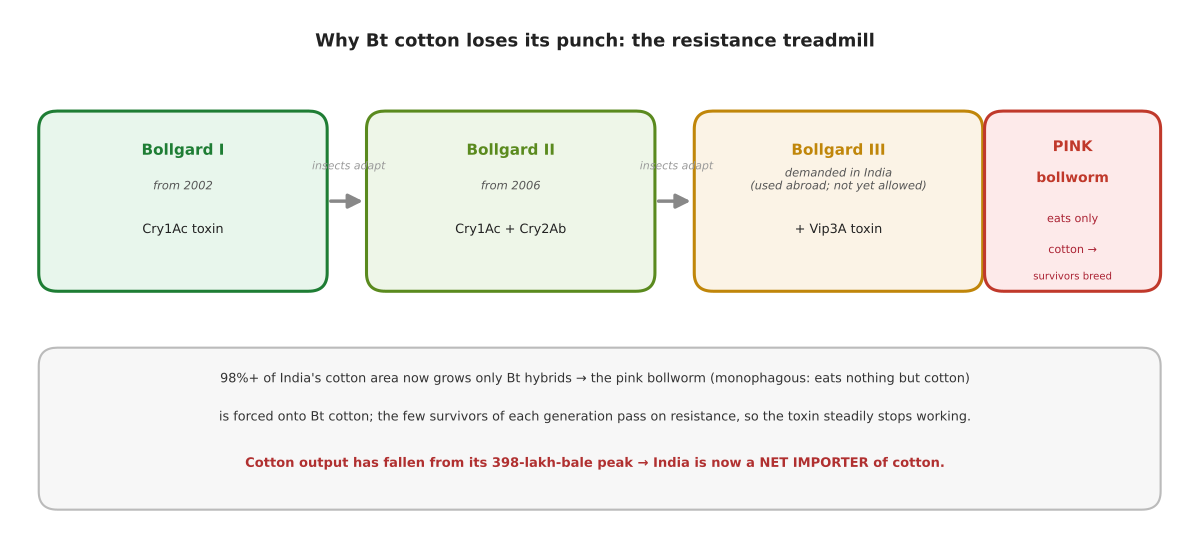
The ~398-lakh-bale figure was a peak; cotton output has been falling ever since, and India is now a net importer of cotton (import duty was even waived till September). The reason is pest resistance: Monsanto's first product Bollgard I carried the Cry1Ac toxin; as bollworms adapted, it launched Bollgard II (2006) with Cry1Ac + Cry2Ab. Today the worst pest is the pink bollworm, which is monophagous — it eats nothing but cotton. Since 98%+ of India's cotton area grows only Bt cotton, the pink bollworm is forced onto Bt cotton; of (say) one lakh that enter a field, only ~100 survive — and those survivors breed, passing resistance on, so each generation is more resistant and the toxin steadily stops working. Indian farmers are therefore demanding Bollgard III (already used in other cotton countries, not yet allowed in India). (Verified: Bollgard III / "XtendFlex" adds the Vip3A toxin (event COT102) plus glyphosate tolerance.) The teacher's analogy: antibiotics that stop working after 15 years because microbes develop resistance — we then need a new generation.
- Creation of monopolies. In the cotton-seed market you find nothing but Bt-cotton hybrids — no alternative. A company that develops the trait registers it under the PPV&FR Act, gets a patent, ties up with an Indian company (e.g. Mahyco) to multiply and sell locally, and collects royalty on every packet — entrenching a monopoly. The teacher also described the "indirect route / evergreening" by which an unapproved trait spreads: companies quietly release it (when state price caps removed their incentive to apply officially, Monsanto withdrew its HTBt application), farmers adopt it for the profit, a shortage builds, farmers protest, the government buckles and legalises it — then the cycle repeats with the next generation (Bollgard I → II → III…). This is not hypothetical: it is exactly how Bt cotton itself got de-facto legalised — Punjab resisted until 2006, but pressure mounted and today 98%+ of the area is Bt.
EXAM FOCUS / READING. The teacher asked students to read Dr. Ashok Gulati's article "A crisis in India's cotton fields" — on how cotton output has declined, how India's cotton yield is barely ~20% of countries like Australia, how public R&D is under-funded and innovation suppressed, and why new GM varieties may be needed. He also flagged the science angle goes to the science teacher and the ethics of GM goes to the ethics teacher. He deliberately left the GM debate open-ended — strong arguments exist on both sides.
Seeds — board revision (verbatim sense). Seeds are an important input in cultivation; quality seed itself raises production/productivity (example: Green Revolution = an HYV of wheat by Norman Borlaug). Most Indian farmers lack access to quality certified seed and rely on farm-saved seed → low Seed Replacement Rate. Issues: availability (esp. pulses & oilseeds neglected in the Green Revolution), affordability (most hybrids can't be reused), and the GM debate (concerns over biodiversity loss, loss of efficacy over time, harm to human health, creation of monopolies, etc.).
5. FERTILIZERS — the second backward linkage
5.1 What fertilizers are
Fertilizers are supplements — the teacher's analogy: a body-builder needs protein for muscle; if his food doesn't supply enough, a dietitian adds protein supplements; if your food lacks iron, the doctor gives iron supplements. Likewise plants draw nutrients from the soil, and where the soil falls short, fertilizers add those nutrients artificially. Plant nutrients fall into three classes:
| Class | Needed in | Nutrients |
|---|---|---|
| Macronutrients / primary | very large quantities | N (nitrogen), P (phosphorus), K (potassium) |
| Secondary (macro)nutrients | between micro and macro | Sulphur (S), Calcium (Ca), Magnesium (Mg) |
| Micronutrients | small quantities, still essential | Iron (Fe), Zinc (Zn), Copper (Cu), Molybdenum (Mo), Boron (B) |
(The same iron deficiency that makes Indian women anaemic shows up in plants too — iron is a plant micronutrient.) By source, fertilizers are:
- Chemical — e.g. urea (factory-made, supplies nitrogen);
- Organic — e.g. vermicompost (supplies nitrogen + many other nutrients);
- Biofertilizers — living microbes such as Rhizobium (fixes atmospheric nitrogen into soluble nitrate the plant can use), Azotobacter, Acetobacter, Trichoderma.
The teacher then argued that, like seeds, the fertilizer linkage is broken — for three reasons.
5.2 Problem 1 — Non-uniform distribution
Chemical-fertilizer use has risen more than ten-fold in 50 years, but that national average hides huge inequality.
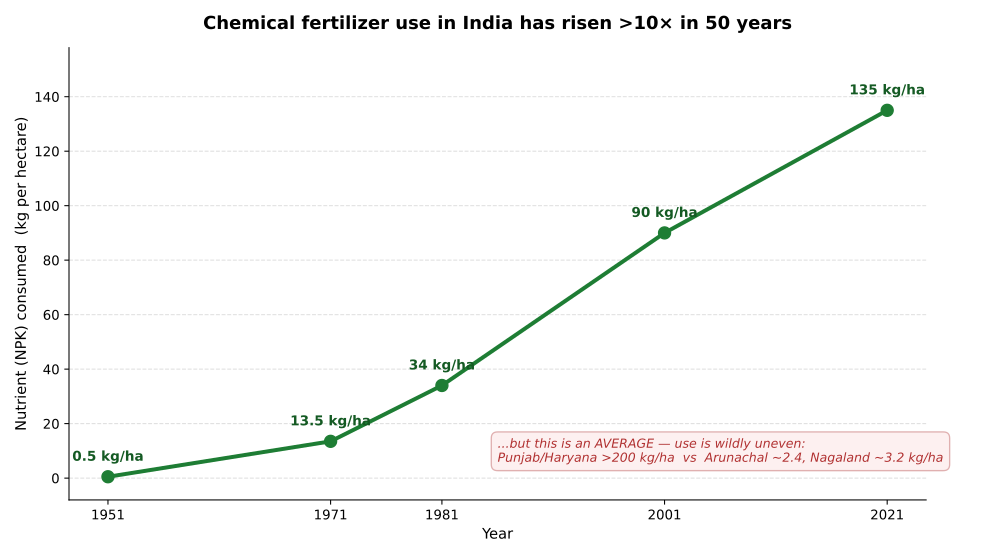
Board figures (kg of nutrients per hectare): 1950-51 ≈ 0.5 → 1970-71 ≈ 13.5 → 1980-81 ≈ 34 → 2000-01 ≈ 90 → 2020-21 ≈ 135+. The 2020-21 figure of ~135 kg/ha is only an average. Actual use is wildly non-uniform:
- >200 kg/ha: Punjab, Haryana, Bihar, Andhra Pradesh, and UTs like Delhi, Puducherry (the teacher cited Puducherry ~400 kg/ha).
- Very low: Sikkim (a fully organic state since 2016), Arunachal Pradesh ~2.4 kg/ha, Nagaland ~3.2 kg/ha — so Punjab uses ~100× more than Arunachal.
Why the gap? The teacher's explanation is irrigation. A farmer broadcasts fertilizer either on a flooded field or just before a round of irrigation, because fertilizers need water to be absorbed by the plant. So wherever irrigation is good, fertilizer use is high, and where irrigation is poor, fertilizer use is low. He pre-empted the obvious objection — "but the North-East has good rainfall" — by noting that rain is uncertain: if you apply fertilizer and it then rains continuously for 48 hours, the fertilizer is washed away or leaches into the sub-soil, lost to the plant. So there is a near one-to-one relationship between fertilizer use and assured irrigation — not mere rainfall. (A side-benefit: because chemicals never penetrated the North-East, states like Arunachal can go fully organic in a few years, whereas it would take Punjab decades to wean off chemicals.)
5.3 Problem 2 — Urea overuse & the skewed NPK ratio
The three big fertilizers and what they supply:
| Fertilizer | Supplies | Key role / teacher's note |
|---|---|---|
| Urea | 46% Nitrogen (only N) | Faster growth / foliage — N builds the green leaf, so more food is made and the plant grows faster. A 100-kg bag gives 46 kg N. |
| DAP (di-ammonium phosphate) | 46% Phosphorus + 18% Nitrogen | Applied in the early days — phosphorus establishes the roots; a good root network means better nutrient absorption. (Other P sources: single super phosphate, mono-ammonium phosphate.) |
| MOP (muriate of potash) | 60% Potassium (only K) | Potassium gives the plant immunity against diseases and post-harvest lustre to the grain. |
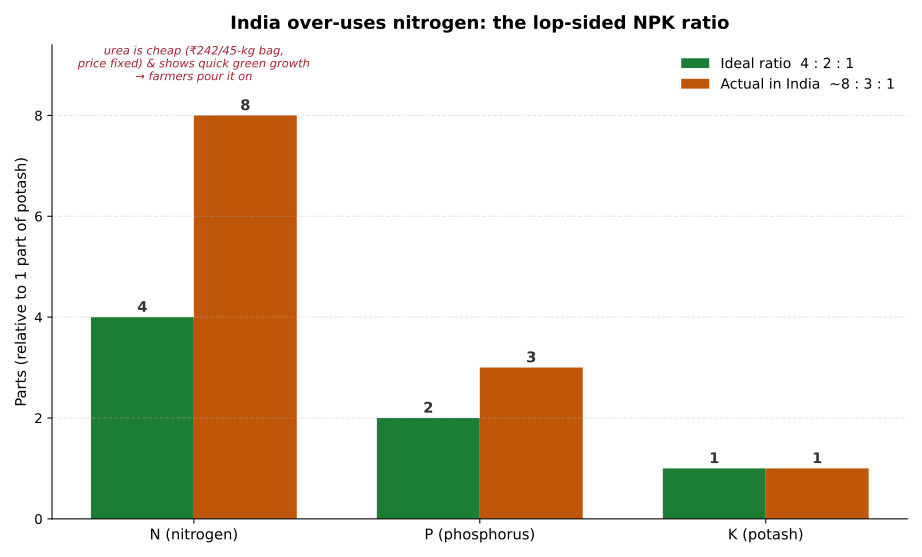
The teacher said that, generalising for Indian soils and crops, the ideal N:P:K ratio is 4:2:1, but the actual ratio is roughly 8:3:1 (precisely ~7.6 : 2.8 : 1) — i.e. India massively over-uses nitrogen (urea). Two reasons:
- Lack of soil-science knowledge — many farmers wrongly believe "more fertilizer = more production" (it isn't; over-use creates problems without raising yield), and urea shows a visible green flush of growth.
- Urea is far cheaper — and this is the decisive reason. A bag of DAP costs ~₹1,350, but a 45-kg bag of urea costs under ~₹300 (verified: urea MRP ₹242/45-kg bag, excl. neem-coating & taxes). So farmers pour on the cheap urea.
Why is urea so cheap? Because of how the subsidy works.
- (Verified:) Since 1 April 2010, all P&K fertilizers (28 grades) except urea are under the Nutrient-Based Subsidy (NBS) scheme — the government fixes a per-kg subsidy on each nutrient (N, P, K, S), announced twice a year (one rate for April-September, one for October-March), and the company must pass that subsidy on to the farmer (deducting it before printing the MRP). The teacher's cited NBS rates (₹/kg, Apr-Sep 2026): N ≈ 47.32, P ≈ 52.76, K ≈ 2.38, S ≈ 3.16. A company computes its subsidy from the nutrient content × these rates (e.g. for DAP: 18% N + 46% P per tonne, multiplied out).
- Urea is NOT under NBS — the government still fixes urea's MRP directly (statutory price control). So however much the production cost rises, urea's price stays frozen while DAP's price has climbed steeply over 15 years — making urea look ever cheaper, which fuels its over-use. The teacher's blunt verdict: there is "no economic logic" to keeping urea out of NBS; it is purely political — the government doesn't want to raise urea's price and upset farmers, so ~60% of the entire fertilizer subsidy goes to urea alone.
TEACHER'S REASONING — why subsidise nutrients not products? If the only goal were to cut the subsidy bill, the government could simply fix a subsidy per product (₹X on DAP, ₹Y on MOP…). It chose to subsidise per nutrient so that companies can mix-and-match nutrients in different ratios and launch many tailored fertilizer products suited to specific soils/crops — e.g. new NPK + Mg/Zn/Boron/S grades brought under NBS from April 2024. Subsidising nutrients keeps the product market innovative; subsidising urea by fixed MRP does the opposite — it incentivises inefficiency, since an inefficient, high-cost urea producer is simply handed a bigger subsidy to cover its costs, with no incentive to become efficient.
CURRENT AFFAIRS — why phosphorus subsidy was raised. The teacher noted the P subsidy jumped from ~₹28 to ~₹52/kg because DAP/phosphorus imports became dearer and scarcer: China stopped supplying phosphoric acid / DAP (diverting it to EV batteries), and Red Sea / Houthi disruptions plus West Asia (Persian Gulf) tensions choked the route through which Saudi Arabia/Morocco fertilizer reaches India. The government absorbs the higher cost via more subsidy rather than passing it to farmers — because under NBS, if the subsidy were not raised, the company would print a higher MRP and the farmer would pay the difference.
5.4 Problem 3 — Subsidy leakage (urea doesn't reach the farmer)
Even though ~60% of fertilizer subsidy goes to urea, the subsidy doesn't reach the intended beneficiary. The government fixes urea's price, controls its production, and controls its imports through an annual demand assessment: states report demand → the Centre consolidates it → gives production orders to domestic urea companies → and for the shortfall places import orders. But imports arrive slowly, and by then the monsoon arrives and every farmer demands urea at once. With demand high, supply short, and price frozen (so price can't rise to clear the market), the result is black-marketing — the retailer says "stock is over" but hands over urea to whoever pays extra. That is just the start; cheap, subsidised, agriculture-grade urea then gets diverted in four more ways the teacher detailed:
- Diversion to industry. Urea is used by automobile/diesel engines (in SCR systems to cut NOx/nitrate emissions), plywood adhesives, and cattle-feed. Industry has been free to import urea since 2018 — but at higher (unsubsidised) price — so industries instead exploit loopholes and siphon off cheap agriculture-grade urea, worsening the farm shortage.
- Illegal liquor. Bootleggers add urea to spurious country liquor to boost its potency — until it turns poisonous (the recurring hooch tragedies where people lose eyesight or die). That urea, too, is diverted farm urea.
- Adulterated / "synthetic" milk. Around Diwali / the wedding season (Oct-Nov), when milk demand spikes, fake milk is made from detergent powder + hydrogenated oil + water + urea — again using agriculture urea. (Delhi, a high-income urban market with too few dairies, pulls milk from Agra-Mathura-Aligarh in western UP, and shortages invite adulteration.)
- Smuggling across porous borders. Urea is far costlier in Nepal and Bangladesh, and India's borders with them are porous (Nepal highly porous; Bangladesh fencing incomplete — historically cattle were smuggled here). So subsidised Indian urea is smuggled out, deepening the domestic shortfall.
CURRENT AFFAIRS — crackdown. The teacher cited a headline that the government cancelled over 6,900 dealer licences in a crackdown on fertilizer hoarding and black-marketing — a phenomenon that recurs at the start of every sowing season.
The bottom line. India spends over ₹2 lakh crore a year on fertilizer subsidy (verified: ~₹2.55 lakh crore in 2022-23), yet because so much is black-marketed, diverted or smuggled, the farmer often still has to buy fertilizer at a high price — proving the teacher's thesis that the fertilizer linkage is broken. Solutions (e.g. nano-urea, neem-coating, DBT for fertilizer, balanced fertilisation, soil-health cards) were deferred to the NEXT class — this class only diagnosed the problems.
6. Quick revision & exam pointers
- Three features of Indian agriculture: rainfed · limited mechanisation (small/fragmented holdings) · most backward & forward linkages missing.
- Backward = upstream (seeds, fertilizer, pesticide, irrigation, machinery/labour, credit). Forward = downstream (market/e-NAM/MSP, transport/reefer vans, warehousing/cold storage, value addition).
- Seeds — 3 challenges: Availability (low SRR; worst for pulses & oilseeds — gram ~22%, groundnut ~16%, 2015-16) · Affordability (hybrids can't be reused; UPOV abroad vs PPV&FR Act 2001 in India; parent lines withheld; Terminator seeds banned) · GM debate.
- Genome editing (own gene, no foreign gene) ≠ GM/transgenic (foreign gene). Only Bt cotton is legally cultivated; DMH-11 GM mustard would be the first GM food crop (GEAC cleared 2022; SC split 2024). Bt brinjal not allowed (eaten raw).
- Bt cotton: gene from Bacillus thuringiensis → Cry1Ac toxin → kills bollworm in its alkaline gut. 2002→2013: 136→398 lakh bales (1 bale = 170 kg); India = top producer. Then pink bollworm resistance + Bollgard I (Cry1Ac) → II (Cry1Ac+Cry2Ab) → III (+Vip3A, not yet allowed) → output fell → India now a net cotton importer.
- HTBt cotton (glyphosate/Roundup-tolerant) is illegal; ~15-25% of area grows it; Shetkari Sanghatana civil disobedience. Glyphosate = IARC "probably carcinogenic" (Group 2A), contested. GM approval = GEAC under MoEFCC.
- Recent seed varieties (verified, exam-hot): genome-edited rice DRR Dhan 100 "Kamala" (IIRR, from Samba Mahsuri) & Pusa DST Rice 1 (IARI, from MTU1010), released 5 May 2025, CRISPR-Cas9, India first in world; heat-tolerant pigeon pea ICPV 25444 (ICRISAT, speed breeding, 45 °C); herbicide-tolerant Pusa Basmati 1985/1979 (non-GM, imazethapyr); Pusa Double Zero Mustard 31 (low erucic + low glucosinolate); biofortified iron potato (CIP) & Golden Rice.
- Fertilizers: Macro/primary NPK · secondary S, Ca, Mg · micro Fe, Zn, Cu, Mo, B. Urea 46% N · DAP 46% P + 18% N (roots) · MOP 60% K (immunity/lustre). Ideal NPK 4:2:1, actual ~8:3:1 → N over-use.
- Subsidy regime: NBS since April 2010 on 28 P&K grades — subsidy fixed per nutrient (N,P,K,S), twice a year, passed on by companies. Urea outside NBS — MRP fixed (₹242/45-kg bag since 2018) → urea cheapest → over-used; ~60% of fertilizer subsidy goes to urea. Total fertilizer subsidy > ₹2 lakh crore/yr.
- Urea leakage: black-marketing · diversion to industry (diesel SCR, plywood, cattle-feed) · illegal liquor · fake milk · smuggling to Nepal/Bangladesh → farmer still pays high. 6,900+ licences cancelled.
- Schemes/laws to name: Draft Seeds Bill 2025 (₹30 lakh penalty; replaces Seeds Act 1966) · NMEO-Oilseeds · Mission for Aatmanirbharta in Pulses (₹11,440 cr, 2025-31) · e-NAM, MSP · PPV&FR Act 2001 · NBS (2010).
- Read: Ashok Gulati — "A crisis in India's cotton fields."
Current Affairs
(Updated as relevant news/magazine content comes in)
| Date | Source | Headline | Connection to this topic |
|---|---|---|---|