Distribution of Earthquakes & Volcanism, Earthquakes, Seismic Waves & the Seismic Model of Earth's Interior
GS Paper: I (Physical Geography — geomorphology); Prelims; GS III (Disaster Management) | Subject: Geography — Physical | Class: 8 (teacher folder Md) | Last updated: 2026-06-28
This note covers Class 8, which closes the Geomorphology (World Physical Geography) chapter. It has four big blocks, each built around how the teacher wants the answer written:
- Global distribution of earthquakes & volcanism — the standard answer-format keyed to the three plate-boundary types and what each produces (trenches, island arcs, fold mountains, rift valleys, mid-oceanic ridges).
- Earthquakes — definition, the elastic-rebound mechanism, and all the causes (natural + anthropogenic + climate-linked).
- Focus / epicentre, magnitude, and the two scales (Richter vs Mercalli) — with the disaster-management angle (Sendai, BIS zones).
- Earthquake waves & the seismic model of the Earth's interior — body vs surface waves, P vs S, and how their shadow zones prove the mantle is solid, the outer core liquid, and the inner core solid.
The class ends by previewing the Indian Physical Geography syllabus (next chapter). All board diagrams were hand-drawn and rough, so they are redrawn cleanly here; the prose independently states everything each diagram conveys.
Table of Contents
- Global distribution of earthquakes & volcanism
- 1.1 The four opening observations
- 1.2 Intensity by boundary type
- 1.3 Convergent boundary on the ocean floor → trench, island arc, tsunami
- 1.4 Convergent boundary at the continent → fold mountains
- 1.5 Divergent boundary at the continent → rifting
- 1.6 Divergent boundary on the ocean floor → mid-oceanic ridge
- 1.7 Summary table & the answer-writing format
- Earthquakes — definition & mechanism
- 2.1 Definition
- 2.2 Catastrophic expression, diastrophic origin
- 2.3 The elastic-rebound mechanism (equilibrium → imbalance → release)
- 2.4 Causes of earthquakes
- 2.5 Isostasy, glacier melt & global warming (IPCC)
- Focus, epicentre & magnitude
- Measuring earthquakes — Richter vs Mercalli
- 4.1 Richter scale (magnitude / strength)
- 4.2 Mercalli scale (intensity / impact)
- 4.3 Disaster management — Sendai & BIS seismic zones
- Earthquake waves
- The seismic model of the Earth's interior
- 6.1 The assumption & how the data contradicts it
- 6.2 Behaviour of the P-wave → shadow zone 105°–145°
- 6.3 Behaviour of the S-wave → shadow zone beyond 105°
- 6.4 Putting it together → mantle solid, outer core liquid, inner core solid
- Next chapter — Indian Physical Geography (syllabus preview)
- Current Affairs
1. Global distribution of earthquakes & volcanism
EXAM FOCUS / PYQ: The teacher stressed that this single answer-format covers most questions in this area — whether the question is framed as "global distribution of earthquakes", "global distribution of volcanism", "plate-tectonic boundaries", or "geophysical phenomena". Learn the sequence below and reuse it. He also said to support it with a sketch — even a partial world map showing a few plates and the boundary types is enough.
The whole topic is approached as: first establish the pattern of distribution, then explain it through plate tectonics.
1.1 The four opening observations
When you describe the worldwide distribution of earthquakes and volcanoes, open with these four points, in order:
- It is a zonal (belt-wise) distribution, not random. Earthquakes and volcanoes do not occur randomly across the globe; they are concentrated in definite belts/zones. The classic belt runs down the western margins of North and South America (the Pacific-facing edge), and another belt of volcanism + earthquakes runs through the middle of the Atlantic Ocean.
- The two zones overlap. Wherever there are volcanic eruptions, earthquakes are also recorded — volcanism and seismicity go together. So the volcanic belt and the earthquake belt are essentially the same belt (one is "accompanied by" the other).
- The zones are interpreted on the basis of plate tectonics — i.e., these belts coincide with plate boundaries. (Reasoning the teacher wants you to carry forward from the plate-tectonics chapter.)
- The majority of earthquakes and volcanic eruptions are recorded at plate boundaries. This is the single load-bearing sentence: seismicity and volcanism cluster at the edges where plates meet (or pull apart).
TEACHER'S EXAMPLE (the world sketch): On the board he drew the Americas to anchor it. Down the west coast of North America the Pacific plate meets the North American plate; down the west coast of South America the Nazca plate meets the South American plate — both convergent belts of intense earthquakes and volcanoes. In between sits the small Caribbean plate (colliding with the North American plate). Running down the middle of the Atlantic is a divergent boundary on the ocean floor — the Mid-Atlantic Ridge — which records its own volcanism and (low-intensity) earthquakes. Then the three boundary types — convergent, divergent, transform — are each related to earthquakes and volcanism in turn (below).
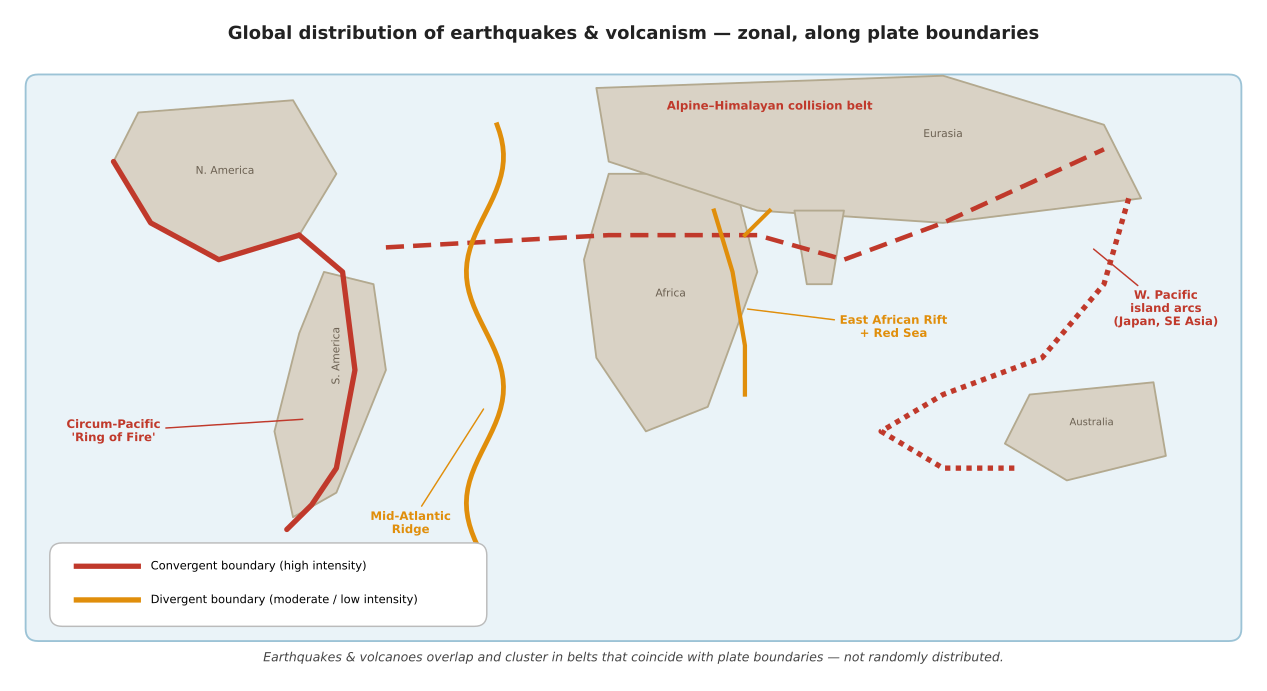
The belts (Circum-Pacific "Ring of Fire" along the Americas/Asia-Pacific margins, the Mid-Atlantic Ridge, the East African Rift, and the Alpine–Himalayan collision belt) all trace plate boundaries — this is the "zonal, non-random, boundary-controlled" pattern of points 1–4 above.
1.2 Intensity by boundary type
The intensity of earthquakes and volcanism depends on the type of boundary:
- Convergent boundary → HIGH intensity. Where two plates collide, the locked-up stress is huge, so both earthquakes and volcanic eruptions are the most intense.
- Divergent boundary → MODERATE / LOW intensity. Where two plates move apart, the interior pressure is released gradually (at a slower pace), so the earthquakes and volcanism recorded there are of lower intensity.
- Transform boundary → the third type (plates sliding past each other); the teacher noted it as one of the three but the class's worked detail was on convergent and divergent.
The rest of the section works through what each boundary produces, depending on whether it sits on the ocean floor or at/within a continent. All four cross-sections are redrawn together:
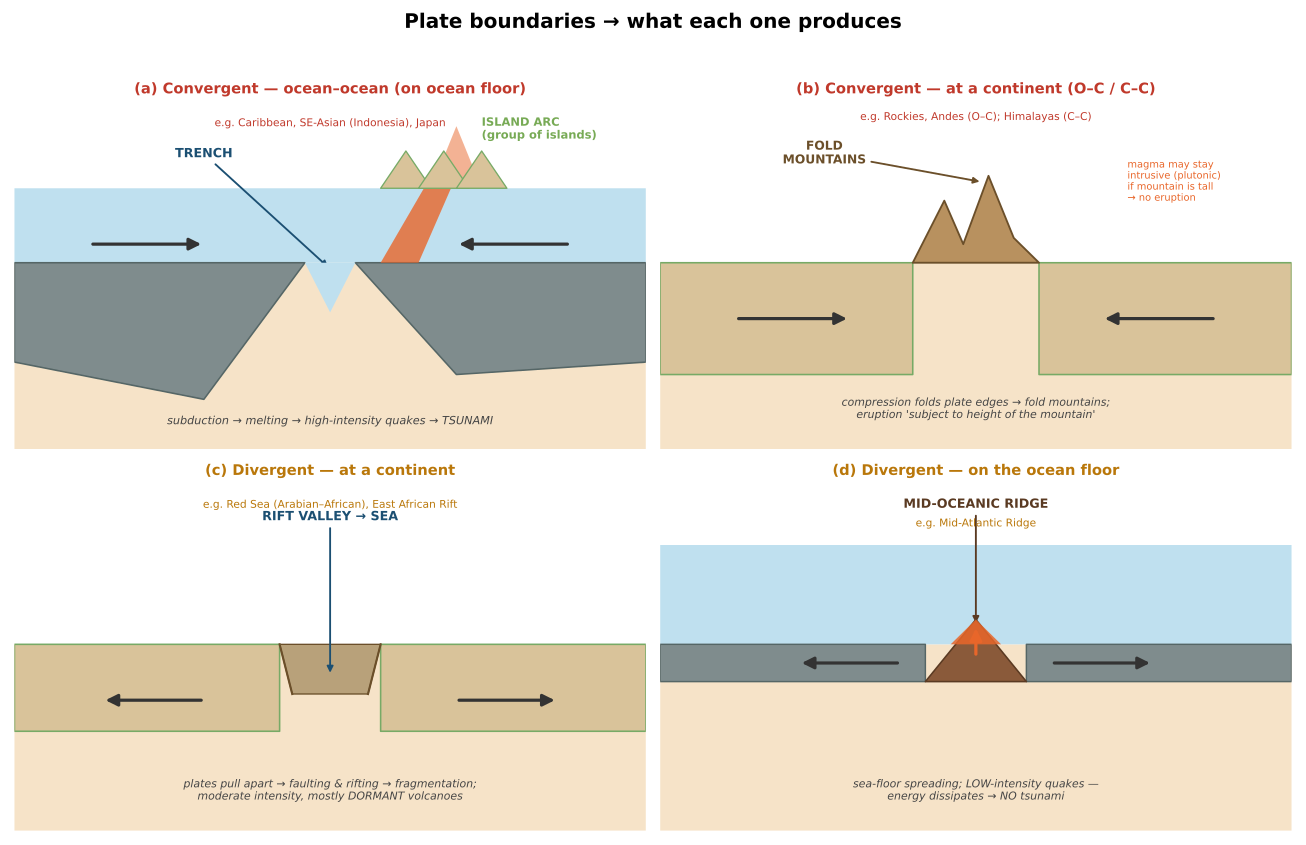
1.3 Convergent boundary on the ocean floor
There are three kinds of convergence — ocean–ocean, ocean–continent, and continent–continent. When the convergence sits on the ocean floor (the ocean–ocean case), the boundary lies at the ocean floor and one plate subducts beneath the other. The subducting plate melts in the mantle, feeding magma upward. This produces four outcomes (all four are exam-worthy, especially for objective questions):
- A deep-sea TRENCH — the V-shaped depression at the line where one plate dives under the other.
- An ISLAND ARC — a group of islands formed by the rising central-type (not fissure-type) volcanic eruptions. Because it is ocean–ocean convergence, the eruption is always central type, of very high intensity, and the structure rises above sea level to form arc-shaped chains of islands.
- HIGH-intensity earthquakes at the ocean floor.
- TSUNAMIS — because the high-intensity earthquakes occur under the ocean, the energy added to the water travels to the surface and increases the height of the sea waves, expressed as a tsunami.
TEACHER'S EXAMPLE / EXAM POINT: Examples of ocean–ocean convergence and their island arcs — and all are equally tsunami-prone: - Caribbean Islands — Caribbean plate colliding with the North American plate (boundary on the ocean floor). - South-East Asian Islands (Indonesia and the arc) — the Indo-Australian plate in the west, plus several minor plates here (notably the Philippine plate, and the Burma / Sunda ("Java") microplates). - Japan Islands. He stressed: when you elaborate (depending on word limit), name the interacting plates — that is the detail that lifts the answer. "Island arc" = archipelago = a group of islands.
1.4 Convergent boundary at the continent
When convergence happens at/near a continent — i.e., the ocean–continent case or the continent–continent case — the outcomes are largely common, so they're taken together. The compressive force folds the edges of both plates, so the result is:
- FOLD MOUNTAINS (all the world's fold mountains belong to this category), plus earthquakes, plus volcanic eruption — but the eruption is "subject to the height of the fold mountain". This last clause is the subtle point: a very tall fold mountain can stop the magma from actually erupting at the surface.
TEACHER'S EXAMPLE — three cases on a spectrum of height: - Rockies — Pacific (oceanic) plate converging against the North American (continental) plate = ocean–continent convergence; there is volcanism and this whole belt is seismically active. - Andes — Nazca plate colliding with the South American plate = ocean–continent; the Andes are a volcanic and earthquake belt. - Himalayas — continent–continent collision (Indian plate vs Eurasian plate). The Himalayas are far taller than the Rockies or Andes. Here a "weak zone" forms and magma rises inside the mountain, but because of the great height the volcano cannot erupt at the surface — the magma cools in the interior and forms an intrusive (plutonic) rock body instead. This is exactly why we say "volcanic eruption subject to the height of the fold mountain".
CLARIFICATION (for Mains precision): The teacher's framing — Rockies = oceanic-continental convergence — is the standard UPSC simplification. In current geology the Rockies' formation (the Laramide orogeny) is attributed to flat-slab subduction of the Farallon plate far inland and is debated; for the exam, keep the oceanic–continental convergence framing but don't over-claim a simple Pacific–North-American collision. The Andes (Nazca–South American) and Himalayas (continent–continent) examples are exact.
1.5 Divergent boundary at the continent
At a divergent boundary two plates move apart. There are only two settings in the present arrangement of plates — continent–continent and ocean–ocean (we do not currently experience ocean–continent divergence).
When the divergent boundary is at a continent (continent–continent divergence), the plates pulling apart cause:
- FAULTING and RIFTING, with fragmentation of the land mass — the continent breaks. A rift develops, which can eventually deepen into a sea.
- The earthquakes and volcanism here are of moderate intensity; importantly, the volcanoes are typically dormant (they erupt with long gaps — accumulate energy, then erupt — rather than continuously).
TEACHER'S EXAMPLE: - The Arabian plate diverging away from Africa has opened the Red Sea (fragmentation of land). - The East African Rift is the divergent force tearing Africa apart. Most volcanoes along the East African Rift are dormant; the recent eruption in Ethiopia is an example of one erupting after a very long gap. There is no continuous eruption here — that's the "moderate intensity + dormancy" signature.
1.6 Divergent boundary on the ocean floor
When the divergent boundary lies on the ocean floor (ocean–ocean divergence), the two plates pull apart under the sea. Magma rises into the gap; the eruption is fissure-type, the earthquake intensity is very low, and the result is:
- SEA-FLOOR SPREADING and the formation of a MID-OCEANIC RIDGE (the rising magma builds the ridge).
- LOW-intensity earthquakes that are NOT capable of causing a tsunami. Because the seismic energy added on the ocean floor is so small, by the time it reaches the surface it has scattered / dissipated — so no tsunami originates here.
EXAM POINT — the clean contrast the teacher wants you to remember: Tsunamis are always associated with convergent boundaries (island arcs and tsunamis go together); divergent boundaries (ridges) cannot cause tsunamis. So "island + tsunami go together, but ridge + tsunami do not." The textbook example of a divergent ocean-floor boundary is again the Mid-Atlantic Ridge — sea-floor spreading, ridges, low-intensity quakes, no tsunami.
1.7 Summary table & the answer-writing format
| Boundary | Setting | Process | Landform / outcome | Earthquake intensity | Volcanism | Tsunami? | Examples |
|---|---|---|---|---|---|---|---|
| Convergent | Ocean–ocean (on ocean floor) | Subduction | Trench + Island arc | High | Central-type, intense | Yes | Caribbean, SE Asian (Indonesia), Japan |
| Convergent | Ocean–continent / Continent–continent (at continent) | Folding of plate edges | Fold mountains | High | Eruption subject to height (may stay intrusive/plutonic) | Generally no | Rockies, Andes (O–C); Himalayas (C–C) |
| Divergent | Continent–continent (at continent) | Faulting & rifting, fragmentation | Rift → Sea | Moderate | Mostly dormant | No | Red Sea (Arabian–African), East African Rift |
| Divergent | Ocean–ocean (on ocean floor) | Sea-floor spreading | Mid-oceanic ridge | Low | Fissure-type | No | Mid-Atlantic Ridge |
EXAM FOCUS / answer skeleton (the teacher's exact "sequence"): 1. Distribution is zonal/belt-wise, not random; earthquake and volcanic zones overlap. 2. Interpret via plate tectonics — the belts are plate boundaries; majority of events occur at boundaries. 3. Then walk through convergent (high intensity) → ocean-floor case (trench/island arc/tsunami) and continent case (fold mountains); divergent (moderate/low) → continent case (rifting) and ocean-floor case (mid-oceanic ridge). 4. Elaborate with the interacting plates and named examples as the word limit allows, and add a sketch (even a partial world map with a few plates). This single structure answers questions on earthquake distribution, volcanism distribution, plate-tectonic boundaries, or "geophysical phenomena."
2. Earthquakes — definition & mechanism
EXAM FOCUS: Very important for objective (Prelims) questions, and one question can come in GS Paper I.
2.1 Definition
DEFINITION (write it precisely): An earthquake is the release of energy from the Earth's interior that is expressed or recorded on the surface.
Two words carry the definition:
- "Recorded" = sensed by a device (a seismograph / recording station).
- "Expressed" = felt by people.
Either is sufficient — if an event is felt by people or recorded by a device, it is an earthquake. Both halves matter because many earthquakes have no surface expression (nobody feels them) yet are still recorded by instruments. (The teacher's everyday example: there was an earthquake in Delhi "yesterday" that most people didn't feel, but the seismogram recorded it — that still counts as an earthquake.)
2.2 Catastrophic expression, diastrophic origin
KEY EXAM LINE: An earthquake is a catastrophic expression of endogenic force, but it can have a diastrophic origin.
- Catastrophic = sudden. When the energy is released, it is expressed within a very short time (a few seconds) — that's why it is "catastrophic."
- Diastrophic origin = it can be caused by the slow movement of the crust. Plate-tectonic movement is diastrophic — plates may be sliding at only ~2 cm per year, yet that slow process still builds up to an earthquake.
So if asked "is an earthquake a diastrophic phenomenon — yes or no?", the answer is yes (it can result from the slow movement of the crust), but its expression/release of energy is catastrophic (within seconds). Hold both ideas together.
2.3 The elastic-rebound mechanism
MECHANISM (one word answer): The mechanism of an earthquake is elastic rebound.
Take any point in the Earth's interior. Normally it is in a state of stability / equilibrium / crustal stability — meaning the forces acting at that point are balanced. Two forces act:
- Force A = stress — the load from above (the overlying weight pressing down).
- Force B = resistance — the resistance from the interior, produced by endogenic factors.
When A = B, the point is in equilibrium and its energy is simply stored (like potential energy). If something alters A or B (the resistance changes due to an endogenic process, or the load changes), the point becomes unstable. Because the Earth's interior is a closed system, it cannot stay permanently unstable — it tries to restore equilibrium, and in the process of restoring stability the additional energy is released, and that release is recorded as an earthquake. This restoring process is elastic rebound.
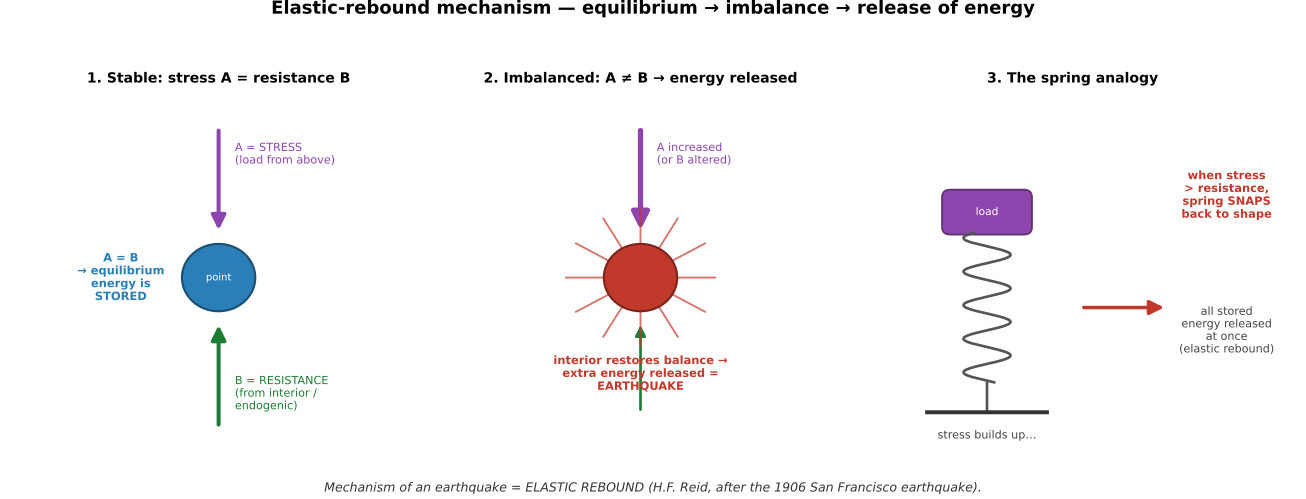
TEACHER'S ANALOGY — the spring: Imagine a spring with a weight on it. The weight = stress, the spring's resistance = the interior resistance. Add more and more load (1 kg, 2, 3, 4…) and the spring keeps bending, offering more resistance — until a point where stress exceeds the resistance. The spring then snaps back to its original shape, throwing off the load and releasing all its stored energy at once. The same happens in the Earth's interior: at the disturbed point, the Earth tries to restore equilibrium, and the additional energy is released — felt as an earthquake. (This is exactly the Young's-modulus / stress–strain idea of elasticity.)
NCERT BASE / attribution: The elastic rebound theory was proposed by Harry Fielding Reid after studying the 1906 San Francisco earthquake — rocks deform elastically under stress until they rupture along a fault and "rebound" to a relaxed state, releasing the stored energy as seismic waves.
2.4 Causes of earthquakes
Because an earthquake is an imbalance between A (stress/load) and B (resistance), anything that alters either force can cause one. B (interior resistance) can only be altered by endogenic processes (geothermal heat, convection currents); A (load) can be altered by endogenic or exogenic processes (deposition adds load, erosion removes it). The teacher listed the primary causes:
- Plate tectonics — the master cause; all earthquakes can ultimately be explained by it, and in plate tectonics both A and B get altered.
- Volcanic eruption — volcanism itself alters the interior energy, triggering earthquakes.
- Denudation (erosion + deposition) — intense deposition increases the load at a place (interior responds → quake); intense erosion removes material (interior responds to re-balance → quake).
- Anthropogenic (human-induced) factors:
- Construction of dams — storing a huge mass of water increases stress in that region and imbalances it. This is Reservoir-Induced Seismicity (RIS) / "reservoir-triggered seismicity."
- Mining — removing large amounts of material alters the load/stress → imbalance → possible quake.
- Intense exploitation of groundwater / over-drilling — slowly alters the forces; can be a reason for earthquakes, though it depends on the nature of the rock (still markable for objective questions).
TEACHER'S EXAMPLE — RIS (verified): The teacher cited a dam in Maharashtra responsible for earthquakes (the transcript garbled the name). This is the Koyna Dam, Maharashtra — the 11 December 1967 Koyna earthquake (M ≈ 6.3, max intensity VIII) is the world's largest and textbook example of Reservoir-Induced Seismicity, occurring soon after the reservoir was impounded. He also flagged that large new dam projects (e.g., China's mega-dams) carry a threat of induced earthquakes.
2.5 Isostasy, glacier melt & global warming
The same stress/resistance logic explains a subtler, climate-linked cause. Consider a mountain covered by a glacier. The mountain rests on the surface in mechanical stability — its stress is balanced by the resistance from the interior.
DEFINITION — Isostasy: Isostasy is the mechanical stability (state of equilibrium/balance) of any landform resting on the Earth's surface — the landform "floats" in balance, neither sinking nor rising.
Now write the total stress as S = S_L + S_G (stress of the landform + stress of the glacier). Over time the mountain has reached equilibrium with the glacier's weight included. Then global warming / climate change rapidly raises temperatures → the glacier melts and loses volume rapidly → the S_G component changes → the balance (S = R) is broken → the landform/interior tries to re-achieve balance → energy is released = an earthquake.
EXAM POINT (verified, IPCC): Global warming can be an indirect cause of earthquakes in glacier-covered regions. The teacher attributed this to the IPCC assessment reports — that glacier-covered areas become vulnerable to earthquakes due to warming, and that the Himalayas are experiencing a greater frequency of earthquakes, partly from rapid glacier melt, apart from plate tectonics. - Calibration: The robust, peer-reviewed mechanism here is glacial isostatic adjustment (isostatic rebound / unloading) — removing ice mass changes the load and can promote fault slip. The IPCC's AR6 (2021–2023) documents accelerating Himalayan glacier loss; AR7 is still in progress (not yet published as of 2026). Present it as the teacher framed it (warming → glacier unloading → isostatic re-balancing → seismicity), but attribute the direct "increased Himalayan earthquakes" claim cautiously, since Himalayan seismicity is dominated by the ongoing Indian–Eurasian collision.
3. Focus, epicentre & magnitude
Set up the basics on a cross-section of the Earth:
- FOCUS (hypocentre) = the point inside the Earth where the energy is released.
- MOMENT MAGNITUDE = the total amount of energy released at the focus at that instant. (Energy at the focus = moment magnitude.)
- The energy released at the focus propagates in all directions as earthquake waves. The waves generated at the focus are body waves (further split into P and S — primary and secondary).
- As the wave travels outward, its amplitude/energy decreases with increasing distance from the focus. (On an energy-vs-distance graph, the amplitude is maximum at the focus and decays outward.)
Surface waves and the "expression" of an earthquake. When the body-wave energy reaches the outer part of the crust, it turns horizontal and travels parallel to the surface — this is the surface wave. Surface waves are usually not generated directly at the focus; they are the modified version of a body wave (most often the P-wave). The crust's outer layer has cracks, faults and gaps, so when a surface wave passes, the rocks vibrate — and that vibration is what we feel as tremors.
KEY LINE: The expression of an earthquake (what people feel) is determined by the condition of the surface wave, not directly by the body wave.
Shallow-focus vs deep-focus. Compare two quakes: one with a shallow focus (say 5 km deep, 100 units of energy released) and one with a deep focus (say 50 units released but much deeper). At the focus, the shallow one is "stronger" by moment magnitude — but what matters for damage is how much energy survives to the surface. The deep-focus energy travels farther and arrives at the surface much weakened (e.g., only ~10 units), while the shallow-focus energy arrives less weakened (e.g., ~30 units) and creates a stronger surface wave.
EXAM LINE: A shallow-focus earthquake has a greater expression (is felt more, causes more damage) than a deep-focus earthquake — even if the deep one had a higher magnitude at the focus.
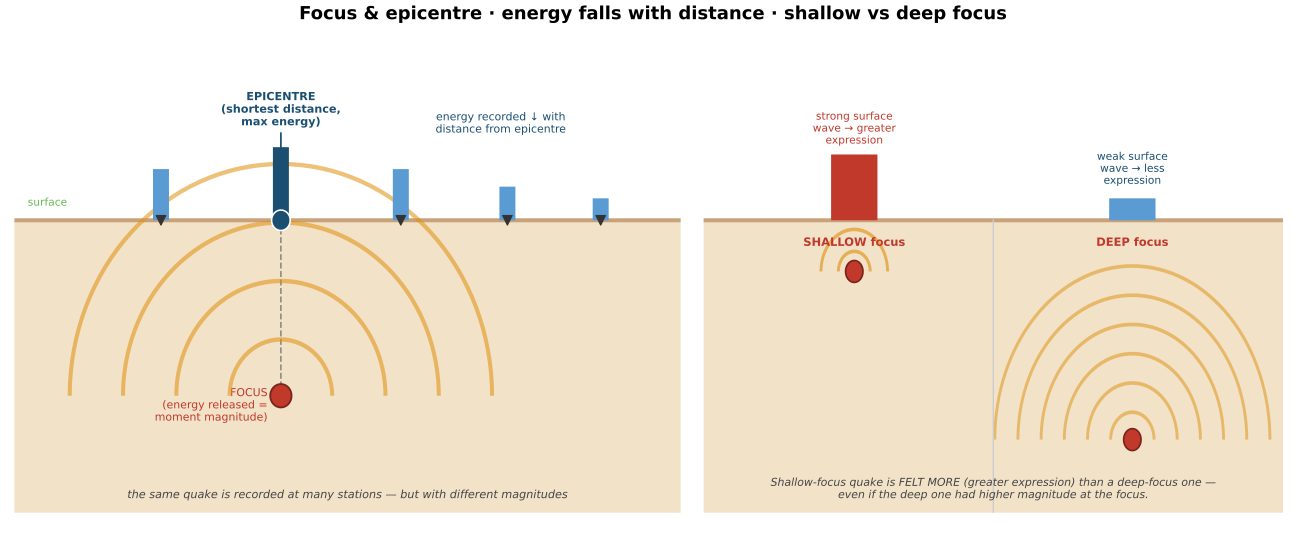
Epicentre. The energy released at the focus is recorded simultaneously at many surface stations, but not with the same energy at each. The recording station at the shortest distance from the focus records the maximum energy — that point is the epicentre.
DEFINITION — Epicentre: The point on the surface, vertically above / at the shortest distance from the focus, that records the maximum energy of the earthquake.
KEY LINE: The magnitude recorded decreases with increasing distance from the epicentre (because moving away from the epicentre = moving away from the focus). So the same event is recorded across many countries with different** magnitudes.
TEACHER'S EXAMPLE: A single South-East Asian earthquake with its epicentre in Indonesia is recorded in Thailand, Myanmar, South India, even Afghanistan — the same event, different energies. A seismologist cannot directly measure energy at the focus; instead they first locate the epicentre (a surface point), measure the energy at the epicentre, and from that estimate the energy and depth of the focus. Hence: energy at the focus = moment magnitude; energy on the surface = the magnitude measured on the Richter scale.
4. Measuring earthquakes — Richter vs Mercalli
There are two scales, and the teacher's whole point is that they measure different things — one measures strength, the other measures impact.
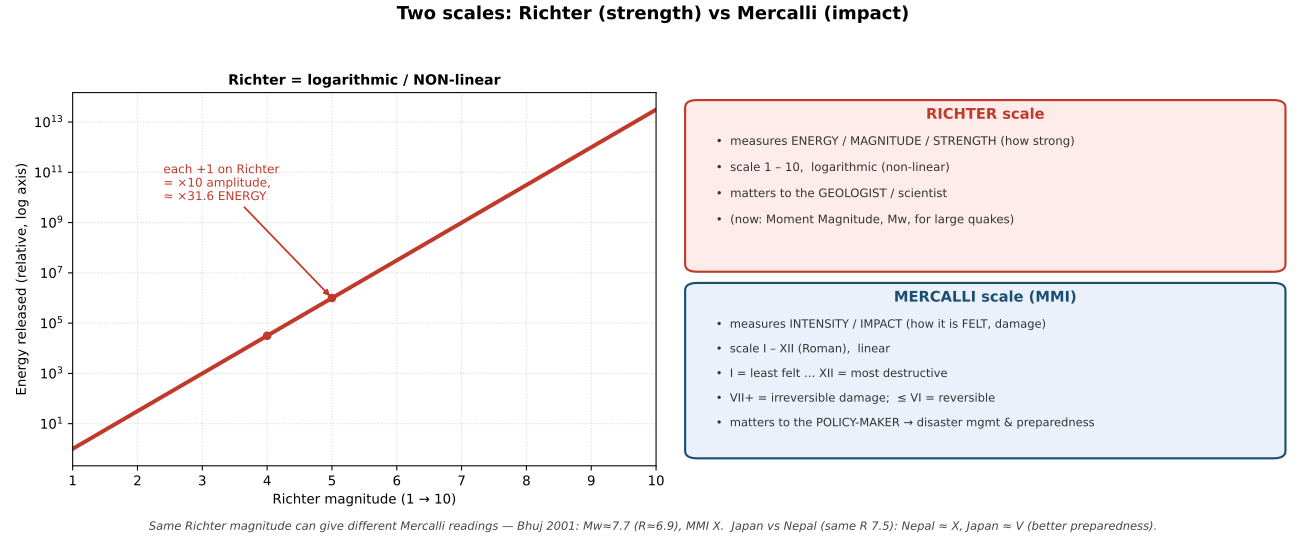
4.1 Richter scale (magnitude / strength)
- Measures energy / magnitude / strength of the earthquake — how strong the quake is at a place (how much energy is recorded there).
- Runs 1 to 10.
- It is a logarithmic (non-linear) scale. Each one-point increase is a multiple of the energy of the previous point — the increase is exponential, not linear. So a magnitude-5 quake versus a magnitude-4 quake looks like only "1 point" apart, but the energy differs by a large factor.
CLARIFICATION (exam-critical numbers): Each whole-number step on the Richter scale = ×10 in wave amplitude and ≈ ×31.6 (~32) in energy released. The teacher's "10×" refers to the amplitude; the energy factor per step is ~31.6×. Also note that seismologists now use the Moment Magnitude scale (Mw) for moderate-to-large quakes (it's accurate across all sizes); the classic Richter (local magnitude, M_L) is what the "energy at the focus = moment magnitude" idea connects to.
4.2 Mercalli scale (intensity / impact)
- Named after the geologist Mercalli (Modified Mercalli Intensity, MMI).
- Measures intensity / impact — i.e., how the earthquake is felt by people and how much damage it causes.
- It is a linear scale, written in Roman numerals I to XII.
- I = least felt (an earthquake that occurred but was barely noticed — e.g., you only learn of it later via social media). As the number rises, the damage rises: a clock falling = ~III–IV; a crack in a wall = ~V–VI; part of a roof collapsing = ~VII. XII = most destructive / devastating — felt as a national emergency.
KEY THRESHOLD: On Mercalli, VII and above = irreversible damage (cannot be easily restored); up to VI = reversible damage** (normalcy can be restored relatively easily).
TEACHER'S EXAMPLE — why two scales differ (same magnitude, different impact): Take the same magnitude-7 quake felt in a mountainous region and in a plain. The strength (Richter) is the same (7), but the damage (Mercalli) is greater in the mountains because of topography — so the Mercalli reading might be X in the mountains but ~VI–VII in the plain. Country example: Japan vs Nepal, both at plate boundaries; for the same Richter 7.5, Nepal's Mercalli ≈ X while Japan's ≈ V, because Japan has far better earthquake preparedness. So Mercalli also reflects a region's preparedness/management, not just geography.
CLARIFICATION — Bhuj 2001 (verified): The teacher used the 2001 Bhuj (Gujarat) earthquake as: Richter ≈ 7.5, Mercalli = X. Verified figures: 26 January 2001, moment magnitude Mw ≈ 7.6–7.7 (≈ 6.9 on the local Richter scale), with a maximum Modified Mercalli Intensity of X (Extreme) over ~4,000 km² around Bhuj; ~20,000+ deaths. So: a destructive (≥7) strength quake that actually caused large-scale (X) damage — exactly the "strength vs impact" contrast.
4.3 Disaster management — Sendai & BIS seismic zones
Which scale matters to whom?
- A geologist focuses on the Richter scale (the science of how strong the quake is).
- A policy-maker / administrator / disaster manager focuses on the Mercalli scale — because it measures impact and preparedness. Hence the Mercalli scale is a tool for disaster management, and it helps in understanding the preparedness of a region in managing earthquakes.
TEACHER'S EXAMPLE — the prelims-paper analogy (memorable): Think of the prelims paper itself. Its Richter reading = how tough the paper was (the strength/magnitude — say 8 or 9 this year). Your Mercalli reading = how you experienced it / your score (the impact). Scoring 20/200 = a devastating, irreversible disaster (one or ten years of prep won't recover it — like Mercalli VII+); scoring 60–70 = reversible — you can "build back" with better preparedness next attempt. That's the disaster-management cycle.
Sendai Framework & "Build Back Better."
HANDOUT/EXAM (verified): The teacher referenced the Sendai Framework as the global disaster-management standard and the principle of "Build Back Better" — every disaster experience should enhance our capacity to respond next time. Verified: the Sendai Framework for Disaster Risk Reduction (2015–2030) was adopted on 18 March 2015 at the Third UN World Conference on DRR (Sendai, Japan). It has 7 global targets and 4 priorities for action (1. understanding disaster risk; 2. strengthening disaster-risk governance; 3. investing in DRR for resilience; 4. enhancing preparedness for effective response and to "Build Back Better" in recovery). Its goal is the substantial reduction of disaster risk and losses. - CLARIFICATION: The teacher's "reduce damage by 50% by 2030" is a simplification — Sendai aims at "substantial reduction" across its 7 targets (e.g., substantially lower disaster mortality and affected people per 100,000 in 2020–2030 vs 2005–2015, reduce economic loss relative to GDP, reduce damage to critical infrastructure), not a blanket "50%" figure. Keep "Build Back Better" and "2015–2030, 7 targets + 4 priorities" as the exam facts.
BIS seismic zones (India).
EXAM POINT (verified): The Bureau of Indian Standards (BIS) divides India into seismic zones for earthquake-resistant design (code IS 1893). The demarcation uses disaster-management considerations — not the Richter scale alone — so the Mercalli (intensity/impact) dimension is built in. Verified: under the traditional classification (IS 1893:2016), India has 4 zones — II, III, IV, V (the old Zone I was merged into Zone II), with Zone V = highest/"very high" risk (parts of the NE, J&K/Himachal/Uttarakhand Himalaya, Kutch, and the Andaman & Nicobar Islands). - CURRENT AFFAIRS: A recent revision (IS 1893:2025) introduces a new Zone VI ("super-critical") as the highest category, based on modern probabilistic seismic-hazard assessment — worth a line in a 2026 answer.
5. Earthquake waves
EXAM FOCUS: From here on, the material is important for Mains because it is applied to build the model of the Earth's interior. This theme repeats in GS Paper I roughly every 3–4 years; the format of the question varies, but the answer structure is standard.
Earthquake waves are classified into two:
- Surface waves — horizontal propagation of energy in the outer part of the crust; the modified version of a body wave; these decide the expression/damage of the quake (§3).
- Body waves — generated at the focus; they travel through the body of the Earth. Body waves are split into:
- P-waves (Primary) and
- S-waves (Secondary).
The words primary and secondary define their velocity / order of arrival:
- P-wave = Primary = first to be recorded = maximum velocity (travels fastest, detected first).
- S-wave = Secondary = second to be recorded = delayed, lower velocity. Velocity of S < velocity of P.
Direction of particle vibration (the key physical difference):
- P-wave = LONGITUDINAL wave — the particles of the medium vibrate parallel to the direction of propagation (compression and relaxation — the medium is squeezed and relaxed forward-and-back, in the same direction the wave travels).
- S-wave = TRANSVERSE wave — the particles vibrate perpendicular to the direction of propagation.
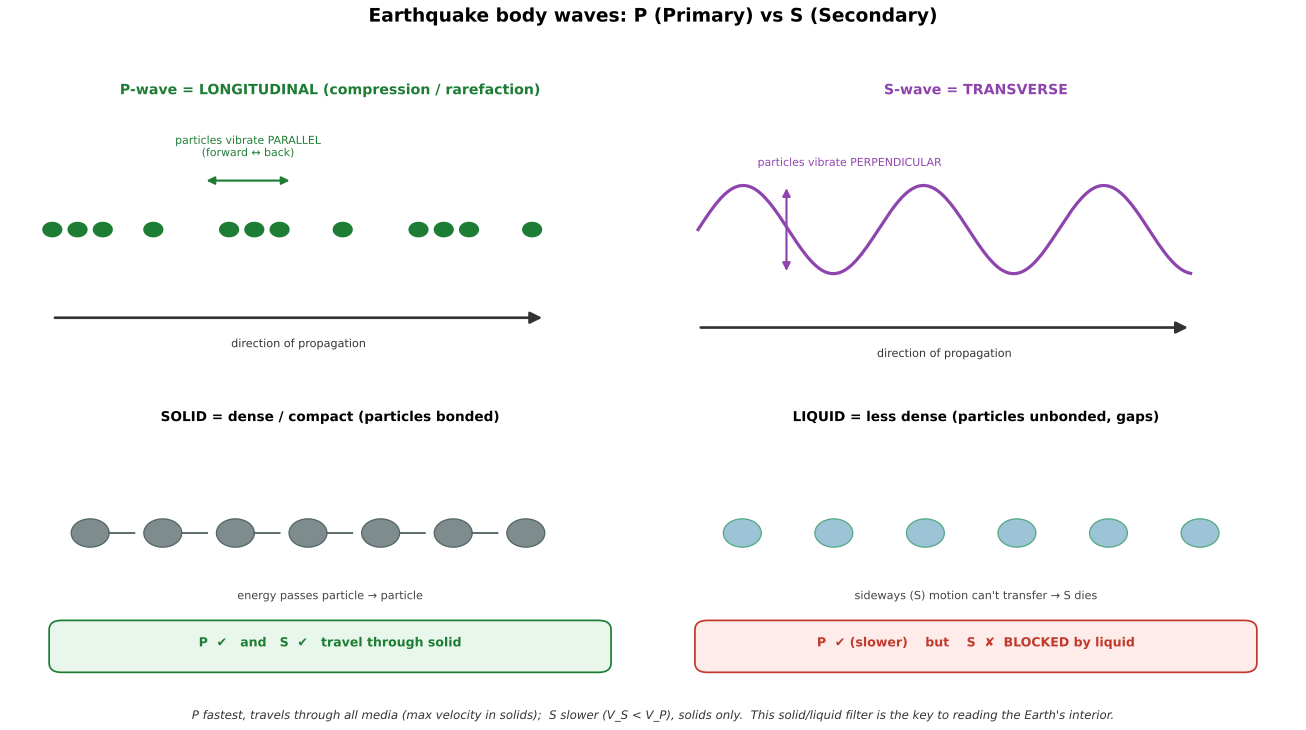
Behaviour in different media (solid vs liquid) — this is the punchline used for the interior:
The teacher demonstrated with a queue of people:
- Solid = dense/compact: people stand close, holding each other (strong bonds). When the first person vibrates, the energy passes person-to-person down the line → the wave propagates.
- Liquid = less dense: people stand apart, not holding (weak bonds, gaps between particles).
From this:
- P-waves can propagate through ALL media (solid AND liquid) — because the energy transfer is by compression/relaxation (forward–back), it works even when particles aren't bonded (the energy can still be "passed forward"). But the velocity differs with the medium: the maximum velocity of the P-wave is recorded in a solid (the more compact the medium, the higher the P-wave velocity).
- S-waves can propagate ONLY through solids. In a transverse (sideways) vibration, an unbonded liquid particle cannot pass the sideways motion to the next — the energy dissipates at the first particle without transfer. So S-waves are blocked by a liquid medium. Even in a solid, the S-wave's velocity is less than the P-wave's (the sideways orientation transfers energy less efficiently than compression).
EXAM TIP (the teacher's caution): Don't drift into wave-physics derivations (especially if you have an engineering background). Just state the result — P = longitudinal, travels through all media, fastest in solids; S = transverse, solids only; V_S < V_P — and move to the application: these characteristic properties of P and S waves are applied to study the interior of the Earth.
| Property | P-wave (Primary) | S-wave (Secondary) |
|---|---|---|
| Origin | Body wave (at focus) | Body wave (at focus) |
| Order of arrival | First (fastest) | Second (delayed) |
| Particle motion | Longitudinal (parallel) | Transverse (perpendicular) |
| Velocity | Higher; max in solids | Lower (V_S < V_P) |
| Solid medium | ✔ travels | ✔ travels |
| Liquid medium | ✔ travels (slower) | ✘ blocked |
6. The seismic model of the Earth's interior
EXAM FOCUS / answer format: Questions come as — "Explain how earthquake waves are used as indirect evidence for the study of the interior of the Earth", or "Write a note on the seismic proof of the Earth's interior", or "Discuss the seismic model of the interior of the Earth." The teacher gave a three-part answer skeleton: - Part 1 (introduction): direct vs indirect evidence; what an earthquake is; body waves; the nature of P and S waves (everything in §5). - Part 2: state the assumption about the interior, then show how the practical data contradicts it → conclude the interior is heterogeneous. - Part 3: use the behaviour of P-waves and S-waves (with diagrams) to prove the state of each layer — mantle solid, outer core liquid, inner core solid. Earthquake waves are an indirect evidence for the interior ("indirect" = they reach us deflected/refracted, not straight).
6.1 The assumption & how the data contradicts it
Assumption: the interior of the Earth is homogeneous and solid throughout (made of the same material everywhere).
If that were true, then a wave generated at a point would travel without any change of medium — so P-waves would be recorded everywhere with almost the same velocity, and S-waves would be recorded everywhere (slightly delayed, but also at similar velocity). No deflection, no gaps.
But the practical earthquake data (from the global network of ~120 seismograph stations) shows two things that contradict the assumption:
- P-waves are recorded at almost all locations, but with differences in velocity. → If the medium were uniform, velocity wouldn't vary. So the interior is NOT homogeneous.
- S-waves are NOT recorded over a large area of the surface. → Something is blocking the S-waves in the interior — and what blocks an S-wave is a liquid medium. So the interior is NOT solid throughout.
CONCLUSION (Part 2): The practical data of earthquakes contradicts the assumption; therefore the interior of the Earth is heterogeneous, with a difference in the state of matter (not the same material/state throughout).
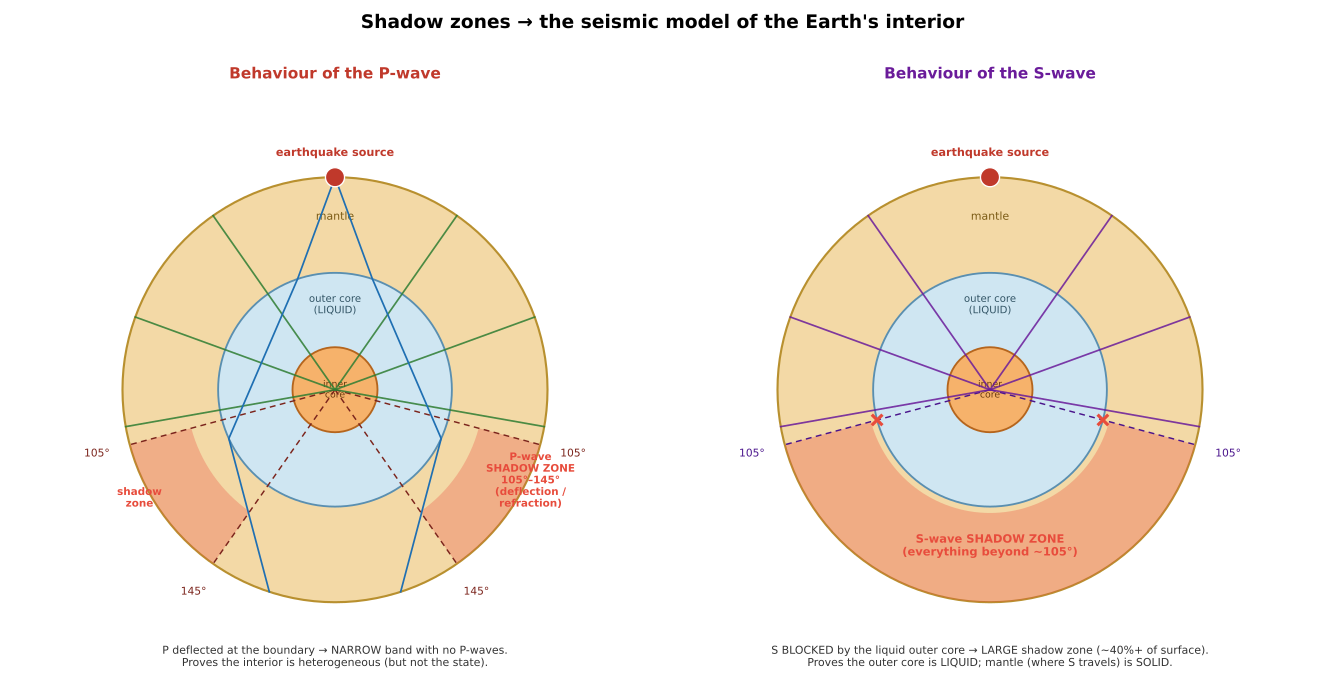
6.2 Behaviour of the P-wave
Draw the Earth with mantle / outer core / inner core. Place a P-wave source at the top and ring the Earth with recording stations. Track the readings (P1, P2, P3 … with velocities V1, V2, V3 …), symmetric on both sides:
- Through the mantle, P-waves are recorded at every station with almost similar velocity (a slight curve, because of semi-solid asthenosphere etc.) — the material is the same, so velocities cluster (call this the red set). At the same angle on both sides, the readings match.
- When the P-wave hits the outer core (a different state/material), its first response is to get deflected (refracted). It bends, travels through the new medium, and re-emerges deflected again, recorded later as P4 (velocity V4 ≠ V3) — a different velocity, because it passed through a different condition (the blue set). V4 and V5 resemble each other (same kind of change on both sides).
- Between the last "direct" mantle reading (P3) and the re-emerging P4 there is a band where NO P-wave is recorded — the P-wave SHADOW ZONE.
KEY NUMBER (verified): The P-wave shadow zone lies between 105° and 145° from the epicentre (measured at the Earth's centre). It is caused by the deflection/refraction of P-waves at the mantle–outer-core boundary (seismic velocity drops sharply in the liquid outer core), so it is a relatively narrow band. (Inside ~105°, a station can detect the P-wave; in 105°–145° it cannot; beyond ~145° the deflected P4 reappears.)
- Deeper still, the inner core is small and very dense; it disperses the P-waves in multiple directions (the teacher's analogy: the inner core acts like a prism scattering incident light), recorded as a third green set (P6–P10) at yet another velocity. Because of this dispersion there is no shadow zone caused by the inner core — waves reappear at almost all positions past it.
What the P-wave diagram proves — and its limit: Three different velocity-sets (red/blue/green) prove the interior is NOT made of the same material → heterogeneous. But the P-wave alone cannot prove the exact state (solid/liquid) of each layer — for that it must be correlated with the S-wave data.
6.3 Behaviour of the S-wave
Repeat with an S-wave source:
- Through the mantle, an S-wave is recorded at the same stations as the P-wave (as S1, S2, S3 …) but with lower velocity (V_S1 < V1). The very fact that S-waves travel through the mantle proves the mantle is dominated by SOLID (S-waves need a solid).
- When the S-wave hits the outer core (liquid), it is completely BLOCKED — it cannot propagate through liquid. So beyond ~105° on both sides, S-waves are simply not recorded.
KEY NUMBER (verified): The S-wave shadow zone is everything beyond ~105° (the entire zone past ~103°–105° from the epicentre receives no S-waves). It is therefore much larger than the P-wave shadow zone — covering roughly 40%+ of the Earth's surface — and it is caused by blocking (not mere deflection).
6.4 Putting it together
CONCLUSION (Part 3) — how the layers are proved: 1. Mantle = SOLID — directly proved because the area where S-waves are recorded overlaps the area of direct P-wave recording (S-waves travel the mantle ⇒ solid). 2. Outer core = LIQUID — proved by superimposing the two shadow zones. The boundary of the P-wave shadow zone and the boundary of the S-wave shadow zone both coincide at 105°. That common angle corresponds to the depth at which P-waves are deflected and S-waves are blocked — i.e., the mantle–core boundary, where the medium changes from solid to liquid. Hence the outer core is liquid. 3. Inner core = SOLID — cannot be read directly from either wave (S-waves never reach it). It is estimated: by comparing the velocities of P-waves in the outer vs inner core and correlating with densities, the inner core is concluded to be solid. (The P-wave velocity changes again, and the density correlation points to a solid inner core.)
EXAM ADD-ON (the teacher's "extra mark" point): State the difference between the two shadow zones — the P-wave shadow zone is small and is created by deflection/refraction; the S-wave shadow zone is significantly large and is created by the blocking of S-waves at the outer-core boundary.
CLARIFICATION (so you write it correctly): This is a model built from decades of pooled global seismic data, not one real earthquake felt by the whole planet at once (that never happens and never should). In reality, energy radiates in all directions from wherever the focus is, and the shadow-zone positions differ from event to event — the diagram is a simulated/idealised representation of wave behaviour, used only to infer the interior. This closes the Geomorphology chapter and connects back to the earlier "study of the interior of the Earth" topic (which gave three models of the interior).
NCERT BASE: This is the NCERT Class XI, Fundamentals of Physical Geography, Ch. 3 "Interior of the Earth" content — direct vs indirect sources, P/S/L (surface) waves, the shadow zones, and the resulting crust–mantle–outer core–inner core structure (with the Mohorovičić and Gutenberg discontinuities). Cross-refer the earthquake basics in NCERT's geomorphology unit.
7. Next chapter — Indian Physical Geography (syllabus preview)
With Geomorphology (World Physical Geography) done, the next segment is the Physical Geography of India — important for Prelims, GS Paper I & III, and map-based questions. The teacher expects ~3 more classes for it. Syllabus (in order):
- Subcontinental identity of India — why India is called a subcontinent.
- Configuration of India as a part of South Asia.
- Geological structure of India — the rock make-up of the country; how different rock types arose across the Indian region.
- Physiographic divisions of India — relief features (plateaus, mountains, hills).
- Drainage system — rivers, tributaries, hydro-power & multipurpose projects. (The teacher has already covered two static river basins — Ganga and Indus — in an earlier recorded class; the remaining rivers come with the physiographic divisions.)
- Climate of India — tropical monsoon → ITCZ origin (largely covered under climatology; included here as part of physical geography).
- Soil — types & distribution, pedogenesis/pedology (largely covered with ecology & environment).
REFERENCES the teacher set for this segment: 1. Class notes (primary). 2. NCERT — India: Physical Environment (Class XI). (The two relevant NCERTs are Fundamentals of Physical Geography and India: Physical Environment.) 3. The "Yellow Book" — for factual additions / a good compilation for Indian geography. 4. An Atlas — for the map-work.
Current Affairs
(Updated as relevant news/magazine content comes in)
| Date | Source | Headline | Connection to this topic |
|---|---|---|---|
| 2025 | BIS / IS 1893:2025 | New Zone VI ("super-critical") added to India's seismic-zone code | §4.3 — BIS seismic zones; shows India's seismic-risk map being revised upward (PSHA-based) |