Social Influence — Conformity, Compliance & Obedience (+ Receiver Characteristics in Persuasion)
GS Paper: IV (Ethics) | Subject: Attitude — Social Influence & Persuasion | Teacher: Pathak Sir | Class: 9 (21-07-2026) | Last updated: 2026-07-22
Syllabus hook. This class sits on the last clause of the GS-IV attitude syllabus — "…its influence and relation with thought and behaviour; moral and political attitudes; social influence and persuasion." It is the direct continuation of the Persuasion section begun in lec07 §8: that note covered what persuasion is (Aristotle's ethos/pathos/logos, the four elements, the four steps); this one covers who receives the message and then the whole machinery of social influence.
Source note. This is a dictation class — the teacher reads out the note, then explains each line with stories. Everything below is built from both the transcript (his spoken explanations, in full) and the 9 dictated board pages. Board page 1 opens with a short carry-over from the previous class (emotional vs factual appeal, channel factor, distraction); it is preserved in §1 so the board notes read continuously.
⚠ Fact-check warning. The teacher's spoken account of the Milgram experiment got several load-bearing numbers wrong (year, voltage range, who the subjects were), and his description of Eichmann was imprecise. The note below carries the verified facts, with each discrepancy flagged in a
CLARIFICATIONbox. Write the verified version in the exam. See §5.4.
Table of Contents
- Carry-over: emotional vs factual appeal, channel, distraction
- Receiver Characteristics
- Personality — self-esteem & anxiety
- Intelligence
- Selective exposure, attention & interpretation
- Social Influence — the framework, power, leadership
- Mechanism 1 — Conformity
- Mechanism 2 — Compliance
- The six principles
- Techniques on liking/friendship
- Techniques on commitment & consistency — foot-in-the-door
- Techniques on reciprocity — door-in-the-face, that's-not-all
- Techniques on scarcity
- Mechanism 3 — Obedience
- Life-lessons the teacher wove in
- Cross-GS Linkages / Applications
- Exam Focus
- Previous Year Questions
- Current Affairs
1. Carry-over from the Previous Class
The board opens with three residual points on message and channel before moving to the receiver.
Emotional vs factual appeal. A combination of both produces the best outcome. However, as between the two, it is the emotional appeal that is usually more powerful than the factual appeal. (This is why, later in §2.1, the prescription for persuading a high-self-esteem person is logical appeals judiciously mixed with relevant emotion — not logic alone.)
Channel factor. The channel is the medium through which information travels to reach the target group. The channel selected must be compatible (i) with the characteristics of the message, and (ii) with the characteristics of the target group.
Distraction. A pleasant form of distraction that positively reinforces the target group happens to enhance the persuasiveness of the message. Note the qualifier carefully — the distraction must be pleasant and must positively reinforce; an unpleasant distraction does the opposite.
2. Receiver Characteristics
Everything so far concerned the source, the message and the channel. Now the fourth element: the person receiving the message. Three receiver characteristics matter — personality factors, intelligence, and the selective processes.
2.1 Personality Factors
Personality refers to a combination of psycho-physical and socio-emotional traits that define an individual's unique adjustment in his environment. ("Traits" simply means characteristics.) Under personality, two sub-factors matter for persuasion.
(a) Self-esteem
Self-esteem is the result of the evaluation of the individual's self-concept.
Individuals with high self-esteem are difficult to persuade, because they possess a high degree of trust and confidence in their belief system. They believe in themselves, so a message that asks them to abandon a held position meets resistance.
To alter the attitude and behaviour of such individuals, we need to provide them with logical appeals that are empirically well supported and judiciously mixed with relevant emotions. If that is done, the impact is far greater. Note the three-part prescription — logical + empirically supported + judiciously mixed with emotion. Logic alone will not move a confident person; emotion alone will insult his intelligence.
(b) Anxiety
Anxiety is the state of uneasiness caused by an impending threat. The teacher's gloss: it is that condition of restlessness where a person cannot even say what is wrong with him — he only feels that danger is hovering all around.
Individuals with a high anxiety level can easily be persuaded by messages that bring their anxiety level down. This is the exact psychological lever a persuader pulls when he first raises your fear and then offers himself as the relief.
TEACHER'S EXAMPLE — why appeals get made before elections. This, the teacher said, is the reason that before every election a caste appeal and a religious appeal is presented — and sometimes a need-based appeal as well. The mechanism is not ideological but psychological: the appeal works on an anxious electorate because it promises to bring the anxiety level down. (Recognise the structure; you can use it in an answer on the ethics of political communication without naming any party.)
2.2 Intelligence
Intelligence is the information-processing ability of an individual.
Individuals with a high intelligence level possess superior critical-thinking ability and are therefore unlikely to be influenced by messages that rely upon unsupported generalities — that is, sweeping generalisations with no facts behind them and no logical support.
To bring about attitude change in them, we need to make use of empirically validated logical appeals — appeals supported with facts, figures and data.
TEACHER'S EXAMPLE — an unsupported generality, dismantled. He offered a live demonstration of what an unsupported generality looks like and how a critical thinker takes it apart. People commonly say: "There is huge unity among Muslims — you find them congregating in mosques; among Sikhs too, you find them congregating in gurudwaras." This is repeated as though it proves something about those communities' character. The teacher's point was that this is a generalisation with no logical support, and that there are two straightforward psychological and structural explanations:
- Minority status generates consciousness of identity. Whenever a community enjoys minority status, it becomes more conscious of its identity. The mechanism is fear — the fear of being assimilated by the majority — and that fear generates a greater level of consciousness about ethnic identity. His test case: Hindus in the USA visit temples far more frequently than Hindus in India. Same community, different minority/majority position, different congregating behaviour. So the behaviour tracks minority status, not some special communal virtue.
- Monotheistic vs polytheistic structure. Islam is a monotheistic religion; Hinduism is polytheistic. A polytheistic faith has many gods and goddesses, and therefore a distribution of devotees across many shrines and deities. So finding them congregating at one place is structurally less likely.
He added a third caution about inferring anything from attendance at all: you cannot know with what intention any individual goes to a place of worship. Not everyone who visits a temple is there in devotion; not everyone who rings the bell does so out of reverence. He was explicit that this was a psychological argument, not a religious one — the point being that "we should argue with logic, not repeat hearsay."
EXAM FOCUS. This example is doing double duty. Substantively it is a ready-made illustration for "minority consciousness" in GS-I society answers. Methodologically it models exactly what GS-IV rewards: refusing an unsupported generalisation about a community and replacing it with a structural explanation. That is the demonstrated behaviour of the high-intelligence receiver the section is about.
2.3 Selective Exposure, Attention and Interpretation
First, why the word "selective"? Because, as the teacher put it, there is a motive behind everything. Even when a person swears he acted without reason — "I just called you for no reason at all" — some cause was operating. And crucially, that motive may sit in the unconscious mind, so the person is not lying when he denies it; he genuinely does not know. Hence selective: the filtering is motivated, but not necessarily deliberate.
Many times the target group members do not deliberately avoid the counter-attitudinal message, but because of the culture in which they live, they get exposed to only those messages which support their underlying attitudes and values.
TEACHER'S EXAMPLE — the business family. Suppose you hail from a business family. Then most of the conversation over the dining table will be business-related. The periodicals, newspapers and magazines that come into the house will be business-related. The chances are that your family's friends will also be in business. So you eat business, you drink business, you talk business. To then expect that bureaucracy-related information is likely to reach you — the chances are less. You are not deliberately avoiding it; because of the culture in which you live, you get exposed only to information that supports your existing attitude structure. That is selective exposure.
This is why it is said: "You can take the man out of his culture, but you cannot take the culture out of the man."
TEACHER'S EXAMPLE — why prejudice survives relocation. People who are misogynistic or sexist, even when they move to a society where sexism is less prevalent, will socialise with people like themselves in their new universities — birds of a feather flock together. That is the reason their sexism never dies; it only gets reinforced with time. Physical relocation does not break selective exposure, because people reconstruct the same informational environment around themselves.
How to overcome selective exposure
To overcome the challenge of selective exposure, the persuader must:
- Keep the message short and simple.
- Present it in receiver-friendly symbols.
- Support the message with culturally congruent illustrations.
- Repeat the message many times.
- Make the message interesting and useful for the target group.
Attention and interpretation — the second gate
Even when the change agent is able to overcome the challenge of selective exposure, the desired attitude change might still not take place, due to the operation of selective attention and interpretation. Getting the message in front of someone is not the same as getting it attended to and understood as intended.
To overcome these challenges, the persuader must:
- Use a credible source to present the message.
- Keep it short and simple, supported with relevant illustrations.
- Present it in receiver-friendly symbols.
- Make use of feedback wherever possible.
- Make the verbal and the non-verbal aspects of the message congruent.
EXAM FOCUS. Notice that the two lists overlap but are not identical. Exposure is solved by repetition + cultural congruence + usefulness; attention/interpretation is solved by source credibility + feedback + verbal–non-verbal congruence. Examiners like the distinction between "reaching" a group and "landing with" a group.
3. Social Influence
Social influence refers to the efforts by one or more persons to change the attitudes and behaviours of one or more others. (Note the framing — one or many on both sides.)
Social influence plays an important role in various types of social behaviour, such as:
- Aggressive behaviour
- Altruistic (helping) behaviour
- Attitude formation and change
- Prejudice development and removal
- Group decision-making, etc.
Social influence operates through three mechanisms:
| Mechanism | Medium | One-line definition |
|---|---|---|
| Conformity | Group influence in action | Changing yourself to fall in line with existing social norms |
| Compliance | The medium of request | Saying yes to a direct request from another person |
| Obedience | The use of direct order | Obeying a command from an authority figure |
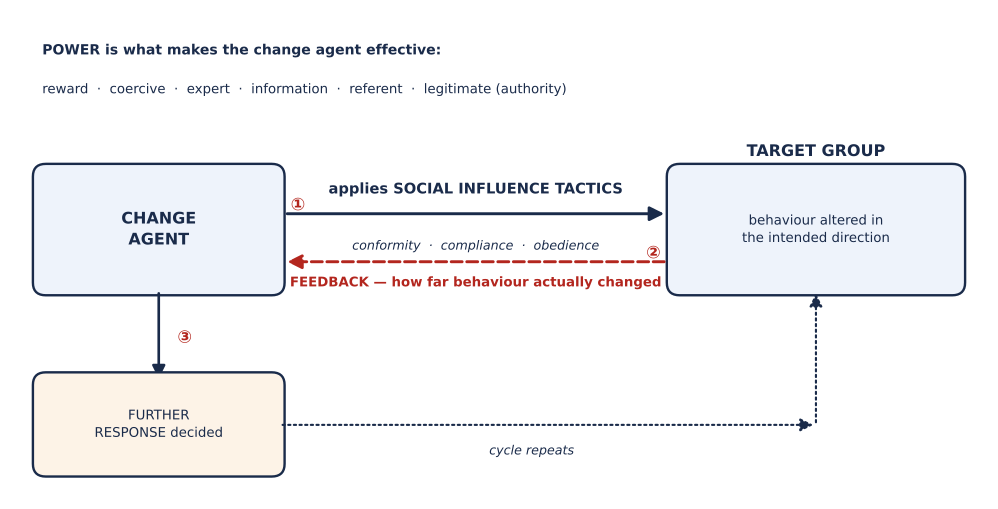
DIAGRAM (board). The teacher drew the change-agent cycle on the board. Clean redraw:
The diagram says this in full: ① a change agent uses social influence tactics to alter the behaviour of the target group in the intended direction. ② Information regarding the degree to which the target group's behaviour has actually been altered is fed back to the change agent. ③ On the basis of that feedback, the change agent's further response is decided — and the cycle runs again. Influence is therefore not a single broadcast but a loop, and feedback is what makes it adaptive.
3.1 Power — what the change agent needs
For a change agent to be able to make an impression on the target group, he needs power. The teacher listed six bases of power, each with an illustration:
| Type of power | Basis | Teacher's illustration |
|---|---|---|
| Reward power | Ability to give something desired | Wealth — "richness is always funny" |
| Coercive power | Ability to punish | "Jiski laathi, usi ki bhains" — the buffalo belongs to the person who has the stick |
| Expert power | Specialised skill others need | A heart surgeon and the heart patient: the surgeon holds power because the skill is indispensable |
| Information power | Exclusive possession of information | Holding a leaked exam paper — but note its fragility: once the leak happens, the power is gone unless you can obtain fresh information. Expert power, by contrast, endures — people will keep needing heart surgery, so the surgeon's power persists |
| Referent power | Personal attractiveness, charisma, identification | "Your good looks are also a power" — people want to be associated with you |
| Legitimate power | Formal authority of office | The power of bureaucrats and politicians |
EXAM FOCUS. The information-power vs expert-power contrast is the sharpest analytical point in this list and is very usable: information power is exhausted by disclosure; expert power is renewed by demand. This maps directly onto administrative ethics — an officer who hoards information holds a depleting asset, while an officer who builds genuine competence holds a compounding one. Good material for questions on transparency, RTI and why information-hoarding is a poor basis for authority.
3.2 Leadership vs Power
Leaders possess power, but not all those with power are leaders.
- Leadership is the ability to exercise power to convert vision into reality.
- Leadership involves the exercise of power to achieve common good.
So the distinguishing marks of leadership over bare power are (i) a vision that is actually realised and (ii) the orientation of that power towards the common good. A person may hold enormous coercive power and be no leader at all.
TEACHER'S ASIDE — power without authority, and why accountability matters. Discussing the sources of power available to different actors, he noted that protesters have a form of coercive power and the support of people, but not legitimate power, since they hold no authority. His broader point was about the value of being questioned: even where a protest does not succeed in changing anything, it carries an important message — "I cannot have my will imposed upon the people all the time." He grounded this in a constitutional principle: the success of democracy calls for open examination of the conduct and the affairs of the government, and if we are not open to questioning, there is a possibility that we may become autocratic. He framed this as a requirement of democracy, not a partisan point.
He also linked the psychology to material conditions: AI inroads, rising unemployment, poor quality of education, corruption and poor road infrastructure have degraded quality of life, so there is genuine frustration in most people — and frustration is precisely the anxiety that §2.1 said makes populations persuadable.
4. Mechanism 1 — Conformity
Conformity is a type of social influence in which individuals change their attitudes or behaviours in order to fall in line with the existing social norms.
Social norms are the rules indicating how individuals are expected to behave in specific situations. They may be:
- Implicit — the unwritten rules. Example: the norms in your family.
- Explicit — the written rules. Example: the Constitution of India.
TEACHER'S EXAMPLE — conformity is what peer pressure is. If you want to imagine what conformity is, the best example is the activities you did under peer pressure. That is conformity in operation. This is why it is said that a person is known by the company he keeps: in bad company you acquire anti-social behaviours, in good company you acquire pro-social behaviours. The company decides what kind of behaviours you acquire.
4.1 Why we conform — three reasons
(i) The need to be liked by others whose acceptance we desire. If you are desperate for acceptance in a particular group, you will not want the other members to dislike you — so you follow their behaviours.
(ii) So that we can be correct in our judgements. The key insight here is when this operates: only when you are not sure about yourself. When you are sure, group opinion is not a problem; when you are unsure, you would like to follow what the masses do.
TEACHER'S EXAMPLE — the exam-hall answer. You are sitting in an exam. Question 1 is fine. On Question 2 you get confused between option B and option C — B, C, C, B. You ask a friend; he says C. Then, because there is still confusion, you ask another friend when the invigilator's back is turned; he says B. Then, on the pretext of going to the washroom, you excuse yourself and meet a third person, who says B. You come back, rub out C and write B. When you get home and check the book — the answer was C. The whole reversal was conformity pressure operating on an unsure mind. Had you been certain, no amount of peer opinion would have moved you.
(iii) Self-categorization. Like others, we want to place ourselves in some or the other category, and our group membership facilitates this. We identify with the group that enables us to maintain our self-esteem and positive self-concept. And the greater the significance of the group in the realization of our self-esteem and self-concept, the stronger will be the tendency to abide by the group norms.
TEACHER'S EXAMPLE — identity plus interest (the petrol-pump story). He illustrated self-categorization with a deliberately self-mocking hypothetical about himself: suppose that after taking class he attends the meetings of a particular organisation. Why would he join? Two reasons, and both are the theory in action.
First, identity: "our identity is from the fuel depot" — he is known in the market as a man of that group, and that identity is doing work for him.
Second, and more honestly, interest: if the group says something he does not agree with, he still goes along, because he knows that if he opposes them, the petrol pump will be taken away. So conformity pressure operates because an interest is being served.
He then generalised this to political parties without exempting anyone: it is not the case that every person in a ruling party genuinely admires its leadership — "everybody wants to become that himself." The reason for the outward unanimity is that they know their continuation in office depends on remaining in the good books of the leadership. As long as the interest is served, the person continues with the group.
TEACHER'S EXAMPLE — the reward–cost principle of relationships. He then stated what he called psychology's most important principle: we continue our relationships till the time the rewards that come are greater than the costs involved. Every relationship has a reward and a cost. Once that ratio is reversed, we look for another group. So when someone protests "I stay with you for no self-interest at all" — treat it sceptically. And the need being met need not be material; it can be emotional. This is why you sometimes cannot understand why a person continues in a relationship that looks intolerable from outside: that may not be your need, but his need is being suitably met, and that is why he continues.
TEACHER'S EXAMPLE — when you don't need the group. The contrast case: a person so accomplished that the world will welcome him anywhere does not face conformity pressure, because he does not need any single group to supply his identity. He used Messi — his popularity is such that any country would have him, so no group holds leverage over him. But most people are not in that position. Someone on a Green Card who wishes to remain in the country must weigh the cost of speaking out against the risk to their status. Conformity pressure is a function of how much you need the group.
TEACHER'S EXAMPLE — the Delhi Golf Club. Membership costs a very large sum with a waiting period of decades, and many members neither play nor even know how to hold a golf club — they come for the samosas and tea. Why, then, is membership so prized? Because the golf course is where you make contact with important people and deals get done — recover the fee many times over and you will happily continue the membership — and because of status: "I am a member of that golf course." Golf itself is a tiring and expensive sport; that is not the reason people join. It is another demonstration of reward exceeding cost, with the reward being partly material and partly identity.
4.2 When conformity pressure increases
Conformity pressure increases when:
- Group size is large — meaning five to seven members (the teacher stressed this: "five to seven, not five hundred and twenty-seven").
- There is unanimity among the members.
- Members are seen as operating independently, rather than as part of a single group.
TEACHER'S EXAMPLE — why parents must present one voice. On unanimity: if in a family the father tells the son something diametrically opposite to what the mother tells him, the son concludes that his parents are not united, and the message loses its force. So whatever disagreements you have with your spouse, in front of the child you should represent one voice, not different voices. He added the realistic caveat about why this so often fails: the problem in the world is that people lack the patience, and the urge to defeat the other and show them down is so strong, that peace cannot be maintained. Disagreements are inevitable — but one voice in front of the child.
TEACHER'S EXAMPLE — why independent sources persuade (the third condition). This is the subtlest of the three, and he built a whole story for it. Suppose your father gives you a piece of advice about how to conduct yourself. You dismiss it as old-fashioned. Then your uncle tells you the same thing — you conclude your uncle is as foolish as your father. Then your aunt says the same — now you suspect "my father has fixed all three of them," i.e. they are not independent, they are one group acting together. So the message still does not land. But then you travel abroad, and there you come across three complete strangers who say exactly the same thing. And now you are convinced.
Why? Because when so many people in different places, who could not possibly have coordinated, are saying the same thing, there must be substance in it. Independence of sources is what converts repetition into evidence. Notice how this connects back to §2.2 — the intelligent receiver is asking whether the agreeing sources are genuinely independent or merely one bloc.
4.3 Who resists conformity, and who yields
People resist conformity pressure if they wish to maintain their unique identity.
The characteristics common to non-conformers are:
- Self-reliance
- High self-efficacy
- Social maturity
- Naturalness
- Ability to express themselves
- Intellectual effectiveness
- Ego strength
CLARIFICATION — what "ego strength" means here. The teacher explicitly warned against the everyday misreading. Ego here means the self. Ego strength = a strong self, which means self-confidence and self-trust — NOT arrogance. This is a technical usage from psychology, and confusing it with conceit inverts the meaning of the whole list.
In contrast, conformers exhibit characteristics like:
- Low self-esteem
- Low self-efficacy
- Submissiveness
- High anxiety level
- Narrow world-view
EXAM FOCUS. Read this pair of lists back against §2.1. The conformer's profile (low self-esteem, high anxiety) is exactly the profile of the easily persuaded receiver; the non-conformer's profile (ego strength, self-reliance) is the difficult-to-persuade receiver. The two sections are one theory. For the 2020 PYQ on what contributes to a positive attitude, this list of non-conformer traits is directly deployable — and for the 2016 PYQ on changing undesirable acquired attitudes, the conformer list tells you what you are up against.
5. Mechanism 2 — Compliance
Compliance is a form of social influence involving direct requests from one person to another.
All techniques of compliance rest on six basic principles.
5.1 The six basic principles
| # | Principle | Statement |
|---|---|---|
| 1 | Friendship or liking | We comply with requests from friends or people we like. |
| 2 | Commitment and consistency | Once we have committed ourselves to a position or action, we are more willing to comply with requests for behaviours that are consistent with that position. |
| 3 | Reciprocity | We comply with the request of someone who has provided us a favour. |
| 4 | Scarcity | We try to secure opportunities that are scarce or limited. |
| 5 | Social validation | We comply with a request for some action if that action is consistent with what we believe persons similar to us are doing. |
| 6 | Authority | We are willing to comply with a request from someone who is a legitimate authority. |
EXAM FOCUS — the teacher's explicit priority. He stated it plainly: the first four principles are very important from the standpoint of the exam; the last two (social validation and authority) are not so important. Accordingly he taught techniques only for the first four — so §§5.2–5.5 cover four principles, not six. Budget your revision the same way.
On commitment and consistency — the public apology. The practical application he drew out: if a person issues a public apology for misconduct and then takes a pledge publicly not to repeat the behaviour, it is very difficult to go back on that promise, because it was given in front of many people. Hence public apologies are far more forceful than private apologies. He flagged this as directly usable: when a case study asks how to make a person reform, "secure a public apology plus a public commitment" is a valid answer — applicable to cases of corruption and of gender harassment.
On social validation. He was careful to distinguish it from conformity: in conformity, pressure is applied; in social validation, no pressure is applied — you simply observe what people similar to you are doing and align. His illustration: at a Janmashtami collection, children go door to door; you had decided to give ₹51, but on learning that Sharma-ji, Verma-ji and Mohan-ji each gave ₹1,100, you find yourself giving more — not because anyone pressured you, but because you do not want to be the odd one out. A second illustration: at a beach, when most visitors are dressed for swimming, you dress as the situation and the surrounding people warrant. (Contrast the conformity case: in a hostel where everyone is attempting the civil services exam, friends actively push you to attempt it too — that is pressure, hence conformity, not social validation.)
On authority. A request from someone who could instead have issued an order is disproportionately powerful. His illustration of the two kinds of parent: a father who asks "can you get me a glass of water, please?" leaves the child feeling touched, and the child offers to bring something more as well; a father who barks the same demand gets the water, but grudgingly and slowly. Same outcome sought, opposite relational effect — the softer the exercise of legitimate authority, the greater the compliance it draws.
5.2 Techniques based on liking / friendship
Two families of technique: either you make yourself more attractive, or you make the other person feel pleasant.
(1) Self-enhancing techniques:
- Improving one's appearance. His example: at the Civil Services interview you are immaculately dressed — you do not go in casual wear.
- Associating oneself with positive events. If you have a photograph with Dr. Kalam, a person seeing it starts believing that you too are a person of character. The association transfers.
- Use of positive non-verbal cues — chiefly eye contact and smiling.
CLARIFICATION — eye contact is not staring. The teacher drew a firm line. Staring is prolonged and makes the other person uncomfortable. Eye contact is mutual, short-lived, and enjoyable for both parties. Same physical act, opposite social effect.
TEACHER'S EXAMPLE — non-verbal cues must be executed properly, or they backfire. He warned that non-verbal behaviour, though well-intentioned, may backfire if done carelessly. His illustrations: a student who says "Guruji pranam" and performs a half-executed touching of the feet creates awkwardness for both — if you do it, take the hand all the way down, or don't do it at all. Likewise the namaste: the palms should be brought together and raised closer to the face, rather than the body being bent oddly forward. His conclusion: "proper execution is a must." A botched gesture of respect produces embarrassment instead of the positivity it was meant to create.
(2) Other-enhancing techniques:
- Praising the target person.
- Display of agreement with the target person.
TEACHER'S EXAMPLE — agreeableness and the order of disagreement. People always like a person who is high on the agreeableness quotient. There are people with whom every exchange is contrarian — you ask whether they'd like tea and get a hostile counter-question in return; talk to such a person and "your mind goes mad." Nobody likes that person. So his practical rule for when you must disagree: first agree, and then disagree. Lead with the point of genuine common ground before stating the difference.
On praise: everybody loves flattery. He was careful to qualify — "I am not asking for insincere flattery" — but genuine, authentic praise for some good aspect of a person's personality can always be offered, because each person has some good traits. If you can find and praise them, it is always welcome.
5.3 Techniques based on commitment & consistency
Foot-in-the-door: a procedure of gaining compliance in which the requester begins with a small request, and when it is granted, escalates it to the larger one.
The teacher unpacked the metaphor with two questions. Why did I insert my foot in your door? Because you did not open the door wide enough to invite me in. What is the advantage of my foot being in your door? Communication can continue — and based on the kind of communication that follows, it will be decided whether the door opens fully or I am forced to withdraw my foot.
TEACHER'S EXAMPLE — foot-in-the-door, the classic case. He cited The Polyester Prince, the book on Dhirubhai Ambani, which describes how the business empire was built and what use was made of loopholes in the government system. The episode: Rajiv Gandhi, who then had the image of "Mr. Clean," did not want any association with the Ambanis. So a one-minute meeting with the Prime Minister was arranged through the Cabinet Secretary — who was explicit that he could not guarantee any proposal would be accepted, only that a one-minute meeting could be arranged. In that one minute, the sentence spoken was designed to guarantee that the door would open further. The small request (one minute) was granted; the large one followed.
(Verified: the book is Hamish McDonald's The Polyester Prince: The Rise of Dhirubhai Ambani, 1998. Treat the anecdote as the teacher's illustration of the technique rather than as established fact — the book is journalistic and was never officially released in India. Use the technique, not the allegation, in an exam answer.)
TEACHER'S EXAMPLE — foot-in-the-door as financial fraud. The structure of a Ponzi scheme is pure foot-in-the-door. "I want to swindle your money. I launch an investment company and say: invest ₹1,000, and in a year I will give you ₹2,000." I want far more than ₹1,000 — but I start with ₹1,000. In six months I return ₹2,000. Then: take a little more risk — ₹2,000 becomes ₹4,000; ₹4,000 becomes ₹8,000. Now you feel your original ₹1,000 has become eight times. Then I invite you to invest ₹1 crore — and the moment you do, it is gone.
What happened? "Trust — commitment and consistency — was built by the regular performance of doubling the money. But what you failed to take notice of is that when the amounts were small, such reliability can easily be shown." Small-stakes reliability is cheap to manufacture; it is purchased precisely to induce the large-stakes commitment. Once the foot is in the door, you open it wide enough to invite the person in — and that is where the cheating is done.
EXAM FOCUS. Foot-in-the-door is one of the most examinable items in this class. It explains why small favours must be refused by public servants (see the Kalam point in §5.4), how corruption is incrementally normalised (an officer who accepts a cup of tea, then a gift, then a favour), and how financial frauds are engineered. Pair it with gradual escalation in §6 — they are the same psychology, one operating through requests and the other through orders.
5.4 Techniques based on reciprocity
(1) Door-in-the-face: the requester begins with a large request, and when it is refused, retreats to a smaller one — which is the one that was actually desired.
The teacher enjoyed the symmetry of the two metaphors: in foot-in-the-door I lodged my foot in your door; in door-in-the-face I slammed the door on you. Both are door techniques, running in opposite directions.
(2) That's-not-all: the requester offers additional benefits to the target person before they have decided to comply with or reject the specific request. A small extra concession increases the pressure to reciprocate.
Note the timing element — the concession is offered before the target has decided. That is what distinguishes it.
TEACHER'S EXAMPLE — Dr. Kalam on never accepting gifts. The teacher grounded reciprocity in an administrative rule: Dr. Kalam wrote that a public administrator must never accept gifts from anyone — even when the gift is given with altruistic intentions. The reason is precisely this principle: once you have accepted a gift, there is pressure on you to give something back in return. And usually, particularly where the giver is in business, they will eventually extract from you something far more substantial than what they gave. (This is the single most exam-usable line in the section — it converts a psychology principle into a probity rule.)
TEACHER'S EXAMPLE — the property-dealer story (an extended demonstration). He told a long, deliberately comic story to show reciprocity and framing working together, and then explained exactly why he told it.
A student comes to Delhi to prepare for the civil services and needs an apartment, budget ₹1 lakh per month, with an elaborate list of requirements. The property dealer first shows him apartments he knows the student will not like — deliberately. Why? To convey how difficult it is to find such a place, and to communicate how committed the dealer is to the student's cause. As the teacher put it: "only after sweat do things appear to be sweet." The dealer's calculation is explicit: "Tomorrow, when I ask for my commission, you will not say no — I was working so hard for you."
He paused the story to make the underlying observation about human irrationality: if a doctor makes you visit his clinic many times and eventually cures you, you value that doctor more than a doctor who cures you in a single visit — even though, rationally, the person who can cure you in one visit "is a much better proposition." We mistake effort expended for value delivered.
The story then resolves through negotiation. The owner ("uncle") wants ₹2 lakh; the student can pay ₹1 lakh. The dealer shuttles between them, each time reframing rather than pressuring: he presents the boy's character and conduct as a benefit to the property; then the boy's academic credentials — a strong physics student — as a benefit to uncle's two daughters, who are preparing for a competitive exam, saving uncle the cost of external coaching. Finally the dealer makes his own concession: he waives his commission from the boy, taking it only from uncle.
Why the teacher told it. "Life is all about how you frame the message and make sure that it lands in the zone of acceptance." In the resolved version, all three parties are winners — uncle gets a capable tutor and rent, the boy gets an apartment well below what it would have cost, and the dealer gets a commission he would otherwise have lost. Then he ran the counterfactual: had uncle simply been taken to the boy at the outset and said "rent is higher, and you will also teach my daughters physics," the boy would have refused outright — "I am paying money and then offering my services free of cost; that is not acceptable to me." The identical deal, framed as an order rather than as a mutual benefit, falls outside the zone of acceptance.
EXAM FOCUS — "zone of acceptance" is the takeaway. Strip away the comedy and the transferable principle is: the same substantive proposal succeeds or fails depending on how it is framed and whose interests it is shown to serve. This is directly usable in GS-IV case studies (persuading a resistant stakeholder — a village that refuses a vaccination drive, a department that resists reform) and in GS-II/III answers on stakeholder management and reform implementation.
5.5 Techniques based on scarcity
(1) Playing hard to get: increasing compliance by suggesting that the target person or the target group is scarce or hard to obtain. (Things that are hard to obtain acquire greater value.)
(2) Deadline technique: target persons are told that they have only limited time to take advantage of some offer.
TEACHER'S ASIDE. On scarcity generally: "whatever is scarce, man lunges at." Gold and silver are the classic case — and, he added pointedly, water is now becoming scarce too, and may one day be costlier than gold.
6. Mechanism 3 — Obedience
Obedience is a form of social influence in which one person obeys a direct order from another person to perform some action.
We often obey commands from authority figures even when such persons have little power to enforce their orders. That clause is the whole puzzle of the section — obedience occurs without enforcement capacity.
6.1 Reasons for obedience
| # | Reason | The subject's own words |
|---|---|---|
| 1 | Transfer of responsibility | "I was only carrying out the order." |
| 2 | Visible badge | "Faced with an obvious reminder of who is in charge." |
| 3 | Gradual escalation of authority-figure orders | — |
6.2 Destructive obedience
Destructive obedience is obedience that produces harm. The teacher's examples: the Nazi persecution of Jews, and in India, the Jallianwala Bagh tragedy — "that is also an example of destructive obedience."
6.3 The Milgram experiment
DIAGRAM (board). The teacher sketched the experimental setup. Clean redraw (with the verified figures, not the board's):
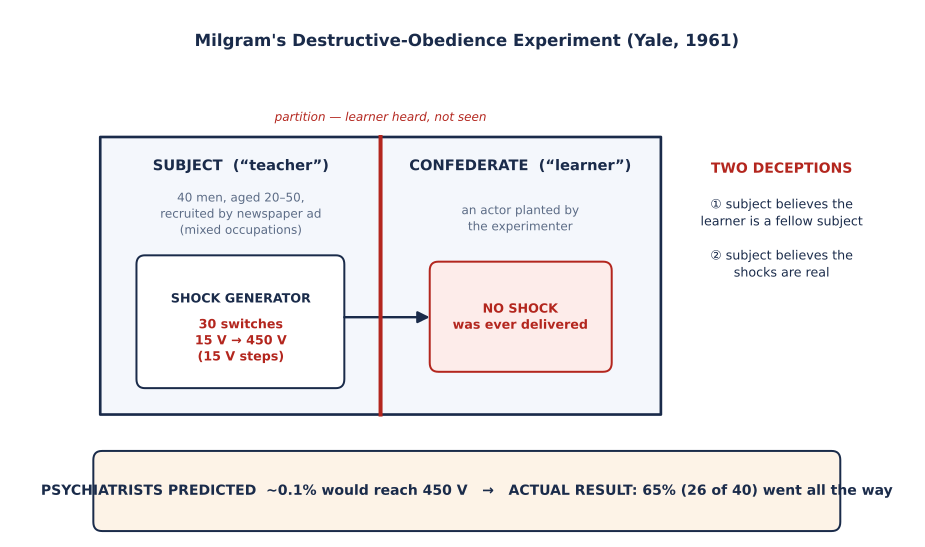
The design. The experiment involved the use of deception — "deception is making people believe in something which is not true." There were two separate deceptions:
- The real subjects were made to believe that the people on the other side were fellow subjects like themselves. In fact they were confederates — people planted in the experiment by the experimenter, who were theatre artists with acting skills, and who followed the experimenter's instructions.
- The subjects were made to believe that they were delivering electric shocks. In fact no shock was ever delivered.
The task. The confederate had to perform a trivial task — the teacher's illustration was taking the cap off a pen and putting it back on. Whenever the confederate made an error, the subject was instructed to press a button delivering a shock, and told: "don't let him go without punishment." The confederates, being actors, produced sounds of excruciating pain each time a shock was supposedly delivered — so the subjects experienced real guilt, believing they were inflicting severe pain. Both the visual and auditory senses were in operation.
The result. Asked in advance whether subjects would ever go to the maximum level, psychiatrists were unanimous that they would not, giving two reasons: (i) human-heartedness and (ii) the sense of justice that would prevail upon them. To their surprise, the majority of subjects went all the way to the maximum level.
Why they did it — the three reasons in action. This is where the experiment demonstrates §6.1:
- Transfer of responsibility. Asked why they gave the shock, subjects said: "I may have given the shock, but I am not guilty — I was just following the order. He told me to do this; I didn't do it on my own." As the teacher put it, "the buck will stop on the table of the experimenter, not on my table."
- Visible badge. The experimenter was a bearded, knowledgeable person who explained the setup in detail and had subordinates alongside him taking notes. The subject had no reason to doubt that he was a genuine experimenter. The teacher's parallel: in the Army, the decorations on the uniform of a major and a captain make it visible at a glance who is in charge.
- Gradual escalation. "If the shock had jumped to the maximum in the second go itself, you would have said no." But it rose one step at a time, and you never realised you had reached dangerous levels. (This is exactly foot-in-the-door from §5.3, operating through orders instead of requests.)
CLARIFICATION — the transcript's Milgram facts are wrong on four counts. Write the verified version.
Point As said in class Verified Year 1974 1961, at Yale University. (1974 is the year Milgram's book Obedience to Authority was published — likely the source of the confusion.) Shock range 40 V to 400 V, in 40 V steps 15 V to 450 V, across 30 switches in 15 V increments, labelled from "Slight Shock" to "Danger: Severe Shock" Who the subjects were College students (with a rationale that students most resist authority) 40 men aged 20–50, recruited by newspaper advertisement and direct mail from New Haven — a broad mix of occupations (postal clerks, teachers, salesmen, engineers, labourers) and education levels. Not students. The prediction & result Psychiatrists said none would; "majority" went to 400 V Psychiatrists predicted only about 0.1% would reach the maximum. In fact 65% (26 of 40) went to the full 450 V. One further point of accuracy: in the standard condition the learner was in a separate room and heard but not seen — the "transparent glass wall" the teacher described (both sight and sound) corresponds to Milgram's proximity variants, in which obedience actually fell as the learner became more visible. The teacher's substantive lesson is unaffected, but the 65% figure belongs to the standard, learner-unseen condition — do not attach it to a "glass wall" setup in an answer.
(Sources: Britannica · SimplyPsychology · Wikipedia)
CLARIFICATION — the ethics of the experiment. The teacher noted that the experiment was conducted at a time when human-rights concerns were not dominant, which is why it was allowed; in present times it would not be possible. This is correct and is itself examinable: consider the mental turmoil of a subject who believes he is inflicting severe pain on an innocent person. The Milgram study is a standard case in research ethics — informed consent, deception, and psychological harm to participants.
6.4 Arendt, Eichmann, and the banality of evil
Hannah Arendt advanced a closely parallel understanding with the concept of the "banality of evil" — meaning that ordinary people, like you and me, are capable of doing evil tasks. You do not need an evil person to do an evil task.
The teacher's application: this explains the brutality of police forces at times. You do not need a monstrous individual; ordinary people in a certain structure of authority will do it.
The idea is documented in what he called "Eichmann's fallacy." Eichmann, when tried and asked by the judge whether he was guilty, said: "No sir, I was just following orders."
The teacher's verdict on that defence is the moral punchline of the entire class: "Merely following the order does not absolve you. Ultimately you will be held culpable if it is an unconstitutional order. You have to think twice, even when it comes from the authority, about whether you have to do it or not."
CLARIFICATION — Eichmann, precisely. The transcript's description ("a commander in German Army") is imprecise. Adolf Eichmann was an SS officer (SS-Obersturmbannführer, i.e. Lieutenant-Colonel) — a Nazi bureaucrat, not a Wehrmacht army commander. He was the administrator chiefly responsible for organising the logistics of the mass deportation of Jews to ghettos and extermination camps. He was captured by Mossad in Argentina in 1960, tried in Jerusalem in 1961, convicted, and executed in 1962.
Hannah Arendt covered the trial for The New Yorker and published "Eichmann in Jerusalem: A Report on the Banality of Evil" (1963) — she found him "terrifyingly normal," and located his evil in thoughtlessness and unreflective conformity rather than monstrous intent.
On the term: "Eichmann's fallacy" is the teacher's usage. The standard names for the defence "I was only following orders" are the superior-orders defence, the Nuremberg defence, or the Eichmann defence. It is expressly not a valid defence under the Nuremberg Principles (Principle IV). Prefer "superior orders defence" in an exam answer; if you use the teacher's phrase, gloss it.
(Sources: Wikipedia — Eichmann in Jerusalem · NEH)
The one-line summary to memorise (dictated verbatim):
Milgram's experiment: ordinary people are willing, although with some reluctance, to harm an innocent stranger if ordered to do so by someone in authority.
6.5 Ways to resist destructive obedience
- Exposure to disobedient models. The teacher's example: Mahatma Gandhi, who disobeyed the draconian British laws — this motivated other people to do the same. A visible model of principled disobedience licenses others to refuse.
- Making people realise that it is them, and not the authorities, that are responsible for the harm produced. This directly attacks reason (1) in §6.1 — it blocks the transfer of responsibility.
- Encouraging people to question the expertise and motives of authority figures. If people are encouraged to question the expertise and motives of authority figures, they are likely to resist destructive obedience. This attacks reason (2) — it dissolves the visible badge.
EXAM FOCUS — this is the highest-value paragraph in the class for GS-IV. These three remedies map exactly onto the three causes, and that symmetry is what makes a good answer. They also translate directly into administrative practice: protection for whistle-blowers and conscientious objectors (disobedient models), personal accountability regardless of orders (the Nuremberg principle, and the reason Indian service rules require an officer to obtain written orders for a doubtful instruction), and an institutional culture where subordinates may question a superior's instruction. Deploy this in any case study where an officer is given an illegal or unethical instruction by a political or bureaucratic superior.
7. Life-Lessons the Teacher Wove In
These recur across his classes and are ready-made Essay and interview material.
- How people are captured — the anatomy of manipulation. He set this out with unusual directness: "Getting people on your side is not tough. You generate in them insecurity; create in them the sense of helplessness; convince them that you are the only person in this universe who can pull them out of the crisis." And the crucial multiplier: "the more the state of deprivation in their lives, and the fewer the controls they have over their life, the higher the probability that they will surrender themselves to you."
- Why freedom is surrendered. "People want freedom, but very few of them are ready to assume the responsibility that comes with that freedom. Because they are not ready to assume that responsibility, they often surrender their freedom to an autocrat." He noted this can be seen in operation everywhere, India included. This is superb Essay material on democracy, populism and the burden of liberty — and it pairs naturally with Erich Fromm's Escape from Freedom.
- Control over media and the manufacture of consent. Following from the above: to create in people a sense of inferiority, control over media is very important — hence the concentration of media houses in a few hands, so that information capable of indoctrinating minds can be disseminated. Usable in GS-II (media and democracy) and Essay.
- Interest, not affection, sustains most alliances. "You will stay with someone only as long as your self-interest is served." Combined with the reward–cost principle (§4.1), this is his consistent, unsentimental account of why groups hold together.
- Argue with logic, not hearsay. The refrain behind the whole of §2.2 — "talk with logic; we make useless talk." The habit of asking what is the actual mechanism here? is the intellectual discipline he is teaching throughout.
- On self-knowledge. People are not in "a state of perpetual ignorance" about right and wrong. Human beings are biologically designed to show compassion and empathy to fellow human beings, and they carry a sense of justice inside them. If someone genuinely has no idea about it, that is an example of poor socialization — which ties this class back to lec07.
- The Plato line he closed on: "We can forgive a child who fears the dark; the real tragedy of society is when men fear the light." He used it to argue that ignorance is forgivable in a child but not in an adult who chooses not to see.
CLARIFICATION. This quotation is universally attributed to Plato but is of doubtful authenticity — it does not appear in the Platonic corpus. Safe to use as an aphorism; do not cite it as a sourced Plato quotation in an answer.
8. Cross-GS Linkages / Applications
| Where it applies | Node | The angle |
|---|---|---|
| Ethics — case studies | [[GS4-ETH-08]] | Obedience to an unlawful order is the single most common GS-IV case-study scenario. §6.5 supplies the resolution framework; the superior-orders defence is not a defence. Compliance techniques (§5) supply the persuasion toolkit when a case asks you to bring a resistant stakeholder around. |
| Ethics — public administration | [[GS4-ETH-06]] | Dr. Kalam on refusing gifts (§5.4) is reciprocity converted into a probity rule. Foot-in-the-door + gradual escalation explain how corruption is normalised incrementally. Information vs expert power (§3.1) explains why information-hoarding is a poor basis for administrative authority. |
| Ethics — probity, RTI, accountability | [[GS4-ETH-07]] | "Success of democracy calls for open examination of the conduct and affairs of the government" (§3.2) is a usable line on transparency; questioning authority (§6.5) is the cultural precondition for whistle-blowing. |
| Ethics — human interface, values | [[GS4-ETH-01]] | Conformity vs non-conformity is the tension between social belonging and moral autonomy — when should a person break from the group? |
| Ethics — emotional intelligence | [[GS4-ETH-04]] | Self-esteem, self-efficacy, anxiety and ego strength (§§2.1, 4.3) are EI constructs; the persuasion prescriptions are applied EI. |
| GS-I — Indian society | [[GS1-SOC-04]] | Minority status → heightened identity consciousness (§2.2) is a precise, quotable mechanism for communalism, identity politics and diaspora behaviour. Selective exposure explains why prejudice survives migration. |
| GS-II — polity & governance | [[GS2-GOV-03]] | Media concentration and manufacture of consent; accountability of authority; why service rules require written orders for doubtful instructions. |
| Essay — philosophy & ethics | [[ESS-PHE-01]] | Banality of evil; the ordinary person's capacity for harm; conscience vs obedience. |
| Essay — democracy & administration | [[ESS-DEM-07]] | "People want freedom but few will assume the responsibility that comes with it" (§7) is a first-class essay thesis on populism, autocracy and the burden of liberty. |
9. Exam Focus
- Definitions to reproduce verbatim: personality; self-esteem; anxiety; intelligence; social influence; conformity; social norms; compliance; obedience; destructive obedience; leadership.
- The three mechanisms are the spine of the topic — memorise the medium that distinguishes them: conformity = norms (no explicit request at all) · compliance = request · obedience = order. Examiners test the boundaries; and remember the teacher's finer distinction that social validation involves no pressure, whereas conformity does.
- The six bases of power (reward, coercive, expert, information, referent, legitimate) is a list question waiting to happen. Carry the information vs expert power contrast as your value-add.
- Leadership vs power — leaders have power, but not all who have power are leaders; leadership adds vision realised + common good.
- Cialdini's six principles — but revise the first four in depth, per the teacher's explicit exam guidance, along with their techniques: foot-in-the-door · door-in-the-face · that's-not-all · playing hard to get · deadline.
- Milgram is the most examinable single item here — and the transcript's version is wrong. Learn: Yale, 1961; 15–450 V in 30 steps; 40 men aged 20–50 recruited by advertisement; psychiatrists predicted ~0.1%, actual 65%. Then the three reasons (transfer of responsibility, visible badge, gradual escalation) and the three remedies (disobedient models, personal responsibility, questioning authority).
- Arendt's banality of evil + the superior-orders defence is the ethical core: an unconstitutional order must be refused, and "I was following orders" does not absolve.
- Answer-writing tip: in a case study about an unethical instruction from a superior, structure the answer as cause → remedy using §6.1 against §6.5. That pairing reads as analysis rather than as a list.
10. Previous Year Questions
Node: GS4-ETH-02 — Attitude ("…social influence and persuasion"). Pattern analysis: pyq/analysis/gs4-pyq-analysis.md · Full bank: pyq/analysis/gs4-pyq-bank.md
| Year | Marks | Question | Framing |
|---|---|---|---|
| 2020 | 10 | (b) A positive attitude is considered to be an essential characteristic of a civil servant who is often required to function under extreme stress. What contributes to a positive attitude in a person? | Directly answerable from the non-conformer traits (§4.3) — self-reliance, high self-efficacy, social maturity, ego strength — plus low anxiety (§2.1). |
| 2017 | 10 | Young people with ethical conduct are not willing to come forward to join active politics. Suggest steps to motivate them to come forward. | A persuasion design problem: use §2.3 (overcoming selective exposure/attention) and §5.2 (liking-based techniques). |
| 2016 | 10 | Attitudes are shaped unconsciously by family and social surroundings… (a) undesirable values in educated Indians (b) how can such undesirable attitudes be changed? | The unconscious acquisition described here is selective exposure (§2.3). Part (b) is answered by the attitude-change prescriptions in §§2.1–2.3. |
| 2014 | 10 | What factors affect the formation of a person's attitude towards social problems? Contrasting attitudes about the caste system — how do you explain their existence? | Receiver characteristics (§2) + selective exposure (§2.3) + conformity (§4) together explain why contrasting attitudes coexist and persist. |
| 2014 | 10 | Increasing instances of sexual violence against women despite legal provisions. Suggest innovative measures. | Attitude change at scale — a social influence design question; the teacher's public apology / public commitment point (§5.1) is directly on record as applicable to gender harassment cases. |
EXAM FOCUS — the pattern. GS4-ETH-02 is asked almost every alternate year, and the framing is consistently applied, not definitional: how do you change an attitude? rather than what is an attitude? This class is therefore high-yield — it is the paper's toolkit for the "how" half of every one of these questions.
Current Affairs
(Updated as relevant news/magazine content comes in — e.g. stories on misinformation and echo chambers, media ownership concentration, whistle-blower protection, or officers refusing unlawful orders.)
| Date | Source | Headline | Connection to this topic |
|---|---|---|---|