Strengthening Ethical & Moral Values in Governance
GS Paper: IV (Ethics) | Subject: Ethics in Public Administration | Teacher: Brijendra Singh (Vajiram & Ravi) | Class: 9 (17-06-2026) | Last updated: 2026-06-18
What this class is. Class 9 closes the diagnosis left open in Class 8 and then gives the cure. Day-1 finishes the seven features of administrative culture (the table Class 8 §11 only listed) and the three India-specific problems. Day-2 takes up the two syllabus sections proper: (1) Strengthening of Ethical & Moral Values in Governance — built on the Framework of Value Development (a 4-dimension ladder) and 10 elements of value development — and (2) Codes of Ethics vs Codes of Conduct. The teacher's running method: "any question they ask, the answer is already written in front of you — understand the concept, then learn to reverse it to answer whatever is asked."
Table of Contents
- The seven features of administrative culture (the diagnosis)
- Two case studies — culture in everyday administration
- Armed forces vs civil administration — feature by feature
- Recognition of merit — favouritism & sycophancy
- Administrative culture in India — three problems & their cures
- Framework of Value Development — the core diagram
- The organisational direction (outside-in): the four dimensions
- Limitations of an organisation — and the individual direction (inside-out)
- The 10 elements of value development
- Code of Ethics vs Code of Conduct
- Mission Karmayogi & AIS Conduct Rules 1968 (readings)
- Exam focus
- Current Affairs
1. The seven features of administrative culture
Administrative culture = the shared values, beliefs and behaviours of a country's government officials. The class works from a PPT table with three columns — the feature, India's 2016 self-assessment, and how that assessment plays out in practice. In 2016 the Government of India ran a survey of mid-career officers (~16–18 years of service) asking them to rate the administrative culture. The verdict: of the seven features only two were rated "high" — and even where the rating is high, the actual usage is unsatisfactory. In short, Indian administrative cultures are not good, and there is large scope for improvement.
The teacher's technique: explain features 1→5, then read them back in reverse to show how they are causally linked, and finally drive them home with case studies.
| # | Feature (what it means) | India's rating | How it actually plays out |
|---|---|---|---|
| 1 | Level of discretion — the autonomy/freedom an officer has in a decision | High | Used for personal, not public, interest |
| 2 | People orientation — how far public interest is the first priority | Low | Self-serving; disregard for people |
| 3 | Outcome orientation — balancing the process with the outcome | Low | Procedural compliance only (means–ends reversal; rule-based) |
| 4 | Mechanisms of control — checks that can supervise/punish officials | High (in number) | Discourage initiative-taking (high in number, low in impact) |
| 5 | Sense of identity — grasping the value/importance of one's work | Low | Value of work not understood |
| 6 | Recognition of merit — is merit rewarded, non-performance punished? | Low | Favouritism + sycophancy |
| 7 | Communication channels — open vs restricted | Low | Closed; top-down |
CLARIFICATION — how the first five chain together (read in reverse). The features are not a loose list; they cause one another. Because an officer does not understand the value of his work (low sense of identity, 5), he takes no initiative (the many control mechanisms, 4, only make this worse); taking no initiative, he merely complies with procedure (low outcome orientation, 3); not bothered about the outcome, his focus drifts to himself, not the public (low people orientation, 2); and on the rare occasion he does use his high discretion (1), he uses it for personal, not public, interest. The root is feature 5 — not understanding the importance of one's work.
CLARIFICATION — "level of discretion" in the IAS. Discretion = the independence/autonomy/freedom an officer has in a decision, and in India it is very high. "Once an IAS officer decides he wants to do something, there is no force in this country that can stop him — not the Chief Minister, not the Chief Secretary; they can only delay it." If a District Collector with even six months left in office truly wanted to, "he could transform his district to almost look like a developed country — right now, not by 2047." The problem is where that enormous discretion is used: not for the common people, but where there is a personal return — for a rich industrialist, a powerful politician, a famous celebrity.
CLARIFICATION — "mechanisms of control" (recap from Class 4). These are the tools to control the bureaucracy: Judiciary — judicial review, PIL; Legislature/Parliament — law-making power, budgetary control, parliamentary committees; Citizens — elections (indirect), RTI, social audit, Citizen's Charter, social media. Their number has grown rapidly in the last 10–15 years ("did your parents have RTI, social audit, citizen's charters at your age? No — you do") — yet their impact has not improved, because as supervision multiplies, officers grow even more reluctant to take any initiative (every initiative is one more thing for which they can be questioned or punished).
2. Two case studies
TEACHER'S EXAMPLE — the qualified doctor who would not raise his hand (sense of identity & "personal not public interest"). Years ago, mid-lecture in a Vajiram classroom, a boy in the front rows quietly collapsed — a heart attack (the class later learned both his parents had severe heart conditions and his own heart was weak). The teacher had no medical training; he repeatedly asked the packed room, "Is anyone here a doctor? Anyone with medical experience?" — no hand went up. Other students carried the boy out and were about to give him water. Only after the teacher shouted the question a third time did one boy in the last rows finally raise his hand — a qualified doctor working at a Delhi hospital. He rushed out and stopped them: "Don't give him water — he's having a heart attack, he'll die"; the boy was rushed to hospital and survived. Days later the doctor came to explain why he had stayed silent: in medical training, "we are taught not to interfere in a case that is not assigned to you" — because in India, when a patient dies, "the family brutally beats up the doctors," so doctors now protect themselves by not intervening. The teacher's reply cut to the bone: Could you have lived with the guilt if the boy had died because you stayed silent? What is the value of the Hippocratic oath you took? And — if this boy had been your roommate, your cousin, your best friend, would you still have waited for someone to "assign" the patient? This is having the discretion to act, but using it for personal (self-protection from criticism/punishment), not public, interest — and it grows from a weak sense of the value of one's work.
TEACHER'S EXAMPLE — the Dwarka abduction (9 Feb 2012; the "Chawla case," SC verdict Aug 2024). Around 4:30 p.m. in Dwarka, a ~22-year-old girl — recently graduated, only 2–3 months into her first job, happy to be contributing to the family income — was walking home with two friends when a car stopped, three men dragged her in and sped off. Her friends screamed; within minutes a crowd of ~100 gathered; police constables arrived within ~15 minutes (to Delhi Police's credit). The crowd told them: it's 5 p.m. rush hour, the roads are choked, the car can't have gone far — go after it. The constables agreed — "but we have no vehicle of our own; arrange one and we'll chase." Not one of the 100 bystanders offered a car or a bike. The girl's father, working elsewhere, took 3–4 hours to reach and arrange a vehicle; by then the trail was cold. Three days later (12 Feb) her body was found in Rewari, Haryana — raped, then horrifically mutilated (bones broken, teeth and eyes pulled out); the post-mortem showed she had died only 1–2 hours before discovery, meaning she had lain in a field, alive and dying, possibly for two days.
The hard question: when the two constables were told a girl had just been abducted, what did they think the value of their work was? Their idea of "duty" was pure procedural compliance — "file an FIR, arrest the accused, produce them in court; punishment is the court's job, not mine." But the real duty of a policeman is, if possible, to prevent the crime — and an incomplete understanding of that duty cost a human being her life and dignity. Where does the responsibility lie? Partly the two constables — but far more with the future IPS leadership: "when you join the IPS, if you don't have the right behaviour and attitude, you set a terrible precedent and build a toxic culture in your organisation."
TEACHER'S EXAMPLE — the same case, with a powerful victim (discretion for personal interest). Suppose, instead, the constable phones the SSP (Traffic) and asks him to set up road-blocks in a 2 km radius and check cars. The SSP refuses: "This is a 3-crore city at 5 p.m.; if I block roads for every kidnapping the city is paralysed." — which seems reasonable. But the moment the constable adds, "Sir, the girl's mother is a Delhi High Court judge, her father is a Rajya Sabha MP, the family is a 5,000-crore industrialist house," the road-blocks go up instantly — and not for 2 km but 5 km. The SSP had the same discretion in the first case; he simply chose not to use it because there was no personal interest. The teacher's blunt correction of a national myth: "It is not that women are unsafe in India — men and women who do not belong to the elite are unsafe. If your family has a judge, an MP, or 5,000 crore, the State will move heaven and earth to protect you." The deepest problem, then, is not money, laws or manpower — "it is fundamentally in our organisational cultures: we exist to serve the few, the elite; the rest can fend for themselves."
TEACHER'S EXAMPLE — where the police-station money actually goes (the SP's renovation). Visit any police station in India and constables will tell you they lack the basics — no vehicles, sometimes not even a register or pen to write an FIR — "yet the government gives the police a lot of money; where does it go?" It is consumed by seniors to keep their own lives comfortable. A typical pattern: on taking charge, a new SP sanctions ₹40 lakh to renovate his office and ₹30 lakh to renovate his (government) house; a year later he is transferred and the next SP does the same — ₹40 lakh office + ₹30 lakh house + ₹30 lakh for a new SUV — "so he can drive from office to house." So when a constable won't spend his own salary to hire a taxi to chase a kidnapper, he asks: "If my seniors spend lakhs on personal comfort, why should I spend my salary doing my duty?" — and "will he ever dare ask that question of the people above him? No. The rot is not at the bottom; it is usually right at the top."
3. Armed forces vs civil administration
The teacher's set question — "Why is the culture in the armed forces usually considered better than in the civil administration?" — is answered feature by feature, with a sharp caveat against moralising.
CLARIFICATION — it is NOT about being "morally superior." "You cannot say armed-forces people are more moral, more patriotic, or better human beings than the IAS/IPS/IFS — that earns minus one." The values are the same; the culture differs because of the features, above all low discretion and stronger control mechanisms.
- Discretion is relatively low in the forces → less misuse. The proof is AFSPA: the same well-mannered, decent soldier who behaves perfectly in Delhi, Bhopal or Mumbai is far more likely to commit excesses in Imphal, "not because the man changed, but because the Armed Forces (Special Powers) Act gives him high discretion there — and the moment you raise discretion, the probability of misuse rises." (Yes, the Army too can commit rape/murder/torture — but it happens where discretion spikes.)
- Mechanisms of control are higher in impact. An officer accused of misconduct faces a Court of Inquiry and a Court Martial that decide within ~6–8 weeks — innocent → back to work; guilty → strict, swift punishment. Contrast the civil side, where a final verdict can take 3, 5 or more years. So corruption in the forces is not absent, but relatively rare.
- Recruitment assesses values far more carefully (see §9.1): the SSB is a 5-day process with psychometric testing that can't be coached, versus a 25–30-minute civil-services interview — "in 30 minutes, however intelligent I am, I cannot accurately assess your values."
4. Recognition of merit
Recognition of merit = the extent to which meritorious performance is appreciated and non-performance is penalised. In Indian civil administration this is low, and it shows up as favouritism and sycophancy.
TEACHER'S EXAMPLE — recognition of merit, forces vs civil. What is India's highest gallantry award in war? The Param Vir Chakra. In peace? The Ashoka Chakra. Work well in the armed forces and you earn medals you wear with pride on your uniform. Work well in the civil services and what do you get? "IAS officers don't even wear a uniform." How many IAS officers have ever received the Bharat Ratna? Zero. Even the Civil Services Day awards (given on 21 April) are so obscure that "students preparing for this very exam have never heard of them." That obscurity is poor recognition of merit — even when the government does honour someone, society barely registers what they did for the country.
TEACHER'S EXAMPLE — favouritism vs sycophancy (defined). Favouritism: a superior must send one of two subordinates to an important assignment (say, to meet the PM). A is hardworking, intelligent, creative; B has no good quality except that he is from the boss's home state, speaks his language, and every Sunday brings him something nice to eat. Sending B instead of A is favouritism. Sycophancy ("chamchagiri"): "the boss is always right" — no matter what the senior says, it's right because he said it. Under both, a genuinely hardworking officer is never recognised; the promotion goes to the flatterer. "Look at three or four powerful organisations in India and the people heading them — sometimes you wonder how someone so incompetent, so biased, reached the top. Usually because they mastered sycophancy: keep the senior happy and your non-performance is overlooked while you keep rising."
5. Administrative culture in India
The PPT then narrows to India-specific problems and their recommended cures (a problem → recommendation table). The teacher stressed three (political interference, seniority, red-tapism) and the slide adds weak accountability and job security.
| Problem | Recommendation |
|---|---|
| Excessive political interference | Security of tenure |
| Weak accountability | Strengthen accountability |
| Job security (no performance metric) | Performance-linked work |
| Principle of seniority | Performance-linked work |
| Red-tapism | Rule-based → Role-based |
TEACHER'S EXAMPLE — political interference & the "transfer" weapon (Ashok Khemka). The commonest way a politician pressures an officer is the threat of transfer. Should a transfer worry you? Idealistically no; realistically yes. Take Ashok Khemka — ~30 years of service, transferred almost 60 times — "every six months you and your family pack your bags and move; after a while even the best people lose heart and break." The cure is security of tenure (a fixed minimum period at a posting during which you cannot be removed), so an honest officer can work fearlessly without the threat of transfer.
CLARIFICATION — but security of tenure is a double-edged sword. "Will fixing tenure improve governance? Only if you assume the officer is honest." If most bureaucrats are not trustworthy, then guaranteeing them two immovable years simply lets them maximise their gains — "I can't be removed, so I'll keep the local industrialist, businessman and politician happy and extract as much as I can." Good in theory, hard to implement in reality — because the underlying values are poor. This is the recurring lesson of the whole class: every structural reform works only on top of good values.
TEACHER'S EXAMPLE — the principle of seniority kills the incentive to perform (Tina Dabi vs the late entrant). Under the principle of seniority, your age at entry — not your performance — largely fixes where you will end up, because promotions are time-bound. Enter the IAS at ~22 (like Tina Dabi), finish training at ~24, and "unless you commit a major blunder, almost kill someone with your own hands, nobody can stop you from becoming Cabinet Secretary" — so why work harder? Do the minimum, avoid controversy, take no risks, and you still rise, "because age is on your side." Conversely, a brilliant candidate who clears the exam late and gets a first posting at 31 "will never become even a Joint Secretary, no matter how far beyond the call of duty he goes — because age is not on his side." For both, there is zero incentive to work harder. The cure: link performance to promotion, pay and appreciation.
CLARIFICATION — but you can't simply abolish seniority either. "Remove the principle of seniority and who decides who rises? Whoever is at the top — and they will reward sycophancy and favouritism, making both even stronger." The teacher's evidence: Supreme Court judges' elevation is by seniority — predictable, you can already name the future CJIs from the website (DoB + date of elevation) — and it is criticised; but appointments not based on seniority (e.g. to the Election Commission, chosen by a committee at the highest levels of government) are widely seen as even more compromised in recent years. "We can't remove seniority because we don't have enough good, trustworthy people to whom we can hand the discretion to choose." (Aside: in Singapore, New Zealand, Sri Lanka, even politicians "speak with facts and content at their fingertips" — how much was allocated, which projects completed — whereas here understanding is superficial.)
HANDOUT — red-tapism & the rest. Red-tapism = excessive paperwork for even the smallest service; cure = shift from a rule-based to a role-based approach (laws/rules matter, but your understanding must not be restricted to them — be willing to go beyond procedure to the actual role/outcome). Weak accountability is hard to fix because of Art. 311 protection, non-time-bound enquiries and complex penalty procedures; job security with no metric breeds complacency.
6. Framework of Value Development
CLARIFICATION — what "value development" is even trying to do. Whether the person you depend on is a doctor, a train driver, a judge or a bureaucrat, you ultimately need one thing: that they have the right values (honesty, courage, compassion, empathy, team spirit…). The problem is that values cannot be enforced — "I cannot compel you to be honest or courageous; values must be inculcated." And the easiest time to inculcate values is age ~3, not 23 — a responsibility that lies with your mother, father and primary-school teacher, not the government. By the time an organisation gets you (22, 25, 27), your value system is already stable, even rigid. (This is exactly why the armed forces, recruiting mostly by 21, find it easier to mould people than state civil services where the joining age — after relaxations — can reach 44: "whom can you train and mould more easily, a 21-year-old or a 44-year-old?")
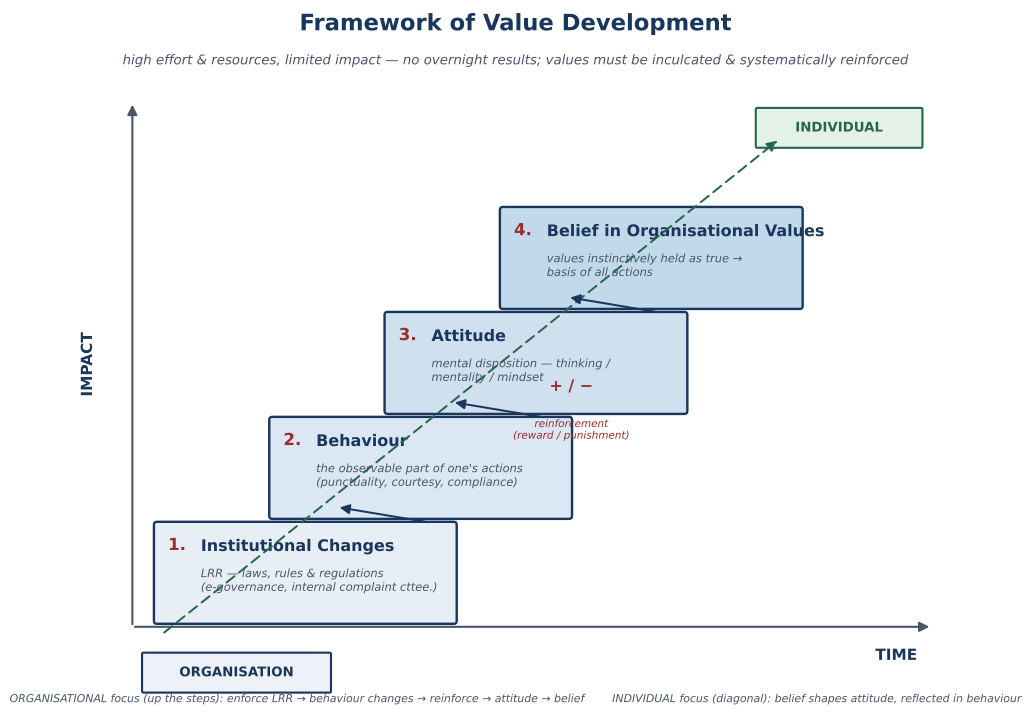
So the question is: if an organisation finds that a 22-year-old lacks some values, what can it do? The answer is the Framework of Value Development — a combination of tangible and abstract dimensions, with one warning built in: the effort/resources are high but the impact is limited — there are no overnight results; values need sustained reinforcement over a sustained period.
DIAGRAM (clean redraw). The board diagram is an IMPACT (y) vs TIME (x) chart of four ascending steps, read in two directions. The teacher's red annotations — "LRR", "observable part of actions", the "+ / −" reinforcement loop, "Mental Disposition: thinking / mentality / mindset", and the ORGANISATION → INDIVIDUAL diagonal — are folded into the clean version below. The prose in §7–§8 carries everything in it.
7. The organisational direction
From an organisation's point of view the framework is read upward / outside-in, across four dimensions:
- Institutional Changes — tangible measures, "in three words: Laws, Rules and Regulations (LRR)," that the organisation enforces. E.g. introducing e-governance (standardisation, less misuse of discretion); setting up an internal complaints committee (less harassment/favouritism).
- Behaviour — "the observable part of your actions — what I can see and notice about you." When LRR are strictly enforced, behaviour changes almost immediately, because the individual knows the same organisation can also punish him. Visible in punctuality, social courtesy, public hygiene, compliance.
- Attitude — "your mental disposition towards objects, people and issues — in simpler words, your thinking / mentality / mindset." Enforcing rules changes behaviour but not necessarily attitude. So the organisation applies reinforcement: positive (rewards) and negative (punishment), hoping the attitude shifts too.
- Belief in Organisational Values — a belief is an idea held as true; a value is a stable, long-lasting, important belief. The long-term goal is that the individual develops conviction that the organisation's values benefit him, not just the organisation — so they become instinctive and the basis of all his actions.
TEACHER'S EXAMPLE — the four steps run live on the Vajiram class itself. "You are the individual; Vajiram is the organisation; the value we want is that students put in hard work" ("not hard work — back-breaking hard work; anyone who tells you 'smart work' clears this exam is lying"). (1) Institutional change: from next class, when the teacher points at three students, "you will come up, take the mic, and explain the answer to the class." (2) Behaviour changes immediately — "look at the smile vanish; two boys are already deciding 'next class I'm not coming, he'll make me stand.'" That's behaviour change out of fear of punishment — but only inside this one class; it won't carry to the other 300 GS classes. (3) Reinforcement for attitude: add positive incentives — "answer 5 questions correctly and I'll genuinely buy you an iPhone 17; 7 → an iPad; 10 → a MacBook" — and negative ones (standing up, the embarrassment of not being able to answer). The "worst student in the class," who ignores everything until he hears "iPhone, iPad, MacBook," studies ethics inside-out for a week and wins several devices. The novelty wears off — but he keeps studying ethics, because by now the respect and confidence he earns (the whole room goes silent and looks to him for the hard answers) is its own reward; soon his history, polity, economics improve too, with no iPhone on offer — that is the attitude change. (4) Belief: he now believes hard work benefits him (rank, selection), not just Vajiram (toppers' list) — "the value is beneficial for the individual, more than for the organisation."
8. Limitations & the individual direction
Enforcing rules reliably changes behaviour, but not certainly attitude. The teacher framed the gap as three questions (a PPT slide, "Limitations of an Organisation"):
- Does a person's behaviour always reflect their true attitude/values? The key word is "always" — it demands a guarantee, and with human beings nobody can give it. People often behave to conceal their real values, not reveal them. E.g. candidates in a civil-services interview behave like ideal, perfect human beings ("Yes, I'll serve honestly on a low salary; no, I'll never let my driver do wrong") — while privately thinking "let me get into the government, then I'll show you what corruption really is."
- If a person shows the same behaviour for a long time (5, 10, 12 years), can we be certain his attitude changed? The key word is "certain" — and again, no. People often behave consistently because they are supervised and afraid of punishment. E.g. a child wakes at 6 a.m. and bathes daily for ~15 years (ages 3–18) — "but the day he joins college, getting him up even by 11 a.m. is a task." The behaviour held only because of supervision + fear of punishment, not a changed attitude.
- How do we increase the probability that a behavioural change also produces an attitudinal change? → read the framework in reverse.
CLARIFICATION — the reverse (individual) direction: importance of the right individual. Read the same ladder from the individual's side and it says: every person already believes in certain values; that belief shapes their attitude; and that attitude is reflected in their behaviour. So an organisation increases the probability of behaviour→attitude alignment by selecting individuals who already believe in values similar to what the organisation wants. Congruence between individual and organisational values → acceptance and compliance; divergence → resistance and conflict (compliance only "as long as you can stand on their head — supervise, threaten, reward"; withdraw that and they revert).
TEACHER'S EXAMPLE — belief → attitude → behaviour (the bowl of water). A boy has believed since childhood that all living beings are equal. That belief gives him a compassionate attitude, visible in his behaviour: "however busy or tired, he never forgets to keep a bowl of water outside his window in this heat, refilled three or four times a day, so any thirsty bird or animal can drink." Belief shaping attitude, reflected in behaviour.
TEACHER'S EXAMPLE — congruence: Missionaries of Charity vs the Taliban. This compassionate boy applies to two organisations — Missionaries of Charity and the Taliban/Al-Qaeda. Which should recruit him? The first — because his personal values overlap with the organisation's, so he'll be happy, committed and effective, and the organisation benefits. "If the Taliban hired him, he'd neither like nor understand the work, and would be useless at it." The same logic applies to selecting people for the IAS/IPS vs entrepreneurship/start-ups — match the values to the role. (Smaller version: the student who, arriving late, holds his backpack close to his body and squeezes in without disturbing others shows concern for others — "put him in government, he'll serve"; the one who is "absolutely unconcerned in a cinema hall, a metro, a classroom" may do well in private business but not public service.)
CLARIFICATION — which individuals matter most? Judge, bureaucrat, politician. These three make, implement and adjudicate the institutional changes (LRR), so their values must be assessed as carefully as possible, because a wrong pick costs you for years: a bad politician ~5 years, a bad judge ~10–15 years, a bad bureaucrat ~30–35 years — "this person can destroy your system." And when you assess, assess values/integrity, not just ability: "Integrity without knowledge is weak, but knowledge without integrity is dangerous" — an honest-but-less-knowledgeable person can be trained; "an intelligent but dishonest person can destroy your system."
CLARIFICATION — but how do you actually assess values? (recruitment's hardest problem). You can test physics, maths or history with a few exams; "how do you test compassion, honesty or empathy?" A moral-character certificate is meaningless (identical for everyone). In class, people pretend — formal and polite — hiding their real selves; in the ethics paper "you can lie — write what the examiner wants to read" ("it's possible to score 110/150 in ethics without understanding ethics, because of how questions are framed"); in the interview, candidates arrive with a memorised "profile," learn the right answers and "blurt them out without meaning a single word." You cannot reach 100% accuracy — but you can raise the probability: the SSB's 5-day process + psychometric testing (which can't be coached) assesses values far better than a 30-minute interview that mostly tests memory (home state/district, graduation subject, current affairs). "Who enjoys more power — the armed forces or the civil services? Then why are their values assessed less carefully?"
TEACHER'S EXAMPLE — selection quality & "brain drain." If you want five values in an officer (honest, courageous, compassionate, people-oriented, determined) but no one in the pool has all five, pick the candidate with three or four, never the one with zero — and never a −5 (one whose qualities are the opposite of what you want). The deeper trouble: "the best pool of human capital has already left the country (brain drain); you must select from the second rung — so choose carefully." The teacher tied this to the post-result felicitation function: single-digit rankers were seated on sofas, double-digit rankers on chairs, and the latter "had already started complaining and griping — before their training has even begun," a sign the system selected people focused on self-glorification. Contrast a friend in the Army/Navy/Air Force, who talks about the work "with excitement and happiness, because they enjoy it" — even though "nobody garlands them."
TEACHER'S EXAMPLE — responsibility = taking charge of your own life (plan B). Responsibility rests on moral obligation, not rules. "Have you, in five months of preparation, given even five minutes of serious thought to a genuine Plan B?" Few aspirants know about the UN civil service, or that WTO/WHO and many international organisations based in Delhi hire people like them, or that their own state runs a Chief Minister's Internship Programme — experiences that would strengthen a résumé. "If you take responsibility for your own future now, I can be reassured you'll think out of the box in government too."
CLARIFICATION — every kind of work matters (against the "poster boys" narrative). "Never make the mistake — the way the government and journalists sometimes speak — of thinking a soldier's work is more important than anyone else's." A doctor treating a 3–5-year-old whose body has been mauled by stray dogs (because the municipality couldn't control them), the fact that "~5,000 children under five die every day in India for lack of food" — "does that not wake your conscience as much as the border?" "Start unlearning the narrative that one kind of work is more important than another."
9. The ten elements of value development
To implement the framework, the handout lists 10 elements. The teacher discussed Recruitment in depth in class (and Code of Ethics/Conduct, see §10); the rest are "easy to understand and written clearly in the handout."
PPT — the 10 elements: 1. Recruitment · 2. Training · 3. Performance Appraisal · 4. Disciplinary Action · 5. Leadership · 6. Simplified & Effective LRR · 7. Code of Ethics & Code of Conduct · 8. Positive Organisational Cultures · 9. Encouraging Ethical Behaviour · 10. Evaluation of Value Development.
9.1 Recruitment
Purpose: attract, identify and select good-quality human capital — sincere, diligent people genuinely committed to public welfare. Good-policy elements: (i) assess not just intellect but temperament, using psychometric tests (objectively measure honesty/trustworthiness/compassion), situational analysis (past handling of ethical dilemmas) and integrity testing (attitudes to dishonest behaviour); (ii) keep the entry age low enough that behaviour/attitude can still be moulded ("the older the candidate, the more rigid the value system"); (iii) enrich the knowledge base with formal higher-education courses on the Constitution, laws, political system, social/economic concerns; (iv) allow lateral entry to inject competition, experience, innovation and dynamism into a career-based service that "breeds rigidity, incompetence and inertia" — while guarding against it becoming a tool for nepotism/favouritism.
EXAM FOCUS — quotes (handout): "In looking for people to hire, look for three qualities: integrity, intelligence and energy. And if someone doesn't have the first, the other two will kill you." — Warren Buffett. "In government recruitment, it's not enough to look for skills; we must also seek values and a commitment to public service." — Angela Merkel. "Hire character. Train skill." — Peter Schutz.
9.2 Training
"A good administrator is not born but made." Train at recruitment and at periodic intervals throughout the career. Issues in India: training is often narrowly technical; probationers treat it as a formality (worsened by leave to re-attempt the exam); probationers get accustomed to perks before confirmation ("use the spartan armed-forces model — a culture of service, not elitism"); misconduct in training goes unpunished. Methods that build ethics: group exercises (case-study method, role-play), experiential learning (volunteering/fieldwork), immersion programmes (time with marginalised communities), role models, mentorship, sensitivity training. The flagship Indian initiative here is Mission Karmayogi (§11).
9.3 Performance Appraisal
Appraisal can be misused by a superior to pressurise/victimise subordinates and breed sycophancy. Good design: a 360° review (assessed by superiors, colleagues, subordinates and clients/citizens — hard for any one person to bias), peer review, multi-member bodies (Civil Services Board for transfers/promotions); qualitative indicators (Outcome Budgeting, Social Impact Assessment, Social Audits), not just quantitative; incentives/disincentives (performance-linked pay); stability of tenure + awards. Above all, shift from Performance Appraisal → Performance Management.
| Characteristic | Performance Appraisal | Performance Management |
|---|---|---|
| Rating system | Top-down | Joint/participative, mutual dialogue |
| Focus of review | Past performance | Future-focused |
| Frequency | Once/twice a year | Ongoing, continuous |
| Type of measures | Quantitative | Quantitative + Qualitative |
| Emphasis | Ratings & evaluation | Planning, review, analysis, improvement |
| Question asked | How well was the work done? | What can help employees work better? |
9.4 Disciplinary Action
Investigating and penalising misconduct, guided by natural justice, fairness, transparency. Issues → recommendations: prolonged enquiries → strict time limits, simplified procedures; political interference → autonomy of bodies like the CVC, merit-based appointment of inquiry officers; delaying tactics (endless litigation) → fast-track corruption cases; collusion → rotate/assign external, independent inquiry officers. (Aristotle: "the purpose of punishment is to improve those who do wrong, not to condemn them"; Lord Hewart: "justice must not only be done, but be seen to be done.")
9.5 Leadership
Leadership = the capacity to make others follow willingly. A good civil servant: acts as a source of ethical guidance; serves as a role model ("when leaders make personal sacrifices, others follow"); is a catalyst for social change; manages crises (disasters, pandemics, unrest); and acts as mediator/negotiator. (Robert Noyce: "if ethics are poor at the top, that behaviour is copied down through the organisation.")
9.6 Simplified & Progressive LRR
LRR must be simple, progressive, inclusive and create positive change. Ten features, with BNS-era examples: address historical injustices (Manual Scavengers Act 2013); respect individual differences (BNS drops IPC Sec 377); eliminate gender bias (BNS drops adultery/Sec 497); promote gender equality (Equal Remuneration Act 1976, DV Act 2005, Maternity Benefit Act 1961); restorative justice (BNS community service for minor offences); align with progressive laws (no offence for attempted suicide — Mental Healthcare Act 2017); speedy justice; economic justice (gig/contract workers); protect privacy (data, cyber, surveillance); bodily autonomy (consent in medical treatment, organ donation, abortion, euthanasia, surrogacy). (Napoleon: "law should be so simple it can be understood by a peasant.")
9.7 Code of Ethics / Code of Conduct → see §10.
9.8 Positive Organisational Culture
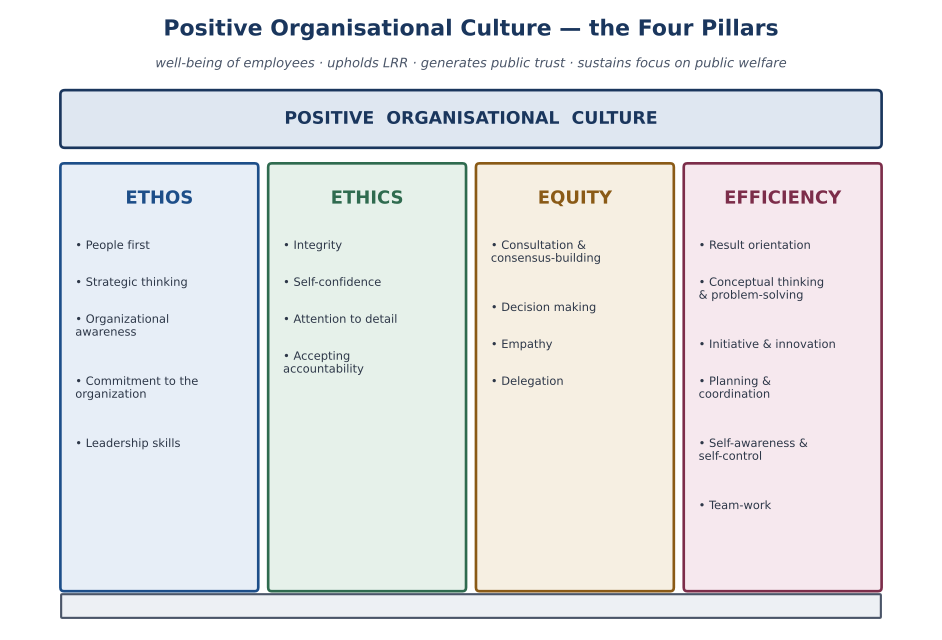
A positive work culture ensures employee well-being, upholds LRR, generates public trust and sustains focus on public welfare. The handout builds it on four pillars — Ethos, Ethics, Equity, Efficiency — each with component competencies.
9.9 Encouraging Ethical Behaviour
Ethical behaviour holds only when malpractice is reported and punished — but people won't report unless their own safety is assured. So: identify ethics-prone areas (monopolistic work, high discretion, weak accountability, low citizen awareness, threats/temptations); enable citizens to complain; safeguard complainants. The key Indian mechanism is the Whistleblower Protection Act (2011) — a public-interest disclosure = a complaint about wilful misuse of power/discretion causing demonstrable loss to government or gain to a public servant. Salient features: disclosure within 7 years; identity required but kept confidential; the Competent Authority can summon documents/persons but only recommend corrective measures; can direct protection for the complainant; punishes revealing identity or mala-fide disclosure. The 2014 amendment added 10 prohibited categories (security, economic/scientific interests, Cabinet proceedings, IP…), reversed the 2011 position to disallow disclosures covered by the Official Secrets Act 1923, and modelled the categories on the RTI Act (criticised as an inapt comparison — whistleblower disclosures are made in confidence, not made public). Notable whistleblowers: Satyendra Dubey (NHAI / Golden Quadrilateral — India's first), Shanmughan Manjunath (IOC, adulterated fuel), Julian Assange (WikiLeaks), Edward Snowden (NSA surveillance), Daniel Ellsberg (Pentagon Papers, 1971). → PYQ 2022: how would you strengthen whistleblower protection?
9.10 Evaluation of Value Development
Measure whether value-development initiatives work, so they can be modified. Indicators: increased awareness (morality, public welfare, corruption); change in the number of complaints/detected offences; change in punishments/penalties awarded; change in queries to superiors about conflicts of interest; an increasingly critical attitude to ethically questionable activities.
10. Code of Ethics vs Code of Conduct
Both are bodies of guidelines that encourage or discourage specific behaviour in a profession. Three things matter: they are mutually supplementary/complementary; they differ on five/six parameters; and where one falls silent, the other supplements it.
DIAGRAM (PPT table, reproduced).
| Parameter | Code of Ethics | Code of Conduct |
|---|---|---|
| Nature | Social, moral (guides thinking) | Specific (dictates action) |
| Coverage | Wide | Limited (can fall silent) |
| Impact | Cognitive (influences thinking) | Behavioural (permits/prohibits acts) |
| Specificity | Weak (open to interpretation) | Strong (no ambiguity) |
| Enforceability | Hard → depends on Responsibility | Easy → enforces Accountability |
| Example | Oaths; Fundamental Duties | EC's Model Code of Conduct; Flag Code of India |
TEACHER'S EXAMPLE — the National Flag (how the two interlock). The Fundamental Duty "respect the national flag" is a code of ethics — social/moral, wide, but vague: ask ten students how they "respect" the flag and you get ten different, often unconvincing answers; you can't establish a violation or punish anyone. So it is supplemented by the Flag Code of India — a code of conduct with specific rules (the flag must not touch the floor, not be draped over a table, not get wet, not be flown upside-down); violate one and a police complaint can be filed and you can be punished. But a code of conduct can fall silent. The Hamid Ansari episode: on a Republic Day, when the flag was raised, the PM and President saluted while the Vice-President stood at attention but did not salute, sparking a national controversy. The Flag Code says only those in uniform salute; none of the three wore uniform, so none was required to salute — the VP standing at attention did satisfy the Fundamental Duty (the code of ethics) to respect the flag. Where the code of conduct is silent, fall back on the code of ethics for guidance; then, to prevent recurrence, you can strengthen the code of conduct with new specific guidelines. India has many Codes of Conduct (AIS Conduct Rules 1968, Central Services Conduct Rules 1964) but no Code of Ethics yet — hence PYQ 2024, asking you to design one.
HANDOUT — a model Code of Ethics for India (suggested provisions, for PYQ 2024): (1) Constitution — understand and uphold its spirit; make constitutional principles the bedrock of decisions; don't misuse safeguards. (2) Professional obligations — duty first; sacrifice is integral to duty. (3) Relationship with superiors — work with, not beneath, superiors; serve the office, not the person; obey orders, but not blindly. (4) Public dealings — the public is the master (courtesy, empathy, concern); a problem-solving (not merely procedural) attitude; dedicated time for the public. (5) Social media — for information/grievance redressal, not personal glorification. (6) Ethics training & review — an Ethics Commission, regular ethics training, a designated Ethics Commissioner.
CLARIFICATION — oaths & religion. Oaths sit in the Third Schedule (oath of office, oath of secrecy) — their value depends entirely on your sense of responsibility: believe in the oath and you'll never break it; don't, and you'll break it whenever convenient. And whether one is an atheist, agnostic or deeply religious makes no fundamental difference to doing the right thing — "that depends on what you choose to learn," not on religious labels.
11. Mission Karmayogi & AIS Conduct Rules 1968
PPT — Readings: (1) All India Services (Conduct) Rules, 1968 — pages 1–15; (2) Mission Karmayogi booklet — pages 1–17 ("mostly photos and government publicity; the real reading is ~3–4 pages").
Mission Karmayogi (NPCSCB, approved Sept 2020). Aim: a competent civil service rooted in Indian ethos, citizen-centric, with officials as enablers for ease of living/doing business. Its spirit is the Gita's "Yogah Karmasu Kaushalam" (excellence/efficiency in action) and the motto "Right Person for the Right Role at the Right Time." Outcomes: on-time delivery; citizen delight; accountability & transparency; solving local problems with global best practices. Six pillars: Policy Framework · Competency Framework · Institutional Framework · Digital Learning Framework (iGOT-Karmayogi) · e-HRMS · Monitoring & Evaluation. Salient features: Rules-based → Roles-based HR (match competencies to the post); on-site complements off-site learning; shared training ecosystem; the FRAC (Framework of Roles, Activities and Competencies) approach; strengthening Behavioural, Functional and Domain competencies; partnership with content creators. → PYQ 2024.
All India Services (Conduct) Rules, 1968 — salient provisions. Every member shall maintain absolute integrity and devotion to duty and do nothing unbecoming of the Service, upholding high ethical standards, political neutrality, merit/fairness/impartiality, accountability and transparency, responsiveness to the public (especially weaker sections), and courtesy. Members must uphold the supremacy of the Constitution, take decisions solely in public interest, use public resources economically, declare private interests/conflicts, take no obligations that compromise duty, and not misuse position for personal/family gain. Other heads: act on own best judgment except under a superior's direction (oral directions to be confirmed in writing); habitual failure to perform = lacking devotion to duty; no child labour below 14; restrictions on employing near relatives, politics/elections (may vote but reveal nothing; no electoral symbols), criticism of government in public media, giving evidence before committees without sanction; gifts (report if value > ₹25,000; no acceptance without sanction if > ₹5,000; avoid lavish/frequent hospitality from those with official dealings); no dowry; restrictions on public demonstrations in one's honour, private trade/employment, speculation/insolvency, property transactions (intimate the government beyond ~2 months' basic pay); observe environmental/cultural norms, two-child norm, and rules on intoxicating drinks.
12. Exam focus
EXAM FOCUS — how this maps to GS4. - The whole class in one line: values cannot be enforced, only inculcated — and the toolkit to inculcate them is the Framework of Value Development (Institutional Changes → Behaviour → Attitude → Belief), implemented through 10 elements (recruitment, training, appraisal, discipline, leadership, LRR, codes, culture, encouraging ethics, evaluation). - The single most reusable diagram: the value-development ladder, read two ways — organisational (enforce LRR → behaviour → reinforce → attitude → belief) and individual (belief shapes attitude, reflected in behaviour, hence select the right person). Pair it with "behaviour ≠ attitude" (the interview-candidate and school-child examples) and "congruence vs divergence" of values (Missionaries of Charity vs Taliban). - The 7-feature administrative-culture table + the India problem→cure table (political interference→security of tenure; seniority→performance-linked; red-tapism→rule-to-role) is a ready framework for "why is Indian administrative culture poor / how to reform it." Always add the double-edged caveat: every structural cure (tenure, abolishing seniority) works only on top of good values. - PYQ-ready set-pieces: Code of Ethics vs Code of Conduct (the 6-parameter table + the National Flag / Hamid Ansari illustration + the model Code of Ethics for India — PYQs 2018 & 2024); Mission Karmayogi (Gita, FRAC, Rules→Roles — PYQ 2024); Whistleblower Protection Act 2011/2014 (+ Dubey/Manjunath/Snowden — PYQ 2022). - High-impact case studies for answers/essays: the Dwarka/Chawla abduction (procedural compliance vs preventing crime; discretion used only for the elite — "we exist to serve the few"); the qualified doctor who wouldn't intervene (discretion for self-protection); armed forces vs civil administration (AFSPA shows it's culture/discretion, not character); recognition of merit (Param Vir Chakra/Ashoka Chakra vs zero IAS Bharat Ratnas). - Quotable line: "Integrity without knowledge is weak, but knowledge without integrity is dangerous."
LINKS. Directly completes Class 8 — Work Culture: the seven features and "how to build a good culture" that Class 8 §11 deferred are delivered here (§1, §5), and the "why good people turn corrupt after entering service" thread is answered by the recruitment/selection-of-values discussion (§8–§9.1). The honest officer who "immediately knows he cannot accept the money" acts on his conscience; the Mission Karmayogi / Whistleblower / Sevottam toolkit also appears in Class 8's Quality of Service Delivery.
Current Affairs
(Updated as relevant news/magazine content comes in)
| Date | Source | Headline | Connection to this topic |
|---|---|---|---|