Answering Ethics Case Studies — The 5-Element Answer Structure
GS Paper: IV (Ethics) | Subject: Ethics — Case Studies | Teacher: Brijendra Singh (Vajiram & Ravi) | Class: 7 (10-06-2026) | Last updated: 2026-06-14
What this class is. This is a method class, not a content class. Its single goal is to fix the structure of a case-study answer — how you start it, how you develop it, and how you finish it — so that under exam pressure you already know what every sentence will be. Everything below is drilled on two solved cases (Ramesh, Fatima) and a third left for practice (Rakesh). Conscience (a Class-4 topic) was not yet covered in this batch and is promised for the next class; wherever conscience is needed here it is handled with the plain words shame / guilt / regret = a "troubled conscience".
Table of Contents
- Orientation & mindset (why this paper, who you compete with)
- Basic guidelines for the ethics paper
- The 5-element answer skeleton (master diagram)
- Element I — Introduction
- Element II — Options available
- Element III — Ethical issues & dilemmas
- Element IV — Choosing an option (choice + justification + further action)
- Element V — Conclusion
- Fully worked Case 1 — Ramesh (infiltration report)
- Fully worked Case 2 — Fatima (toxic waste)
- Case 3 — Rakesh (left for practice)
- Reference bank from the handout (7 categories, tables, 50 quotes)
- Exam focus & recurring traps
- Current Affairs
1. Orientation & Mindset
The teacher opened with a long, deliberate orientation because he realised this batch is unusually young — most are in their final/second year of college or have just graduated (≈19–22 years old), many with no work experience. He wanted to correct the way they approach this exam before touching any technique.
You are not preparing for a school or college exam. The instinct of a young student is: someone gives me a fixed set of questions, I memorise the answers, the same questions appear, I reproduce them, done. This exam does not work that way. The people who compete with you are not students — they are men and women already working in the IPS, the revenue service, the audit & accounts service, with one, two, three years of real government or private experience. They know how the government actually works. The competition is therefore intense, and you cannot beat it by memorising capsules.
TEACHER'S EXAMPLE — read the newspaper, distrust "capsule" shortcuts. Anyone who tells you "I'll give you a small capsule course / a small magazine you can finish in a week" is misleading you. Those magazines are loaded with data — and no human being can process, remember and then reproduce that much data in the exam. What works is reading the newspaper every single day for 1½–2 hours (he insists on 2 hours, because most students have a weak reading habit). When you read daily, the information slowly starts sitting inside your head on its own, regardless of who you are. There is no shortcut substitute for the daily paper.
TEACHER'S EXAMPLE — the exam tests your self-assessment, so find what works for you. There is no single "right" number of questions to attempt in Prelims. He knows two boys who both cleared Prelims — one scored ~114 attempting 94 questions, the other ~122–124 attempting only 78. A high attempt-count helps some students and wrecks others (their error rate explodes). "Whatever works for you might not work for the next student, and vice-versa." Start identifying your own pattern early — the exam is built entirely on your own assessment of yourself.
Write, don't just collect answers. From now on, every class ends with a PYQ to attempt, and model answers are uploaded to the portal — but he says: forget the uploaded answers and write your own first. Confidence in this exam comes only from writing, never from reading a model answer. Students who only "finish classes" and keep collecting material — a module course here, a current-affairs course there — without writing, waste two or three years.
CLARIFICATION — "Perfect is the enemy of good." This was a central warning. Many sincere, hard-working students fail because they chase perfection instead of marks: "I'll finish all my classes, take a year off, master Geography, Polity, everything, then give the exam." Nobody rewards your perfection; this is a comparative exam that rewards your ability to score. In ethics your target is 125, not 175 (if 175 happens, it's a bonus/luck). He cited a girl from Gurgaon who cleared a different exam only on her 6th attempt for an ₹18,000/month job — proof the world is brutally competitive and that over-polishing one or two answers while leaving others blank is fatal. Keep every part simple; do only what is required; but do the basics correctly.
TEACHER'S EXAMPLE — 90% of your result is you. "Tomorrow, whether you pass or fail, ~5% is your family/friends, ~5% is your teachers/institute — together about 10%. The other 90% depends on you. You all sat in the same room, same teacher, same handout, same task — yet some will score full marks, some zero, some average. That difference is not the book or the teacher. It is you." Hence: get serious about your own studies.
CLARIFICATION — the exam-centre myth. A "bunch of fools" advise that you'll get more lenient marking if you write Mains in Jammu / Guwahati / Bhopal rather than Delhi. False. Toppers come from every centre; marks depend only on what you write in your answer, not where you sit. Don't waste a second on this.
2. Basic Guidelines for the Ethics Paper
Two problems sink most candidates in GS-IV: (1) they don't know what to write (never studied ethics, or studied it months ago and forgot), and (2) they don't know what they are supposed to be doing in the paper. The fix for both is to understand the structure, because the ethics paper is unusually small in scope for its weight.
Why case studies are "free marks." Of the paper's 250 marks, 120 marks ride on just 6 case studies. Compare that to GS-I/II/III, where a single subject like Geography (~90–100 marks) or World History demands a tremendous amount of reading. Here, the entire toolkit fits in the first 8 pages of the handout (pages 9–10 are only quotations). The case studies are simple, repetitive and almost identical year after year — "literally free marks given to us." If you don't score here, the fault is entirely yours.
EXAM FOCUS — the five questions are the *same every year. Look at 2024, 2023, 2022 … every case study fundamentally asks the same five things: 1. What are the options available to you? 2. Critically examine / evaluate the options (merits & demerits). 3. Which option would you choose? Why? 4. What are the ethical issues / ethical dilemmas? 5. Suggestions for the larger issue (e.g. "steps to curb child labour / illegal sand-mining / infiltration").
The class focuses on questions 1–4. The 5th (suggestions / policy measures) is not taught here — it depends on your newspaper reading and your other GS preparation, not on a template.
Time & word discipline — fixed from day one. The single biggest practical failure in GS-IV is not finishing the paper. So the teacher decides the budget for you:
| Section | Count | Total time | Per question | Word limit |
|---|---|---|---|---|
| Theory questions | 13 | 80 min | ~6 min each | 150–180 words |
| Case studies | 6 | 100 min | ~16 min each | 250–300 words |
In those 16 minutes per case you must read a long case, understand it, and write answers to its 3–5 questions. He stressed that even sitting at home with coffee and a computer and no time pressure, he himself barely finishes a case answer in under 300 words while writing the bare minimum — so a student who writes "everything that comes to mind" will balloon to 500 words, do one or two cases beautifully, and score a clear zero on the rest. You cannot ask for extra sheets any more (that ended ~5–7 years ago); space is fixed. Discipline on word-count is the skill.
CLARIFICATION — reading "slowly" does NOT waste time. Students worry that careful reading will cost them the paper. Wrong: you don't lose time by reading slowly; you lose time by having to read the same thing again. The classic failure is the student who "finishes" an editorial but, asked what he read, can't recall three points — because he read to finish the exercise, not to understand. So read with intent the first time and underline / circle / tick every important word, term or fact as you go (handout point 4). The aim: never hunt back through the case for a word like "compensation" you already passed.
CLARIFICATION — read what is conveyed and what is NOT conveyed. Pay attention to the choice of words, and equally to what the case does not say — never fill a gap with your own assumption. The sexual-harassment example: a man in a Delhi office is accused of sexual harassment by a female colleague. Asked "strict or symbolic punishment?", both answers score zero — because an accusation is not proof; the complaint itself may be false. The correct response is to start with an inquiry/investigation: if the man is found guilty, punish him swiftly; if the woman is found to have lied, punish her likewise so the law is not misused. Lesson: when information is incomplete, don't decide or assume — act on what is actually established.
CLARIFICATION — always give the ETHICAL / moral / ideal answer. You are aspiring to be a civil servant; in this paper, give the answer you believe is correct, ethical, moral, ideal — under any circumstance. Do not try to be "practical" or "radical" or innovative. He has watched two bright IIT-Delhi boys clear Prelims and Mains for three straight years (2024, 2025, 2026) but never reach the interview, because in their answers they "try to be innovative — and we are not looking for innovation yet, we are looking for the correct understanding first." If you genuinely can't tell right from wrong, use two benchmarks: the Constitution and public welfare. Any decision that violates the Constitution or harms public welfare is, necessarily, wrong. (Child labour, illegal sand-mining, domestic violence — everyone already knows these are wrong; the benchmarks are only a fallback.)
Read the CASE first, then the questions. You cannot pre-guess the questions: one case asks "ethical issues", another "ethical dilemmas", another "what should Amit do?" — and you can't know who Amit is or what he faces until you've read the case. So: read the case → read the questions → answer them in the order asked.
3. The 5-Element Answer Skeleton
Every case-study answer is built from the same five elements, in this order. This skeleton is the spine of the entire class — memorise the element and its internal count (how many sentences / points / words each part takes), so that while you are still reading the case your mind is already filling the slots.
DIAGRAM (PPT slide → clean redraw). The slide titled "Structure of the Answer — 5 Elements" listed: 1. Introduction, 2. Options available, 3. Ethical Issues/Dilemmas, 4. Choice of option + Justification + Further action, 5. Conclusion. The clean version below expands each element with the sub-structure and word/point budget the teacher drilled aloud.
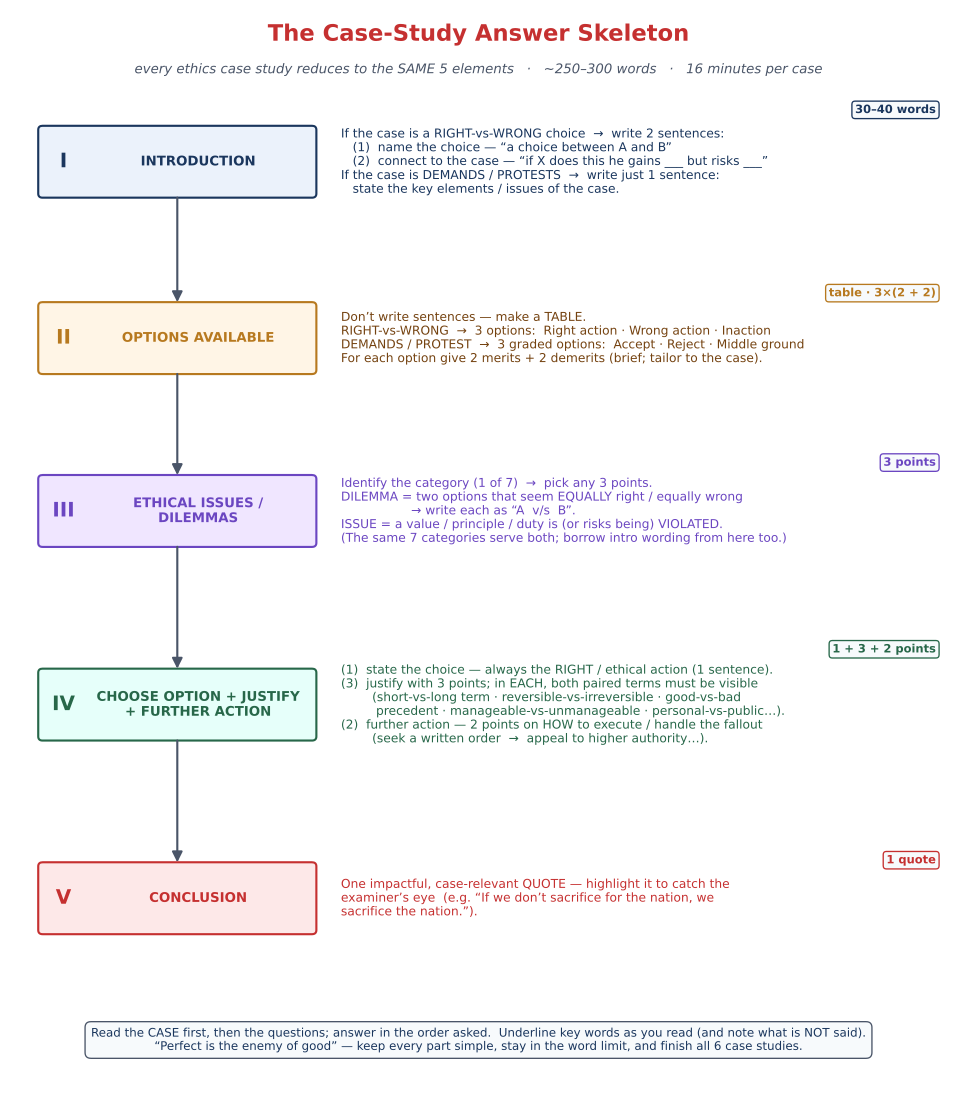
In words, so the note is complete without the image:
- Introduction (30–40 words). If the case is a right-vs-wrong choice → 2 sentences (name the choice; connect it to the case). If the case is about demands/protests → 1 sentence (state the key issues).
- Options available (a small table, not sentences). A right-vs-wrong case has 3 options — Right action, Wrong action, Inaction — each with 2 merits + 2 demerits. A demands/protests case has 3 graded options — Accept, Reject, Middle ground.
- Ethical issues / dilemmas (3 points). Identify which of 7 categories the case belongs to, then pick any 3 points. A dilemma is written with "v/s"; an issue is a violated value/principle/duty.
- Choice + justification + further action (1 + 3 + 2). 1 sentence choosing the right action; 3 points of justification (each must show both paired terms); 2 points of further/future action (how to execute it).
- Conclusion (1 line). One impactful, case-relevant quote, highlighted.
Total ≈ 250–300 words in ~16 minutes.
CLARIFICATION — you don't have time to "think" in Mains. Unlike a school/college exam where you read a question, pause, recall points, then write, in these three hours there is no time to stop. So the structure must be so automatic that, as you read the case, you are already deciding: how will I open, what fills the middle, how will I close. That is the whole reason for keeping it simple and templated.
4. Element I — Introduction
A case study comes in one of two forms, and the form decides your introduction:
- Form A — a choice between Right and Wrong (the more common form; every student can see which action is right and which is wrong).
- Form B — demands or protests by people (covered in detail under Options; its intro is a single sentence stating the case's key elements/issues).
For Form A, write exactly 2 sentences (30–40 words total):
- Name the fundamental choice — "This case involves a choice between ___ and ___." You are free to phrase the two poles however you like: nation vs family, personal responsibilities vs professional duties, short-term benefit vs long-term harm — all acceptable.
- Connect that choice to the case — say what the protagonist will gain and what he will risk. Crucially, write only one direction and put the contrast word "but" in it: "If X does this, he will gain ___, but will risk ___."
CLARIFICATION — why "but", and why only one direction. The word "but" signals contrast, which is the whole point: in any system that has corruption, if you choose to be honest it will be hard for you personally, but your country and people benefit; if you choose the easy wrong, it may benefit you personally but it is dangerous for the country and the public. That tension is the case. Do not write both directions ("if he withdraws… and if he doesn't…") — that is just repeating yourself and wasting words. Pick one framing with a "but".
CLARIFICATION — don't shrink the case to the individual. Some students wrote an intro that talks only about the protagonist (he'll be affected personally / professionally). Remember the larger level too — his duties, responsibilities, and the impact on public welfare / national security — not just his private gain or loss.
EXAM FOCUS — staying inside 30–40 words. Strong writers often fail here because they can't control their length — they write 60–80 words where 30–40 are required, and then can't finish the paper. The introduction is "nothing great, nothing different": two simple sentences. (Model intros are assembled in the worked cases below.)
TEACHER'S TIP — if your English is weak, borrow the wording for the choice from the dilemmas list. You don't know how to phrase "the choice"? The same pairs you'd use as dilemmas work as the choice — just swap the connector: write "and" in the introduction where you would write "v/s" in a dilemma. E.g. "a choice between family duties and professional duties", "between career advancement and faithful discharge of duties", "between personal interest and national security." Focus on finding the solution, not complaining that your English is poor.
5. Element II — Options Available
When a case asks "what are the options available?", don't write paragraphs or even bullet sentences — make a small TABLE. A point that takes ~100 words as prose collapses to a few words in a table cell; the table also stops you from forgetting an option. Keep cells to brief bullet fragments, not sentences.
For a Right-vs-Wrong case there are always exactly 3 options: the right action, the wrong action, or inaction (doing nothing). For each, give 2 merits and 2 demerits. The handout's generic table (which you then modify to the specific case):
| Option | Merits | Demerits |
|---|---|---|
| Right action | • Justice to professional duties • Promotes public welfare • Job satisfaction | • Endangers personal interests/welfare • Endangers professional advancement • Slippery slope (see below) |
| Wrong action | • Promotes personal interests • Ensures professional benefits | • Dereliction of duties • Detrimental to public welfare • Guilt / troubled conscience • Organizational decay |
| Inaction / delay | • Status quo maintained • Temporary respite | • Problem aggravates • Harms public welfare • Anxiety & fear • Conveys apathy & indifference |
CLARIFICATION — "slippery slope" belongs to the wrong action, not the right one. The handout had a typo placing it under the right action; move it to the wrong-action / further consequences. The idea: once you do a small wrong thing, you cannot stop the slide — the demands only keep increasing.
TEACHER'S EXAMPLE (peer pressure / alcohol): a perfectly decent non-drinker is urged by friends, "just one drink, for our sake." If he gives in to that one in 2026, by 2027 it's two per dinner, by 2028 three — "Sir, three should start in the second year itself." You lose control. TEACHER'S EXAMPLE (the driving licence): you are the DC of a district; an MLA calls for "one small favour" — get a relative a driving licence without the test. It seems harmless, you say yes. Tomorrow he wants a licence to set up an industry; the day after, help clearing a ₹75-crore loan from Punjab National Bank to finance his business. The demands never stop; they only escalate. That is a slippery slope.
CLARIFICATION — inaction is the worst response at a time of crisis. Doing nothing feels safe but "your inaction / delay is a very powerful decision with terrible consequences." Its only merits are a temporary status-quo respite; its costs are that the problem aggravates, public welfare is harmed, you suffer anxiety and fear, and you are seen as apathetic/indifferent. TEACHER'S EXAMPLE (Bhishma & the cheer-haran): in the Mahabharata, Bhishma — respected by everyone, Kauravas and Pandavas alike — sat in the court while Draupadi was being disrobed. He knew it was wrong, yet did nothing; that inaction at a moment of crisis led to a catastrophic war and the destruction of the whole dynasty. At a time of crisis, the impact of doing nothing is almost the same as the wrong action. What is "apathy"? Most Indians walking into a government office feel the staff are not rude, but apathetic — "I don't care; whatever your problem, in one ear and out the other." (e.g. you plead that a family member must be hospitalised, and the clerk simply does not care.) That indifference is the demerit of inaction.
CLARIFICATION — modify the generic table to the case, and write FULL words. The handout table is only your understanding; in the answer you rewrite each cell in the language of the case. "Right action" → "Ramesh does not withdraw the report"; "promotes public welfare" → "national security strengthened"; "endangers professional advancement" → "promotion denied." And although the teacher himself scribbles shorthand on the board (a cross for "withdraw", "NS↑" for national security), you must write formal full words in the exam — "national security compromised", "mother's treatment & children's education disrupted" — because a third-party examiner who didn't sit in this class won't decode your arrows.
CLARIFICATION — can I add a 4th/5th option (e.g. "go to a higher authority")? Yes, you could list more options, but don't — that material belongs in Element IV (further action), where you say "seek a written order; if the senior still refuses, approach the higher authorities." Putting it in Options just makes you repeat yourself. Keep Options to the 3 core choices, brief.
For a Demands/Protests case, the 3 options are graded (this is a negotiation, so offer a graded response):
| Option | Merits | Demerits |
|---|---|---|
| Accept demands | • Agitation subsides • Public will prevails | • Unhealthy precedent • May amount to miscarriage of justice |
| Reject demands | • Resists public pressure • Establishes a strong precedent | • Authoritarian (rule-based) • Lacks compassion/flexibility • Agitation intensifies |
| Middle ground | • Consultative (role-based) • Allows mediation & mutually beneficial dialogue + action • Better understanding / resolution | • Time-consuming; immediate relief unlikely • May require compromising some principles |
EXAM FOCUS — repetition is unavoidable, and that's fine. The merits of one option are literally the mirror-opposite of another's demerits, so a degree of repetition is built into the question itself. Minimise it only by changing your words: "job satisfaction" on one side ↔ "troubled conscience" on the other; "mother's treatment & children's education disrupted" ↔ "domestic life remains undisturbed." The thought stays the same (because the question is repetitive); just vary the wording so the answer at least looks fresh.
TEACHER'S ASIDE — the questions the exam should ask (but doesn't). If the paper truly wanted to test ethics, it would probe the system: why would a senior officer (himself risen over 20+ years) tell a junior to bury a national-security report? How does such a corrupt-yet-"efficient" officer keep rising? Is the judiciary failing? Those expose the real rot — but you do not write them in the answer. He raised it only to show why the standard answer is repetitive and "easy".
6. Element III — Ethical Issues & Dilemmas
A case will ask for either "ethical dilemmas" or "ethical issues" (occasionally either-or). Whichever is asked, write 3 points. First, the distinction:
- Ethical DILEMMA = a situation forcing a choice between two options that seem equally right (or equally wrong). Because both sides pull equally, you write each dilemma with the connector "v/s" in the middle — the "v/s" is the signal that the two are equally weighted.
- Ethical ISSUE = a situation where a value, principle or duty is being violated, or is at risk of being violated. No "equally balanced" tension — just a violation.
TEACHER'S EXAMPLE — what a dilemma feels like (the resignation question). A working professional (on ₹1.5 lakh/month, enjoying her private job) asks him on 1st January: "Should I resign and study full-time for the civil services, or keep the job and balance both?" He is instantly in a dilemma. His instinct is "resign and focus fully" — but the moment he says it, he remembers the exam is so unpredictable that even the hardest workers sometimes never clear it; if she resigns, studies three years, fails, she may not get an equally good job back. Resign vs balance — both options seem equally reasonable. That is a dilemma.
TEACHER'S EXAMPLE — a dilemma still has a right answer ("Duty comes first"). Some students confuse "dilemma" with "no correct choice." Wrong. Ask a child: "Whom do you love more — your father or your mother?" — assume both are listening. Say "father" and your mother is hurt; say "mother" and your father is hurt. That tension is the dilemma, yet you can still choose. One clever student answered "mother" in half a second ("even my father knows I love my mother more") — so the teacher reframed it: "Do you like any girl romantically? Yes? Then — your mother or that girl?" The boy went quiet for five seconds, then answered. That pause is the dilemma. Conclusion: a dilemma means both options seem equally right/wrong, but you still make a choice (how to choose is a later class, Class 11). So "personal interest v/s national security" is a valid dilemma even though duty ultimately comes first.
EXAM FOCUS — to write an ISSUE, name the violated value. Using the same resignation case: if she resigns, the issues (things violated or put at risk) are her financial security, her career progression, and her emotional stability / peace of mind. An issue is simply "value X is violated or at risk."
The mechanical procedure (identical for issues and dilemmas):
- Identify which of the 7 categories the case belongs to.
- From that category, pick any 3 points and write them down.
- You may take all 3 from one category, or 1 each from three different categories — your choice. The examiner has no idea these seven categories exist (only you and the teacher do), so mixing is invisible — but the category you pick must be correct. If you misidentify the category, the whole answer derails.
The 7 categories (a case usually fits more than one):
- Environment
- Unfair orders / pressure from superiors
- Threat to public safety
- Unverified allegations
- Personal or family issues
- Demands / protests by public or employees
- Ethical conduct threatens (your own) survival
TEACHER'S WORKED MAPPING (Ramesh case). Walk the 7 categories like a checklist: environment? No. Unfair orders/pressure from a senior? Yes. Threat to public safety? To some extent, yes. Unverified allegations/rumours? No. Personal/family issues? Yes. Public demanding/protesting? No. Ethical conduct threatening his survival (career)? To some extent, yes. So Ramesh's case lives in categories 2, 3, 5 and 7 — and you simply pull 3 dilemmas/issues from any of them (e.g. two from "unfair orders", one from "personal/family").
TEACHER'S TIP — the handout gives you the words for weak writers. Under each of the 7 categories the handout lists not just dilemmas/issues but three more banks: Problems (vocabulary for "what goes wrong if the wrong thing is done" — maladministration, corruption, nexus, sycophancy, favouritism…), Tools (what the officer can do — seek written orders, appeal to higher authority, whistle-blow, judicial appeal/PIL…), and Laws (POSH Act 2013, Whistleblowers Protection Act 2014, Environment Protection Act 1986…). Use Problems words in your critique, Tools in "further action", and Laws in "suggestions". Study the first 8 pages of the handout until this sits in your head — in the exam you may keep the handout open, but the actual UPSC has no handout, so you must recall it.
CLARIFICATION — borrow these dilemma-pairs for the introduction too. As noted in §4, the very pairs you list as dilemmas ("family duties v/s professional duties") become your introduction's "choice" — just change v/s → and.
7. Element IV — Choosing an Option
When asked "which option should X choose / what should X do?", always choose the right (ethical) action, and write this part in three segments — 1 + 3 + 2:
- State the choice — 1 sentence. e.g. "Ramesh should not withdraw the report." That alone is correct but worth nothing until justified.
- Justify — 3 points. Draw them from the 8 standard justification factors (handout). The strict rule: in each sentence, both words of the chosen pair must be visible.
The 8 factors (each is a pair):
- Short-term and Long-term consequences
- Reversible and Irreversible consequences
- Good or Bad precedent
- Manageable and Unmanageable factors
- Costs/Risks and Benefits
- Legal and Ethical implications
- Certain and Uncertain outcomes
- Personal and Public welfare
So point 1 might read "… because it amounts to sacrificing the country's long-term security for short-term personal benefit" (both "short-term" and "long-term" visible); point 2 "professional setbacks are reversible but a risk to national security is irreversible"; point 3 "*it sets a good precedent and encourages other officials to do the same*". You only need 3 of the 8**.
- Further / future action — 2 points: how to actually do the right thing. In a corrupt system, doing right is hard and you'll meet obstacles, so show how you'd execute it and handle the fallout. When the obstacle is your own senior giving an (legal but) wrong order, the answer comes from Class 3: (a) ask for a written / return order from that senior; (b) if he still refuses, appeal to the higher authorities, emphasising the urgency (e.g. of curbing infiltration / preserving national security). (Do not be needlessly defiant of a senior; escalate properly.)
CLARIFICATION — why "both words must be visible". A third-party examiner must instantly see your logic. One student wrote "you should not withdraw the report because it benefits national security at the cost of personal sacrifice" — the teacher understood it (he taught him), but an outside evaluator might not give marks because the paired contrast isn't crisp. Force both halves of the pair into the sentence so the reasoning is unmistakable. (And when you don't know a word's meaning in class — e.g. "precedent" — take your phone out, look it up then and there, and note it. Students are encouraged to use phones/internet for studies in class, never for social media.)
TEACHER'S EXAMPLE — "manageable vs unmanageable" made concrete. If Ramesh is transferred, how does he manage his mother's treatment and children's schooling? Take the family along; or, since good hospitals/schools exist mainly in that state capital, leave the family there and visit every alternate weekend — difficult but manageable. Whereas a national-security breach from infiltration becomes unmanageable over time. That contrast is the justification.
Ramesh — the three justification points, as finally drilled: (1) Don't withdraw, because it sacrifices the country's long-term security for short-term personal benefit. (2) Personal inconveniences are manageable, but infiltration becomes unmanageable over time. (3) Public welfare must take priority over personal welfare (/ it sets a good precedent for other officials). ≈50 words. Then the 2 further-action points (written order → appeal higher up) ≈25 words.
8. Element V — Conclusion
The conclusion is one line: a single, case-relevant, impactful quote, which you should highlight/underline so it catches the examiner's eye. Nothing more.
TEACHER'S EXAMPLE — Ramesh's conclusion. Quote #10 from the handout: "If we don't sacrifice for the nation, we sacrifice the nation." It fits perfectly — yes, refusing to withdraw the report will cost Ramesh personally and professionally, but that sacrifice must be made, because if we don't sacrifice for the nation, we sacrifice the nation itself. (≈20–40 words with a one-line lead-in.)
EXAM FOCUS — choosing the right quote is a skill (don't just pick one you "like"). A quote you personally love can be irrelevant to the case and earn nothing — relevance to the question is what matters. The handout's page 9–10 carries 50 quotes; the conclusion is where they pay off. If you can't remember a suitable quote, the only fix is to study more / better — there's no shortcut.
TEACHER'S WORKED EXERCISE — picking a quote for the environment case (Case 2). Students proposed quote numbers; the teacher marked each ✓ (good) / ? (not the best) / ✗ (unsuitable) for this particular case, to show how fit, not personal liking, decides:
| Verdict | Quote no. (handout page 9–10) |
|---|---|
| ✓ Good fit | 3 (silence at a moral crisis), 6 (can't live as if we have another planet), 7 (we belong to the earth), 8 (greatest threat = belief someone else will save it), 16 (our lives end when we go silent), 22 (one voice when the world is silent), 27 (recognise a problem before it becomes an emergency), 42 (know the value, not just the price), 46 (the idea that some lives matter less) |
| ? Not the best | 2 (obey conscience or obey the world), 15 (when doubt arises, think of consequences), 21 (no moral authority like sacrifice) |
| ✗ Unsuitable here | 4 (first generation of climate change), 39 (never negotiate out of fear), 41 (a "no" with conviction), 45 (conscience hurts when all else feels good — great for other cases, not this), 50 (prime purpose is to help others) |
TEACHER'S "cup of tea" analogy. Give everyone the same ingredients (the same points) and ask them to make tea — water, milk, sugar, leaves are identical, but how you combine them decides whether the tea is good. Likewise every student has the same handout and points; how you use them earns your marks. This also answers "won't everyone's answer be the same if we all follow the template?" — no, execution differs, just as your Prelims centre/examiner differs and yet results differ by the candidate, not the venue.
9. Worked Case 1 — Ramesh
CASE (Mains 2022). Ramesh, a State Civil Services officer, is posted — after 20 years' service — as Director, Home Department, in the capital of a border state. His mother (recently diagnosed with cancer) is admitted in the city's leading cancer hospital and his two adolescent children have got into one of the best public schools. He receives a confidential intelligence report that illegal migrants are infiltrating from the neighbouring country; on a personal surprise check he catches two families (12 members) who infiltrated with the connivance of border security personnel, and finds their Aadhaar/Ration/Voter cards are forged and they are settled in a particular area. Ramesh submits a detailed report to the Additional Home Secretary, who a week later orders him to withdraw it, saying "the higher authorities are not happy", and warns that failure to withdraw will cost him this prestigious posting and his due promotion.
Reading the case — significance of each detail (the teacher quizzed every phrase): 20 years = he's a senior, experienced officer, not a junior. Border state = a sensitive posting; his decisions affect neighbouring countries too. Capital city = better education, healthcare, transport, banking — exactly the facilities his mother and children now need. Mother + 2 children = 3 dependants (the wife is not mentioned — don't assume one). "Higher authorities are not happy" = whether the senior is telling the truth or lying is NOT conveyed — so don't assume. Withdrawing brings Ramesh a professional benefit (promotion) and a personal benefit (no transfer; mother's treatment and children's schooling continue). The right thing is clear: between country and family, the country comes first → do not withdraw.
Model answer, assembled:
-
Introduction (≈35 words): "This case involves a choice between national security and personal interest. If Ramesh withdraws the report, his family can live in the capital city and he will get a promotion, but this will endanger national security." (Equally acceptable, reversed: "If Ramesh does not withdraw the report, he will be transferred and denied promotion, but this will strengthen national security.")
-
Options (table, modified to the case):
| Option | Merits | Demerits |
|---|---|---|
| Right — does not withdraw the report | • Illegal infiltration & corruption reduce • National security strengthened • Ramesh enjoys job satisfaction | • Transferred; mother's treatment & children's education disrupted • Promotion denied |
| Wrong — withdraws the report | • Domestic life remains undisturbed • Next promotion secured | • Border/national security compromised • Corruption & infiltration aggravated • Ramesh suffers a troubled conscience |
| Inaction — sits on it / delays | • Status quo; temporary respite | • Problem aggravates • Harms public welfare • Conveys apathy |
-
Ethical dilemmas (3, with "v/s"; categories 2 & 5): conflict of duties — family duties v/s professional duties; career advancement v/s faithful discharge of duties; personal interest v/s national security. (≈25 words.)
-
Ethical issues (3; PPT slide, ≈30 words): (i) Dereliction of duties, if the report is withdrawn; (ii) Neglect of domestic responsibilities, if the report is not withdrawn; (iii) Slippery slope, because such demands will only increase in future. (Alternative set from "unfair orders": it demoralises honest officers; creates a toxic work-culture / corruption nexus; starts a slippery slope of blind obedience.)
-
Choice + justification + further action (1 + 3 + 2): Ramesh should not withdraw the report. Because — (1) it sacrifices the country's long-term security for short-term personal benefit; (2) personal inconveniences are manageable, but infiltration becomes unmanageable over time; (3) public welfare must take priority over personal welfare (and it sets a good precedent for other officers). Further action: (a) seek a written/return order from the Additional Home Secretary; (b) if he still refuses, appeal to the higher authorities, stressing the urgency of curbing infiltration.
-
Conclusion: "If we don't sacrifice for the nation, we sacrifice the nation."
-
Q5 (policy measures to combat infiltration) — not templated; depends on your newspaper + GS preparation (e.g. border fencing/tech, biometric de-duplication of IDs, action against colluding personnel, etc.).
10. Worked Case 2 — Fatima
CASE (Mains 2016). Ms. Fatima, a Chemical Engineering Master's graduate and one of the best students of her IIT batch, takes a well-paid job at a prestigious chemical company. She discovers the plant dumps huge quantities of highly toxic waste straight into a nearby river instead of treating it, and that downstream villagers are falling seriously ill without knowing why. She decides to complain to the Central Pollution Control Board (CPCB) but first consults her Senior Manager, who brushes her off — a proper waste-disposal mechanism is "prohibitively expensive", would cut revenues and cause local job losses, and "nobody knows anyway." When she persists she is threatened with termination — devastating, since she is her family's only earner and is repaying an education loan (EMIs).
Reading the case — significance. "One of the best students of IIT" matters: a termination threat is not really a problem for her — a top graduate of a top college will easily get another job. So the real choice is environment vs economics, and you must phrase it with better words: she should choose the environment, because economic losses are reversible but environmental damage becomes irreversible — Fatima can find another job, but the poisoned river, if it continues, cannot be undone. The plant's workers are local, so protecting "jobs" vs "lives" is itself a dilemma (public livelihood v/s public health).
Model answer (the PPT slides shown in class are reproduced verbatim):
- Introduction (34 words; slide): "This case involves a choice between environmental preservation and economic considerations. If Fatima complains about the improper waste disposal, she may lose her job but she will prevent further environmental degradation and protect public health." (Alternative, reversed: "If Fatima does not complain about the waste disposal, she will retain her job but cause further environmental degradation and endanger public health.")
EXAM FOCUS — the word "environment" MUST appear in this intro. The teacher was emphatic: if the word environment is not visible in your introduction for this case, deduct half a mark — in one word this case is about the environment, and "economic considerations" deliberately covers Fatima's job, the other workers' jobs and the company's profitability all at once.
-
Ethical dilemmas (35 words; slide; category 1 — environment): i. Preservation of the environment v/s profitability of the company. ii. Health of the people v/s loss of their livelihoods. iii. Short-term financial considerations v/s long-term ecological and health crisis.
-
Choosing an option / justification (slide — "Fatima must complain to the CPCB because:"):
| Reason (factor) | Point in the answer |
|---|---|
| Short-term & Long-term | Short-term economic benefits must not cause long-term ecological catastrophe. |
| Reversible & Irreversible | Job losses are reversible, but environmental degradation can be irreversible. |
| Good or Bad precedent | It establishes a good precedent and promotes a circular economy. |
CLARIFICATION — "circular economy" (asked of a Geography-optional student). Instead of abandoning/discarding the waste or by-product a process generates, you feed it back into future production cycles — reuse rather than dump. That is a circular economy, and it's the constructive fix the company should have adopted instead of dumping in the river.
-
Conclusion: pick one environment quote (see the ✓ list in §8 — e.g. #8 "the greatest threat to our planet is the belief that someone else will save it", or #6, #7, #16, #22, #27, #42, #46).
-
Q5 (steps to prevent industrial pollution of water bodies) — again not templated; draw on your environment/GS prep (strict CPCB/SPCB enforcement, Polluter Pays, EIA & environmental audit, real-time effluent monitoring, etc.).
11. Case 3 — Rakesh (left for practice)
This is a demands/protests case (Form B → use the graded Accept / Reject / Middle-ground options table, and a 1-sentence introduction). The teacher ran out of time and will upload a video solving it; attempt it yourself first.
CASE (Mains 2022). Rakesh, Joint Commissioner of a city Transport Department, must decide a 10-day-old strike by the Drivers' Union. A bus driver (Bus No. 528) died after an on-road altercation with a car driver near a busy intersection: a fight broke out, blows were exchanged, both were badly injured; the bus driver succumbed, the car driver recovered. Police investigation found the bus driver had started the quarrel and resorted to physical violence. The management is considering denying extra compensation to his family. The deceased (52) was the sole earner, survived by a wife and two school/college-going daughters. The Union demands (a) extra compensation as given to other on-duty deaths, and (b) a job for one family member; with no favourable response it struck work, and the deadlock continues.
Questions: (i) options for Rakesh + critical evaluation; (ii) ethical dilemmas faced by Rakesh; (iii) ethical issues involved; (iv) course of action to defuse the situation.
HOW TO APPROACH (from the method): the crux is objectivity v/s compassion — the family deserves sympathy (sole earner, two daughters), but the deceased was at fault (he started the violence), so paying full "on-duty death" compensation could set an unhealthy precedent / miscarriage of justice. Hence a middle-ground, consultative resolution (some humanitarian relief / ex-gratia without endorsing the fault, dialogue with the Union to end the strike) typically fits a demands case better than a flat accept or reject.
12. Reference Bank from the Handout
The teacher told students to study the first 8 pages of the handout until this is in their head. Reproduced here so the note is self-contained. Use Problems words in your critique, Tools in "further action", Laws in "suggestions".
The 7 categories — Ethical DILEMMAS (write with "v/s")
| # | Category | Representative dilemmas (pick any 3 across categories) |
|---|---|---|
| 1 | Environment | environmental preservation v/s firm's survival/profitability; preservation v/s displacement & lost livelihoods; public health v/s public livelihood; short-term benefit v/s long-term impact; reversible v/s irreversible impact |
| 2 | Unfair orders / superior pressure | obedience v/s public welfare; career advancement v/s faithful discharge of duties; loyalty to superior v/s loyalty to duties; personal/professional benefit v/s dereliction of duty; harassment/victimization v/s fiduciary responsibility; short-term safety v/s long-term accountability |
| 3 | Threat to public safety | short-term work disruption v/s long-term harm to people; economic cost v/s public lives/safety; cost/profit v/s reputation & credibility; personal/professional gain v/s public welfare; cost of improvement v/s loss of business to competitors |
| 4 | Unverified allegations | morale v/s veracity of allegation; punishment v/s natural justice (right to be heard); person's merit/utility v/s justice/fairness; risk of agitation v/s fairness of decision; objectivity v/s emotions |
| 5 | Personal / family issues | professional duties v/s duty to family; crisis of conscience if either duty is ignored; conflict of duties (domestic v/s official); conflict of interest (personal v/s professional) |
| 6 | Demands / protests | objectivity v/s compassion; insubordination v/s public welfare; public welfare v/s precedent; prompt resolution v/s right precedent; rule-based v/s role-based approach; public order v/s public welfare |
| 7 | Ethical conduct threatens survival | victimization v/s dereliction of duty; career advancement v/s fiduciary responsibility; integrity v/s herd mentality; disillusionment v/s determination; rights v/s responsibilities; rule-based v/s role-based |
The 7 categories — Ethical ISSUES (a value/principle/duty violated)
| # | Category | Representative issues |
|---|---|---|
| 1 | Environment | irreversible ecological damage; air/water/soil contamination endangering public health; loss of biodiversity; depletion of natural resources; violation of forest-dwellers' rights; national interest jeopardising global welfare |
| 2 | Unfair orders / superior pressure | unholy nexus (honest officers victimized, dishonest patronised); demoralised officials; culture of sycophancy/favouritism/nepotism; slippery slope; toxic work culture; violation of fiduciary duty; maladministration & corruption; blind obedience & populism |
| 3 | Threat to public safety | dereliction of duty; misuse of authority/discretion; crony capitalism; damages organisation's image/credibility; vitiates public trust; wastage of taxpayers' money; wilful negligence (risk to life & limb); violation of human/women's/disability/animal rights |
| 4 | Unverified allegations | violates right to be heard; violates natural justice; dampens morale; employee attrition; defamation/humiliation/harassment; discrimination & prejudice |
| 5 | Personal / family issues | dereliction of duty; neglect of domestic responsibilities; guilt & emotional turmoil; nepotism/favouritism; risk of slippery slope; family estrangement/social boycott; personal ethics violating professional ethics (or vice-versa); emotions overpowering objectivity |
| 6 | Demands / protests | use of pressure tactics; insubordination & indiscipline; interferes with natural course of justice; legal v moral duties; threatens public safety & organisational functioning; groupthink / mob mentality; toxic work culture |
| 7 | Ethical conduct threatens survival | risk to life/career/family/reputation; moral turpitude; crisis of conscience (guilt/shame/regret); poor self-esteem; victimization & harassment |
Problems / Tools / Laws bank (vocabulary for the rest of the answer)
- Environment — Tools: cost-benefit analysis, circular economy, Environmental Impact Assessment, environmental audit, Polluter-Pays Principle, environmental stewardship, inter-generational equity, Life-Cycle Assessment, industrial symbiosis, CSR. Laws: Environment Protection Act 1986, Wildlife Protection Act 1972, Biological Diversity Act 2002, NGT Act 2010, Forest Rights Act 2006, CAMPA Act 2016, Public Liability Insurance Act 1991.
- Unfair orders — Tools: appeal to higher authority, seek written orders, whistle-blowing (Public Interest Disclosure), moral suasion/persuasion, law-enforcement, judicial appeal/PIL, courage of conviction, grievance redressal. Laws: POSH Act 2013, OSH Code 2020, SC/ST (Prevention of Atrocities) Act 1989, Whistleblowers Protection Act 2014, IT Act 2000, NHRC, NCW.
- Threat to public safety — Tools: social audit, watchdog (media/NGOs), citizen journalism, civil society, CSR, crowd-funding, volunteers. Laws: Consumer Protection Act 2019, RERA 2016, Right to Service Acts, Food Safety & Standards Act 2006.
- Unverified allegations — Tools: formal/informal enquiry, background check, personnel records, Principle of Natural Justice / Audi Alteram Partem (right to be heard).
- Personal/family — Tools: "duty comes first", introspection, moral compass, fiduciary duty, soul-searching.
- Demands/protests — Tools: graded response, consensus-building, personal assurance, emotional appeal, mediation/negotiation/consultation, collective bargaining, public hearing, zone of acceptance/rejection, change agents, role models. Laws: Essential Services Maintenance Act 1981, Code on Wages 2019 ("no work, no pay"), Public Liability Insurance Act 1991.
- Survival threatened — Tools: courage of conviction, Categorical Imperative, Golden Rule, sacrifice, moral authority, conscientiousness.
50 conclusion quotes (handout pages 9–10)
Full quote bank — click to expand
1. The purpose of life is a life of purpose. — *Robert Byrne* 2. Those who don't obey their conscience will have to obey the world. 3. The worst places in hell are reserved for those who maintain their silence at times of a moral crisis. — *Dante* 4. We are the first generation to feel the sting of climate change, and the last that can do something about it. — *Barack Obama* 5. The price of democracy is eternal vigilance. — *Thomas Jefferson* 6. We can't live on this planet as if we have another one to go to. — *Terri Swearingen* 7. The earth does not belong to us. We belong to the earth. 8. The greatest threat to our planet is the belief that someone else will save it. — *Robert Swan* 9. A nation is defined not only by what it creates, but by what it refuses to destroy. — *John Sawhill* 10. If we don't sacrifice for the nation, we sacrifice the nation. 11. A good settlement is better than a lawsuit. — *Abraham Lincoln* 12. In a gentle way, you can shake the world. — *Mahatma Gandhi* 13. Be the change you want to see in the world. — *Mahatma Gandhi* 14. Happiness is when what you think, what you say, and what you do are in harmony. — *M.K. Gandhi* 15. When doubt arises, think of the consequences. 16. Our lives begin to end the day we become silent about things that matter. — *Martin Luther King* 17. Honesty is the fastest way to prevent a mistake from turning into a failure. — *James Altucher* 18. Trust takes years to build, seconds to break, and forever to repair. 19. However long the night, dawn will break. 20. Great achievements are born of great sacrifices, not selfishness. — *Napoleon Hill* 21. There is no moral authority like that of sacrifice. — *Nadine Gordimer* 22. When the whole world is silent, even one voice becomes powerful. — *Malala Yousafzai* 23. Someone is sitting in the shade today because someone planted a tree a long time ago. 24. We must accept finite disappointment, but never lose infinite hope. — *Martin Luther King* 25. If you want to go fast, go alone. If you want to go far, go together. 26. The world is changed by your example, not by your opinion. — *Paulo Coelho* 27. It is vital to recognize a problem before it becomes an emergency. 28. A leader is not a searcher of consensus, but a moulder of consensus. 29. A leader sees opportunity in chaos. 30. Control your emotions or they will control you. 31. The journey of a thousand miles begins with a single step. — *Confucius* 32. The best time to plant a tree was 20 years ago. The second-best time is now. 33. The essence of patriotism is the sacrifice of personal interest to public welfare. — *J. Nehru* 34. The deepest sin against the human mind is to believe things without evidence. — *Aldous Huxley* 35. There is a higher court than the courts of law and that is the court of conscience. — *Gandhi* 36. Hate the sin, not the sinner. — *Mahatma Gandhi* 37. He who is overly attached to his family experiences fear and sorrow; the root of all grief is attachment, so discard attachment to be happy. — *Chanakya* 38. Never do anything against your conscience, even if the state demands it. — *Albert Einstein* 39. Let us never negotiate out of fear. But let us not fear to negotiate. — *John F. Kennedy* 40. It takes years to build a reputation and a moment to lose it. — *Benjamin Franklin* 41. A "no" uttered with conviction is better than a "yes" uttered to please or to avoid trouble. — *Mahatma Gandhi* 42. It is more important to know the value of something, than just its price. 43. *Dharmo Rakshati Rakshitah* — the law protects when it is protected. 44. He who sacrifices that which is imperishable for that which is perishable loses both. — *Chanakya* 45. Conscience is what hurts when all else feels good. — *Kevin Dutton* 46. The idea that some lives matter less is the root of all that is wrong with the world. 47. An unexamined life is not worth living. — *Socrates* 48. The tyranny of a dictator is not as dangerous as the apathy of a citizen in a democracy. — *Montesquieu* 49. Our greatest glory is not in never falling but in rising every time we fall. — *Confucius* 50. Our prime purpose in this life is to help others. And if you can't help them, at least don't hurt them. — *Dalai Lama*13. Exam Focus & Recurring Traps
- Six case studies = 120 marks; finish all six. One or two brilliant 500-word answers + blanks = zero on the rest. Perfect is the enemy of good.
- Stay in the word budget: intro 30–40; whole case 250–300; ~16 min each. Practise compressing.
- Always give the ethical/moral/ideal answer — never "practical", "radical" or "innovative". Fallback benchmarks: Constitution + public welfare.
- Read the case first, underline as you go, respect what is NOT said — never assume facts (e.g. an accusation ≠ guilt; a senior's claim that "higher-ups are unhappy" may be true or false — unstated).
- Element counts to memorise: Intro = 2 sentences (or 1 for demands); Options = table of 3 × (2 merits + 2 demerits); Issues/Dilemmas = 3 points; Choice = 1 + 3 + 2; Conclusion = 1 quote.
- Dilemma → write "v/s"; Issue → name the violated value. A dilemma still has a right choice ("duty comes first").
- Justification: both paired words visible in every sentence. Pick 3 of the 8 factors.
- Conclusion: relevance beats personal liking when picking a quote.
- The 5th question (suggestions/policy) rides on newspaper + GS prep, not the template.
EXAM FOCUS / PYQ. All three classroom cases are real Mains case studies: Ramesh/infiltration (2022), Fatima/toxic-waste (2016), Rakesh/strike (2022) — strong evidence that the question pattern and even the situations recur, so mastering this template directly translates to marks.
Current Affairs
(Updated as relevant news/magazine content comes in — e.g. real cases of whistle-blowing, industrial river pollution, border infiltration, or transport-worker strikes that can serve as live examples in these answer types.)
| Date | Source | Headline | Connection to this topic |
|---|---|---|---|