Trade Agreements — Benefits, Concerns & Way Forward
GS Paper: III (Economy) | Subject: Economy — External Sector | Teacher: Shubham Raturi | Class: 4 (20-07-2026) | Last updated: 2026-07-20
What this class is. Classes 1–3 built the ladder of economic integration — PTA → FTA → CECA/CEPA → Customs Union → Common Market → Economic Union. This class turns analytical: the teacher set three questions and spent the whole session answering the first two.
- What are the benefits of a trade agreement?
- What issues/concerns arise from it — for the world, and for India specifically?
- What is the way forward — how do we tailor a trade agreement to our own benefit?
On the diagrams: the class was taught on a board and survives as 5 pages of handwritten notes. Following this repo's practice, the clean redraws below are the primary visual and the prose carries all their content; the raw scan stays in
raw/as the faithful backup.On completeness: the recording ends mid-sentence ("So, when COVID happened, most…") during the near-shoring discussion. Question 3 was therefore never taught as its own block — but the teacher gave the solution to each concern as he discussed it, and those are collected in §8 Way forward below, flagged where they are his.
Table of Contents
- Where this class picks up — the integration ladder
- The three-question answer skeleton
- Benefits I — as an EXPORTING country
- Benefits II — as a HOST country
- Benefits III — GLOBAL benefits
- Concerns A — GENERAL issues (any country)
- Concerns B — SPECIFIC concerns (India)
- Way forward
- Exam focus
- Current Affairs
- Cross-GS Linkages / Applications
- Previous Year Questions
1. Where this class picks up — the integration ladder
The teacher opened with a recap, and the recap itself is the frame for everything that follows.
Why trade agreements exist at all. Look at the world from the point of view of trade and things are not in order. There is a kind of disorder — protectionism, isolationism, "more domestic" movements in various countries, and the era of hyper-globalisation that we experienced from the 1990s is winding down. As he put it in an earlier class, we are living through slowbalisation. In this fragmented order the multilateral system — the WTO — is not working well at promoting international trade, and specifically not at promoting trade as a tool of economic development. Countries no longer have the same confidence in doing business under the WTO umbrella; the WTO is "in a kind of rupture".
TEACHER'S EXAMPLE — the sentence to carry into the exam. "Trade is a means, trade is not an end. We are not doing trade to do trade. We are doing trade to achieve something — and the thing we are trying to achieve through trade is economic development, especially of a developing country like ours."
This one line is the spine of every answer in this chapter. Whenever you argue about trade, argue about what the trade is for.
So when multilateralism stalls, an alternative route appears — and that route is the trade agreement. But "trade agreement" is a loose umbrella. There are many ways to integrate economies, and the FTA — the term everyone uses as a catch-all — is only one rung on a ladder:
| Rung | What gets liberalised | Note |
|---|---|---|
| PTA — Preferential Trade Agreement | Selected goods get preferential (not zero) tariffs | The shallowest form |
| FTA — Free Trade Agreement | A substantial number of items liberalised when they cross the border, country to country | The workhorse term |
| CECA / CEPA — "deeper" trade agreements | Goes beyond goods: government procurement, competition policy, intellectual property, investment regime, labour, environment, sustainability standards | The modern default |
| Customs Union | FTA + a Common External Tariff — the bloc has one integrated trade policy | A third country now faces the region as a single unit, not separate countries |
| Common Market | Customs Union + liberalised movement of the factors of production — labour and capital | Factor-policy integration |
| Economic Union | Common Market + harmonised macroeconomic policies | Best example: the European Union |
On CECA vs CEPA — the exam trap. The teacher was explicit: "The difference is not substantial as such — the difference is about degree." CEPA is more comprehensive and broader than CECA, but there is hardly anything that can be in a CECA and not found in a CEPA. In practice the naming is often just a political decision: the same provisions may be called CECA with one country, CEPA with another, and something else entirely with a third — India's deals with the UK, Australia and the EFTA nations all carry different labels. So do not build an answer on the name; build it on what the agreement actually liberalises.
CLARIFICATION — the ASEAN count. The teacher noted mid-sentence that ASEAN "is now 11". Verified: Timor-Leste became ASEAN's 11th member on 26 October 2025 at the 47th ASEAN Summit in Kuala Lumpur — the bloc's first expansion since Cambodia joined in 1999. When you write about RCEP negotiations, however, ASEAN was still 10.
2. The three-question answer skeleton
Everything in this class hangs off one structure, and the structure itself is the deliverable — because, as the teacher stressed, the same skeleton answers several differently-worded questions: "benefits of trade", "benefits of a trade agreement", and "benefits of economic integration" all take almost the same answer; you only swap the terminology here and there.
DIAGRAM (board): the master map the teacher drew at the top of the class — the three branches, and the sub-branches under Benefits and under Concerns.
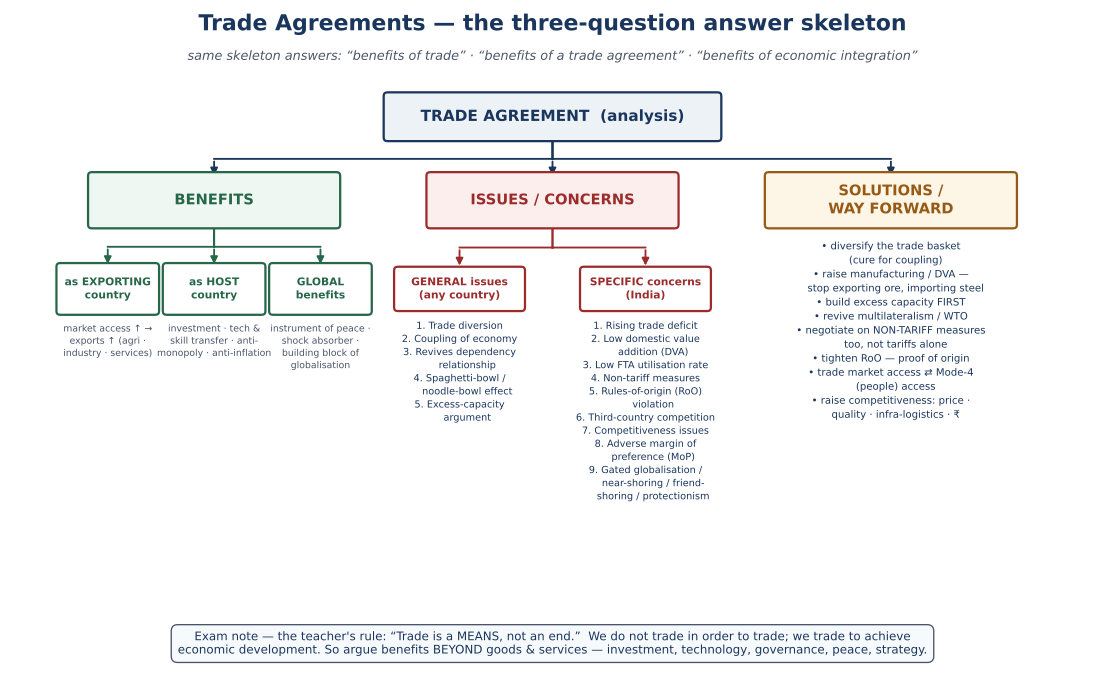
In prose, the skeleton is:
- Benefits, split three ways — as an exporting country, as a host country, and global benefits.
- Issues / concerns, split two ways — general issues (which any country signing any agreement can face, India included) and specific concerns (why India is not capitalising on its agreements).
- Solutions / way forward — how to tailor an agreement for our own betterment.
EXAM FOCUS / PYQ. The teacher's advice on why this three-way split of benefits matters: when you argue about trade, do not limit your lens to trade. Trade moves goods and services, yes — but it also moves investment, technology, skills, governance standards, and strategic goodwill. An answer that only talks about exports has missed most of the marks. "There are external benefits which you can derive by using trade as an instrument."
3. Benefits I — as an EXPORTING country
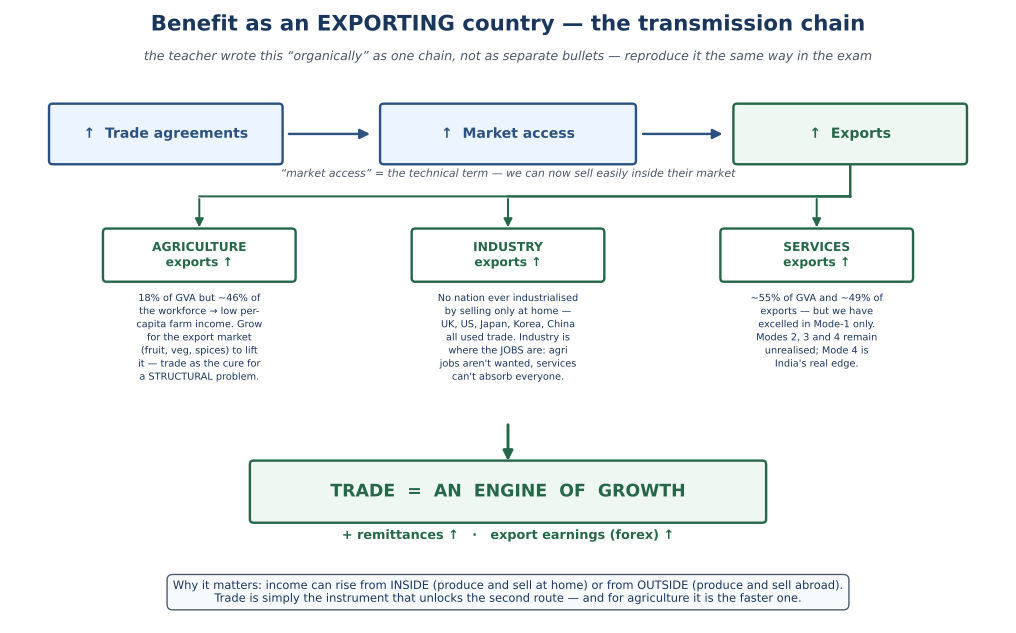
TEACHER'S EXAMPLE — how to write it. He deliberately dictated this section as one organic chain rather than as separate bullets: "I can dictate the points one by one — but if you write it organically, it will be easier to remember first, and then to reproduce in the exam." Reproduce it as a chain.
DIAGRAM (board): the transmission chain from more agreements through to growth.
3.1 The chain
An increasing number of trade agreements leads to an increase in market access; increased market access leads to an increase in exports.
Market access is the technical term used specifically in trade discussions — it means we can now sell our goods easily inside their market. The teacher's live example: the UK has cut tariffs on almost 99% of goods for us, so it is now genuinely easier to export there.
CLARIFICATION — the 99% figure, made precise. Under the India–UK CETA, India secured immediate duty-free access on 99% of tariff lines, covering nearly 100% of trade value. Conversely the UK got immediate duty elimination on 96.8% of India's tariff lines, covering 97.7% of UK trade value. So "99%" is right, but it is India's gain on the UK side — quote it that way.
And this increase in exports can come from the three sectors of the economy — agriculture, industry and services.
3.2 Agriculture exports — trade as the cure for a structural problem
India's agriculture has many problems, but the major one is structural: roughly 18% of GVA is contributed by agriculture while about 45–46% of the workforce is employed in it. That mismatch — a small share of income divided among a huge share of workers — is precisely why per-capita farm income stays low.
There are two possible solutions. One is to fix the domestic issues in agriculture. The other, the teacher's argument here, is: why not use trade as the instrument to solve agriculture's problem? Ask farmers to grow the varieties we can market outside — perishables and non-perishables, fruit and vegetables — and sell them into the countries we have agreements with: the UK, UAE, Oman and others. That lifts farm income from the outside.
TEACHER'S EXAMPLE — the underlying logic, in his words. "Whenever you have to increase your income, either income can increase from inside or from outside. Either you produce more and sell within the country, or you produce more and sell outside the country. Trade allows us to produce more and sell outside — and increase the farmer's income within the country."
CLARIFICATION — verified data. Economic Survey 2025-26: agriculture and allied activities account for 46.1% of the workforce while contributing roughly one-fifth of national income. The teacher's "18% and 45%" is essentially correct — quote ~18% of GVA, ~46% of the workforce in the exam.
3.3 Industrial exports — no nation ever industrialised by selling only at home
TEACHER'S EXAMPLE. "No country has ever become industrialised by being self-reliant — that is, by selling things within the country. Every country has used the instrument of trade." The East Asian nations — China, Japan, Korea — and before them the US and UK in their time: every one of them climbed the industrialisation ladder only through the instrument of trade. The problem is that trade was easy to do earlier; today the scenario has changed, so you cannot carry out increasing trade without trade agreements.
Industrialisation matters because that is where most of India's economic problems get solved:
- Problem 1 — we are not producing enough. That cannot be solved by agriculture; it is solved by industry.
- Problem 2 — we are not creating enough jobs. This cannot be solved in agriculture, because we do not want more agricultural jobs. And it cannot be fully solved by services either, because services cannot absorb everyone — services carry a higher benchmark, they demand higher-order skills, and you cannot give all the people that skill at one go. So most of the jobs will have to be created by industry.
And again — you cannot industrialise by producing and selling only within India. You have to sell outside. So the question becomes: how do you make the world more hospitable for your economy? By signing more trade agreements.
3.4 Services exports — and the four GATS modes
Here the teacher made his sharpest argument. We take great pride in services: roughly 55% of GVA comes from the service sector, and services are close to half of our exports — the split is broadly 52% merchandise / 48% services. Most of that success came in a short window after the 1991 reforms.
CLARIFICATION — verified split. FY 2025-26 (PIB/Commerce Ministry): merchandise exports US$441.78 bn, services exports US$418.31 bn of a total US$860.09 bn — a 51.4% / 48.6% split. The teacher's 52/48 is accurate.
But — "we are not fully realising the potential of services in India." Why? Because of the four modes.
NCERT BASE / WTO BASE. Under the General Agreement on Trade in Services (GATS) — an agreement inside the WTO — services trade is divided into four modes. The teacher was careful to flag this is not a coaching invention: "I am not making this artificial creation by myself — according to the WTO we can say four parts."
DIAGRAM (board): the four modes, with the teacher's examples and his verdict on each.
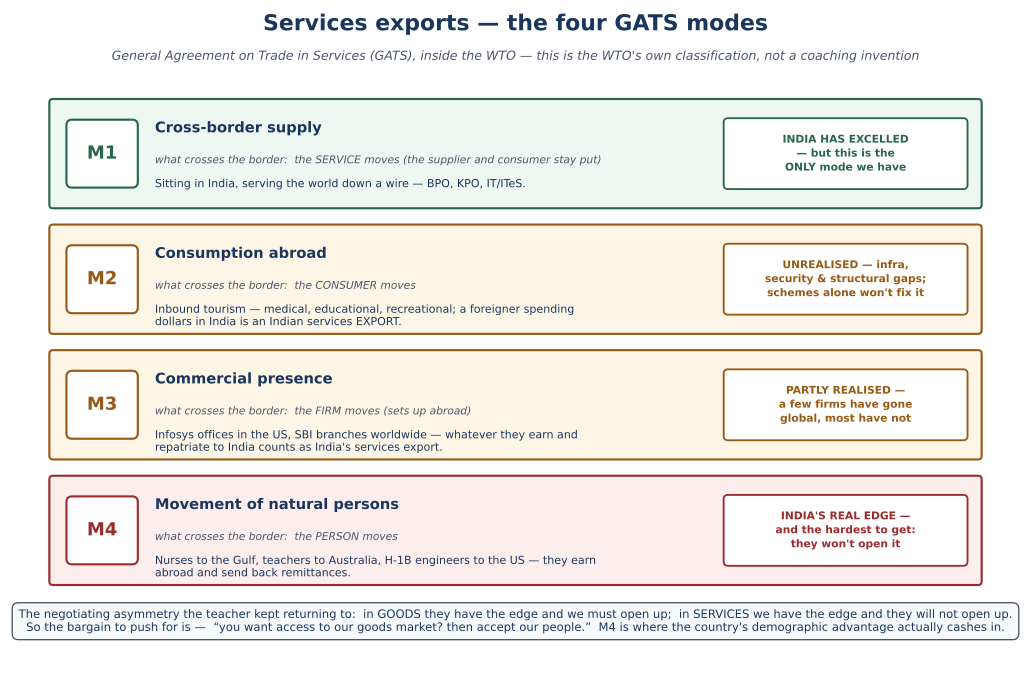
| Mode | Name | What crosses the border | Teacher's example | India's position |
|---|---|---|---|---|
| Mode 1 | Cross-border supply | The service moves | Sitting in India and providing services to the rest of the world through telecommunication — BPO, KPO (knowledge process outsourcing), IT/ITeS | Excelled — but this is the only one |
| Mode 2 | Consumption abroad | The consumer moves | Tourism — outbound and inbound; medical, educational, recreational | Largely unrealised |
| Mode 3 | Commercial presence | The firm moves | Infosys offices in the US; SBI branches across the world — what they earn and repatriate counts as India's services export | Partly realised |
| Mode 4 | Movement of natural persons | The person moves | Nurses to the Gulf, teachers to Australia, H-1B engineers to the US — they earn there and send back remittances | India's real edge — and the hardest to obtain |
The counter-intuitive bit — inbound tourism is an export. The teacher spent time here because students get it wrong. If people come to India and spend dollars here, that is an Indian services export, even though the physical movement is inward.
TEACHER'S EXAMPLE — the accounting rule, in one line. "Jo bhi foreign exchange earn karega, uska export consider kiya jaayega." Whichever country earns the foreign exchange — that country's export it is. If Indians go to the Maldives, it is a Maldivian export. If foreigners come to India, it is India's export.
He then linked it straight to a PYQ: in 2010 India hosted the Commonwealth Games; players, organisations and spectators came, stayed, and exchanged dollars for rupees. UPSC asked whether that counted as a service export. It does — as Mode 2, consumption abroad. (Verified: UPSC Prelims 2011, answer (a) Export. See §12.)
Why Modes 2, 3 and 4 have not delivered.
- Mode 2: people are not that interested in coming to India as a tourism hub. There are structural reasons, infrastructure reasons and security reasons. We have the campaigns — Incredible India, Swadesh Darshan — "but simply the schemes will not solve the problem. There are ground problems you have to be sorry about."
- Mode 3: some companies have gone outside exceptionally well, but many are not able to become service providers across the world.
- Mode 4: "the only advantage that we have as of now in the world is our people." People are our most advantageous resource — provided they get skilled, especially higher-order skills, and pick up basic English, because most of the income sits in English-speaking countries. If they accept us, that is a very big thing.
But they increasingly will not. In a world where protectionism is rising, countries are reluctant to assimilate people from other cultures. They feel Indians are a threat to their own economic future — because Indians will go there and work even at lower wages. Cultural nationalism has emerged everywhere; every country wants to preserve its culture. This was always present, but it intensified after the 2008 global financial crisis and especially after the COVID pandemic — everyone now wants to protect their own interest, and one convenient banner for that is culture.
TEACHER'S EXAMPLE — the trade-off to write in a Mains answer. "We want it, but they are not willing. So we have to ask them to do it by telling them: let's have a deal. We'll give you the market for goods; you give us the market for services." And he named the asymmetry precisely: "In goods, we don't have the edge — they do, and they get access. In services, we have the edge — and they don't give us access." So whenever an agreement is being negotiated, ask: what are we committing, and what are we getting back? One of the things we must get back is Mode 4.
And when Mode 4 is conceded, it comes fenced. They set benchmarks — "we will accept only the highly talented people from your country" — typically from STEM fields and medicine. So the people who move out are the cream of the nation.
TEACHER'S EXAMPLE — the brain-drain digression (he was asked about it directly, and answered at length). "Recently more than 100 scientists from ISRO have resigned. There is hardly any debate about it. Newspapers printed something, but there is no national debate — how does a public-sector organisation lose more than 100 scientists within a month? What is that? Brain drain."
His verdict was deliberately qualified, and the qualification is the exam-worthy part: "If you ask the simple question — is it good for the economy? — no, it is not. But if you ask me in context: somebody has a brain and is not getting the opportunity to use it, and that brain gets utilised after moving outside — then it is good. Brain drain is always better than brain in the drain."
He extended it to his own students: many people in India are talented but never get the opportunity to showcase it — those who could not crack UPSC are not fools; those who could not make it to AIIMS or a government medical college, or to the IITs, are also good — "most scientists are from non-IIT institutions". They may simply not have been at the right place at the right time. So the moral he drew: individuals decide from their own perspective; institutions have to decide from the country's perspective — and institutions must create incentives good enough that people get better jobs and opportunities here. You cannot expect an individual to sacrifice for the nation while the system does nothing.
(Verified: reported ~18 July 2026 — over 100 Group 'A' scientists and technical staff sought VRS or resigned; roughly 80 from the UR Rao Satellite Centre, Bengaluru and 20+ from the Vikram Sarabhai Space Centre, Thiruvananthapuram. Drivers: private space/defence firms paying multiples of government pay, plus bureaucratic work culture and mission delays. The Department of Space has since withdrawn Centre Directors' delegated power to accept such resignations.)
And it should not only be the cream. The teacher pushed the argument further: why only the highly skilled? Why not move construction labour too?
TEACHER'S EXAMPLE — Israel. Mainland Israel used to get cheap construction labour from Palestine and Gaza. After the October 2023 attacks they barricaded that route on security grounds — and Indian construction workers filled the gap. "I was listening to a discussion — in India they were earning ₹15,000–20,000. There they are earning ₹1.5 lakh, because there is a risk premium. Out of that, ₹50,000 covers expenses — they live in shared accommodation, 10–20 people together — and ₹1 lakh they send back home." Yes there is risk, but there is a huge gain.
The government is trying: there are skilling schemes designed to place people abroad, and agencies are told they must place candidates — either within the country or outside. "But the point is, other countries are not that welcoming. They welcome only a certain set of people — the highly skilled. What about the masses? That is what we have to use as a tool: if you want market access, accept our people first."
CLARIFICATION — the scheme's name. The teacher called it "Rashtriya Kaushal Vikas Yojana". The correct name is the Pradhan Mantri Kaushal Vikas Yojana (PMKVY), launched 2015 by the Ministry of Skill Development & Entrepreneurship, now in its 4.0 phase, with training under the NSQF and placement assistance by training partners. Its overseas-mobility arm is real and directly supports his Israel example: in November 2023 MSDE signed an MoU with Israel enabling skilled mobility in exactly two sectors — construction and home-based caregiving.
3.5 What the whole chain adds up to
By signing more agreements you get greater market access and higher exports; through that you address agriculture's income problem, industry's structural problem and services' unrealised potential. All three are the economy. So:
trade agreements → economic growth rate ↑ → trade acts as an engine of growth.
And beyond that, going outside also brings remittances ↑ and export earnings / foreign exchange ↑.
4. Benefits II — as a HOST country
This is the second and less obvious branch, and the teacher was insistent on it: even if you are not exporting anything, merely by being part of a trade agreement you become a beneficiary. Trade is not only about the movement of goods and services — it also moves investment, it moves technology, and it even moves policy.
1. Investment increases. When you sign an agreement, the partner may commit capital.
TEACHER'S EXAMPLE — EFTA. "When we signed the trade agreement with the EFTA nations, they committed that in the next 15 years they are going to bring in US$100 billion as investment in your country. That commitment is in it. They also committed to create a certain number of jobs."
The mechanism matters more than the number: "We ask them — we are going to give you access to our larger market, only if you make certain commitments, and the whole trade agreement rests on those commitments. Unless they are fulfilled, you cannot expect the agreement to move. We are making trade a bargaining tool: we are giving you the market — what are you putting on the table?"
(Verified: India–EFTA TEPA, signed 10 March 2024, in force 1 October 2025. EFTA = Switzerland, Norway, Iceland, Liechtenstein. Under Article 7.1 the four states committed US$100 bn of FDI and 1 million direct jobs over 15 years — US$50 bn in the first 10 years, US$50 bn in the next 5. This is the first binding investment pledge of its kind in any Indian FTA.)
2. Technology transfer. When these companies come in, they bring their own technology — "and once the technology comes in, it is very difficult not to allow it to be absorbed into the domestic economy." If Swiss firms with better technology set up units in India, the people working with that technology will not be Swiss nationals — they will be Indians. So the technology gets diffused and absorbed here.
3. Skill transfer. Same logic: the people working in those firms acquire skills — "and once they have got the skill, they can work for them, and they can also work for Indians."
4. Trade agreements act as an ANTI-MONOPOLY tool and foster competition. Suppose in India there is only one producer of product X. How do you bring in more competition? By signing a trade agreement — producers from the rest of the world come in and challenge that producer's dominance. Competition increases, the monopoly is broken, and the consumer gains.
5. Trade agreements act as an ANTI-INFLATIONARY tool. (The teacher explicitly linked this back to the previous chapter on inflation.) An agreement increases the availability of goods and the supply within the country — because now the country gets not only what is produced domestically but what is produced across the world.
TEACHER'S EXAMPLE — pre-1991 India, at length. Before 1991 we hardly traded, because we operated a closed-economy model and were not interested in free or foreign trade. All of it — the foreign trade policy, the export-import policy — came only after the 1991 reforms. So what existed before? A limited number of companies producing goods, largely public-sector ones, which were quite inefficient and produced little, at very high cost.
The consequences were concrete: "It was very difficult to get a telephone connection. It was very difficult to buy a scooter. It was very difficult to buy a car. You had to wait for years — sometimes decades — for a telephone connection." Many things were in chronic short supply.
After 1991 production capacity rose and supply increased — "but from where did this supply come? Some from within the country, but much of it came because we integrated with the rest of the world — many supplies also came from outside, and on easier terms." That is trade acting as an anti-inflationary tool.
6. Job creation increases — because when trade brings investment in, employment follows.
EXAM FOCUS. The teacher's framing of this whole section: these benefits are not derived by exporting. "It is a kind of benefit we derive from the trade agreement by being part of the trade agreement — and these things come to us automatically."
5. Benefits III — GLOBAL benefits
The third branch: when two (or many) countries come together, the benefits are not confined to the signatories. Other countries and the world as a whole can benefit too — what economics calls externalities or spillover effects.
5.1 Trade as an instrument of peace
TEACHER'S EXAMPLE — the academically sound version. He first offered the hypotheticals — if the US and China signed a trade deal, if Iran and Israel found some positive change, would that not settle a great deal beyond trade? — then gave the rigorous version:
"Look at China and the US. They have many conflicts — economic conflicts, political conflicts, philosophical and ideological conflicts, because one is more controlling in the nature of its state and the other is more liberalised. And yet they don't fight with each other. Why? Because both of them are dependent on each other. For China, the US is the largest market. For the US, China is the largest supplier. And what is binding both of them? Trade."
The general principle: once you have a trade agreement with each other, the incentive to fight has already gone down. That is why it is said that if you want to improve an overall relationship, the first step you can take is to start trading — the moment you begin trading, other incentives fall into order.
TEACHER'S QUOTATION — worth memorising for essays and Mains intros. "If goods don't cross the border, then soldiers will." So if you want to stop soldiers crossing the border, let the goods move easily.
5.2 Trade as a shock absorber for the global economy
Not every part of the world grows at the same pace. If India faces a domestic problem — growth is not coming, per-capita income is weak, demand is soft, there are early signs of recession — and we are well integrated with the world, then we can produce here and sell across the world. The rest of the world becomes a springboard for our growth.
TEACHER'S CLARIFICATION (he re-explained this on a student's question). "Growth can either come domestically or it can come from outside. If you are not able to grow domestically, you can take the help of external factors — you can use the other part of the world as a springboard. Suppose you are well connected with the US and the US is your large market: if growth is not coming from India, we can cool all this down by exporting more to the rest of the world. In normal circumstances it can help; in adverse circumstances it can be much more helpful."
5.3 Trade agreements as a building block of globalisation
Globalisation is already fractured; not every country will come under the WTO umbrella immediately, because there is a lack of confidence and trust between nations. So the problem cannot be solved by all countries together at once. It can be solved in bits and pieces — and the bits and pieces are the trade agreements.
Five countries come together and sign; ten others do the same; twenty more do the same. Over time these groups can sign with other groups, and the whole thing can build up until multilateralism itself is revived. The teacher was careful to flag that this is contested — "some people criticise this; there is a whole theory that if you have to build back multilateralism, you should not use the instrument of trade agreements. We will write that point as a concern." But many people do see trade agreements as a building block of globalisation, and there is some truth in it, so you can write it as a positive point. (The counter-argument arrives in §6.4.)
6. Concerns A — GENERAL issues (any country)
The taxonomy: general issues are those any country signing any agreement can face — including India. Specific concerns (§7) are the ones pinching us.
6.1 Trade diversion (and its twin, trade creation)
Every trade agreement can have two effects — and both terms must appear in your answer.
DIAGRAM (board): the A–B–C triangle the teacher drew, plus both dictated definitions.
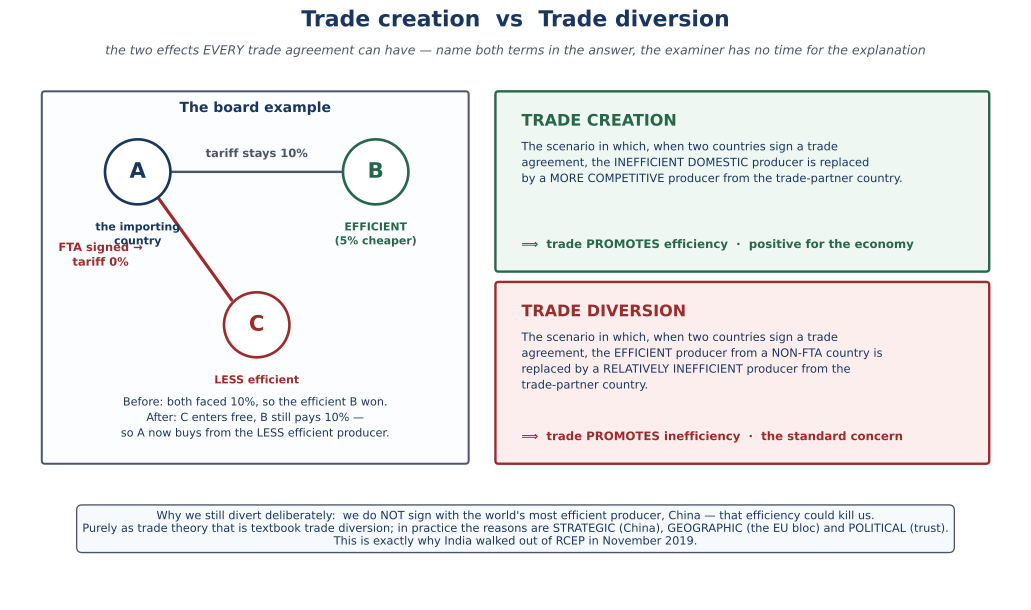
The board example, in prose. Country A imports. Country B is the efficient producer — 5% more efficient than country C. Initially both B and C face a 10% tariff in A, so B, having the efficiency advantage, sells more to A. Then A signs a trade agreement with C. Now C's goods enter A free, while B's goods still face the 10% tariff. The result: A now buys from the less efficient producer. The agreement has "penalised the efficient producer".
The dictated definitions — write these verbatim.
Trade creation — "It is the scenario in which, when two countries sign the trade agreement, the inefficient domestic producer is replaced by a more competitive producer from the trade-partner country." → trade promotes efficiency; positive for the economy.
Trade diversion — "It is the scenario in which, when two countries sign the trade agreement, the efficient producer from a non-FTA country is replaced by a relatively inefficient producer from the trade-partner country." → trade promotes inefficiency; this is why the term sits under concerns.
Why it is called diversion: because the agreement is diverting trade away from the efficient producer to the inefficient one.
TEACHER'S EXAMPLE — the short-term vs long-term lens on trade creation. Seen through a narrow, short-term lens, a domestic producer will not want a free trade agreement — "he was inefficient, but he was my producer." That was exactly India's policy before 1991: we wanted to protect our producers even at the cost of inefficiency in the economy, so we never went for free trade or trade agreements. After 1991 we changed — because by protecting the interest of a few producers we were killing the interest of the larger economy. When competition comes in, the domestic producer is forced to pull up his socks and produce more competitively. "When you bring in competition, the foreign firm is already competitive — but even the others become more competitive, so as to fight with them."
And here is the sharp bit — India diverts trade deliberately.
TEACHER'S EXAMPLE — why we don't sign with China. "If India has to sign a trade agreement with any country so as to promote the efficiency of the economy, then that country should be China — China is the most efficient in the whole world. But still we are not signing a trade agreement with China. Why? Woh bhi efficient hai — but that efficiency might kill us. We have strategic reasons not to sign."
"If you see purely from the perspective of international trade theory — not bringing in any nationalistic argument — the best thing should be that we sign with the most efficient country. Instead we give an easier pass to less efficient countries. So we are, in a way, theoretically resorting to trade diversion. You will not write that we are doing it — but understand that we are."
The three reasons a country diverts trade on purpose:
- Strategic — the India–China case above.
- Geographic — "If you are a member of the European Union, even if you are inefficient, you will still get greater market access to the German, Italian or French market than India will." Belonging to the geography is itself a preference.
- Political — "You are efficient, so what — my dear vision? If you don't have that much political trust, why should we do it?"
TEACHER'S EXAMPLE — RCEP, told at length. "From 2010 till 2019 we were discussing a trade agreement called RCEP — Regional Comprehensive Economic Partnership, between 16 countries: the 10 ASEAN nations plus Australia, New Zealand, China, India, Japan and Korea. We discussed it for almost a decade, and at the end, when the agreement had to be signed, we said we are not going to become a member."
He was blunt about the sunk cost: "You spent 10 years, you spent the resources and money of the country, you spent the diplomatic capital — many people went there to discuss it — and by the time it came to sign, we said no. We even flew all the way to the ASEAN nations and then came back."
Why we walked out: "Because China was sitting there. The real reason was this: China would have gained access to the Indian market, and China would have destroyed all our ambitions of becoming a manufacturing power. Those ambitions would have evaporated within a second, because China would have offloaded onto our market — so much, at such low cost and high quality, that no producer would have been able to compete."
And New Zealand too: "Australia and New Zealand were also sitting there. New Zealand is a dairy power, and farmers in India get whatever poultry and dairy income they get from that sector. If we signed with New Zealand and they got market access for agriculture, that would be quite against the interest of our farmers." So by joining, "you would have almost signed the death letter of the economy" — because New Zealand is very efficient in dairy and China is very efficient in manufacturing. We intentionally walked out.
(Verified: RCEP negotiations were formally launched in November 2012, not 2010 — see the clarification below. India walked out on 4 November 2019 at the Bangkok summit. RCEP went ahead with 15 members, was signed in November 2020 and entered into force 1 January 2022. India had a trade deficit with 11 of the 15 members. And his dairy point is confirmed by what happened next: the India–New Zealand FTA signed 27 April 2026 excludes dairy almost entirely — India protected the sector exactly as he said.)
CLARIFICATION — RCEP dates. The teacher said the discussion ran "since 2010". RCEP negotiations were formally launched at the ASEAN Summit in Phnom Penh in November 2012 (the concept was floated in 2011). Use 2012–2019 in the exam.
6.2 Coupling of economy
The mirror image of the "shock absorber" benefit. If you are too integrated, you get the positive shocks — but you also get the negative ones.
The dictated definition — verbatim. "Coupling of economy is a situation in which the economic prospect of one country is interlocked with the economic prospect of a trade partner."
If there is a global recession and you depended heavily on that market, they will not be able to buy that much from you — their problem becomes your problem.
TEACHER'S EXAMPLE — India and the US. "About 20% of India's exports go to the US. If anything happens there — suppose a recession — we are going to get impacted, because their incomes get sacrificed and of course they will demand less from India. If they have political disturbances, like right now with Trump, we get impacted. Even if we don't want a relationship with them, we still have to keep them."
He extended it: "Canada — more than 75% of exports go to the US. Mexico — more than 80%. That's why they are so interested in having a good relationship with the US: because the economic interest resides there. That is coupling."
And then the crucial asymmetry, which is where this becomes a negotiating point:
TEACHER'S EXAMPLE — the bargaining-power argument. "Suppose our economy is so coupled to the US. But is the US economy coupled to us? For us, they are 20%. For them, our market is less than 2%. So they are not so interested in having a good relationship with us — and that is what is impacting the negotiation in the trade agreement, because you know where the bargaining power lies."
"They talk of a 500% tariff, then say they'll impose 100%, then say okay let's do a trade agreement — now how much less than 100% will I go? They put the bar very high and then bargain down from there. Why can they do it? Because they know the power relationship. They cannot do it with China. But with countries like India, Canada, Mexico, Japan, Korea and the European nations, they give the same treatment — because they know: I am more powerful compared to them."
CLARIFICATION — the two percentages. Verified for 2025: US goods imports from India were US$103.8 bn, which against India's FY26 merchandise exports of US$441.78 bn is roughly 23% — so "20% of exports go to the US" is sound. On the other side, India is a low single-digit share of total US goods imports. The teacher's "less than 2%" understates it slightly (it is nearer 3%), but the asymmetry he is drawing — roughly 20% vs roughly 2–3% — is real and is the point.
And coupling has a sovereignty dimension. The teacher extended the argument himself: "Don't you think such a relationship can pinch on the sovereignty of the country? A trade agreement can act as a tool to violate sovereignty. What is sovereignty? Freedom to take action for your nation. Your options get constrained when you have too much of an uneven trade relationship — and if your trade partner is able to find that out, the person can compromise your sovereignty. The basic meaning of not being sovereign is that you are not able to take the best decision for your nation; you are taking decisions under pressure."
6.3 It can revive the dependency relationship
DIAGRAM (board): the core–periphery model, and the claim that trade agreements revive it.
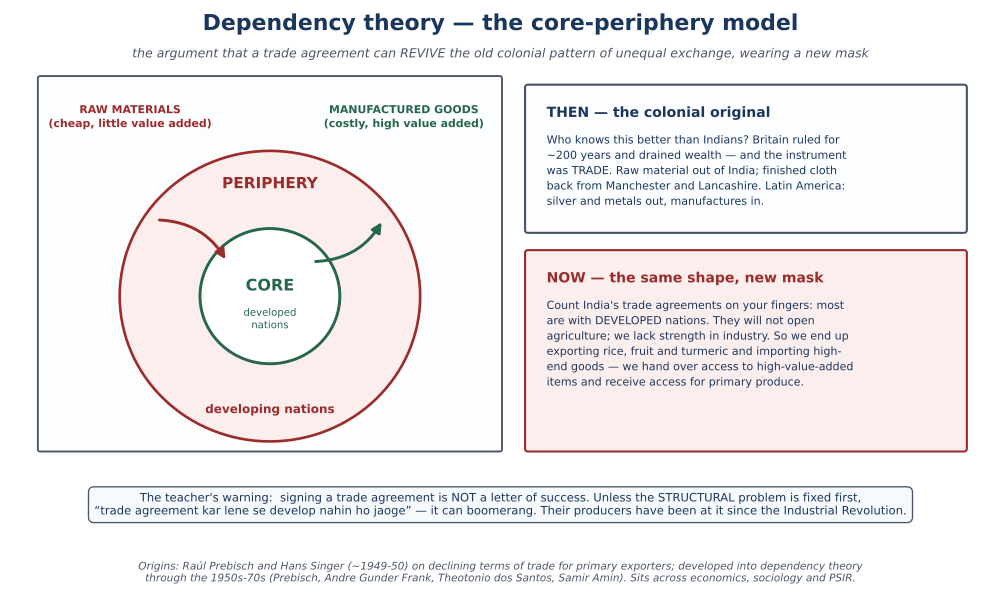
The theory. A school of thought emerged in the 1950s arguing that developed countries exploit developing countries — and the main instrument is trade. It works as a core–periphery model: the core (developed nations) sells manufactured goods to the periphery (developing nations) and buys raw materials from it.
TEACHER'S EXAMPLE — why Indians should recognise this instantly. "Who knows this better than Indians? The British ruled us for around 200 years and drained our wealth. How were they able to do it? The main instrument was trade." Raw materials were diverted out of India, and what they sold back were the finished goods made in the Manchester and Lancashire mills. Latin America the same: silver, metals and raw materials out; manufactures in. "It is an uneven kind of trade — raw materials are cheaper, they carry no significant value addition; manufactured goods are higher cost, higher value addition, more profit."
The revival claim. Experts are reviving this theory in the context of trade agreements. Count India's trade agreements on your fingers and you will find most are with developed nations. Do we have evenness with them? No: "We are mostly producing raw material or primary agricultural stuff. We are not that great an industrial power. Trade can happen in agriculture, industry or services — they are not allowing agriculture, and in industry we don't have the strength. So at the end of the day, what is happening? We are importing industrial goods and exporting agricultural stuff."
TEACHER'S EXAMPLE — the EU deal test. "Go and read any article on the India–European free trade agreement and just read the benefits we will derive from it. Most of the points are agricultural: hum fruits bhej denge, rice bhej denge, haldi bhej denge. How much will we earn from that? Very little. And they will sell Lamborghinis here — high-end goods. So we are giving them access for high-value-added items and getting access for primary produce. That is exactly what happened to developing countries for a long time — the same thing is now being revived in the form of trade agreements, with a different mask."
(Note: it is commonly called an FTA; it is actually a CEPA.)
The warning he built from it: "Unless you solve these structural problems, sirf trade agreement karne se develop nahi ho jaoge. Trade will definitely help — but when you already have the competitiveness. Simply signing a trade agreement, without thinking about what you are committing, is not writing a letter for your success. It can boomerang." Everyone says sign it, become that — "but just filling the form will not make you an IAS. For that, you have to work on yourself." We are not putting in that effort, so it is not generating the result it should. We keep signing one agreement after another — but do we have the productive capacity to export to these nations, and to fight producers who have been producing things since the Industrial Revolution?
CLARIFICATION — the theory's origins. The teacher dated the school to "1956". The lineage is: the Prebisch–Singer hypothesis (~1949–50) on the declining terms of trade for primary-goods exporters, developed through the 1950s–70s into dependency theory by Raúl Prebisch, Andre Gunder Frank, Theotonio dos Santos and Samir Amin. Write "late 1940s–1950s onwards" rather than a single year. The theory sits across economics, sociology and PSIR — the teacher flagged that too.
6.4 The spaghetti-bowl / noodle-bowl effect
This is the counter to the "building block of globalisation" benefit — and it comes with a named authority.
TEACHER'S EXAMPLE — the authority. "Jagdish Bhagwati is one of the highest authorities on international trade in the world — if not the highest. He is a professor at Columbia University, US. And Arvind Panagariya, the 16th Finance Commission Chairperson, is his disciple."
(Verified: Bhagwati coined "spaghetti bowl" in 1995, in "US Trade Policy: The Infatuation with Free Trade Agreements". Panagariya is the Jagdish Bhagwati Professor of Indian Political Economy at Columbia, a long-time co-author, and was appointed Chairman of the 16th Finance Commission, constituted 31 December 2023; he was earlier the first Vice-Chairman of NITI Aayog, 2015–17.)
Bhagwati's argument: trade is good — "his bread and butter comes from trade theory" — but it should be promoted through the MULTILATERAL approach (the WTO), not by carving out agreements among small groups of nations. So where we wrote "trade agreements are a building block of globalisation", Bhagwati says the opposite: trade agreements are a stumbling block of globalisation. They fragment the world instead of treating it as an integrated whole — they are "disrupting, fracturing the world", and so instead of promoting globalisation they are stopping it.
And the mechanism is the spaghetti bowl.
TEACHER'S EXAMPLE — India's own criss-cross. "India has a trade agreement with Singapore (CECA). India has one with Malaysia (CECA). And India has one with ASEAN — and both Singapore and Malaysia are members of ASEAN. So we have confused the trading relationship with them."
The consequence for a firm: "Suppose there is a company in India exporting to ASEAN. For ASEAN as a group it follows one set of rules and regulations. When it sells to Singapore, a different set. When it sends goods to Malaysia, a different set. Members of the same group — so instead of facilitating trade, it is confusing trade."
Why it is called a spaghetti (or noodle) bowl: because the rules of different agreements criss-cross each other like strands of spaghetti — "and some of the rules are very much against each other". In East and South-East Asia the same phenomenon is called the noodle-bowl effect.
The dictated definition — verbatim. "Spaghetti-bowl effect is a scenario in which FTAs, instead of facilitating trade between different nations, act as a stumbling block — since every trade agreement comes along with its own layering of rules and regulations; and if a country is having an FTA with multiple trade partners, then this layering of rules and regulations, instead of easing out trade, can impose more burden of compliances. Such criss-crossing nature of FTAs and the increase in compliances out of that is called the spaghetti-bowl effect."
The teacher stressed one phrase: "criss-crossing nature" — "whenever you read a definition of the spaghetti-bowl effect, they will always use that term."
The scale of the problem. He cited the WTO database on how many agreements exist worldwide, and noted India itself has signed with almost 30 countries — so an Indian company serving all of them must comply with 30 different sets of rules. The objective of a trade agreement was to facilitate trade; having different rules with different countries has made it harder to trade.
CLARIFICATION — the number of agreements. The transcript garbles the figure ("3843"). Verified from the WTO RTA database: as of 17 July 2026 there are 386 RTAs notified and in force (350 under GATT Art. XXIV, 221 under GATS Art. V, 65 under the Enabling Clause), plus at least 79 more in force but not yet notified. On India's own count, GTRI (June 2026) puts it at 15 FTAs covering 27 nations — so "almost 30 countries" is right, but say "15 agreements covering 27 countries" for precision.
Bhagwati's prescription: if you must promote trade, do it multilaterally, so that restrictions fall for every country at once and the rules are common across the world — rather than a different rulebook per partner.
6.5 The excess-capacity argument
The teacher called this one "quite self-explanatory", and it may be the most uncomfortable point in the chapter.
Not every country can be a beneficiary of a trade agreement. Signing is the first and easiest thing to do. What it is actually contingent on is whether you have enough capacity within your nation.
Excess capacity = total production − domestic consumption. Whatever is left over is what you can trade with.
China benefits from its agreements mainly because it has excess capacity to offload. Japan the same. Korea the same. New Zealand in dairy the same. All these nations produce more than they require domestically.
TEACHER'S EXAMPLE — the Indian problem, stated bluntly. "In India, excess capacity is negative, because production is less than domestic consumption. That's why we import things from outside — we are a net importing nation. So how can you think that simply signing a trade agreement will change this situation? It will make the situation worse — because you are already producing less than is required domestically, and whatever you are producing is not competitive enough. When you sign the agreement, producers from across the world come in and start competing with them, and most of the time they will not be able to fight that competition. You have removed the barriers without making the domestic producer competitive enough."
So: trade agreements work only for countries that have excess capacity. The first thing we should have done is prepare ourselves.
TEACHER'S COUNTERPOINT (he argued against himself — keep both sides). "But there is a counterpoint also. How long will you take to prepare yourself? Exam se pehle aap kitna padhoge? 'I'll give the exam after five years' — but unless you give it, you will not know its challenges. We protected ourselves for 40 years after independence; in 1991 we said now we are preparing; then we waived the barriers and signed the agreements, and found we were not prepared enough."
His resolution: even if you are having the trade agreement, focus on creating more excess capacity, so that you benefit more from it than your trade partner does.
7. Concerns B — SPECIFIC concerns (India)
The framing question for this whole block: "Why are we not able to capitalise on our trade agreements?"
7.1 Increasing trade deficit
"We have signed trade agreements, but most of them have not worked for us — most have worked for the trade partner." Since we began signing agreements from 2000 onwards, our trade deficit with those countries has continuously increased — and especially with China, "with whom we don't even have a trade agreement. So even without one, China is giving a headache to us."
TEACHER'S EXAMPLE — the GTRI study. "There is an institution in India called GTRI — Global Trade Research Initiative. Its head, Ajay Srivastava, writes many articles in the Indian Express on trade agreements. They carried out a study: from 2019 to 2024, looking at India's trade data with 21 FTA partners — our exports to them increased at 14%, but our imports from them increased at 38%. And this is true with almost all the nations we have signed with — Japan, Korea, the ASEAN nations. With every country we have signed with, our trade deficit has only increased."
His conclusion: "That means the alarm bells. Aisa kya trade agreement sign kar rahe ho — aur aapke paas trade karne ke liye kuchh hai hi nahin."
CLARIFICATION — this is the single most important correction in this note. The teacher (and the board note) present 14% and 38% as annual rates. They are not. The GTRI study (May 2024) measured the cumulative change across the five fiscal years FY2018-19 → FY2023-24: - Exports to FTA partners: +14.48% — from US$107.20 bn (2018-19) to US$122.72 bn (2023-24) - Imports from FTA partners: +38% — to US$187.92 bn - FTA partners accounted for 28% of India's total trade in FY24.
Country detail from the same study: exports to the UAE +18.25% (US$30.13 → 35.63 bn) while imports surged 61.21% (US$29.79 → 48.02 bn); exports to South Korea +36.38% (US$4.71 → 6.42 bn) against imports +26.12% (US$16.76 → 21.14 bn).
Write it as: "over the five years to FY24, India's exports to FTA partners grew ~14% while imports from them grew ~38%." Presenting them as annual rates in a Mains answer would be a factual error.
This is why we keep asking for reviews. "Whenever we meet the Japanese Prime Minister, whenever we meet the ASEAN leaders, one of the things we always put in front of them is: let's review the trade agreement. They say — fine, next time. Because concessions are required from both sides."
CLARIFICATION — India's FY26 export figure. The teacher cited "$868 billion" for FY 2025-26. Verified: US$860.09 billion (merchandise $441.78 bn + services $418.31 bn), up 4.22% from $825.26 bn in FY25. And his deeper point stands, sharply: imports were US$979.40 bn (up 6.47%), so India ran an overall deficit of roughly US$119 bn.
As he said: "Achha lagta hai ki 1 trillion dollar hone wale export — but what about imports? With a single country we have a trade deficit of more than $100 billion — that is China." Verified: the India–China trade deficit reached US$112.16 bn in FY2025-26, up from US$99.2 bn in FY25 — the largest deficit India has ever recorded with any single country. Imports from China were US$131.63 bn, and China overtook the US to become India's largest trading partner in FY26 for the first time in five years.
EXAM FOCUS — the teacher's rule for reading trade data. "Yeh mat batao ki exports badh gaye. Yeh batao — exports minus imports kitne badhe hain." Always look at net exports, not the headline export number. Look at it that way and India's number carries a negative sign: we are a net importing nation.
7.2 Low domestic value addition (DVA)
"It's not that we are not exporting anything." We do export — the issue is how much of the value in those exports was actually created in India.
DVA = how much value is created within the country before the good is exported.
TEACHER'S EXAMPLE — three sectors where the number is embarrassing. - Petroleum products. "Crude oil is the largest import of India, and petroleum products — refined petrol, diesel, petrochemicals — are the largest exports of India. Did you know that?" So what are we doing? Importing crude, carrying out some refining, and exporting it back out. The value added in between is thin. - Diamonds. "We say we are the hub of polished diamonds in the world — almost every diamond in the world is polished in India. That is a kind of pride. But we import the rough-cut diamonds, polish them in Surat, and export them back across the world through Belgium, which is the major diamond market." DVA in polished diamonds: less than 10%. - Pharma. "We are the pharma capital of the world. What are we doing? We are importing APIs and pharma machines, and then exporting pharmaceutical items across the world."
His summary: "Most of the things in which we have some competitive advantage, we export and make some good gains — but those things are not completely 100% made in India. To produce them we are first importing many things."
What the alternative looks like: "If you want to become an exporting power — if you want to use trade as an instrument of prosperity — you have to create the whole ecosystem within the country. That is what China has done. They are able to control the supply chain of almost every raw material, intermediate, machine, skill and finance that goes into production. Most of the activities happen within their country, so they get the benefit of those activities, and then they export."
TEACHER'S EXAMPLE — solar, the cleanest illustration. "We want to do solarisation — but the solar panels are coming from China. So out of your ambition and your project of solarisation, the economy has not benefited fully. Had the solar panels been made in India, the country would have got a double benefit: first, solarisation itself; and second, the whole ecosystem of the solar sector would have developed in India. But where is all that benefit going? To China."
7.3 Low FTA utilisation rate
Whatever agreements we have already signed, we are not able to take the benefit of them.
The concept: when we sign with country X, a certain volume of export opportunity opens up — studies estimate the potential. Suppose signing with the US could raise our exports there by US$100 bn, but we manage only US$25 bn. Then we have used only 25% of the potential of the agreement. "That is the FTA utilisation rate."
TEACHER'S NOTE ON EXAM USE. "FTA utilisation has a formula — but whenever you are making the argument, you don't have to write the formula. Simply write 'low FTA utilisation rate' and then a number."
India's number: about 25%. "₹100 ki baat karte hain, aur jab usme kaam karte hain to ₹25 kaam karte hain." The exception is the Australia agreement, where we are doing well — the rate there is above 80%.
CLARIFICATION — verified, and the comparison that makes it sting. India's overall FTA utilisation has historically run at about 25% (GTRI's June 2026 report puts the current band at 20–30%), against 70–80% in many developed economies — and against 60–70% for partner-country exporters using the same agreements. The India–Australia ECTA utilisation has touched ~84%, higher than India's older Asian FTAs (~50–60%). The named causes: limited MSME awareness, underdeveloped certification infrastructure, and complex rules of origin whose compliance costs fall hardest on small firms.
"So we are not able to utilise what we have already created for ourselves — and we are so busy signing many other trade agreements."
7.4 Prevalence of non-tariff measures (NTMs)
Restrictions come in two forms — tariff barriers and non-tariff barriers. When an agreement is negotiated, the main focus remains on tariffs. Non-tariff measures can come into the picture, but mostly they don't.
And that is the trap. "Later on, these nations make non-tariff measures the excuse to restrict trade. They give us concession on tariff barriers, we give them concession on tariff barriers — and after that, when we start exporting to them, they start wielding the stick of non-tariff barriers."
TEACHER'S EXAMPLE — Japan and mangoes. "With Japan we have an agreement, and still they banned our mango exports... they always use that as a tool."
Why developed countries specifically? "They are the only ones who devised it, and they are the only ones who are using it most rampantly. Why? Because they know they cannot fight against developing countries on cost — cheap labour, less costly resources. So if a product is coming from a developing country it will of course come at a lower cost. On what grounds can we restrict it? On quality grounds — 'it is not safe enough, it is not meeting our standards.' That is simply the non-tariff barrier."
And the problem is compounded because most of our agreements are with developed nations.
TEACHER'S WAY FORWARD (given here, in place). "If we are signing trade agreements, take the commitments on non-tariff measures also. Don't simply go and sign on tariffs. Ask them to commit that they will not use non-tariff barriers too much — and if they will, make the ground clear in advance about what kinds of things they are going to use. But again — they will not commit to it."
7.5 Rules of origin (RoO) violation
DIAGRAM (board): the routing the teacher sketched, and India's legislative answer.
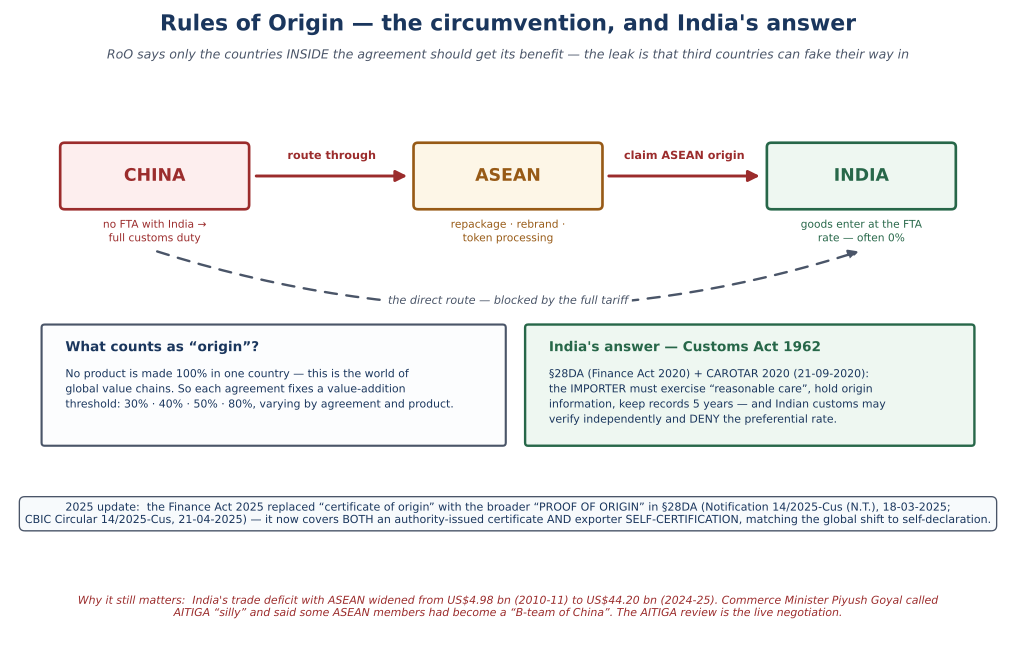
The principle. "It goes very much with the term itself: from where has the product originally come? Rules of origin tell us that only those countries which are members of the trade agreement should get the benefit of the trade agreement."
The leak. India has an FTA with ASEAN (implemented from 2010), so goods moving from ASEAN to India get concessional tariffs — zero for some goods, minimal for others. China has no such agreement with India, so Chinese goods face full customs duty. "But one way China can still come to India is: go to ASEAN, carry out repackaging and rebranding, show that the product originated from ASEAN, and then use the FTA provisions to enter India." That is a rules-of-origin violation — circumvention by a third party.
What "origin" even means. "No product can be made fully in one country. This is the world of global value chains — many things move from one place to another. So you cannot say 100% of a product must be made there; that is not practical." Instead each agreement fixes a value-addition threshold: "sometimes 50%, sometimes 80%, sometimes 30%, sometimes 40% — for different trade agreements we have different definitions of when a product is said to have originated in that country."
The old mechanism and its flaw — the Certificate of Origin (CoO). To claim the benefit, the exporter furnishes a certificate of origin with the shipment, proving it came from the partner country, so customs allow entry at the preferential rate. "Show karna padega proof."
TEACHER'S EXAMPLE — where the design failed. "The problem is that the certificate of origin is issued by the exporting nation — in this case the ASEAN nations. So they can issue it even to the Chinese shipments moving through them. The rules of origin could be easily violated. We were not thinking that this could also happen — we assumed there is some kind of trust, that a government would not lie. But over time we found multiple challenges cropping up."
India's answer — amending the Customs Act, 1962.
CLARIFICATION — this is an exam-critical correction, so read it carefully.
The teacher said India replaced the certificate of origin with a "proof of origin" issued by the importing country — by India — where Indian customs officials inspect and can deny the FTA benefit. The outcome he describes is right; the mechanism is not. Verified position:
- Section 28DA was inserted into the Customs Act, 1962 by the Finance Act 2020, and the CAROTAR 2020 rules (Customs (Administration of Rules of Origin under Trade Agreements) Rules, 2020) came into force on 21 September 2020.
- What actually changed is where the burden sits: the importer claiming a preferential rate must now possess origin information (Form I), exercise "reasonable care" as to its accuracy and truthfulness, and retain supporting documents for five years. Indian customs may seek information, initiate verification, and — if the importer fails to furnish it or fails the reasonable-care test — deny preferential tariff treatment and verify all subsequent bills of entry from that importer. Benefit is restored only prospectively, once origin conditions are demonstrably fixed.
- The Finance Act 2025 then replaced the term "certificate of origin" with the broader "proof of origin" in §28DA (Notification 14/2025-Customs (N.T.), 18-03-2025; CBIC Circular 14/2025-Customs, 21-04-2025). Crucially, "proof of origin" is wider, not stricter in the way described: it covers both a certificate issued by a designated Issuing Authority and exporter self-certification / self-declaration — the stated rationale is to align with the global shift toward self-certification and simplify procedures.
So the correct sentence for an answer is: "India tightened rules-of-origin enforcement through §28DA of the Customs Act, 1962 and CAROTAR 2020, shifting the onus onto the importer and empowering Indian customs to verify origin independently and deny preferential treatment; the Finance Act 2025 broadened 'certificate of origin' to 'proof of origin' to accommodate self-certification." Do not write that India issues the proof of origin.
The teacher's account of enforcement on the ground is accurate and worth keeping: customs officials do go and inspect factories in the partner country to check whether goods are genuinely made there — "'mujhe nahin lag raha hai Thailand mein banaya' — main check karke aaunga." And he noted, with some humour, that officials are not unhappy about the travel.
Is it fixed? "No — we are not able to close this fully. There are still ways in which these countries are able to violate the rules-of-origin requirements, because no method you adopt can be a 100% foolproof guarantee."
The bigger unresolved issue is the review itself. "We keep saying we are going to review the trade agreement, but the ASEAN nations collectively are not agreeing. Thoda bahut kaam kar rahe hain, but it's not getting fully done for the last three-four years. 'We will review it — when? Next meeting.' It is not getting done this time either. And when the Prime Minister raised the issue of the trade deficit, the Japanese PM did not give much heed to it. They were not very serious. Why should they be? They are gaining from it."
TEACHER'S EXAMPLE — the "B-team of China" remark. "Last year, when Piyush Goyal — the Minister of Commerce and Industry — was asked about this, he said that ASEAN is intentionally doing it, and ASEAN is acting as a B-team of China." Why? "Because they are allowing these things to happen. We signed the agreement with you expecting that goods produced in your country would receive the concessional benefit — but you are allowing goods from other countries to enter your country and then use our liberalised provisions to capture our market. That is what we want them to stop."
(Verified: Goyal made the "B-team of China" remark and called AITIGA "silly" at the India Global Forum in London, questioning the rationale of the 2010 ASEAN–India FTA. The ASEAN co-chair of the AITIGA review formally conveyed displeasure at a review meeting in Kuala Lumpur over the tone and timing. India's core complaint is lax rules of origin letting Chinese goods in via ASEAN. India's trade deficit with ASEAN widened from US$4.98 bn in 2010-11 to US$44.20 bn in 2024-25 — the number that makes his case.)
7.6 Third-country competition
"It's almost like treaty shopping" — the teacher reached for the analogy and then made the point directly.
You are not the only one who signed with them. Suppose India signs with the US and expects to benefit. "But you are not the only one who signed a trade agreement with the US. The US might have signed with Bangladesh, with Singapore, with the UK, with the European Union — and rather, they might have given much more favourable terms to them than to you."
So your act of signing is not a guarantee of anything. "Market access can be provided — but whether you have the potential to beat all other nations in the US market or not is a different question. Third countries are already sitting there with agreements on more favourable terms."
The definition to carry: third-country competition = the competition you face in your trade partner's market from other countries that also have preferential access to it. "Competition sirf India ka aur US ka nahin hai — competition India vs Singapore, Malaysia, ASEAN nations, Japan, Korea, Bangladesh, the UK, the European Union. Everyone is exporting things to the US."
TEACHER'S EXAMPLE — why India is deliberately slow-walking the US deal. "One of the reasons we are delaying the trade agreement with the US is this: we fear they will extract more from us compared to other nations, and later we will already have lost the market. Suppose they impose a 30% tariff on us — they say '100% lag raha tha, 20% laga raha hun' — and other countries get a concession at 10%. You have already lost a 10% advantage. You are out of the market. No one is going to buy from you, because 10% is too much. It is not an easy margin — it might take 20 years of working on it to get 10% of competitiveness."
The conclusion: "Trade agreement is not a guarantee of success. It is very much contingent on many other factors."
7.7 Competitiveness issues
The same argument, now given a positive structure. Whether you can fight outside depends on whether you have domestic competitiveness — external competitiveness is nothing but domestic competitiveness showing up abroad.
DIAGRAM (board): the four sources of competitiveness.
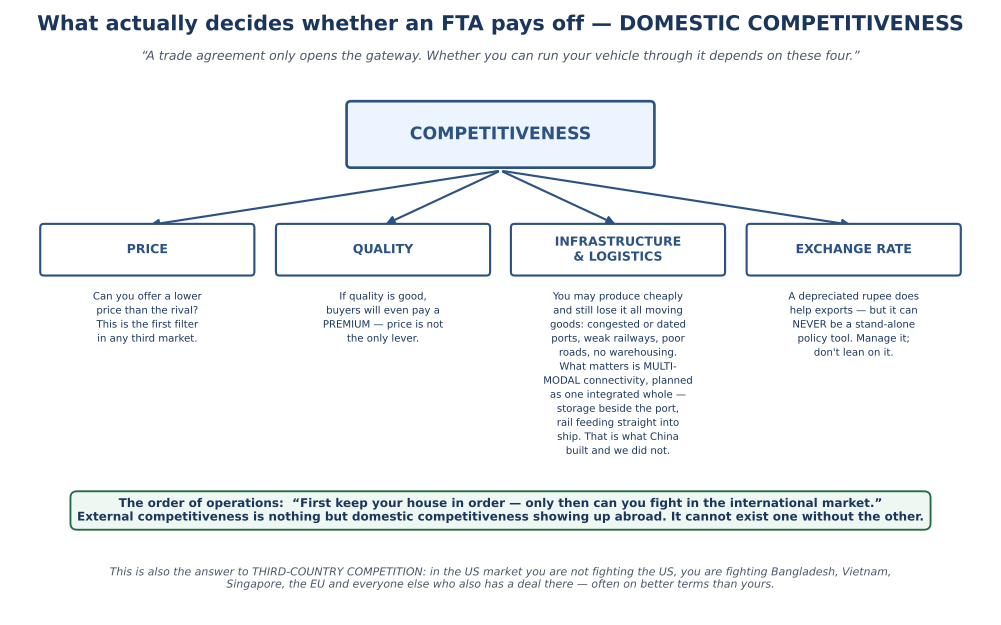
1. Price. Whether your products are price-competitive. The first filter in any third market.
2. Quality. "If quality is good, then people will be ready to pay you a bit higher price also." Price is not the only lever.
3. Infrastructure and logistics. The teacher spent longest here.
TEACHER'S EXAMPLE — where competitiveness leaks away. "Suppose you are able to produce something, but you are not able to shift it to the ports; or from ports to destinations at a lower cost. Then even if you are producing domestically at a competitive rate, all of the competitiveness will go away. Maybe you don't have better ships. Maybe you don't have better ports. Maybe your ports are congested. Maybe your ports are technologically lagging. Maybe your railways are deficient. Maybe your road transportation is not well laid out."
And the fix is not piecemeal: "You don't have to improve them in an isolated manner — you have to improve them as an integrated whole. If there is a port, the storage should be around the port — not that the port is here and the storage is at some other place. So what matters is multi-modal connectivity: road, ports, railways, aviation, storage and warehousing, all connected with each other — so that the moment goods come out of the railway they can be shifted immediately to roads, from roads to ship, and the storage facilities are right next to the port. That is what China has done, and that is what we have not been able to do much — but now we are trying."
4. Exchange rate. "Yes, a depreciated exchange rate can promote exports — but can it alone work as a policy tool to increase your exports? No." (He referenced his third class, on inflation and the exchange rate, here.) The exchange rate can help, but it cannot be a foolproof solution.
EXAM FOCUS — his closing line on this point. "Firstly we have to keep our house in order — then only will we be able to fight in the international market. A trade agreement only opens the gateway; it only gives you the opportunity. Whether you are able to encash that opportunity depends on many factors. If those factors are in order, trade agreements can help. If they are not, and you simply open up for trade, things can boomerang — like they have, in some way, in India: our trade deficit has already soared and is continuously increasing."
7.8 Adverse margin of preference (MoP)
"It's an interesting issue that gets clouded — it disappears when we sign the trade agreement, and many times it is not focused on that much."
Margin of preference = the additional preference you have given to your trade partner (over and above what already applied).
The asymmetry. Most of our agreements are with developed countries — and developed countries' tariffs are already low, because they use the instrument of non-tariff measures instead. "By keeping tariff barriers low they try to show the world how good they are — but what kind of restrictions do they use? Non-tariff."
TEACHER'S EXAMPLE — the arithmetic, worked. "Switzerland — almost 99% of goods have zero tariff. New Zealand — almost 99% of goods, zero tariff. And not just for India — for every country across the world."
"Now suppose we sign a trade agreement with New Zealand. Their tariff is already almost zero — how much can they reduce? Zero se negative to nahi chale jaenge. And where are we coming from? India's average tariff is about 15%. So we come from 15% to zero, and they are already at zero."
"Who is giving more concession? India is giving more concession." "We are relatively opening more market for them. Their market is already open — not only for India, for all the countries across the world. So at the end of the day, what have we gained? We have not gained anything extra, because their market was already open to everyone including us. And what have they gained? They have gained access to our market by getting our 15% tariff removed."
That is why we call the margin of preference adverse against India: "we give more concession to them compared to what they give to us — on tariff grounds. And non-tariff is always subject: it can become part of a trade agreement, but most of the time they keep it out, so that they can use that stick later on."
And the killer follow-up: "Already jab 0% tha tab to aap trade kar nahi paye — aur trade agreement ke baad ab export kar doge? It's not easy." If you could not sell into a zero-tariff market before the agreement, the agreement alone will not make you able to.
CLARIFICATION — verified tariff averages. India's simple average applied MFN tariff is 15.8% (WTO World Tariff Profiles 2025) — the teacher's "about 15%" is accurate. Developed-economy averages sit in the low single digits, and Switzerland and New Zealand are effectively duty-free on the overwhelming majority of industrial tariff lines. The India–EFTA TEPA numbers make the asymmetry concrete: EFTA opened 92.2% of its tariff lines (99.6% of India's exports), while India opened 82.7% (95.3% of EFTA's exports) — but EFTA's lines were largely open already, which is exactly the adverse-MoP point.
7.9 Gated globalisation, near-shoring, friend-shoring and protectionism
The last concern is about the environment in which the agreement has to operate. "All of these terms are different, but they come to the same idea."
Open globalisation is the original idea: an integrated, interconnected world, ready to interact with all countries, exports and imports happening openly without much restriction.
Gated globalisation is different: "I am ready to carry out globalisation — but only with those countries I like to globalise with. I put the gates. For example the US says: I am ready to globalise, but not with China. Or: not with Pakistan, not with China; the rest of the countries, I am ready."
The definition to carry: gated globalisation is subjective globalisation — you are not ready to interact with all countries equally; you interact only with specific ones. "That is why people say globalisation as an idea has not died — it has simply erected some gates."
Near-shoring and friend-shoring are the same instinct applied to supply chains.
TEACHER'S EXAMPLE — the US–Mexico case, told fully. "Instead of importing from China, the US is ready to import from Mexico. They are asking US companies working in China to come back — but not back to the US, because the US doesn't have cheap labour and is not that kind of industrial nation. So they say: shift your companies to Mexico. Produce in Mexico, export to us. That is called near-shoring — or friend-shoring, because Mexico is relatively a good friend; it is part of the USMCA agreement. That is why around 85% of Mexico's exports go to the US."
And India is a beneficiary of the same trend: "Some companies have also shifted from China to India — for example Apple. From China and partly Taiwan they shifted production facilities to India, and now they produce iPhones here and export them to the US. That is friend-shoring, because India is considered to have a relatively friendlier relationship with the US than China does."
But he closed with the honest caveat: "It is not necessary that every time this works for us. Some shifting was happening away from China — some of it came to India, but not every shift has come to India." (The recording ends here, mid-sentence, at "So, when COVID happened, most…".)
Why this is a concern: "Protectionism is increasing, near-shoring is increasing, friend-shoring is increasing, gated globalisation is increasing. The idea is that globalisation is not free for all. So even if you sign a free trade agreement, it is not that exports are bound to increase — because of these fears, which were not there earlier."
EXAM FOCUS — the metaphor he used. "It's very choppy waters — you are not able to sail properly here." Terms to deploy interchangeably in an answer: gated globalisation · near-shoring · friend-shoring · protectionism · slowbalisation.
8. Way forward
Question 3 was never taught as a separate block (the recording ends first), but the teacher gave the remedy alongside almost every concern. Collected:
| Concern | His prescribed remedy |
|---|---|
| Coupling of economy | Diversify your trade basket. "Don't export to only one or three nations. Don't put all your eggs in the same basket." |
| Dependency relationship | Raise manufacturing capacity so you are not exporting only primary items. "What happens in India? We are still exporting iron ore and importing steel — exporting the ore to Japan, Korea and China, and then importing steel back. Does that make sense? It does not make sense." |
| Spaghetti-bowl effect | Revive multilateralism. "We should be very much interested in reviving the WTO." |
| Excess-capacity argument | Create domestic capacity first, so there is something to export; and keep building it even while agreements are in force. |
| Non-tariff measures | Negotiate on NTMs too, not tariffs alone — and get advance clarity on which measures they intend to use. |
| Rules-of-origin violation | Stricter RoO + enforcement — §28DA/CAROTAR, proof of origin, factory-level verification; and push the AITIGA review through. |
| Mode 4 / services | Trade market access for people access — "if you want market access, accept our people first." |
| Competitiveness | Work all four levers: price · quality · integrated multi-modal infrastructure & logistics · a managed exchange rate. |
| FTA utilisation | Use what you have already signed before signing more. |
9. Exam focus
EXAM FOCUS / PYQ — everything the teacher said about writing this chapter.
- One skeleton, many questions. "Whether someone asks the benefits of trade, or the benefits of a trade agreement, or the benefits of economic integration — the approach of the answer will almost be the same. You only have to change the terminology here and there."
- Half the points are enough for a 15-marker. "Even if you are able to remember half of those points you will be able to write a good answer for a 15-marker — because they will not simply ask 'write the concerns'; they will give you a holistic question in which you can write the concerns and the benefits."
- Terms are the currency; explanation is not. "These terms should become part of your vocabulary. It's not that the examiner is that much interested to read your explanation — after that, who has the time? If you simply write 'trade creation, trade diversion', the person knows you know the context and the theoretical aspect." Name the term; don't narrate the mechanism at length.
- Write organically, not as loose bullets — the export-benefit chain especially.
- Argue both sides. He modelled this repeatedly — building block and stumbling block; brain drain bad but better than brain in the drain; excess capacity and the counterpoint that you can never be fully prepared.
- Vocabulary checklist: trade creation · trade diversion · coupling of economy · dependency relationship / core–periphery · spaghetti-bowl (criss-crossing nature) / noodle-bowl · excess capacity · trade deficit · domestic value addition · FTA utilisation rate · non-tariff measures · rules of origin / proof of origin · third-country competition · margin of preference · gated globalisation · near-shoring · friend-shoring · slowbalisation · market access · Modes 1–4.
Current Affairs
(Updated as relevant news/magazine content comes in)
| Date | Source | Headline | Connection to this topic |
|---|---|---|---|
| 15-07-2026 | PIB / The Hindu | India–UK CETA and the Double Contribution Convention enter into force | The live test of this whole class. India got duty-free access on 99% of tariff lines; the UK scrapped duties on 96.8% of lines (97.7% of trade value). Tariff cuts: processed foods up to 70%, marine 21.5%, engineering & auto components 18%, leather/footwear 16%, textiles 12%, chemicals & pharma 8%. Scotch whisky 150% → 75%, then 40% by year 10. Directly answers the Mode-4 concern in [§3.4]: commitments across all 12 service sectors and 137 sub-sectors (>99% of India's services export interest), no Economic Needs Test, no numerical caps on professionals; and the DCC (signed 10-02-2026) ends dual social-security contributions for Indian professionals in the UK for up to 5 years. Bilateral trade ~US$56 bn, targeted to reach US$100–120 bn by 2030. |
| 27-04-2026 | PIB / MFAT NZ | India–New Zealand FTA signed — dairy almost entirely excluded | Confirms the teacher's RCEP/dairy argument in [§6.1] exactly. Negotiations launched March 2025 and closed in ~9 months (NZ's fastest ever). NZ gets tariff relief on ~95% of its current exports (sheep meat, wool, forestry, seafood, honey, wine, apples, kiwifruit) — but India excluded dairy and certain agri products to protect domestic farmers. Not yet in force as of July 2026; NZ ratification targeted later in 2026. |
| 01-10-2025 | EFTA / PIB | India–EFTA TEPA enters into force | The US$100 bn investment + 1 million jobs over 15 years commitment in [§4] — India's first binding investment pledge in any FTA (Art. 7.1: $50 bn in 10 years, $50 bn in the next 5). Also the cleanest illustration of adverse margin of preference ([§7.8]): EFTA opened 92.2% of tariff lines (99.6% of India's exports) vs India's 82.7% (95.3% of EFTA's) — but EFTA's were largely open already. |
| FY 2025-26 | PIB / Commerce Ministry | India's total exports US$860.09 bn; imports US$979.40 bn | The net-exports discipline of [§7.1]. Merchandise $441.78 bn + services $418.31 bn; exports +4.22%, imports +6.47% → overall deficit ≈ US$119 bn. Confirms the 52/48 goods–services split. |
| FY 2025-26 | Commerce Ministry data | India–China trade deficit hits US$112.16 bn — largest ever with any country | Up from US$99.2 bn in FY25; imports from China US$131.63 bn. China overtook the US as India's largest trading partner for the first time in five years. The backdrop to why we never signed with China ([§6.1]) and to the RoO leak ([§7.5]). |
| June 2026 | GTRI report | India has 15 FTAs covering 27 nations; utilisation only 20–30% | Updates [§7.3]. Indian exporters use 20–30% of available preferences vs 60–70% by partner-country exporters. Deficit with ASEAN +381%, Japan +318%, South Korea +268% between 2007-09 and 2023-25. Also flags FTAs aggravating the inverted duty structure, pushing manufacturing to Vietnam/Thailand/Indonesia. |
| 2025-26 | Indian Express / BW | Piyush Goyal: AITIGA "silly"; some ASEAN members a "B-team of China" | The teacher's example in [§7.5], verified. India's ASEAN deficit widened US$4.98 bn (2010-11) → US$44.20 bn (2024-25). The ASEAN co-chair formally objected to the remark at the Kuala Lumpur review meeting. AITIGA review is the live negotiation. |
| July 2026 | Bloomberg / Business Standard | India–US Bilateral Trade Agreement still unsigned at the "last 1%" | A textbook live case of third-country competition ([§7.6]): India is holding out for tariff terms better than its ASEAN peers. US to cut the reciprocal tariff 25% → 18%; the additional 25% Russia-oil-linked tariff removed. Interim arrangement expires 24 July 2026. |
| 18-07-2026 | The Federal / Daily Excelsior | 100+ ISRO scientists resign / seek VRS | The brain-drain digression in [§3.4]. ~80 from UR Rao Satellite Centre (Bengaluru), 20+ from VSSC (Thiruvananthapuram). Causes: private space/defence pay multiples, bureaucratic culture, mission delays. Department of Space has withdrawn Centre Directors' power to accept such resignations. |
| 26-10-2025 | ASEAN Secretariat | Timor-Leste becomes ASEAN's 11th member | Updates [§1]. Admitted at the 47th ASEAN Summit, Kuala Lumpur — ASEAN's first expansion since Cambodia in 1999. |
| 20-07-2026 | The Hindu (editorial, "Maturing approach") | CETA's real test: turning market access into market share | The evaluative counterpart to the 15-07-2026 row above — the editorial's thesis is that "CETA's success lies in turning market access into market share." Three additions to this note: (1) the scale caveat — the UK is only ~3% of India's merchandise exports and ~1% of imports, so CETA's value is qualitative (a high-income market where India runs a surplus), not volume; (2) a precise elasticity asymmetry for [§7.1] — India's surplus could narrow if imports of the UK's price-inelastic exports (luxury vehicles) grow faster than India's labour-intensive, price-sensitive exports; (3) confirms [§7.3]'s utilisation argument with its cause — MSMEs lack the documentation and compliance capacity to claim preferences, and the UK's SPS, technical and sustainability standards "could prove a bigger hurdle than tariffs." Also flags the steel safeguard-quota hurdle before implementation (non-tariff measures diluting a signed deal) and CBAM-type climate regulation hitting India's carbon-intensive exports. Notes India's "maturing" posture — contrast the 2009 ASEAN FTA (balance tilted against India) with the NZ FTA dairy carve-out. |
| 20-07-2026 | The Hindu (op-ed, Australian High Commissioner) | Modi's Melbourne visit — five India–Australia deliverables | Extends [§6] on partner selection. 8–10 July 2026: a Joint Declaration on Defence and Security Cooperation (upgrading the 2009 pact); a Partnership on Cyber, Critical Technologies and Supply Chains; a Statement on Energy Security enabling Australian uranium exports for peaceful use; a Maritime Security Collaboration Roadmap; and a sports playbook. AustralianSuper to invest ~₹3,360 crore in NIIF; eight Australian universities to open India campuses (incl. UNSW). Relevant to this note because India–Australia ECTA is the outlier at ~84% FTA utilisation ([§7.3]) — the strongest evidence that complementary economies (Australian energy/mining/education vs Indian manufacturing) produce usable preferences, not just signed ones. |
Cross-GS Linkages / Applications
Built from the Related: lists of the tagged nodes in syllabus/syllabus-map.md.
- [[GS3-ECO-04]] — Liberalization & Industrial Policy (home node). The pre-1991 closed economy vs post-1991 opening runs through §4 (anti-inflationary tool), §6.1 (why protection was abandoned) and §6.5 (40 years of protection, then exposure). Trade diversion/creation is the analytical core of any liberalisation question.
- [[GS3-INF-01]] — Infrastructure: Ports, Roads, Railways. §7.7 is effectively an infrastructure answer in disguise: multi-modal connectivity planned as an integrated whole is what converts domestic production into export competitiveness. Use the port-congestion / storage-beside-the-port example in either paper.
- [[GS3-ECO-01]] — Planning, Growth & Employment. §3.3's argument that industry, not agriculture or services, must create the jobs is a direct employment-strategy point; §3.2's 18%-of-GVA/46%-of-workforce mismatch is the structural-transformation argument.
- [[GS2-IR-03]] — Policies of Developed/Developing Countries; Diaspora. §3.4 (Mode 4, H-1B, cultural nationalism, the skilled-mobility MoU with Israel) is a diaspora + trade-negotiation answer. §6.2's bargaining-power asymmetry is pure IR.
- [[GS2-IR-04]] — Important International Institutions. The WTO thread: GATS and its four modes (§3.4), the RTA database (§6.4), and Bhagwati's multilateralism-vs-regionalism critique — the standard "is the WTO still relevant?" question.
- [[GS1-SOC-03]] — Effects of Globalization on Indian Society. §7.9 (gated globalisation, cultural nationalism, protectionism after 2008 and COVID) and §3.4 (migration, brain drain, remittances) are the society-facing face of this chapter.
- [[GS2-POL-09]] — Statutory & Regulatory Bodies. CAROTAR 2020 / §28DA enforcement by CBIC (§7.5) is a customs-administration and regulatory-capacity example.
- Essay — [[ESS-ECD-04]] MNCs, Globalization & the Economy. Free trade vs protectionism, comparative advantage, labour mobility: the whole note feeds this theme.
- Essay — [[ESS-ISH-01]] Globalization & Nationalism. "If goods don't cross the border, soldiers will" (§5.1); the China–US interdependence-without-friendship case; gated globalisation as nationalism expressed through trade policy.
- Essay — [[ESS-ECD-01]] Growth vs Development. "Trade is a means, not an end" (§1) is a ready-made essay thesis; so is "brain drain is better than brain in the drain" (§3.4) on whether growth without opportunity is development.
Previous Year Questions
Pulled from pyq/analysis/gs3-pyq-bank.md for GS3-ECO-04 and the trade-facing items in adjacent nodes. Pattern analysis: gs3-pyq-analysis.md — GS3-ECO-04 is rated MEDIUM-HIGH weight (14 questions), with recurring themes of FDI, SEZs, protectionism/currency manipulation, liberalisation's effect on Indian firms vs MNCs, and IPR.
Mains
| Year | Marks | Question | Framing / where this note answers it |
|---|---|---|---|
| 2018 | 15 | How would the recent phenomena of protectionism and currency manipulations in world trade affect macroeconomic stability of India? | The closest fit in the whole bank. §7.9 (protectionism, gated globalisation, near-/friend-shoring), §6.2 (coupling → transmission of external shocks), §7.7 (exchange rate as one of four competitiveness levers, never a stand-alone tool). |
| 2016 | 12.5 | How has globalization led to the reduction of employment in the formal sector of the Indian economy? Is increased informalization detrimental to the development of the country? | §3.3 (industry as the job engine; services cannot absorb everyone), §6.5 (opening without competitiveness), §6.1 (short-term producer pain from trade creation). |
| 2013 | 10 | Examine the impact of liberalization on companies owned by Indians. Are they competing with the MNCs satisfactorily? | §6.1 (trade creation forces domestic firms to "pull up their socks"), §4 (anti-monopoly/competition benefit), §7.7 (why many still cannot compete). |
| 2017 | 10 | Account for the failure of the manufacturing sector in achieving labour-intensive rather than capital-intensive exports. Suggest measures. | §7.2 (low DVA — refining, diamonds, pharma, solar), §6.5 (negative excess capacity), §7.7 (logistics). |
| 2015 | 12.5 | SEZs are a tool of industrial development, manufacturing and exports… Discuss the issues plaguing their success. | §7.7 (infrastructure/logistics), §7.2 (value-addition ecosystem). |
| 2023 | 15 | What are the direct and indirect subsidies provided to the farm sector in India? Discuss the issues raised by the WTO in relation to agricultural subsidies. | §3.2 (agriculture and trade), §7.4 (how developed countries use standards as barriers), §1 (WTO's weakening). |
| 2013 | 10 | Food Security Bill… discuss the concerns it has generated in the WTO. | §1 (multilateralism in rupture), §7.4 (NTMs). |
| 2010 | 12 | Have the Uruguay Round negotiations and the resultant TRIPS agreement helped in resolving trade conflicts…? | §6.4 (multilateral vs regional route — Bhagwati's case). |
| 2010 | 12 | Bring out the FDI and employment implications of China being a manufacturing hub and India a services hub. | §3.4 (the four modes and why we are stuck at Mode 1), §3.3 (industry as job creator), §7.2 (China's whole-ecosystem control). |
Prelims
1. (UPSC Prelims 2011) In terms of economy, the visit by foreign nationals to witness the XIX Commonwealth Games in India amounted to: (a) Export (b) Import (c) Production (d) Consumption
Ans: (a) Export. Exp: Foreigners spending in India earn India foreign exchange — an export of services, specifically GATS Mode 2 (consumption abroad), even though the physical movement is inward. This is the exact question the teacher cited in §3.4.
2. (UPSC Prelims) With reference to the international trade of India at present, which of the following statements is/are correct?
- India's merchandise exports are less than its merchandise imports. 2. India's imports of iron and steel, chemicals, fertilisers and machinery have decreased in recent years. 3. India's exports of services are more than its imports of services. 4. India suffers from an overall trade/current account deficit.
Ans: (d) 1, 3 and 4 only. Exp: India runs a merchandise deficit and a services surplus; statement 2 is wrong — imports of iron & steel, organic chemicals and industrial machinery grew. Directly tests §7.1's net-exports point.
3. (UPSC Prelims) Statement-I: India accounts for 3.2% of global export of goods. Statement-II: Many local and foreign companies in India have taken advantage of the PLI scheme.
Ans: (d) Statement-I is incorrect but Statement-II is correct. Exp: Per WTO data India's share of global merchandise exports was ~1.7% (imports 2.6%); the ~3.2–3.5% figure belongs to services. A useful reality check on §3.4's "we take pride in services".
4. (UPSC Prelims) In the context of which of the following do you sometimes find the terms 'amber box, blue box and green box' in the news? (a) WTO affairs (b) SAARC affairs (c) UNFCCC affairs (d) India–EU FTA negotiations
Ans: (a) WTO affairs. Exp: WTO Agreement on Agriculture domestic-support boxes — Amber (trade-distorting, capped), Blue (amber with production-limiting conditions), Green (non/minimally distorting, government-funded, no price support).
5. (UPSC Prelims) Which of the following best describes the term 'import cover'?
Ans: (d) The number of months of imports that could be paid for by a country's international reserves. Exp: A currency-stability indicator — links §6.2's coupling argument to external vulnerability.
Sources merged: class transcript (20-07-2026) · handwritten board notes (5 pp) · WTO/GATS · PIB & Ministry of Commerce · WTO World Tariff Profiles 2025 · GTRI (May 2024, June 2026) · Economic Survey 2025-26 · CBIC (CAROTAR 2020, Circular 14/2025-Cus) · EFTA Secretariat · ASEAN Secretariat.