Foreign Exchange Rate, Currency Movements & Convertibility
GS Paper: III (Economy) | Subject: Economy — External Sector | Teacher: Shobit Uniyal (Vajiram & Ravi) | Class: 2 (16-06-2026) | Last updated: 2026-06-18
What this class is. This is the External-Sector class on the rupee — but the teacher deliberately turned it into an integrative lecture: "I created this topic so we can connect a lot of different chapters of macroeconomics — GDP, inflation, money & banking, fiscal policy, currency — and see their impact on the currency. In macro, nothing stands in isolation; everything is connected." So this note runs from appreciation/depreciation → expansionary/contractionary policy → exchange-rate systems, and then adds the convertibility material from the handout. Everything the teacher explained is written out below.
On the diagrams: the class was taught on a board and survives as 11 pages of handwritten notes (the raw
DOCscan). Following the established practice for this repo, the clean redraws below are the primary visual and the prose carries all their content; the raw scan remains inraw/as the faithful backup.
Table of Contents
- Foreign exchange & the exchange rate
- Appreciation vs depreciation of the rupee
- RBI's corrective measures for sharp moves
- Long-term measures to strengthen the rupee
- Expansionary vs contractionary policy — and the currency
- Exchange-rate determination systems
- Currency convertibility (handout)
- Exam focus
- Current Affairs
1. Foreign exchange & the exchange rate
- Foreign exchange is the name given to any foreign currency — US dollars, Japanese yen, euro, etc. are all foreign exchange for India.
- The foreign exchange rate is the price of one country's currency in terms of another's — e.g. 1 USD = ₹80.
The whole class hangs on one simple instinct the teacher repeats: treat a currency like any other commodity. Its "price" (the exchange rate) is set by its demand and supply; increase its supply and its price falls, and vice-versa.
2. Appreciation vs depreciation of the rupee
Appreciation = an increase in the value of a currency relative to another. Depreciation = a decrease in the value of a currency relative to another. The catch for beginners is the direction of the number:
- If 1 USD = ₹100 → ₹93, the rupee has appreciated (it now takes fewer rupees to buy one dollar — the rupee is "stronger").
- If 1 USD = ₹80 → ₹100, the rupee has depreciated (it now takes more rupees to buy one dollar — "more rupees are needed to buy 1 USD").
DIAGRAM (clean redraw of the board notes). Causes and effects of each, on one page. The prose below states everything in it.
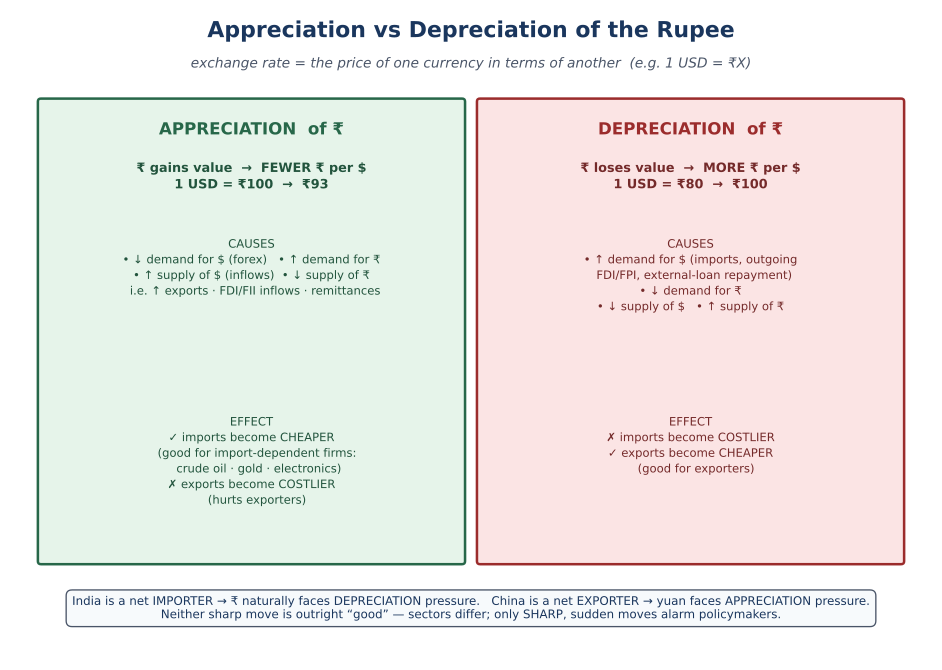
What causes the rupee to appreciate (board notes): a fall in the demand for foreign exchange (dollars), a rise in the demand for the domestic currency (rupees), an increase in the supply of dollars, or a decrease in the supply of rupees. In plain terms, dollars flow in and must be converted into rupees — rising exports, FDI/FII inflows, and remittances all create demand for the rupee and push it up.
What causes the rupee to depreciate (board notes): a rise in the demand for dollars (because of imports, outgoing FDI/FPI, and repayment of external loans → a huge outflow of dollars), a fall in the demand for rupees, a fall in the supply of dollars, or a rise in the supply of rupees.
Effects. Because the exchange rate links the two economies:
- Appreciation makes imports cheaper (good for import-dependent industries) but exports costlier (bad for exporters).
- Depreciation makes imports costlier but exports cheaper (good for exporters).
CLARIFICATION — there is no outright "good" or "bad" for the currency. The teacher stressed this repeatedly: in macroeconomics you rarely get such black-and-white answers, because an economy is not homogeneous — it is made of different sectors whose interests diverge. - Import-dependent industries — crude-oil refiners, the gold/diamond trade, electronics (largely imported components) — benefit from appreciation (their imports get cheaper). - Export-oriented industries — benefit from depreciation (their goods get cheaper, hence more competitive, abroad). - It also depends on what kind of economy you are: China, a heavy exporter, prefers a weak (devalued) currency; India, largely an importer, prefers a stronger (appreciated) currency.
CLARIFICATION — gradual moves are fine; only sharp moves alarm policymakers. If the rupee depreciates (or appreciates) gradually, industry has already factored it in — every business/investment/trading decision is taken knowing the rupee is on a slow downward path, so even the rupee crossing ₹100/$ over two-three years is no shock and creates no panic. The danger is a sharp, drastic move in a short span (say a big jump in 2–3 months) — that shocks various sectors and is when government agencies step in with corrective measures.
3. RBI's corrective measures for sharp moves
When the rupee moves too sharply, the RBI intervenes — and the logic is just the "currency as a commodity" idea:
- If the rupee is appreciating too sharply: the RBI prints more rupees and releases them. More supply of the local currency → its price comes down → appreciation is checked. (Equivalently, the board notes show the RBI buying dollars — see below.)
- If the rupee is depreciating too sharply: the RBI sells dollars from its foreign-exchange reserves. This increases the supply of dollars in the market, so the dollar stops appreciating and the rupee stops depreciating.
TEACHER'S NOTE — this is happening right now. "If you've read the newspaper, the RBI has been resorting to exactly these measures — selling dollars to increase their supply in the market — which is why our foreign-exchange reserves have come down by a few billion dollars: a lot of RBI spending has gone into defending the rupee."
CLARIFICATION — two different tools, don't confuse them. A student asked whether selling dollars / absorbing rupees affects the interest rate. No. The RBI has two distinct levers in monetary policy: (a) the supply of money (printing/absorbing currency, buying/selling dollars) and (b) the cost of capital (the interest/repo rate). Selling dollars or absorbing rupees is about supply; raising/cutting the repo rate is about cost of capital. They are separate instruments used as circumstances demand.
HANDOUT — sterilization. RBI intervention has a side-effect on price stability. When the RBI buys foreign exchange from the market, it issues new rupees to pay for it; this expands the money supply, and if the supply of goods doesn't rise to match, it causes inflation. To neutralise this, the RBI can "sterilize" the impact by selling government securities in the open market (Open Market Operations) — banks pay cash for the securities, and the RBI thereby soaks up the excess liquidity it had injected.
4. Long-term measures to strengthen the rupee
Beyond short-term intervention, the teacher asked: how do you actually make the rupee strong over the long run? The crux is to reduce the outflow of dollars and increase their inflow.
- Cut the import bill — especially crude oil (our single biggest source of dollar outflow). Promote electric vehicles, ethanol blending, and renewable energy so that, over the long term, electricity (from domestic renewables) runs our vehicles and crude-oil imports fall.
- Promote exports and export competitiveness in global markets — "unless you do that, the currency will always stay weak, because if you keep importing you keep spending dollars." The government is acting, but the private sector must contribute too.
- Attract foreign investment (FDI/FII). Make India an attractive destination through ease of doing business and infrastructure spending, so foreign players bring in foreign exchange.
- Boost inbound tourism. Despite India's diversity, our outbound tourism exceeds inbound — tiny countries attract more tourists than we do, so there is huge scope to reverse this and earn forex.
- Dedollarization + internationalization of the rupee. India cannot dedollarize alone; alongside it, push the internationalization of the rupee — persuade trading partners to accept the rupee for trade. If a good amount of trade happens in rupees, demand for dollars falls and the rupee gains strength. (But this depends on acceptability — see §6's aside on the yuan.)
5. Expansionary vs contractionary policy — and the currency
This is the integrative heart of the class. First, two definitions:
- Fiscal policy = the policy of the government, regarding its expenditure and receipts (taxes, non-tax revenue, etc.) — the budget falls under this.
- Monetary policy = the policy of the central bank (RBI), regarding the supply of money and the cost of capital (the interest you pay).
Each comes in two modes, matching the economy's two top priorities:
- Expansionary policy → adopted to promote growth.
- Contractionary policy → adopted to control inflation.
5.1 Why growth needs demand — and the vicious cycle of slowdown
Growth = an increase in the production of goods & services (i.e. GDP). And production depends on demand — you cannot achieve growth without demand. Demand is created only when two factors meet: (1) the willingness to buy and (2) the ability to pay (money in hand). If either is missing, demand isn't created (or is destroyed).
TEACHER'S EXAMPLE — the pandemic's demand destruction. During Covid lockdowns there was a big destruction of demand in India and globally: people sat at home with little willingness to buy (beyond groceries) and huge uncertainty, while many lost jobs/businesses, hitting their ability to pay. Both factors collapsed → demand collapsed.
TEACHER'S EXAMPLE — a poor monsoon cuts growth. With many Indians in agriculture, a poor monsoon lowers food-grain output → rural ability to pay falls and uncertainty dampens willingness → rural demand falls → the year's growth projection is cut. This is why policymakers always talk about reviving demand.
When demand falls, a vicious cycle of slowdown sets in, and once an economy enters it, it cannot easily climb out on its own — which is why government + central-bank intervention is needed to break the cycle.
DIAGRAM (clean redraw of the board notes). The slowdown cycle and how expansionary policy flips it into a growth cycle.
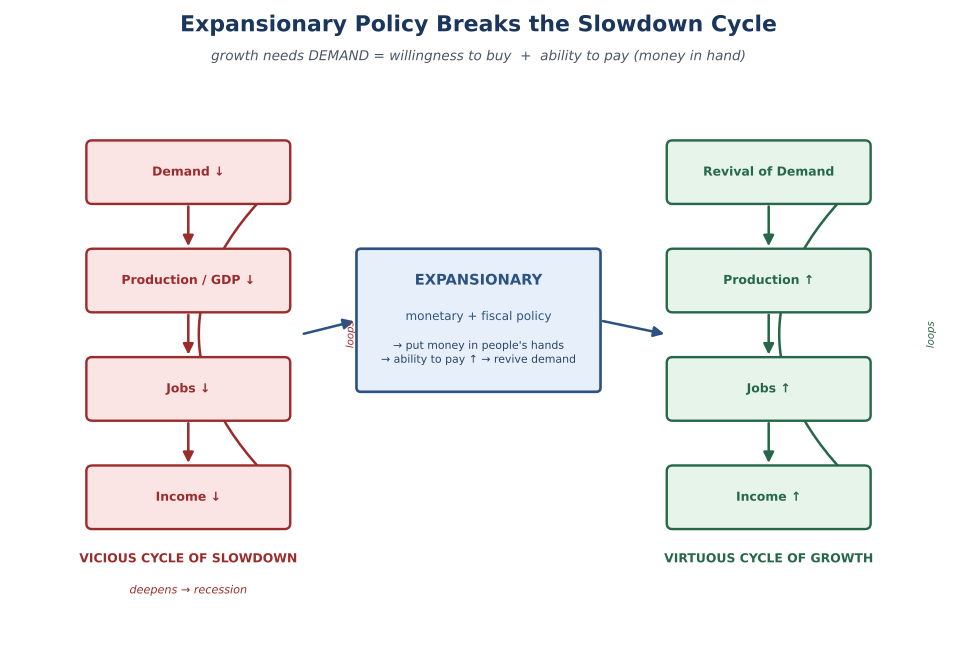
The chain, in words: demand ↓ → production/GDP ↓ → firms cut output and fire workers, so jobs ↓ → overall income ↓ → demand ↓ further… deepening, by intensity, into recession. To break it you must revive demand, and since the government can't manufacture willingness, it works on ability to pay — i.e. put money in people's hands — through expansionary monetary and fiscal policy. (When people have money, willingness usually follows.)
5.2 Expansionary MONETARY policy (RBI)
Two things, matching monetary policy's two levers:
- Increase the money supply / liquidity — largely by printing currency, and also by Open Market Operations (buying government bonds) and by reducing the CRR / SLR (so banks have more to lend). (Buying bonds = lending to the government by, ultimately, printing currency; reducing CRR/SLR leaves banks more funds.)
- Reduce the interest rate — i.e. the repo rate (the rate at which the RBI lends to commercial banks).
CLARIFICATION — which interest rate, and how the repo rate "works". When we say "reduce the interest rate" we mean the repo rate. Commercial banks don't actually run on RBI funds — they lend out depositors' money — so a repo cut is really an indication/signal that banks should cut their lending rates (and, in turn, their deposit rates). Even if one bank (say HDFC) doesn't cut, a competitor (ICICI) will, grab the customers, and competition forces the rest to follow — there can be a lag, but it happens.
TEACHER'S EXAMPLE — how a rate cut becomes growth (the transmission). With ample liquidity and low rates, banks are eager to lend (they'll call you offering loans, "no down-payment, 100% funding," "no-cost EMI") and people are eager to borrow (loans are affordable). Cheap home loans → people who couldn't afford a house now can → a demand in real estate is created → builders build more (production rises) → and through the multiplier effect that demand spreads to cement, iron & steel, wiring, appliances, tube-lights…, creating jobs across all of them. Cheap car loans do the same for autos. Firms, seeing the demand, also borrow to expand and produce more. So the slowdown cycle is broken and the growth cycle begins.
5.3 Expansionary FISCAL policy (Government)
Matching fiscal policy's two sides:
- Increase government expenditure — both revenue and capital.
- Revenue expenditure that puts money in people's hands: salaries, subsidies (food subsidy, DBT), scholarships, pensions — these either hand money directly to people or save their money.
- Capital expenditure on infrastructure — new highways, dams, power projects. Wherever the government spends ₹20,000 crore, it ultimately reaches people: those directly hired on the project get salaries, and indirectly the cement/steel/transport firms tied to it see demand and create jobs. So all government spending ultimately flows into the hands of people, reviving demand.
- Reduce taxes — direct (income tax → more spendable income) and indirect.
TEACHER'S EXAMPLE — the GST cut near Diwali (last year). Why was the GST rate cut? Because the US had imposed very heavy tariffs, hurting our export sector, while overall demand was already weak. So the government revived domestic demand: a GST cut makes goods more affordable, so people buy more — if goods that were going out as exports can't be sold abroad, we consume them domestically. Income-tax cuts do the same by leaving people more spendable money.
CLARIFICATION — expansionary fiscal policy widens the fiscal deficit (short-term). To spend more, the government borrows more, so the fiscal deficit rises (the fiscal deficit is government borrowing). This is a short-term mechanism: in the long term the government expects that reviving industry brings back more tax revenue — even after a GST cut, if many more people buy, the government may earn more in absolute terms. (But this is only a tendency — "nobody can guarantee it"; expansionary policy does not certainly produce growth.)
The growth chain (board notes), in one line: expansionary fiscal + monetary policy → money in people's hands → revival of demand → increase in production (GDP) → more jobs → higher income levels → (back to demand) — breaking the slowdown cycle and entering a healthy cycle of growth.
5.4 The catch — demand-pull inflation
CLARIFICATION — if demand outruns supply, you get inflation. If expansionary policy is run too long, demand can start rising faster than production/supply can catch up. Example: if everyone's home loan is suddenly approved but builders can't build fast enough, a flat that sold for ₹1 crore is bid up to ₹1.5 crore — and the same happens across commodities. "Too much money chasing too few goods" = demand-pull inflation. At that point you must abandon expansionary policy and switch to contractionary policy.
TEACHER'S EXAMPLE — MGNREGA and "protein inflation". When MGNREGA was launched (2005–06), a big segment of the poorest suddenly had assured income → instant demand. With money in hand, the first thing people upgrade is food — from mostly carbohydrates (cereals/rice/wheat) toward protein (milk, eggs, meat, cheese, pulses). But protein supply could not increase instantly, so prices of protein foods spiked — that year's Economic Survey named it "protein inflation."
CLARIFICATION — why "helicopter money" can't end poverty. Since the RBI can print unlimited currency, why not print and distribute money to make everyone rich? Because it would simply cause inflation — what cost ₹10 would cost ₹1,000, leaving people no better off (and possibly worse). Printing-and-distributing to everyone is "helicopter money," and it is counter-productive. The RBI can print, but must keep inflation in mind.
5.5 The impact on the currency — the exam "formula"
Now the payoff — what all this does to the rupee. Reduce any expansionary policy to its essence: increase in money supply + reduction in the cost of capital. Treating the currency as a commodity, increasing the money supply makes the currency depreciate. Therefore:
EXAM FOCUS — memorise the formula. - Expansionary policy → DEPRECIATING pressure on the rupee. - Contractionary policy → APPRECIATING pressure on the rupee.
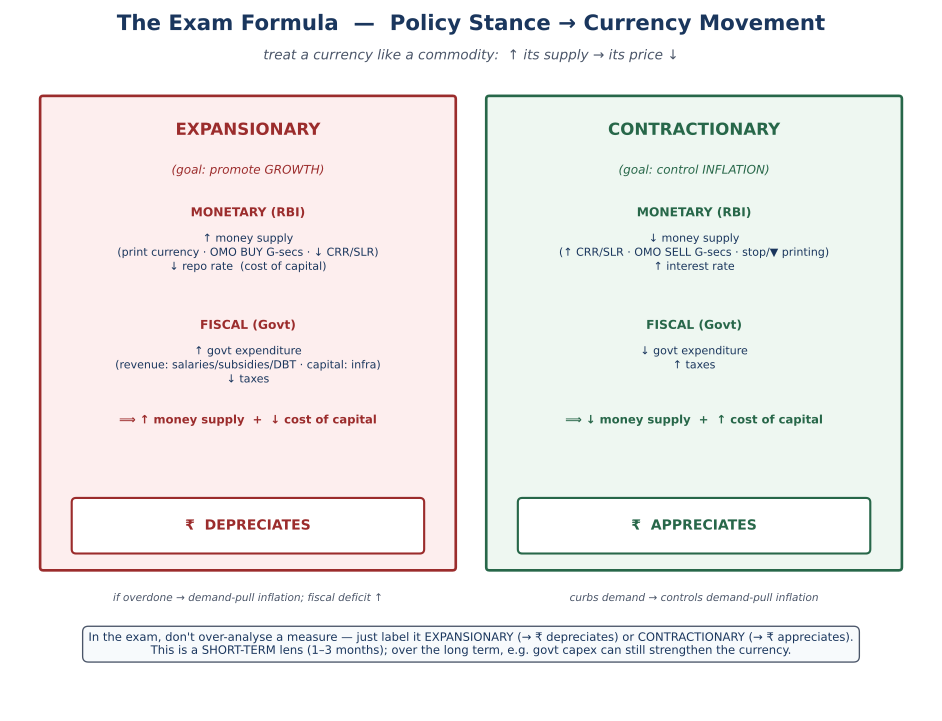
EXAM FOCUS — don't over-think it (the teacher's strong advice). In a Prelims statement, just classify the measure as expansionary or contractionary and apply the formula — don't trace the full chain from scratch each time, or you'll get puzzled. His worked example: a statement says "excessive capital expenditure by the government on infrastructure / power plants — what is the impact on the currency?" You might reason: capex → industries come up → imports fall, exports rise → currency strengthens → appreciates — and mark appreciating. That is wrong for this question. Why? Because currency questions take a SHORT-TERM view (one–three months); in the short term, heavy government spending is expansionary → depreciating pressure. (Over the long term that capex may indeed strengthen the rupee — but that's not what currency questions ask.) So: RBI cuts repo rate → expansionary → depreciating; government spends more / cuts taxes → expansionary → depreciating; and the reverse for contractionary.
5.6 The FII / bond-yield channel
TEACHER'S EXAMPLE — US bond yields pull money out of India. US interest rates have stayed high (the 10-year Treasury yield ~4.5%+, the 30-year crossed 5%) — and that is a risk-free return. With the stock market uncertain, FIIs pull money out of India (and other emerging markets) to park it in US bonds, which adds to the rupee's depreciation pressure. If the US Fed cuts rates, FIIs may sell those bonds and return to markets like India.
CLARIFICATION — why the RBI may delay a rate cut to protect the rupee (relative policy). Suppose India's inflation is comfortable and the RBI could cut rates to support growth — but the rupee is under pressure. If the US keeps its rates high (contractionary) while India cuts (expansionary), the interest-rate differential widens and the rupee depreciates further. So the RBI may hold off on a cut despite a comfortable domestic scenario. (Conversely, once the US Fed cuts, the RBI feels freer to cut too.) This is how money & banking, currency, and global rates are all connected.
5.7 Contractionary policy (the reverse) → appreciation
To control inflation, you reverse everything and curb demand:
- Contractionary monetary policy (RBI): reduce the money supply — increase CRR / SLR, do OMO by selling government securities (RBI sells G-secs to banks and takes their rupees, so banks have fewer funds), and stop or reduce printing currency — and raise the interest rate. Banks then become selective in lending (lower eligibility, higher down-payment demands, costlier EMIs), so people defer purchases and firms defer expansion → demand falls → demand-pull inflation is controlled.
- Contractionary fiscal policy (Government): reduce government expenditure (cut subsidies) and increase taxes.
- Net effect: reduction in money supply + increase in cost of capital → APPRECIATING impact on the rupee.
CLARIFICATION — small terms the teacher defined. Cost of capital = the interest you pay to raise funds (capital = funds). Down payment = the share of a purchase you pay yourself up front (e.g. on a ₹1 crore flat with a 20% down-payment, you pay ₹20 lakh and the bank finances ₹80 lakh); in a tight-money phase banks raise the required down-payment. Collateral = the asset pledged/held until the loan is fully repaid (for a car/home loan, the car/house itself is collateral — you can't sell it until the loan is cleared); a collateral-free loan pledges nothing. The EMI culture has increased affordability (you buy before you've saved up), so it adds to demand — and can contribute to inflation if production doesn't keep pace. Jan Dhan accounts don't raise money supply by themselves, but government transfers into those accounts do.
6. Exchange-rate determination systems
Who decides that "1 USD = ₹96"? Broadly there are three systems, and each country chooses voluntarily, to suit the type of economy it is.
| System | Who sets the rate | Central-bank role | Example countries | Forex reserves needed |
|---|---|---|---|---|
| Free / flexible float | Markets (demand & supply) — totally | Does not intervene to manage the currency | USA, EU, Japan | Not necessarily large |
| Fixed (pegged) | Government fixes a parity | Must defend the parity (buy/sell forex or print) | China, UAE & Gulf | Large |
| Managed float ("dirty float") | Markets, but with occasional intervention | May intervene to curb large swings | India, most emerging markets (Brazil…) | Substantial |
Free / flexible float (e.g. USA, EU, Japan)
The exchange rate is totally market-determined by the demand and supply of the currency; the government and central bank do not intervene in the price determination of their currency — it floats freely, and its price changes every moment.
CLARIFICATION — "no intervention" ≠ "monetary policy has no effect." A Fed rate cut (expansionary) will tend to depreciate the dollar — but that is a side-effect. The point is that the Fed's mandate is growth + inflation, not managing the currency; it will not take any specific measure aimed at the dollar's price. India's RBI, by contrast, can and does make direct interventions (selling dollars) specifically to affect the rupee — and that direct, currency-targeted action is what "intervention" means here.
Advantages of free float: (1) it promotes international mobility of liquidity — since you needn't hold large forex reserves to defend a parity, capital is free to flow between countries as FDI/FII, contributing to global growth; (2) the currency becomes a heavily-traded commodity (forex markets trade dollars, pounds, euros), making it more in demand (e.g. investors rush to buy dollars in a war); (3) because the price changes every moment, it creates trading opportunities (buyers betting it rises, sellers betting it falls).
Disadvantage of free float: the currency is prone to volatility → uncertainty. This is exactly why India did not choose free float — as an emerging nation our currency could face big volatility, so we went for managed float.
Fixed / pegged (e.g. China, UAE)
The rate is not market-determined but fixed by the government, which "pegs" its currency to a fixed parity (e.g. 1 USD = 8 yuan). Announcing a parity is easy; the hard part is defending it.
TEACHER'S EXAMPLE — how China defends the yuan's peg. China, a heavy exporter, has dollars constantly flowing in, which must be converted into yuan → demand for yuan is always high → the yuan naturally faces appreciation pressure. To stop it appreciating beyond the peg, China's central bank must constantly print more yuan and release it. Printing your own currency is easy, which is why a fixed system suits an export-led / trade-surplus economy (China, and the oil-rich Gulf states like the UAE). Conversely, if a pegged currency faced depreciation pressure, the central bank would have to sell dollars to defend the parity — and this is why a fixed system would not suit India. Our currency naturally faces depreciation pressure (we're net importers), so defending a peg would mean constantly selling our limited dollars, risking exhausting the forex reserves we need for crude oil and other essentials. (Note: because China artificially keeps its currency under-valued, the US and others openly label it a "currency manipulator.")
Managed float / "dirty float" (e.g. India)
The rate is largely market-determined, but the central bank may intervene when the currency shows large-scale fluctuation (sharp appreciation or depreciation) — printing currency to curb a sharp rise, or selling dollars to curb a sharp fall. The intervention is not regular, but the provision exists.
CLARIFICATION — why "dirty float." We don't call it that — free-float countries do, with a negative connotation: they allege the central bank is manipulating its currency (not letting it behave per market forces). By that logic a fixed system is even more directly a manipulation. Indeed the US calls China a currency manipulator openly.
TEACHER'S NOTE — reserves are why both fixed and managed-float systems hoard dollars. To defend a parity (fixed) or to manage sharp swings (managed float), you must keep substantial forex reserves — so China holds the world's largest (~$3 trillion) and India ~$700 billion (recently down a little). That capital is locked up in reserves and not free to flow. Free-float economies (US reserves are small; UK <$200 bn) needn't hold large reserves, so more of their capital is free to move as investment.
TEACHER'S EXAMPLE — China's US-Treasury "weapon". China has parked much of its reserves in US government securities — i.e. it has effectively lent the US trillions of dollars. If China dumped those bonds, it could destabilise the US — a real source of leverage despite their rivalry. "Though they may be fighting, they're all connected."
NEXT CLASS (pending): the teacher left the advantages & disadvantages of the fixed and managed-float systems for the next class (only free-float's were completed here).
SIDE NOTES from Q&A. Dedollarization / internationalization of the rupee: the global system runs largely in dollars — a legacy of oil being priced in dollars (every oil-importing country needed dollars). This is now being challenged (dedollarization), but change will be slow; a country cannot push its own currency alone — acceptance depends on trading partners. The gold (exchange) standard — under which the dollar (and other currencies) was pegged to gold — was abandoned in the 1970s.
7. Currency convertibility (handout)
(This section is from Handout-2; the teacher had not reached it in this transcript — it continues the foreign-exchange topic.)
HANDOUT — convertibility. Currency convertibility means a country's currency can be freely converted into foreign exchange and vice-versa at the market-determined rate. Free, unrestricted convertibility is desirable for the rapid growth of world trade and capital flows — without it, trade and capital cannot move smoothly.
Current account convertibility
HANDOUT. = freedom to convert domestic ↔ foreign currency for current-account purposes: exports, imports, remittances, foreign travel, etc. In India: as part of the 1991 reforms, the rupee was made partly convertible from March 1992 under the Liberalised Exchange Rate Management System (LERMS) — a dual exchange rate: 60% of current-account receipts could be converted freely at the market rate, while 40% had to be surrendered to the RBI at the official fixed rate. From March 1993 the rupee was convertible for all merchandise trade, and from March 1994 for invisibles too — i.e. the rupee became fully convertible on the current account.
Capital account convertibility
HANDOUT. = freedom to convert local financial assets ↔ foreign financial assets at the market rate — i.e. converting domestic currency ↔ forex for capital-account purposes (foreign investment, external loans) freely. Its purpose is to give foreign investors an easy entry/exit and to signal that the economy is strong enough (enough forex) to withstand any flight of capital. - First Tarapore Committee (1997) — the RBI appointed a committee on capital-account convertibility under S.S. Tarapore (former RBI Deputy Governor). Preconditions it set: (1) fiscal deficit reduced to 3.5% of GDP; (2) a mandated inflation target of 3–5%, with the RBI free to use monetary tools to hit it; (3) a strengthened financial sector — interest rates fully deregulated, gross NPAs reduced to 5%, weak banks liquidated or merged. (Not implemented, because of the 1997 Asian financial crisis and political instability.) - Second Tarapore Committee (2006) — gave a roadmap for full capital-account convertibility by 2011. (Not implemented, because of the 2007–09 global financial crisis.) - Benefits of capital-account convertibility: large funds to supplement domestic resources (→ growth); better access to international markets & lower cost of capital; incentive for Indians to hold international assets; a financial system improved by global competition. - Concerns: if mismanaged, the market rate may cause heavy depreciation (shaking confidence in the currency); convertibility can make the currency volatile/unstable, enabling capital flight — as in the 1997 Asian crisis (Thailand, Malaysia, Indonesia, Singapore). - Present position: the rupee is fully convertible on the current account but only partially convertible on the capital account.
8. Exam focus
EXAM FOCUS — the high-value takeaways. - Direction of the number: 1 USD = ₹80 → ₹100 is depreciation (more rupees per dollar); → ₹70 is appreciation. Depreciation helps exporters, hurts importers; appreciation the reverse. No move is outright "good" — sectors differ; India (importer) prefers strength, China (exporter) prefers weakness. - The policy → currency formula (Prelims statement questions love this): expansionary (rate cut, more spending, tax cut, more printing) → ₹ depreciates; contractionary (rate hike, less spending, tax hike, ↑CRR/SLR, OMO-sell) → ₹ appreciates. Classify the measure; don't over-analyse; it's a short-term lens. - Demand-pull inflation = "too much money chasing too few goods"; helicopter money can't end poverty; protein inflation (MGNREGA) is a ready example. - Three exchange-rate systems — free float (US/EU/Japan, no intervention, no large reserves), fixed/peg (China/UAE, must defend parity), managed/dirty float (India). Fixed suits exporters; managed/fixed need big reserves (China ~$3T, India ~$700bn). - Sterilization (RBI buys forex → prints rupees → OMO-sells G-secs to soak liquidity) is a classic Prelims term. - Convertibility: rupee fully convertible on current account (LERMS 1992 → full by 1994), partial on capital account (Tarapore I 1997, II 2006; preconditions: fiscal deficit 3.5%, inflation 3–5%, NPAs to 5%). - Connections (the teacher's whole point): currency ties together money & banking (CRR/SLR/OMO/repo), fiscal policy (deficit/spending/taxes), inflation, and global rates (US yields, FII flows).
LINKS. Builds on Class 1 — Open Economy & Trade Policy. Current affairs on the rupee, RBI intervention, REER and inflation are in the CA files
GS3/economy/indian-economy-planning(May CPI; rupee ~₹95–96; REER; RBI dollar-sales) andGS2/international-relations/india-foreign-policy(US tariffs; dedollarization context).
Current Affairs
(Updated as relevant news/magazine content comes in)
| Date | Source | Headline | Connection to this topic |
|---|---|---|---|
| 15-06-2026 | The Hindu | Rupee ~₹95–96/$ after RBI dollar-sales; REER below 96; forex reserves ~$686 bn | RBI managed-float intervention (§3); reserves (§6); REER & "undervalued" rupee |
| 15-06-2026 | The Hindu | May CPI inflation 3.93% (fuel/LPG-driven); RBI neutral stance | Demand-pull vs cost-push (§5.4); why RBI may delay a rate cut (§5.6) |
| 04-06-2026 | Indian Express | FIIs exit to US bonds; US 10-yr yield high; rupee pressure | The FII / bond-yield channel (§5.6) |
| 16-06-2026 | The Hindu | WPI 9.7% (new 2022-23 series) + first PPI / OPPI / Services-PPI; WPI → PPI in 5 yrs | Inflation measurement; the CPI 3.93% vs WPI 9.7% divergence (§5.4) |
| 16-06-2026 | The Hindu | Rupee ₹94.58/$ (+60 paise) & Brent −5.5% as the US–Iran deal reopens Hormuz | Appreciation drivers & RBI managed-float intervention (§2–§3); crude → ₹ link |
| 17-06-2026 | The Hindu | WGC survey: central banks ~1,000 t gold/yr (2× the prior decade); RBI gold 880.52 t; Indian gold +40%/yr on CB-buying + rupee depreciation | Gold in forex reserves (§6); rupee depreciation as a gold-price driver |