Untouchability & the Dalit Question
GS Paper: GS Paper I (Social Empowerment / Indian Society) | Subject: Social Issues | Last updated: 2026-06-24
Built from the end of Class 2 + the whole of Class 3 (Sahil Goyal, 18–19 June 2026), with the Untouchability handout (Handout-2) — which the teacher used across both classes — folded in fully and marked
> **HANDOUT:**. This is the sixth caste group from lec01: the untouchables / Scheduled Castes / Dalits, the worst victims of the caste system. Continues the reservation thread from lec02. Next class: Scheduled Tribes.**
Table of Contents
- Why untouchability exists — the logic of pure & impure
- Atrocities against Dalits, and the two enforcing laws
- The four identities — Dalit, Harijan, Depressed Classes, SC
- The Dalit Movement — four phases
- Gandhi vs Ambedkar; separate electorates & the Poona Pact
- Ambedkar's contribution; constitutional provisions; conversion to Buddhism
- Conversion and reservation
- Present status of Dalits — haves vs have-nots; sub-classification 2024
- Atrocities today and why they have increased
- Schemes (handout)
1. Why untouchability exists — pure & impure
The caste system rests not only on occupation but on a concept of pure and impure. Pure is associated mostly with the upper castes — things connected with God: the temple, the cow and all cow-products (milk, ghee, sweets, even cow-dung and cow-urine). Impure is associated mostly with the lower castes — alcohol, non-veg, dead bodies (animal or human), and all "waste matter" (excreta, urine, sweat).
TEACHER'S NOTE (the rule that creates untouchability): The crucial belief is that impurity is transferable by touch, while purity is not — if something impure touches something pure, the pure becomes impure (never the reverse). Now, all castes emit waste, but no one wants to clean their own (touching waste = becoming impure), so the task of cleaning others' waste is given to one section — the untouchables.
Clean version (study from this):
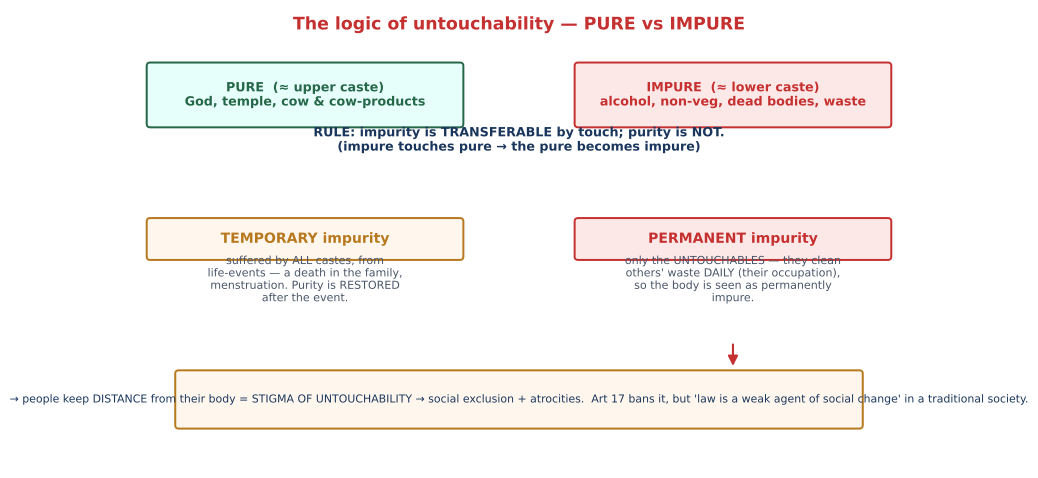
CLARIFICATION (temporary vs permanent impurity): Impurity is of two kinds. Temporary impurity is suffered by all castes through life-events — a death in the family, or a woman's menstrual cycle (during which, even in an upper-caste home, she is kept out of the kitchen and the temple, both symbols of purity) — and purity is restored once the event passes. Permanent impurity is suffered only by the untouchables, because they clean others' waste daily as their occupation — so their body is seen as permanently impure, and people keep distance from it. That distance is the stigma of untouchability — and it produces social exclusion and atrocities. The untouchables are therefore the worst victims of the caste system.
2. Atrocities and the two laws
HANDOUT — atrocities suffered by Dalits: - In public life: (1) no access to community resources (rivers, wells, grazing & cremation grounds); (2) no access to public places (temples, bathing ghats, hospitals, public offices); (3) no access to education; (4) residential segregation (Dalits must settle outside the main village — "Dalit bastis"); (5) rules for entering the main settlement — they had to beat a drum, tie a broom at the back (to wipe out their footprints), hang an earthen pot around the neck (to spit into, lest spit touch the ground and "pollute" an upper-caste person), and could not cover the upper body (a mark of identification). - In economic life: (1) no access to markets to buy/sell; (2) unpaid and underpaid labour; (3) cannot own property (and so got no land in the land reforms — tenants/OBCs did); (4) bonded labour (taking small loans against their own body as mortgage → slavery; Dalits are its worst victims — Article 23 bans bonded labour, but it is not yet eliminated); (5) a vicious cycle of poverty.
Article 17 of the Constitution bans untouchability in all its forms. (It is an absolute right — enforceable against both the state and private individuals — but it does not define untouchability.)
CLARIFICATION (why Art 17 hasn't ended untouchability — the "soft state"): Law is a weak agent of social change in a traditional society. In modern/Western societies people have internalised law (they obey even when unwatched, because modernity created the very idea of law); in India, where modernity was imposed, law's implementation is weak — such states are called "soft states." Hence high crime/atrocity rates and a feeling that one can escape the rule of law. (So untouchability persists despite Art 17.)
To enforce Art 17, two laws were passed (this is the 2017 PYQ: "two major legal initiatives against discrimination of SC/ST"):
HANDOUT — the two laws: 1. Protection of Civil Rights Act, 1955 — gives Dalits civil rights (to enter temples, hotels, places of entertainment, hospitals, educational institutions); punishes anyone preventing such entry, and punishes forcing a person into slavery, skinning dead animals, or manual scavenging. 2. SC/ST (Prevention of Atrocities) Act, 1989 — defines atrocities in detail (even smaller atrocities are covered) and is very stringent: offences are non-bailable (bail is the judge's discretion, not a right) and cognizable (police can register an FIR and arrest without a warrant/magistrate's order). Investigation is by a DySP-level officer; Section 18 bars anticipatory bail; special courts give speedy trials. 2015 amendment: added more atrocities (e.g. tonsuring the head, removing moustache by dominant castes; IPC offences < 10 yrs like hurt/intimidation/kidnapping), set up exclusive special courts + special public prosecutors, mandated trial completion within 2 months of the charge-sheet, and added a chapter on victims'/witnesses' rights.
3. The four identities
The untouchables carry four different names, each given by a different namer:
Clean version (study from this):
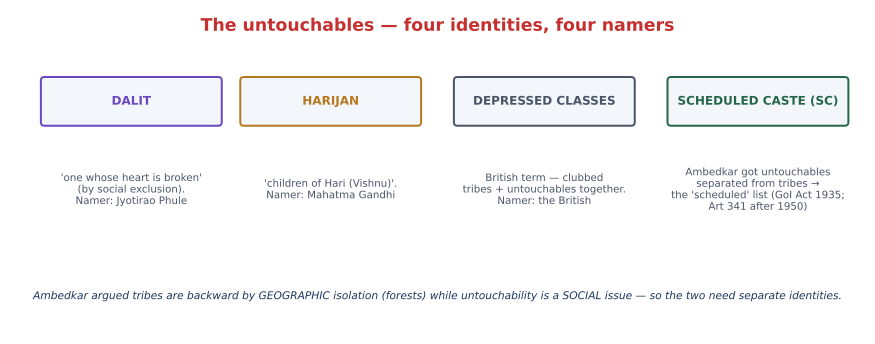
- Dalit = "one whose heart is broken" (by social exclusion) — the term is associated with the social reformer Jyotirao (Jyotiba) Phule (himself an OBC of the Mali/Saini caste, not a Dalit).
- Harijan = "children of Hari (Vishnu)" — coined by Mahatma Gandhi.
- Depressed Classes = the British term, which clubbed tribes and untouchables together.
- Scheduled Caste (SC) — Ambedkar objected to clubbing tribes with untouchables: tribes are backward through geographical isolation (forests), whereas untouchability is a social issue — so they need separate identities. The British accepted this and gave the untouchables the separate label "Scheduled Caste."
TEACHER'S NOTE (why "Scheduled" — Art 341): "Schedule" comes from the Government of India Act, 1935 (a "mini-Constitution" that governed India 1935–1950), under which His Majesty drew up a list (schedule) of castes for the purpose of reservation in provincial & central legislative elections — the Government of India (Scheduled Castes) Order, 1936. After 1950, Article 341 continued the practice: the President notifies the Central list of SCs (the Constitution (SC) Order, 1950), simply adopting the British list. The criterion is the stigma of untouchability; the Constitution does not define "SC." The list is state-wise (caste varies by state), and there is only a Central list (no state SC/ST list).
4. The Dalit Movement — four phases
A social movement aims at a specific social change (the Dalit movement's goal = abolition of untouchability); it is judged a success only if it achieves its goal.
Clean version (study from this):
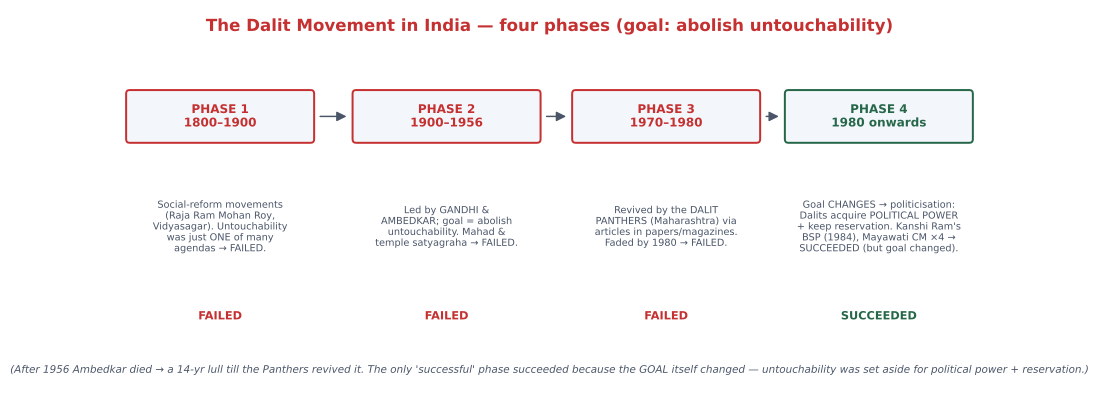
- Phase 1 (1800–1900): the era of social-reform movements (Raja Ram Mohan Roy, Ishwar Chandra Vidyasagar). Untouchability was just one of many agendas (alongside sati, widow remarriage, women's rights), so the movement could not abolish it → failed.
- Phase 2 (1900–1956): the Dalit issue stood on its own, led by Gandhi and Ambedkar — goal: abolish untouchability. It still failed (untouchability continued; see the Mahad/temple satyagraha in §6).
- Phase 3 (1970–1980): after Ambedkar's death (1956) the movement went into a 14-year lull (1956–1970), then was revived by the Dalit Panthers in Maharashtra (Ambedkar's home state and the "hot-bed" of the movement) — through articles in newspapers and magazines highlighting Dalit atrocities and Ambedkar's ideas. It faded by 1980 → failed to bring social change.
- Phase 4 (1980 onwards): the goal itself CHANGED — to the politicisation of Dalits: Dalits should acquire political power and keep the benefit of reservation (abolition of untouchability quietly dropped). This succeeded: Kanshi Ram founded the BSP (Bahujan Samaj Party) in 1984 (bahujan politics, distinct from Mandal's OBC politics), and Mayawati mobilised Dalit votes to become CM of UP four times. So the only "successful" phase succeeded because the goal had changed.
5. Gandhi vs Ambedkar; separate electorates & the Poona Pact
Ambedkar (a Dalit, with first-hand experience of atrocities) and Gandhi (an upper-caste Bania who projected tradition for mass appeal) clashed on caste:
Clean version (study from this):
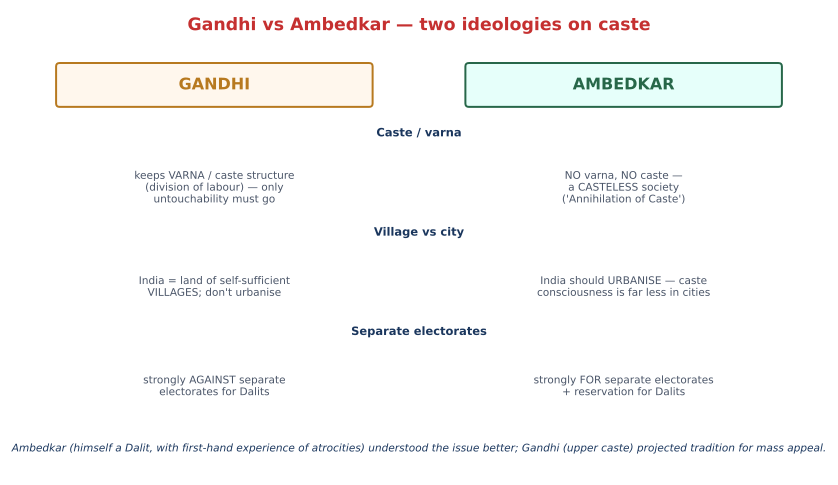
- On caste/varna: Gandhi kept the varna / caste structure (a harmless division of labour) — only untouchability must go. Ambedkar wanted no caste and no varna at all — a casteless society, the "entire structure of caste should collapse" (his book "Annihilation of Caste"), because caste itself is the source of Dalit suffering.
- On villages vs cities: Gandhi wanted India to remain a land of self-sufficient villages (its own model of development, not urbanising/westernising). Ambedkar wanted India to urbanise and Dalits to live in cities, because caste consciousness is far weaker in cities (congestion + anonymity), whereas villages are the "breeding grounds of caste."
- On separate electorates: Gandhi was strongly against separate electorates for Dalits; Ambedkar strongly for separate electorates + reservation.
TEACHER'S NOTE (separate electorates → the Poona Pact, 1932): Background: the Muslim League (1906) demanded separate electorates (Hindus vote only for Hindu candidates, Muslims only for Muslim) → the British granted them in 1909. Congress first rejected the idea but signed the Lucknow Pact (1916) accepting it — a "blunder" that codified Hindu-Muslim difference and seeded Partition. Inspired by this, Ambedkar (from 1919) demanded separate electorates for Dalits too (Dalits being treated as "avarna" — outside the varna system — and beef-eaters, hence in inherent conflict with caste Hindus). The British granted it in the Communal Award (MacDonald Award), 1932. Gandhi went on a fast-unto-death to force its withdrawal → the Poona Pact (1932): Ambedkar gave up separate electorates, but reservation (joint electorate) continued in provincial & central legislatures.
Clean version (study from this):
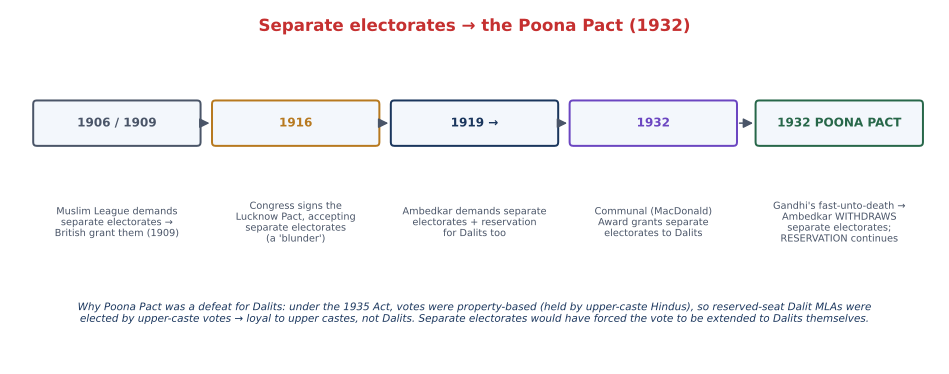
CLARIFICATION (why the Poona Pact was a defeat for Dalits): Under the 1935 Act, voting rights were property/tax-based, and property was held mostly by upper-caste Hindus. So on a reserved seat, a Dalit candidate would win but be elected by upper-caste Hindu votes → that Dalit MLA would be loyal to upper-caste Hindus, not to Dalits. With separate electorates, the British would have had to extend the vote to Dalits themselves, who could then elect leaders truly loyal to them. (Gandhi's deeper fear: separate electorates for Dalits would create a third division — Hindu/Dalit/Muslim — risking a three-way partition, with Dalits possibly merging with Muslims, who don't practise caste discrimination.)
6. Ambedkar's contribution, constitutional provisions, conversion
HANDOUT + class — Ambedkar's timeline: - 1919 — first demanded separate electorates & reservation for Dalits. - 1920 — started the newspaper "Mooknayak" ("Leader of the Voiceless"). - 1924 — second newspaper "Bahishkrit Bharat" ("Excluded India"). - 1927 — Mahad Satyagraha (forcibly drawing water from an upper-caste well) and temple-entry satyagraha — both failed: the upper castes "re-purified" the well/temple with cow-urine and barred the Dalits again. (These failures convinced Ambedkar that social-reform movements can't work — only LAW can: law → political & economic rights → eventually social rights.) - 1932 — Communal (MacDonald) Award; signs the Poona Pact. - 1936 — founded his first party, the Independent Labour Party (ILP); 1942 — the All-India Scheduled Caste Federation (AISCF). - 1947 — made Chairman of the Drafting Committee (chosen partly because he wrote in modern language to draft a modern document). - 1956 — along with ~5 lakh Dalits at Nagpur, converted to Buddhism.
TEACHER'S NOTE (his answer-key idea — reservation is a means to social justice): Ambedkar's logic: law will give Dalits political and economic rights, and these are means to the real goal — social rights / social justice / social equality. Reservation (reserved seats → political power; reserved jobs → economic power) is therefore a means to Social Justice, which takes time. Example: through reservation a Dalit can become an IAS officer or MP (economic & political mobility), yet still face discrimination — "he cannot marry a Brahmin girl," and faces bias in services, promotions and marriage. So social mobility is not yet achieved → reservation must continue until social equality arrives.
HANDOUT — special constitutional provisions for SC/ST: - Articles 14, 15, 16, 17 — equality; abolition of untouchability. - Article 330 — reservation of seats in the Lok Sabha; Article 332 — in the State Legislative Assemblies (there is no reservation in the Rajya Sabha or Legislative Councils). Reservation is proportional to population — by all-India population for the LS, by state population for an Assembly (e.g. ~25% SC population in a state → ~25% of its Assembly seats reserved). - Article 338 — National Commission for SCs (NCSC); 338A — NCST; 338B — NCBC — constitutional bodies that look into the affairs of, and recommend welfare for, SC/ST/OBC; they have the powers of a civil court (e.g. to summon, to direct issue of an SC certificate) but not contempt power, so the government can ignore their recommendations — yet, being constitutional bodies, cannot do so easily (it must answer in Parliament). - Article 325 — universal adult franchise (one person, one vote, equal value) — a political right that is a means to social rights. (Article 25 — freedom of religion — lets a person change religion, but not caste.)
TEACHER'S NOTE (conversion to Buddhism — Navayana): Having lost hope of reform within Hinduism, Ambedkar in 1956 at Nagpur converted with ~5 lakh Dalits to Buddhism — but founded a new school, Navayana ("Neo-Buddhism"): don't worship Buddha as a god ("science is your god" — hence the Fundamental Duty to develop scientific temper, written because Indian society is traditional); don't become a monk; be rational; and uphold liberty, equality and fraternity. He rejected the older schools (Hinayana/Mahayana/Vajrayana), which focus on monkhood/controlling desire. (So the Buddhists of Maharashtra/UP/Rajasthan are mostly these Neo-Buddhist Dalit converts, unlike the original Buddhists of Ladakh/Sikkim/Himachal.)
7. Conversion and reservation
TEACHER'S NOTE (conversion to escape untouchability): Dalits have repeatedly converted to escape untouchability — to Islam (where they became Arzal / Dalit Muslims), Christianity (via Christian missionaries), Sikhism (born to fight caste — though caste later crept in; Punjab has a high SC population), and Buddhism (Ambedkar's Navayana). But conversion rarely brought equality.
CLARIFICATION (reservation after conversion — verified): - A Dalit who converts to Sikhism or Buddhism keeps SC reservation; a Dalit who converts to Islam or Christianity loses SC reservation (and may get OBC instead). - Why: the government treats Sikhism and Buddhism (and Jainism) as Indic religions within the Hindu fold, while Islam and Christianity are Abrahamic — "fundamentally different" (no concept of caste/untouchability; a single life, no rebirth, vs the Hindu cycle of rebirth). (Legal basis: the Constitution (SC) Order, 1950 said no person professing a religion other than Hinduism shall be SC; later extended to Sikhs (1956) and Buddhists (1990).) - Dalit Muslims & Dalit Christians argue they still face discrimination after conversion (separate churches/pastors for Dalit Christians; "double discrimination") and demand SC status (they prefer SC over OBC because the OBC list is overcrowded — a smaller SC pool means a better selection chance). The government has not granted it (reservation is a politically sensitive issue, and existing SCs would protest the overcrowding). - Justice Balakrishnan Commission — appointed in October 2022 (the teacher said 2024) — is studying whether Dalits who converted to religions outside Hinduism/Sikhism/Buddhism (i.e. Christianity/Islam) should get SC status; report still pending. (A recent SC ruling allows regaining SC status on re-conversion, but only if the community accepts the reconvert.) - Pasmanda Muslims = the OBC Muslims (Ajlaf/Arzal — Ansari, Qureshi); lower-class Muslims have "sanskritised" by adopting the "Khan" title of the upper-class Ashraf, just as lower castes once imitated upper castes.
8. Present status — haves vs have-nots, sub-classification 2024
HANDOUT + class — the Dalit movement has weakened because Dalits have split into two groups:
Clean version (study from this):
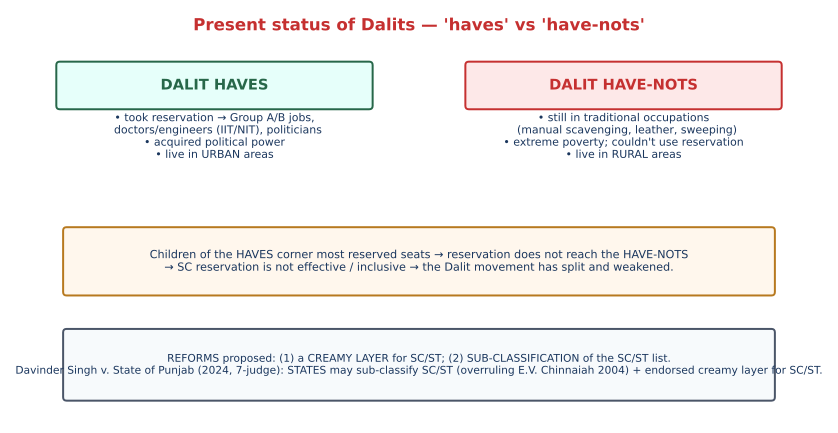
- Dalit "Haves" — those who took the benefit of reservation (entered Group A/B services, became doctors/engineers via reservation in higher education, became politicians / hold constitutional posts) and live in urban areas.
- Dalit "Have-nots" — those still in traditional occupations (manual scavenging, leather work, sweeping), in extreme poverty, who could not use reservation, living in rural areas.
The children of the Haves corner most reserved seats, so the benefit does not reach the Have-nots → SC reservation is not effective or inclusive, and the Dalit movement has split and weakened (the Haves, being the larger, vocal group, resist any change, fearing it as the thin end of removing reservation; they are not concerned with abolishing untouchability).
Reforms proposed: (1) introduce a creamy layer for SC/ST (to exclude the Haves so reservation reaches the Have-nots); (2) sub-classify the SC/ST list.
CURRENT AFFAIRS (sub-classification of SC/ST — verified): Before 2024, sub-classification was not allowed for SC/ST (it was allowed for OBCs since Indra Sawhney 1992). In State of Punjab v. Davinder Singh (1 Aug 2024), a 7-judge bench (6:1) held that States may sub-classify SCs/STs, overruling E.V. Chinnaiah (2004) which had treated SCs as a homogeneous group. The Court reasoned that SCs are not homogeneous — some sub-castes are far more backward (e.g. Bihar's Musahar, "those who eat rats," the most backward Dalit community), and Dalits even practise untouchability against other Dalits. Any sub-classification must rest on quantifiable/empirical data; States may sub-classify but cannot amend the list (only Parliament can, under Art 341); and the majority also endorsed a creamy layer for SC/ST. (Earlier, M. Nagaraj v. Union of India, 2006, had applied the creamy layer to *SC/ST reservation in promotions under Art 16(4A).)*
9. Atrocities today and why they have increased
Despite globalisation, modernisation and urbanisation, atrocities against Dalits have increased, not decreased.
HANDOUT + class — types of atrocities: - Direct (physical harm): sexual exploitation of Dalit women (upper-caste men offend "without fear" in villages, knowing the Dalit family can be threatened — "file an FIR and we burn your village"; residential segregation makes Dalits vulnerable); mob lynching in the name of cow-protection (e.g. Una, 2016); and caste conflict. (2022 Rajasthan: a Dalit boy was beaten to death for drinking from an upper-caste teacher's pot.) - Indirect (mental harm): social exclusion in educational institutions (general-category students and even teachers discriminate against SC students in IITs — the "stigma of reservation" — driving some to suicide, e.g. Rohith Vemula, 2016); defacing statues of Dr Ambedkar.
CLARIFICATION (formal vs substantial equality): Reservation reaches even the PRIs — some seats are reserved so a Dalit becomes Sarpanch — yet the Dalit Sarpanch is often humiliated (not shown the panchayat files, made to sit on the floor while upper-caste members sit on chairs, not allowed to hoist the flag). So India has achieved formal equality (on paper) but not substantial equality (on the ground) — and until social equality arrives, reservation must continue.
TEACHER'S NOTE (why atrocities have increased — three reasons): 1. Law has failed as an agent of social change (the "soft state"). 2. The stigma of untouchability has converted into a "stigma of reservation" — upper castes feel their "rightful" seats were taken away by reservation, breeding hatred toward Dalits. 3. The rise of right-wing politics (after 2014). Right-wing ideology: nation/nationalism is supreme, the nation linked to one identity (religion → "India for Hindus", as "US for Americans"/Trump); develop hatred toward minorities ("Congress appeased Muslims → time for Hindu revival"); pro-globalisation/development and the diaspora; "one nation, one religion, one culture" → Hindu Rashtra. New twist: a strong welfare approach to SC/ST/OBC (their votes are the majority) → an ongoing "Hinduisation" of Dalits, tribes and OBCs (sanskritising them — don't eat non-veg, no alcohol — to bring them into the Hindu fold; RSS was anti-Dalit before 2014, pro-Dalit-mobilisation after). Hence the teacher's earlier point — after 2014, religion has been replacing caste as the axis of Indian politics, and regional caste parties have declined. (Right-wing politics is rising globally too — Trump in the US, Israel, Japan, Germany — which strengthens it in India; e.g. close India-Israel ties after 2014.)
CLARIFICATION (Bhima Koregaon — asked in class): The Mahar (Dalit) vs Maratha enmity is "traditional": in the Anglo-Maratha wars, the British recruited Mahars (whom the Peshwa-led Maratha army had rejected as untouchables); the Mahars helped defeat the Marathas at the Battle of Bhima Koregaon, 1818. Ambedkar made its anniversary a Dalit victory-day, which the Marathas resent — and at the 2018 bicentenary at Bhima Koregaon (near Pune) Dalits were attacked (the "Bhima Koregaon incident"). (The new caste conflict is dominant-caste OBCs vs Dalits — e.g. Marathas vs Mahars — partly a fight over reservation: with the 50% cap, what is left after SC/ST's proportional share goes to OBCs, who feel short-changed despite their larger population.)
10. HANDOUT — schemes
HANDOUT (to read; the teacher deferred detail): - PM-AJAY (Pradhan Mantri Anusuchit Jaati Abhyuday Yojana) — launched FY 2021-22, 100% central, by the Ministry of Social Justice & Empowerment, for the socio-economic uplift of SCs. A merger of three earlier schemes (PMAGY + Special Central Assistance to SCSP + Babu Jagjivan Ram Chhatrawas Yojana). Three components: (1) Adarsh Gram development (turning SC-majority villages into model villages with basic infrastructure & services); (2) Grants-in-Aid for socio-economic projects (infrastructure, hostels, livelihood/skilling, asset loans); (3) construction of hostels (in NIRF-ranked institutions and in schools). - PM-DAKSH (Pradhan Mantri Dakshta Aur Kushalta Sampann Hitgrahi Yojana) — a Central Sector skilling scheme (launched 2020-21) for SCs, OBCs, EWS, DNTs and Safai Karamcharis/waste-pickers, age 18-45, free of cost (no income limit for SC/Safai Karamcharis/DNT; OBC/EWS family income < ₹3 lakh). Three training types: Up-skilling/Re-skilling (RPL) for Safai Mitras (~35 hrs, with a ₹500/person stipend), Short-Term Training (STT) per the NSQF, and Entrepreneurship Development Programmes (EDP) via NIESBUD/IIE.
HANDOUT — also note: the SC/ST PoA Act 1989 defines "social boycott" as refusing customary service/social relations or isolating a person; lists specific atrocities (forcing inedible/obnoxious substances into the mouth; dumping excreta in premises; garlanding with footwear; parading naked; forced tonsuring; wrongful occupation of SC/ST land; begar/forced labour; making a person carry carcasses, dig graves or do manual scavenging) and sexual offences against SC/ST women (including dedicating a woman as a devadasi); punishments 6 months–5 years.
Current Affairs
(Updated as relevant news/magazine content comes in.)
| Date | Source | Headline | Connection |
|---|---|---|---|
| 2024 | SC | Davinder Singh v. Punjab — SC/ST sub-classification & creamy layer allowed | §8 (reforms; overrules E.V. Chinnaiah) |
| 2022 | Govt | Balakrishnan Commission on SC status of Dalit Christians/Muslims | §7 (conversion & reservation) |
| 2018/2016 | News | Bhima Koregaon (2018); Una lynching / Rohith Vemula (2016) | §9 (atrocities) |
Note for linking: CA on SC/ST atrocities / PoA Act / sub-classification / creamy layer / reservation in promotions / Dalit conversion & reservation / manual scavenging / PM-AJAY / PM-DAKSH / caste census maps to this note; CA on OBC / Mandal / Rohini Commission / reservation % maps to lec02; CA on caste politics / dominant castes / Sanskritisation maps to lec01.