Indian Society & the Caste System
GS Paper: GS Paper I | Subject: Social Issues | Last updated: 2026-06-23
Class 1 (Sahil Goyal, Vajiram & Ravi) — the foundation of the Social Issues paper. There is no transcript for Class 1, so this note is written from the 13-page board scan + the syllabus handout, in clean prose (and checked against standard sociology where the board was a bare list). It is the conceptual base for everything that follows — OBC & reservation (lec02) and untouchability (lec03).
The GS-1 "Social Issues" syllabus (from Handout-1): (1) salient aspects of Indian society & diversity; (2) population & associated issues; (3) urbanisation — problems & remedies; (4) social empowerment; (5) communalism, regionalism & secularism; (6) effects of globalisation on Indian society; (7) role of women & women's organisations; (8) poverty & developmental issues.
Table of Contents
- Modern vs traditional society — why India is "half-modern, half-traditional"
- Evolution of Indian society — three phases
- Culture, customs, tradition, creed & ethnicity
- Salient features of Indian society
- The caste system
- Varna vs caste
- Caste today — why it is still alive
1. Modern vs traditional society
The starting distinction of the whole paper: Western societies are modern; Indian society is largely traditional (religion-centred). The reason is historical — India has not undergone the process of modernisation that the West did.
Up to the 14th century the West was also traditional. Then a chain of revolutions modernised it:
- the Renaissance — religion began to be replaced by science;
- the Scientific Revolution — figures like Galileo (telescope) and later Charles Darwin (theory of evolution) questioned the authority of the Church and built a scientific temper;
- the Industrial Revolution + capitalism (which also drove colonisation); and
- the French Revolution, which gave the ideas of liberty, equality, fraternity.
Through these, Europe became modern. No such revolution ever happened in India. Under ~200 years of British rule, India received modern institutions — law, modern education, Parliament, railways, telegraph, press, post — but the British introduced them only to prolong their own rule, so the institutions modernised while the people stayed traditional. The result is the defining feature of Indian society: a mix of modern institutions and traditional minds.
Clean version (study from this):
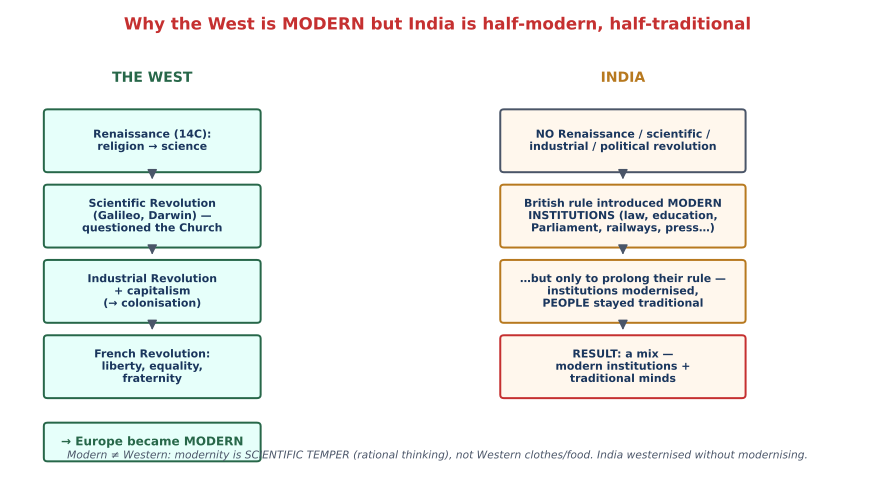
CLARIFICATION (modern ≠ Western): To be modern is to have a scientific temper — rational thinking — not to wear Western clothes, eat pizza or speak English. India has westernised without modernising: it copied the West's culture (dress, food, language) while the mind remained traditional, with strong religious belief. (This modern-vs-traditional thread recurs through the whole paper.)
2. Evolution of Indian society — three phases
Clean version (study from this):
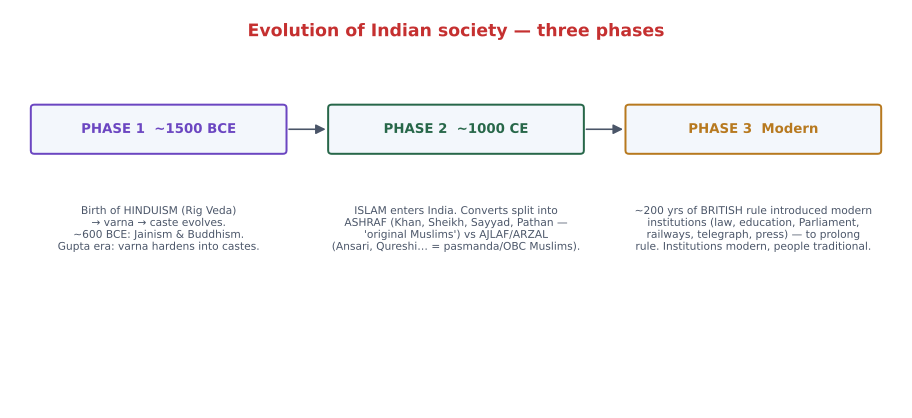
- Phase 1 (~1500 BCE): the birth of Hinduism (Rig Veda) and the evolution of varna → caste. Around 600 BCE came Jainism and Buddhism; by the Gupta era the varna order had hardened into castes (upper caste / lower caste).
- Phase 2 (~1000 CE): Islam entered India. Conversion split Muslims into two broad categories — the Ashraf (Khan, Sheikh, Sayyad, Pathan), who branded themselves the "original Muslims," and the Ajlaf / Arzal (Ansari, Qureshi, etc.), the pasmanda / OBC Muslims. (So caste-like stratification travelled into Islam in India too.)
- Phase 3 (Modern): ~200 years of British rule introduced modern institutions to prolong colonial rule — institutions modernised, people stayed traditional (the mix again).
3. Culture, customs, tradition, creed & ethnicity
Clean version (study from this):
(The conceptual vocabulary the rest of the paper relies on — keep it precise:)
- Culture = "how we do things in a particular society" — a society's way of life. Its elements include dress, food, language, dance, music, customs and traditions.
- Customs = practices followed over a long period of time — e.g. the caste system, untouchability, child marriage, barring women from temples/mosques, triple talaq, dowry.
- The main source of customs is RELIGION. Each religion has its own customs; because India is diverse in religions, it is correspondingly rich in customary diversity.
- Tradition = practices passed from one generation to the next.
- Creed = belief in a particular religion — it has no logic. People follow customs because of belief (creed), not reason.
- Ethnicity = people belonging to a particular group with a common identity. In India the main marker of ethnicity is language (sometimes race); and religion is emerging as a dominant marker of ethnicity, especially with the rise of right-wing politics.
4. Salient features of Indian society
- Very high diversity — of religion, language, ethnicity, racial identity and customs. This is unlike the West, which is comparatively homogeneous.
- Unity in diversity — held together by: (a) the state taking special steps to maintain unity (e.g. punishing those who spread religious hatred); (b) common citizenship; and (c) a common Constitution under which everyone is treated equally.
- The Indian model of secularism — unlike the West (where the state is completely neutral to religion), in India the state engages with religion: it may promote/regulate religion and carries a responsibility to maintain the country's religious diversity (treating all religions even-handedly rather than ignoring them).
- Continuity of customs — Indian society has maintained its customs and cultural practices from the past into the present, unlike the West, which lost its continuity (through modernisation). The reasons: (a) society has not undergone modernisation; (b) the strength of customs; (c) the state also helps preserve continuity; and (d) Indian villages are resistant to social change — they are relatively closed, self-sufficient systems (most needs met within the village, little need to look outside), so little social change penetrates them. Indian villages are the great preservers of tradition.
- Half-traditional, half-modern — unlike the fully-modern West. The persistence of the caste system, untouchability and child marriage are the standing evidence.
EXAM FOCUS (the recurring GS-1 frame): Several PYQs (2019, 2021) ask "what makes Indian society unique in sustaining its culture / maintaining continuity?" The answer always runs through (self-sufficient, change-resistant) Indian villages + the joint family + the inter-generational transfer of values + the absence of a modernising revolution. Keep the answer simple and logical (the teacher's repeated advice for this paper: no data, no quotations needed — just clear reasoning).
5. The caste system
A caste (jati) has its own traditions and customs; India has thousands of caste groups, with strong regional variation (different castes dominate in different regions), which makes the system complex to study. For study, the teacher grouped the thousands of castes into six main caste groups:
Clean version (study from this):
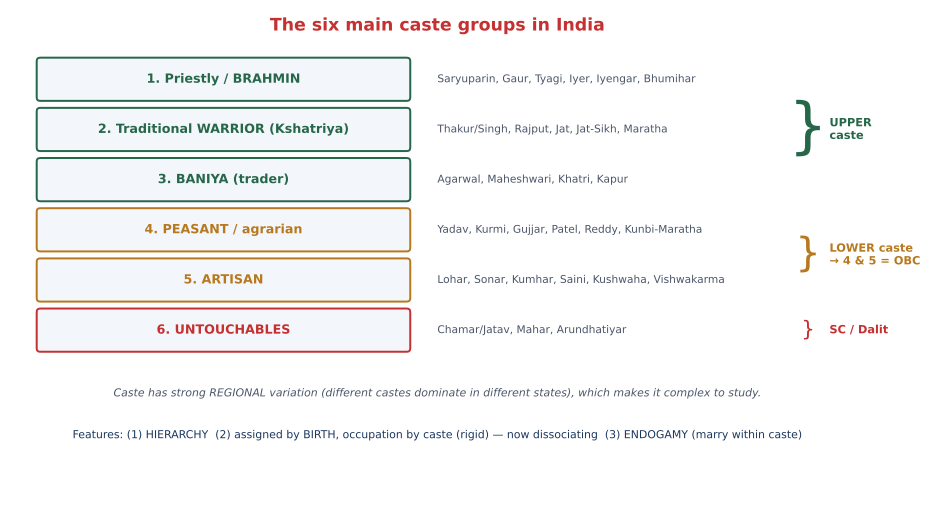
- Priestly / Brahmin — e.g. Saryuparin & Gaur Brahmins, Tyagi, Bhumihar (Bihar), Iyer & Iyengar (Tamil Nadu).
- Traditional Warrior (Kshatriya) — Thakur (title "Singh"), Rajput, Jat / Jat-Sikh, Maratha.
- Baniya (trader) — Agarwal, Maheshwari, Khatri, Kapur.
- Peasant / agrarian — Yadav, Kurmi, Gujjar, Patel (GJ), Reddy/Kapu (AP), Kunbi-Maratha.
- Artisan — Lohar, Sonar, Kumhar, Saini, Kushwaha, Vishwakarma.
- Untouchables — Chamar/Jatav, Mahar (MH), Arundhatiyar (TN).
Groups 1–3 are the "upper" castes; groups 4 & 5 are the "lower" castes that, in modern times, were classified as OBC; group 6 is the Scheduled Castes (SC / Dalits).
Three features of caste:
- Hierarchy — ranked upper to lower.
- Ascription by birth, with occupation defined by caste — and changing occupation was traditionally not allowed, which made caste rigid. Over time, however, caste has shown flexibility: with migration to cities, industrialisation, the service sector and urbanisation, caste and occupation have become dissociated (strongest in urban areas; in rural areas, especially for agrarian/peasant castes, the link survives). Caste no longer decides occupation.
- Endogamy — marriage within one's own caste (with gotra exogamy: one marries within the caste but outside the gotra/clan, since a shared gotra implies a common ancestor and thus a sibling-like relation).
TEACHER'S NOTE (dominant castes): The agrarian/peasant castes (group 4) became "dominant castes" in the villages. Why? Through the land reforms after Independence (abolition of zamindari + tenancy reforms), the former tenant-cultivators became landowners, while the old upper-caste landlords largely lost land and migrated to cities (dissociating caste from occupation there). A caste becomes dominant in a region when it has (i) numerical strength and (ii) landownership (plus economic returns and political contacts). Dominant castes today (e.g. Jats, Yadavs, Gujjars, Marathas, Patels, Reddys) take pride in their caste, have rejected Sanskritisation (they no longer want "upper-caste" status), are very particular about caste rules (endogamy, gotra), and control the regional economy and cooperatives (e.g. the sugar cooperatives of Maharashtra under the Marathas). (Their cars often display caste names — a marker of pride and power; politicians court them for their numbers.)
6. Varna vs caste
Clean version (study from this):
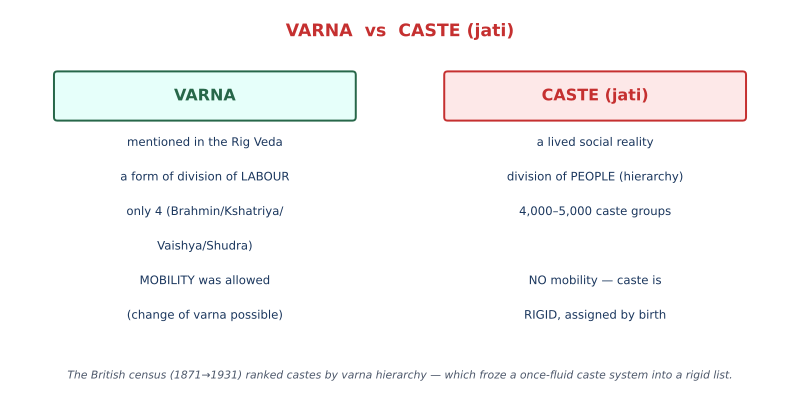
Varna (mentioned in the Rig Veda) was a fourfold division of labour (Brahmin/Kshatriya/Vaishya/Shudra) that allowed mobility (change of varna was possible). Caste (jati) is the lived social reality — 4,000–5,000 caste groups, a division of people into a hierarchy, that is rigid and assigned by birth, with no mobility.
TEACHER'S NOTE (the British census made caste rigid): Caste was once relatively fluid. The British censuses — first in 1871, then through 1881, 1891, and especially 1931 — began listing and ranking castes by varna hierarchy (deciding which caste was "upper" and which "lower"). This froze a fluid caste system into a rigid list. In response, lower-caste groups formed caste associations (e.g. the Yadav Mahasabha unifying pastoral castes; Kurmi associations in Bihar) and petitioned the British to be re-classified as upper caste — petitions the British never accepted, keeping them "lower" in successive censuses. (After 1931, India held no caste census for decades; a caste census is planned for 2026, to make reservation and OBC welfare more effective — a measure critics warn could revive and re-harden caste.)
7. Caste today — why it is still alive
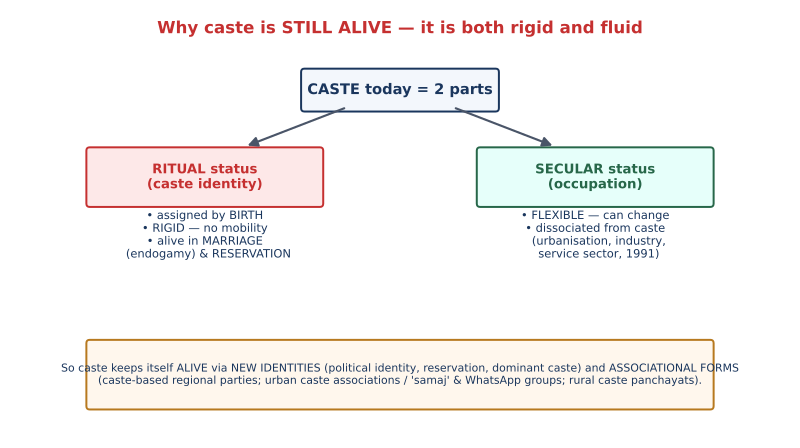
In the present, a person's caste has two parts:
- Ritual status (caste identity) — assigned by birth, RIGID, no mobility — and it stays alive in marriage (endogamy) and in reservation; and
- Secular status (occupation) — FLEXIBLE, can change — now dissociated from caste under the pressure of urbanisation, industrialisation, the service-sector economy, the 1991 reforms, westernisation and globalisation.
Because caste is simultaneously rigid (ritual) and fluid (secular), the caste system is still ALIVE.
EXAM FOCUS (the standard caste PYQ pattern): Almost every caste question (2018, 2020, 2023…) really asks one thing — what keeps caste alive / why can't India become casteless? The answer: caste survives by acquiring NEW IDENTITIES (a political identity via caste-based parties and via reservation, and the "dominant caste" identity) and NEW ASSOCIATIONAL FORMS — caste-based regional political parties; urban caste associations / "samaj" (which arrange same-caste matrimony, run caste schools, hostels and coaching, and now organise via WhatsApp groups & Facebook pages); and caste panchayats in villages (distinct from the 73rd-Amendment PRIs, they enforce caste rules, above all endogamy). The state lets people change religion and occupation, but not caste, which also keeps caste static. Conclusion to write: caste keeps reinventing itself and so remains relevant; it is both fluid and static, and that is exactly why it stays alive.